

The 2026 Licensing Trifecta: How Broadcom, Microsoft, and Oracle Are Collaborating to Drain Your Budget
Your 2026 software licensing strategy is being dismantled from three directions simultaneously — and most architects won’t see it until the renewal invoice lands. Having designed enterprise infrastructure for over 15 years, I remember when an Enterprise Agreement (EA) felt like a genuine partnership. You committed to spending millions, and, in return, the vendor gave you a break. It was a handshake deal: “You scale up, we lower the unit cost.”
However, those days are dead.
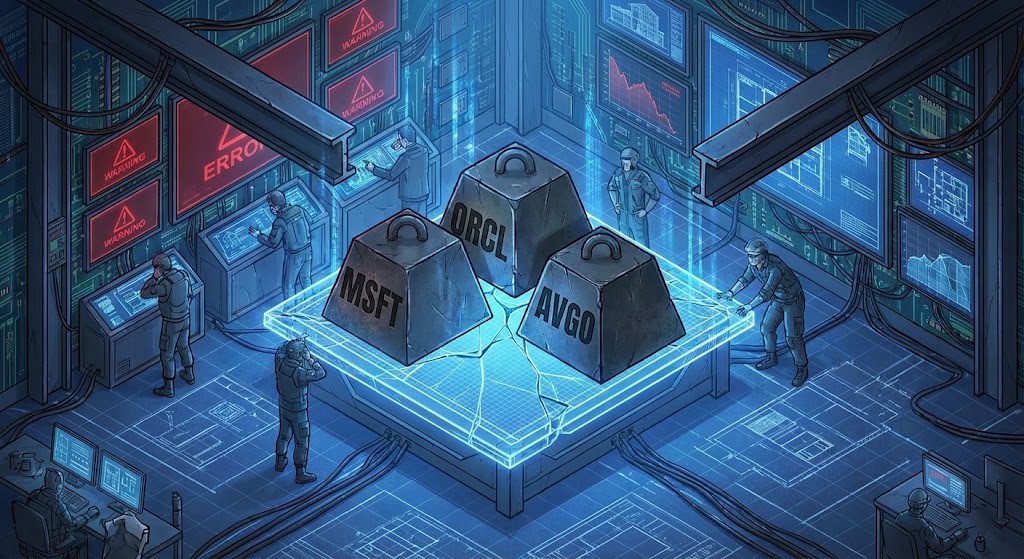
I was recently reviewing a portfolio for a client—a solid, mid-sized enterprise—and realized we are walking into a buzzsaw. It’s not just one vendor tightening the screws; rather, it is a synchronized squeeze. Microsoft, Oracle, and Broadcom have effectively formed a “trifecta” of cost increases that hits every layer of the stack: the OS, the Hypervisor, and the Runtime.
That synchronized squeeze has a name: Lifecycle Convergence — independent vendors scheduling unrelated retirements, price changes, or licensing shifts inside the same compressed window, forcing an organization to allocate whatever resource is scarce (here, budget and procurement authority) by scheduling pressure instead of actual risk. Microsoft, Oracle, and Broadcom didn’t coordinate. They didn’t need to — the calendar did it for them.
For those of us in the trenches, this isn’t merely a procurement headache. On the contrary, it is an architectural crisis.If we don’t design around this now, we’re going to be the ones explaining to the CFO why the OpEx budget just blew a 300% gasket. Your 2026 software licensing strategy needs to start before the renewal notice lands.
Microsoft: The “Big Business” Penalty (Nov 2025)
Starting November 1, 2025, Microsoft is eliminating the pricing tiers (Level A-D) for Enterprise Agreements within the EU/EFTA, with global ripples likely to follow.
The Architect’s Reality:
I used to build ROI models assuming that once we hit 15,000 seats (Level D), we’d get that sweet discount. Unfortunately, that math is now broken. Microsoft is standardizing the price. Effectively, the more you buy, the more you pay. There is no bulk discount at the buffet anymore.
Oracle: The “Janitor Tax”
Furthermore, Oracle’s shift to the “Java SE Universal Subscription” is, frankly, terrifying. They no longer care how many processors you run; instead, they care how many employees you have.
What This Means for You:
I saw a quote recently where a company with only 50 developers was asked to pay for 10,000 employees—including warehouse staff and truck drivers. Why? Because “technical capability” is irrelevant to the license terms. If you are on the payroll, you are a billable unit.
Broadcom: The Subscription Strong-Arm
We all saw this coming with the VMware acquisition, yet the reality is harsh. Perpetual licenses are gone. Support for perpetual is gone.
The Hard Truth:
In the old days, if the budget was tight, we’d just “sweat the assets”—run vSphere 7 for an extra two years without upgrading. Now, we can’t do that. You are renting your hypervisor. Ultimately, if you stop paying the rent, you get evicted.
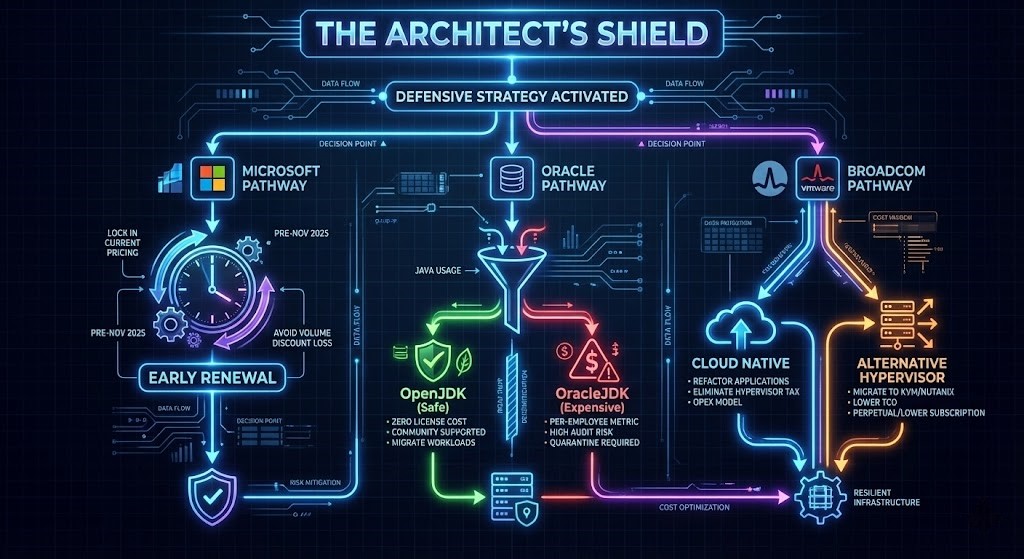
Decision Framework: The Architect’s Defense Strategy
We can’t just complain on Reddit. Rather, we have to architect our way out of this. Here is the playbook I’m using right now.
Strategy A: The “Audit & Purge” (For Oracle)
The Scenario: You have a sprawling legacy estate and no idea who is running Java.
My Advice:
- A sound 2026 software licensing strategy for Oracle starts with a full audit before Oracle runs one for you. Treat it like malware: Use Flexera or Snow (or a simple PowerShell script if you’re scrappy) to hunt down every
java.exe. - The “Red Hat” Pivot: For instance, switching 90% of your backend services to Red Hat OpenJDK or Amazon Corretto is painless. It’s usually a drop-in replacement.
- Quarantine: If you must run Oracle Java, put those workloads in a dedicated, air-gapped environment. Subsequently, you need to prove to the auditors that the rest of the company literally cannot touch it.
Strategy B: The “Time Machine” (For Microsoft)
The Scenario: You are deep in the Azure/O365 ecosystem and can’t leave.
My Advice:
- The Microsoft component of your 2026 software licensing strategy has a hard deadline — November 1, 2025. Beat the Clock: Check your EA renewal date. If it’s in 2026, call your rep today.
- Early Renewal: Negotiate an early renewal before November 1, 2025. Specifically, lock in a 3-year term under the current discount structure. This buys you a three-year runway to figure out your next move while your competitors are paying the markup.
Strategy C: The “Repatriation & Right-Sizing” (For Broadcom)
The Scenario: Your VMware renewal quote just landed, and it looks like a ransom note. My Advice:
1. Stop Guessing Core Counts: Broadcom’s pricing is strictly per-core. Before you negotiate, you need exact numbers.
Broadcom’s per-core pricing means your renewal quote is only as accurate as your core count. Run your environment through the Core Calculator before you negotiate — know your exact license burden before your Broadcom rep does.
→ Calculate My Core Count2. The Nutanix/Flow Option: If you are migrating off ESXi/NSX-T to Nutanix AHV, you can’t just “lift and shift” firewall rules. The logic changes.
Migrating from ESXi to Nutanix AHV means your NSX-T firewall rules don’t lift and shift — the security logic needs to be retranslated to Nutanix Flow. Map your policies before you cut over.
→ Translate My NSX Policies3. Validate the Hardware: If you are moving to new hardware to escape the Broadcom Tax, ensure you aren’t over-provisioning.
Before committing to new hardware to escape the Broadcom Tax, validate your footprint. The HCI Migration Advisor right-sizes your target environment so you don’t trade a licensing problem for an over-provisioning problem.
→ Right-Size My MigrationVisual Engineering: The “Do Nothing” Tax
I always tell my SEs: ‘Don’t bring me problems, bring me data.’ The most powerful tool in your 2026 software licensing strategy is a cost model your CFO can’t argue with. Here is the data you need to show your leadership..
| Feature | Microsoft (Post-Nov ’25) | Oracle (New Model) | Broadcom (VMware) |
| The Old Way | “Buy more, pay less” (Volume Discounts) | Pay for what you use (Processors) | Buy it once, own it forever (Perpetual) |
| The New Way | “One price for everyone” | Pay for everyone employed | Rent it forever (Subscription) |
| The “Gut Punch” | +15-20% cost for large orgs | +300% if you have many non-IT staff | +200% TCO increase |
| Architect’s Move | Renew EARLY (Pre-Nov ’25) | Migrate to OpenJDK | Refactor to Cloud or AHV |
The Cost of Inaction: Mandatory Budget Analysis
Let’s look at a hypothetical manufacturing company: “Widget Corp.” They have 5,000 employees (mostly factory workers) and 200 servers. Here is how the math breaks down:
- Microsoft Impact: Losing their Level C discount hits them for an extra $150,000/year.
- Oracle Impact: Instead of paying for the 20 servers running Java, they pay for 5,000 employees. As a result, their bill goes from $40k/year to $900,000/year.
- VMware Impact: Their perpetual support was $80k/year. In contrast, the new subscription is $250,000/year.
Total Cost of Doing Nothing: An extra $1.1 Million per year. That is innovation budget. That is headcount. That is your bonus. Gone.
Architect’s Verdict
The 2026 licensing trifecta is not a negotiation problem. It is an architecture problem. Microsoft, Oracle, and Broadcom did not coordinate their pricing changes — they did not need to. Each made a rational vendor decision independently, and the compounding effect landed simultaneously on every enterprise that built its stack around their products without modeling the exit cost of doing so.
The $1.1 million annual impact on Widget Corp is not an edge case. It is the median outcome for mid-sized enterprises that optimized for operational convenience over architectural independence. The EA discount felt permanent. The perpetual license felt owned. The per-processor Oracle model felt controllable. None of those assumptions survived contact with the renewal cycle.
The defense strategy is not complex, but it requires acting before the invoice arrives. Audit Oracle exposure before Oracle does. Lock Microsoft EA terms before November 2025 pricing takes hold. Model VMware exit cost before the Broadcom subscription renews. Each of those actions is a procurement decision when done proactively and an architectural crisis when done reactively. The difference between the two is whether your 2026 software licensing strategy exists before Q4 or only after the CFO asks why the budget is on fire.
Additional Resources
Editorial Integrity & Security Protocol
This technical deep-dive adheres to the Rack2Cloud Deterministic Integrity Standard. All benchmarks and security audits are derived from zero-trust validation protocols within our isolated lab environments. No vendor influence.

R.M.
Senior Solutions Architect with 25+ years of experience in HCI, cloud strategy, and data resilience. As the lead behind Rack2Cloud, I focus on lab-verified guidance for complex enterprise transitions. View Credentials →
Get the Playbooks Vendors Won’t Publish
Choose the architecture problems you care about. Get field-tested playbooks and frameworks delivered to your inbox.
- > AI Infrastructure & Inference Economics
- > Cloud Strategy & Hidden Cost Models
- > Virtualization & Deterministic Migration
- > Kubernetes, IaC & Modern Infrastructure
- > Data Protection & Recovery Engineering
Zero spam. Includes The Dispatch weekly drop.
Need Architectural Guidance?
Independent review before major infrastructure decisions.
- > Validate assumptions
- > Identify hidden dependencies
- > Quantify migration risk
- > Challenge vendor narratives
Triage · Advisory · Fractional · Direct Hire