

Sovereign Drift Auditor
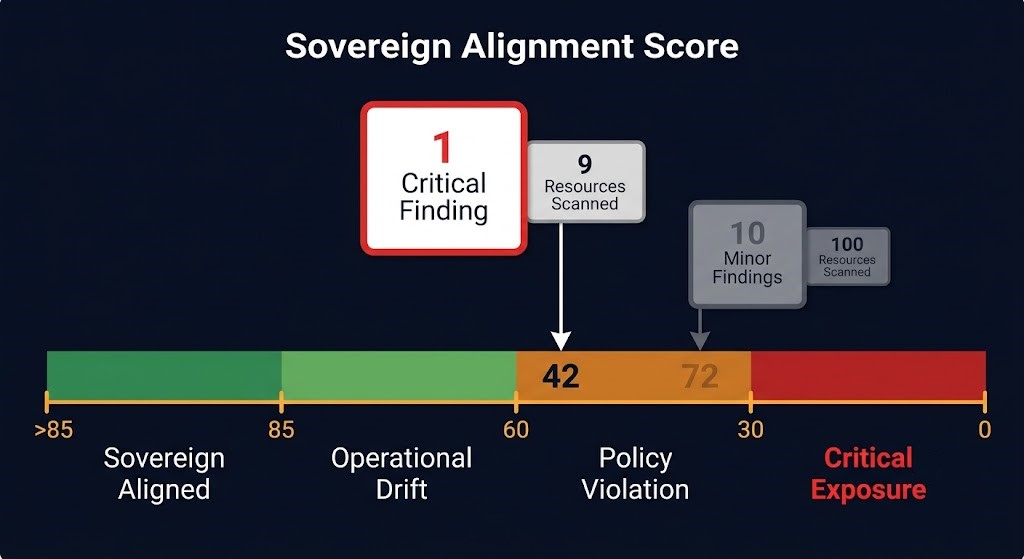
Sovereign Alignment Score · Weighted Risk Findings · Recursive Module Scan · Remediation HCL
Stop Guessing. Start Auditing Your Infrastructure-as-Code Integrity
Most teams treat terraform plan as their only test. But plan only tells you what might happen — not what is actually happening. The Sovereign Drift Auditor bridges the visibility gap between your local state and the live cloud API, exposing non-deterministic risks hidden within your Terraform plans before they reach production. Your drift data is your infrastructure’s blueprint.
The Sovereign Drift Auditor keeps your audit trails, state comparisons, and vulnerability maps within your own secure perimeter — no third-party SaaS, no data leaving your machine. Whether you are migrating away from VMware or hardening a hybrid-cloud sovereign baseline — including your network control plane — this tool surfaces what plan cannot see.
Built for architects running the Modern Infrastructure & IaC Learning Path — the Sovereign Drift Auditor is the operational layer that sits between your IaC code and your production environment.
plan.json data, infrastructure state, or configuration is transmitted, stored, or processed server-side. Your infrastructure data never leaves your machine.Key Features
plan.json to catch drift before it hits production. No reactive remediation — fix it in code before it becomes a console incident..tfstate to query the live provider API for ground truth.Drift Detected.
Now Architect the Fix.
The Sovereign Drift Auditor surfaces the violations. The harder question is what a sovereign remediation plan looks like across your full environment — state files, provider configs, CI/CD gates, and the console habits that created the drift in the first place.
IaC Sovereignty Review
Vendor-agnostic audit of your IaC posture — state integrity, provider parity, drift patterns, and the remediation path to a fully sovereign baseline. Works across Terraform, OpenTofu, and hybrid console-managed environments.
- > State file integrity & drift root cause
- > Sovereign baseline design & enforcement
- > CI/CD gate configuration for drift prevention
- > VMware-to-cloud IaC migration runway
Architecture Playbooks. Every Week.
Field-tested IaC blueprints covering Terraform drift patterns, OpenTofu migration physics, sovereign baseline design, and GitOps enforcement models from real enterprise environments. No vendor marketing. Just architecture depth.
- > Terraform & OpenTofu Migration Physics
- > IaC Sovereignty & Drift Enforcement
- > GitOps & CI/CD Architecture Patterns
- > Real Failure-Mode Case Studies
Zero spam. Unsubscribe anytime.
Frequently Asked Questions
Q: Is my plan.json data secure?
A: Yes. The Sovereign Drift Auditor uses a local JavaScript engine. No data is sent to Rack2Cloud servers or any third-party APIs. When you upload a plan.json, the analysis is performed entirely within your browser’s client-side memory. Your infrastructure data never leaves your machine.
Q: Which cloud providers are supported?
A: The Sovereign Drift Auditor is currently optimized for AWS-based Terraform plans. Azure and GCP rule sets are coming in Rule Set 04.
Q: Why audit the plan.json instead of the live environment?
A: Auditing the live environment is reactive. By auditing the plan.json, you catch drift before it is applied to production. This allows you to correct non-sovereign configurations in code rather than manually rolling back console changes after the fact.
Q: What specific drift patterns does the Sovereign Drift Auditor detect?
A: Version 2.7 focuses on high-risk sovereign violations: publicly accessible RDS instances (databases exposed to the public internet), and S3 Bucket ACL drift (buckets with public-read permissions that bypass sovereign data privacy standards). Additional rule sets are in development.
Q: How does the Remediation Library generate HCL?
A: The engine parses the resource address and faulty attribute from the JSON, then maps these to a pre-validated HCL template — providing the exact block needed to overwrite the drifted state.
Q: Can this tool be integrated into a CI/CD pipeline?
A: The current version is a manual Architect’s Workstation utility designed for high-touch sovereignty reviews. For automated pipeline enforcement, use the sovereign drift auditor’s logic as a baseline for Open Policy Agent (OPA) or Sentinel policies.