

ARCHITECTURE LEARNING PATHS
GUIDED READING SEQUENCES FOR INFRASTRUCTURE ARCHITECTS.
These architecture learning paths are built for infrastructure engineers who have moved past implementation mechanics and are building judgment at the system level.
Each path is an ordered reading sequence through a published architecture discipline — not a course, not a certification track, not vendor training. The sequencing is deliberate: articles are ordered by operational complexity, architectural dependency, and failure-domain depth. You read what you need to architect, not what you need to pass an exam.
Domain Paths provide structured architecture progression across an entire infrastructure discipline. Specialization Tracks focus on deep operational areas within a specific domain. Both are organized against the same underlying framework: the Architecture Maturity Spine.
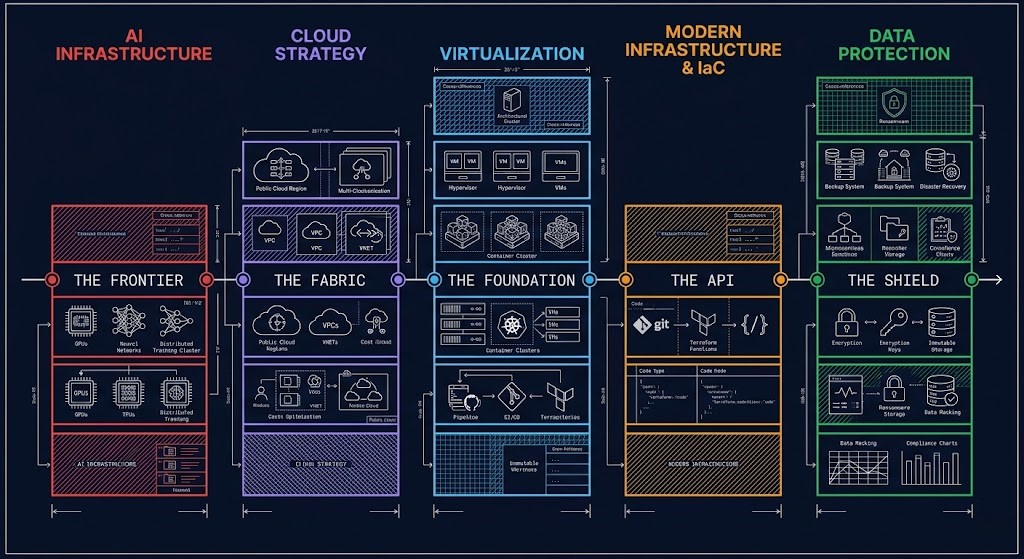
The architecture learning paths on this site cover five domains: virtualization, cloud architecture, data protection and resiliency, modern infrastructure and IaC, and AI infrastructure. Each domain has its own published reading sequence — sequenced from real architecture analysis, ordered by the decisions you will actually face in production.
>_ The Architecture Maturity Spine
All Domain Paths are sequenced against the same five-level maturity spine. A Path uses only the levels the domain genuinely requires — not every path reaches Sovereign.
The spine is not a skill-level framework. Foundation does not mean beginner and Sovereign does not mean expert. The levels describe the type of architectural problem being solved at each stage. A Foundation-level article addresses mechanics and first principles. An Operational-level article addresses repeatability, scale, and Day-2 consequence. A Resilient-level article addresses survivability under failure — a problem that only becomes visible once the system is already running at scale. A Sovereign-level article addresses control, portability, and exit — the decisions you cannot undo.
Not every domain reaches every level because not every domain has the same failure surface. AI Infrastructure stops at Resilient — there is no sovereign exit architecture for GPU fabric the way there is for cloud workloads or IaC state. Data Protection reaches Sovereign because recovery governance and jurisdictional control over backup data are genuine architectural decisions with real operational consequence.
| Level | Positioning | Reader Focus |
|---|---|---|
| Foundation | Core principles and architectural mechanics | Know the physics before the platform |
| Operational | Day-2 operations and scalable execution | Run at scale, not just at launch |
| Strategic | Optimization, governance, and economics | Optimize decisions under constraint |
| Resilient | Failure-domain reduction and survivability | Design for certain failure, not probable uptime |
| Sovereign | Operational independence, portability, and platform control | Retain authority over platform, data, and exit |
NOT every Domain Path uses all five levels. Paths stop at the level the domain genuinely requires.
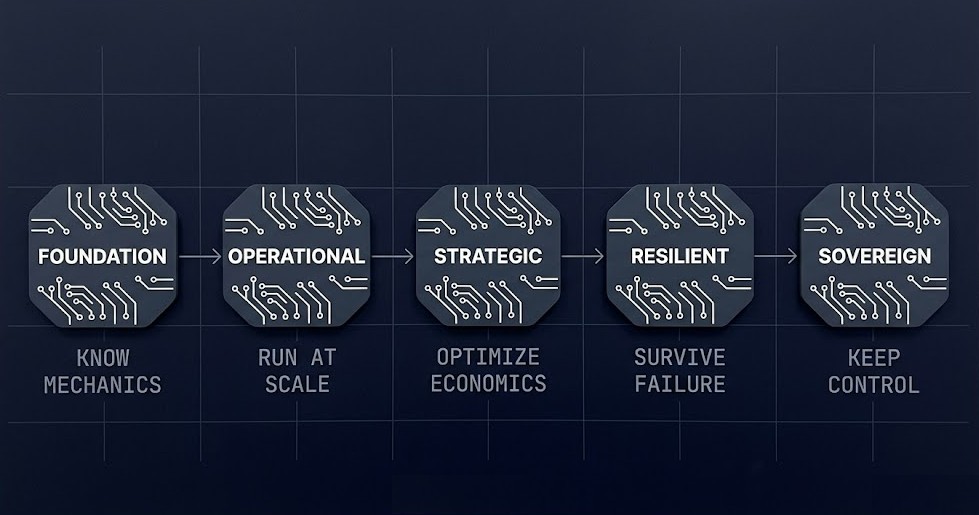
Each Domain Path follows a different architectural progression — determined by operational complexity, platform dependencies, and failure-domain depth. Not every path reaches Sovereign.
>_ Core Domain Paths
Virtualization Architecture
Hypervisor architecture, migration physics, and Day-2 operational determinism for private cloud and sovereign infrastructure.
Cloud Architecture
Egress economics, identity perimeters, multi-region failure modeling, and workload placement across distributed control planes.
Data Protection & Resiliency
RTO/RPO as architectural inputs — immutable backup design, ransomware survival architecture, and recovery assurance governance.
Modern Infrastructure & IaC
Declarative state enforcement — GitOps architecture, drift detection, platform engineering, and bare metal sovereignty.
AI Infrastructure Architecture
Fabric-bound, memory-constrained infrastructure — GPU orchestration, RDMA architecture, AI storage pipelines, and distributed inference.
>_ Choose Your Starting Architecture Domain
>_ Where to Start
>_ Virtualization Specialization Tracks
Specialization Tracks are deep-dive architecture sequences focused on a specific infrastructure discipline. Non-linear and practitioner-targeted — entry assumes operational familiarity with the domain.
The six current Specialization Tracks map to the Virtualization Architecture domain. Specializations for Cloud, Data Protection, Modern Infrastructure & IaC, and AI Infrastructure are planned for a future build cycle.
Compute Architecture
NUMA scheduling, core allocation, and execution physics in virtualized environments.
Open Specialization Track →Networking Architecture
East-west traffic, overlay design, and network virtualization for private cloud environments.
Open Specialization Track →Storage Architecture
Storage protocol selection, SDS architecture, and data path modeling for virtualization platforms.
Open Specialization Track →HCI Architecture
Converged infrastructure design, CVM resource tax, and resiliency modeling for HCI platforms.
Open Specialization Track →Migration Strategy
VMware exit architecture, cutover sequencing, and identity continuity across migration events.
Open Specialization Track →Performance Modeling
Latency budgets, contention modeling, and workload characterization for enterprise infrastructure.
Open Specialization Track →Specialization Tracks for Cloud, Data Protection, Modern Infrastructure & IaC, and AI Infrastructure are planned for a future build cycle.
>_ Build Your Architecture Reading Sequence
Five Domains. One Maturity Framework.
Each Domain Path is a structured progression through the operational, strategic, and resilient architecture decisions that define enterprise infrastructure.
>_ Where Do YouGo From Here
>_ Frequently Asked Questions
Q: What are the architecture learning paths on Rack2Cloud?
A: The architecture learning paths are ordered reading sequences through five infrastructure disciplines: virtualization, cloud architecture, data protection and resiliency, modern infrastructure and IaC, and AI infrastructure. Each path sequences published architecture analysis by operational complexity and failure-domain depth — not by topic alphabetically or by vendor platform. The goal is architectural judgment, not tool familiarity.
Q: How are these architecture learning paths different from certification study guides?
A: Certification guides sequence content to cover exam objectives. These paths sequence content to cover the decisions you face in production — failure domains, control plane architecture, blast radius modeling, cost physics, and operational governance. Certification alignment may happen as a byproduct. It is not the objective.
Q: What is the Architecture Maturity Spine?
A: The Architecture Maturity Spine is the five-level framework that organizes every Domain Path on this site: Foundation, Operational, Strategic, Resilient, and Sovereign. Each level describes the type of architectural problem being solved — mechanics, scale, governance, survivability, and platform control respectively. A Domain Path uses only the levels the domain genuinely requires. Not every path reaches Sovereign.
Q: What is the difference between a Domain Path and a Specialization Track?
A: A Domain Path covers the full breadth of an infrastructure discipline in a structured, maturity-guided sequence. A Specialization Track goes deep on a specific operational area within a domain — non-linear, practitioner-targeted, and entry assumes existing operational familiarity. Currently six Specialization Tracks exist within the Virtualization Architecture domain. Specializations for other domains are planned.
Q: Do I need to follow the paths in order?
A: Domain Paths are sequenced deliberately — the ordering reflects architectural dependency, not arbitrary topic grouping. Starting at Foundation and progressing through the levels will give you the most coherent reading experience. That said, practitioners with deep experience in a specific area can enter at the relevant maturity level without reading every preceding article. Specialization Tracks are explicitly non-linear and have no required entry sequence.
Q: Which architecture learning path should I start with?
A: Start with your current operational pain point, not your desired destination. If you are managing VMware platform decisions or evaluating HCI, start with Virtualization Architecture. If you are dealing with cloud cost overruns, egress problems, or workload placement decisions, start with Cloud Architecture. If your recovery times are theoretical rather than tested, start with Data Protection and Resiliency. IaC drift and GitOps governance problems start with Modern Infrastructure and IaC. GPU workload sizing, AI fabric, or inference architecture problems start with AI Infrastructure.
Q: Are these paths updated as new content is published?
A: Yes. Each Domain Path is a live reading sequence — as new architecture analysis is published it is evaluated for inclusion and sequenced into the appropriate maturity level. The paths reflect the current published inventory, not a static curriculum set at launch.