

VIRTUALIZATION ARCHITECTURE LEARNING PATH
THE PROGRAMMABLE CONTROL PLANE OF PRIVATE CLOUD AND SOVEREIGN INFRASTRUCTURE.
>_ Why Virtualization Still Matters
Kubernetes did not eliminate virtualization. It increased the importance of deterministic infrastructure beneath orchestration layers. Every modern private cloud, sovereign environment, AI cluster, and enterprise recovery platform still depends on virtualization control planes for isolation, scheduling, tenancy, and operational continuity. The hypervisor layer is not legacy — it is the failure domain boundary that everything above it depends on.
This virtualization architecture learning path is a maturity-guided reading sequence for enterprise infrastructure engineers — from hypervisor execution physics through post-VMware strategic architecture. It is built from published architecture analysis, sequenced by operational complexity and failure-domain depth.
The path covers five maturity stages: Virtualization Foundations, Control Plane Architecture, Storage & Network Integration, Deterministic Platform Operations, and Post-VMware Strategic Architecture. Each stage builds on the architectural decisions established before it. The failure domain design principles introduced in Stage 1 run as connective thread through every subsequent stage.
What This Path Is Not
- Not certification prep — no exam objectives, no flashcard sequences
- Not vendor training — no preferred platforms, no product tutorials
- Not beginner tutorials — foundational mechanics are covered, not hand-held
- Not feature documentation — the focus is tradeoffs, failure domains, and operational consequence
>_ Estimated Reading Depth
| Path Depth | Approx Time | Coverage |
|---|---|---|
| Essential Sequence | 3–4 hours | Stage 1 + Stage 5 — foundations and strategic architecture |
| Full Domain Path | 10–12 hours | All five stages in sequence |
| With Specialization Tracks | 20+ hours | Full path + deep-dive tracks across compute, networking, storage, HCI, migration, and performance |
>_ Where to Enter This Path
Not every reader starts at Foundation. Start at the stage that matches your current operational context.
| Audience | Recommended Entry | Reason |
|---|---|---|
| Junior infrastructure engineers | Stage 1 — Foundation | Hypervisor mechanics and failure domain vocabulary are prerequisites for everything above |
| Systems administrators | Stage 2 — Control Plane Architecture | Platform selection and control plane tradeoffs are the first architectural decision most operators face |
| Platform architects | Stage 3 — Storage & Network Integration | Storage-network coupling and failure domain design are the gaps most architects underestimate |
| Architects evaluating VMware alternatives | Stage 4 — Deterministic Platform Operations | Operational governance and drift are the most common post-migration failure modes |
| VMware migration teams | Stage 5 — Post-VMware Strategic Architecture | Exit architecture, identity continuity, and migration failure modes are the immediate operational problems |
>_ The Architecture Maturity Spine
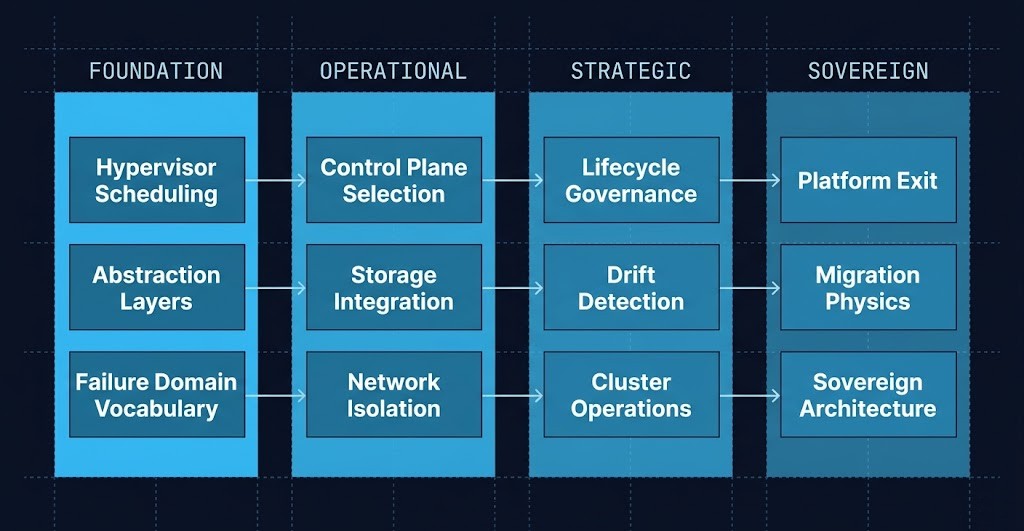
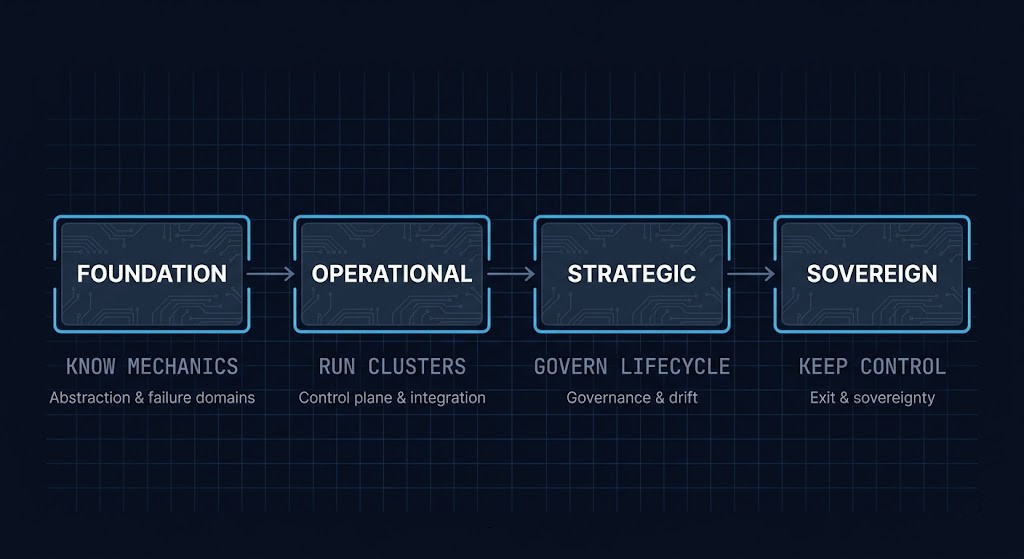
This Domain Path uses four of the five Architecture Maturity Levels: Foundation through Sovereign. Each level describes the type of architectural problem being solved — not the reader’s experience level.
| Level | Positioning | Architectural Goal |
|---|---|---|
| Foundation | Core principles and architectural mechanics | Understand abstraction mechanics and failure domain boundaries |
| Operational | Day-2 operations and scalable execution | Run clusters reliably under failure and load |
| Strategic | Optimization, governance, and economics | Govern platform lifecycle and operational drift |
| Sovereign | Operational independence, portability, and platform control | Preserve infrastructure control and exit optionality |
This Domain Path uses all four levels: Foundation → Operational → Strategic → Sovereign.
>_ Virtualization Architecture Reading Sequence
The reading sequence below follows the maturity spine — each stage builds architecturally on the decisions established before it. Failure domain design is the connective thread across all five stages.
Virtualization Foundations
Hypervisor architecture and execution physics — the mechanics that govern how compute, memory, and storage are abstracted, scheduled, and isolated at the platform layer. This stage establishes the failure domain vocabulary used throughout the path. Every architectural decision in Stages 2–5 depends on the mechanics covered here.
Control Plane Architecture
VMware, AHV, Proxmox, and Hyper-V analyzed as control plane models — not feature comparisons. Each platform carries different operational philosophy, licensing physics, ecosystem assumptions, and failure domain implications. This stage covers the platform selection decision and its architectural consequence, not the scaling and governance problems that follow from it.
Storage & Network Integration
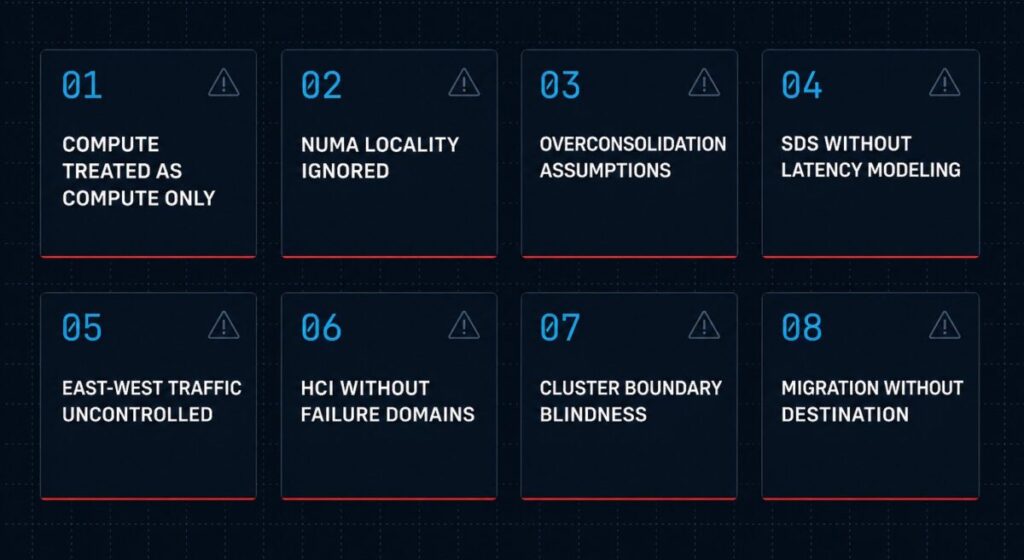
Storage protocol selection, distributed switching, and failure domain design are not infrastructure-layer decisions — they are architectural decisions that determine blast radius, migration risk, and recovery ceiling. How storage and network architecture couples to the virtualization control plane propagates directly into cluster performance and failover behavior.
>_ Common Virtualization Architecture Failure Patterns
Deterministic Platform Operations
Once the control plane is selected, the operational governance problem begins. Lifecycle management, patch sequencing, drift detection, and scaling failure domain design determine whether a platform remains deterministic or accumulates operational entropy. This stage covers the decisions that prevent the platform from becoming the incident — not the platform selection decision itself.
Post-VMware Strategic Architecture
Migration is not automatically modernization. This stage evaluates both migration and retention architecture — including scenarios where remaining on VMware is operationally safer than premature platform displacement.
Broadcom impact, platform exit architecture, alternative hypervisor evaluation, and the full post-VMware decision framework. Post-VMware architecture is the outcome of the entire path — the exit options cannot be properly evaluated without the foundation, control plane, storage integration, and operational governance context from Stages 1–4.
>_ Virtualization Specialization Tracks
Specialization Tracks are deep-dive architecture sequences focused on a specific infrastructure discipline within Virtualization. Non-linear and practitioner-targeted — entry assumes operational familiarity with the domain.
Compute Architecture
NUMA scheduling, core allocation, and execution physics in virtualized environments.
Open Specialization Track →Networking Architecture
East-west traffic, overlay design, and network virtualization for private cloud environments.
Open Specialization Track →Storage Architecture
Storage protocol selection, SDS architecture, and data path modeling under failure conditions.
Open Specialization Track →HCI Architecture
Converged infrastructure design, CVM resource tax, and failure domain resiliency modeling.
Open Specialization Track →Migration Strategy
VMware exit architecture, cutover sequencing, and identity continuity across migration events.
Open Specialization Track →Performance Modeling
Latency budgets, contention modeling, and workload characterization for enterprise infrastructure.
Open Specialization Track →Sovereign Infrastructure
Data residency, air-gapped virtualization, platform independence, licensing sovereignty, and deterministic private cloud architecture.
In DevelopmentSpecialization Tracks for Cloud, Data Protection, Modern Infrastructure & IaC, and AI Infrastructure are planned for a future build cycle.
>_ Deterministic Infrastructure Tools
>_ Where Do You Go From Here
>_ Continue Your Architecture Reading Sequence
Five Domains. One Maturity Framework.
The Virtualization Architecture Domain Path is one of five structured reading sequences across the Rack2Cloud platform. Each path follows the same maturity spine — applied to the operational realities of its domain.
>_ Frequently Asked Questions
Q: What is the Virtualization Architecture Learning Path?
A: The Virtualization Architecture Learning Path is a maturity-guided reading sequence for enterprise infrastructure engineers covering hypervisor architecture, control plane selection, storage and network integration, deterministic platform operations, and post-VMware strategic architecture. It sequences published analysis from this site by operational complexity and failure-domain depth — not by topic alphabetically or by vendor platform. The path uses four Architecture Maturity Levels: Foundation, Operational, Strategic, and Sovereign.
Q: How is this different from VMware certification training or vendor documentation?
A: Certification training sequences content to cover exam objectives. Vendor documentation covers feature implementation. This path sequences content to cover the architectural decisions you face in production — failure domain design, control plane tradeoffs, blast radius modeling, licensing physics, and operational governance. The goal is architectural judgment, not credential or feature familiarity.
Q: What does “post-VMware architecture” mean and why does it matter now?
A: Post-VMware architecture refers to the full decision landscape after Broadcom’s acquisition of VMware changed the licensing, support, and product structure for enterprise customers. It includes the evaluation of alternative platforms (Nutanix AHV, Proxmox, XCP-ng, Hyper-V), migration execution architecture, retention analysis, and hybrid approaches such as Azure VMware Solution. It is not a prescription to migrate — it is the architectural framework for evaluating the full range of options with their operational and economic consequences modeled explicitly.
Q: Is VMware still a viable enterprise platform after Broadcom, and should every organization migrate?
A: Neither a blanket yes nor a blanket no. VMware under Broadcom remains a technically capable platform. The question is whether the licensing cost, support model change, and product consolidation create an architectural constraint that forces a decision — and for many organizations, they do. The correct answer depends on: current licensing exposure and renewal timeline, operational maturity with alternative platforms, destination platform readiness, migration execution risk, and exit cost modeling. Organizations with locked multi-year EAs, limited operational depth in alternatives, or high-risk migration windows may be better served by deferring migration than executing prematurely. Stage 5 of this path covers both migration and retention architecture explicitly.
Q: What is the difference between the Domain Path and the Specialization Tracks?
A: The Domain Path is a broad, maturity-guided reading sequence through the full discipline of virtualization architecture — covering the decisions that span the entire domain from foundations to sovereign architecture. The Specialization Tracks are deep-dive sequences focused on a specific operational area within virtualization: compute, networking, storage, HCI, migration, or performance modeling. The Domain Path is designed to be read sequentially; the Specialization Tracks are non-linear and assume operational familiarity with the domain. Both coexist and serve different reader behaviors.
Q: What Architecture Maturity Levels does this path use?
A: This path uses all four levels of the maturity spine that apply to virtualization architecture: Foundation (abstraction mechanics and failure domain vocabulary), Operational (control plane selection and storage-network integration), Strategic (lifecycle governance and deterministic operations), and Sovereign (post-VMware strategic architecture and platform control). The fifth level — Resilient — is used in domains with explicit survivability and recovery architecture content. Virtualization’s resiliency content is distributed across the Operational and Strategic stages rather than requiring a dedicated Resilient level.
Q: How often is the reading sequence reviewed and updated?
A: The architecture sequence is reviewed when significant platform changes occur — licensing shifts, major product updates, or new published analysis that changes the recommended reading order. The last review date is shown in the governance metadata block above the reading sequence. Articles remain in the sequence as long as the architectural principles they cover remain accurate; they are flagged or replaced when vendor-specific details become materially outdated.