

BARE METAL
Sovereign Control Starts at the Hardware Layer.
Bare metal orchestration is not a legacy architecture pattern. It is an intentional architectural decision about where the trust boundary sits — and what you are willing to delegate outside it.
Virtualization adds capability. It adds flexibility, density, and operational convenience. It also adds abstraction — and abstraction is a trust decision. Every hypervisor layer you introduce is a component you do not directly control that sits between your workload and the hardware it runs on. For most workloads, that tradeoff is correct. For workloads where performance determinism is a hard requirement, where physical isolation is a regulatory mandate, or where the sovereignty of the compute plane cannot be delegated — the hypervisor abstraction is not a convenience. It is a liability.
The organizations that choose bare metal understand this. They are not choosing it because they lack the sophistication to run virtualized infrastructure. They are choosing it because they have modeled the tradeoff and decided that the abstraction cost — in performance overhead, in attack surface, in sovereignty dependency — exceeds the operational benefit. Bare metal is the answer to a specific question: what does it take to run compute with no software layer between the workload and the hardware?
But physical ownership of hardware is not the same as architectural control of the compute plane. A server you own, provisioned by a vendor’s cloud-connected management tool, updated via firmware packages pulled from an external repository, and monitored by an agent that phones home — is not sovereign compute. It is externally governed compute in a rack you pay for. This page answers the harder question: what does it actually take to orchestrate physical servers as programmable, sovereign infrastructure — and where do most bare metal deployments fail before the first workload runs?
The Bare Metal Illusion
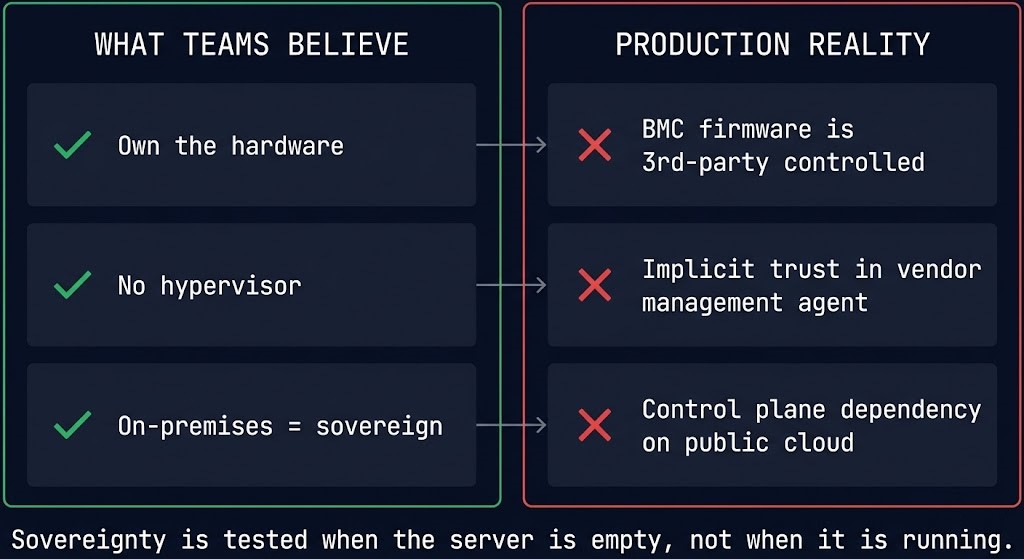
The illusion of bare metal sovereignty is maintained by a set of beliefs that are individually reasonable and collectively wrong. Each belief describes a real infrastructure decision. None of them describes sovereign compute.
| What Teams Believe | What It Actually Means |
|---|---|
| Bare metal is just physical compute | Bare metal is a physical trust boundary with an attached control plane. The hardware is not the architecture — the lifecycle management of that hardware is. |
| No hypervisor means no abstraction risk | BMC, firmware, PXE, and Redfish are abstraction layers. They are just lower in the stack — which makes them harder to audit and more consequential when compromised. |
| Owning hardware means owning the stack | Ownership without lifecycle control is outsourced trust. If provisioning, firmware, or out-of-band management requires external reachability, you own the hardware and someone else governs it. |
| On-premises means sovereign | If provisioning or firmware requires vendor cloud reachability, the compute plane is not sovereign — regardless of where the hardware physically sits. |
| Bare metal orchestration is a platform team problem | The BMC plane is a security domain. If security doesn’t own the out-of-band network, nobody does — and attackers will find it before the next audit does. |
The illusion persists because bare metal sovereignty gaps are invisible under normal operations. The BMC responds. The firmware is current. The provisioning system works. The external dependency only surfaces when it must not exist — during a network isolation event, a supply chain audit, or a regulatory inspection. By which point it is too late to retrofit. The broader pattern — infrastructure that appears sovereign at rest and fails under the conditions it was designed to survive — is the same failure mode that hybrid cloud dependency produces at the architecture level.
What Bare Metal Orchestration Actually Is
The terms automation and orchestration are used interchangeably in bare metal contexts. They are not the same thing — and the distinction determines whether a team has operational capability or architectural control.
Automation executes tasks on physical servers. Orchestration enforces desired state across the hardware lifecycle.
A PXE boot script that installs an OS on a blank server is automation. It runs once, produces an outcome, and stops. If the server drifts from that state — if firmware is updated out of band, if a configuration changes, if the server is repurposed without decommission — automation has no opinion. It ran its task. It is done.
Orchestration is the continuous enforcement of declared state. A server in an orchestrated bare metal environment has a defined desired state: provisioned, running a specific OS image and firmware version, assigned to a specific workload class, monitored for drift, and subject to automated decommission when the workload ends. Deviation from that state is detected and remediated — not because a script ran, but because the orchestration plane continuously reconciles actual state against declared state.
The practical difference: PXE boot automation is not bare metal orchestration. Declarative lifecycle control — where a server moves through hardware discovery, secure provisioning, workload assignment, drift detection, and cryptographic decommission as a managed state machine — is.
workload: k8s-worker-03
firmware: 2.6.1-verified
Full bare metal orchestration spans four lifecycle phases: hardware discovery (automated identification of CPU, memory, NIC, and BMC capabilities), secure provisioning (PXE/iPXE boot, image delivery, OS bootstrapping, and firmware validation), workload assignment (declarative state management, configuration enforcement, and scheduling), and decommission (workload removal, data destruction verification, and hardware return to available pool). Any implementation that covers fewer than all four phases is automation with gaps — not orchestration.
The Real Control Plane Is Out-of-Band
In a bare metal environment, the workload runs on the server. The operating system runs on the server. Kubernetes runs on the server. The application stack runs on the server. None of those own the server.
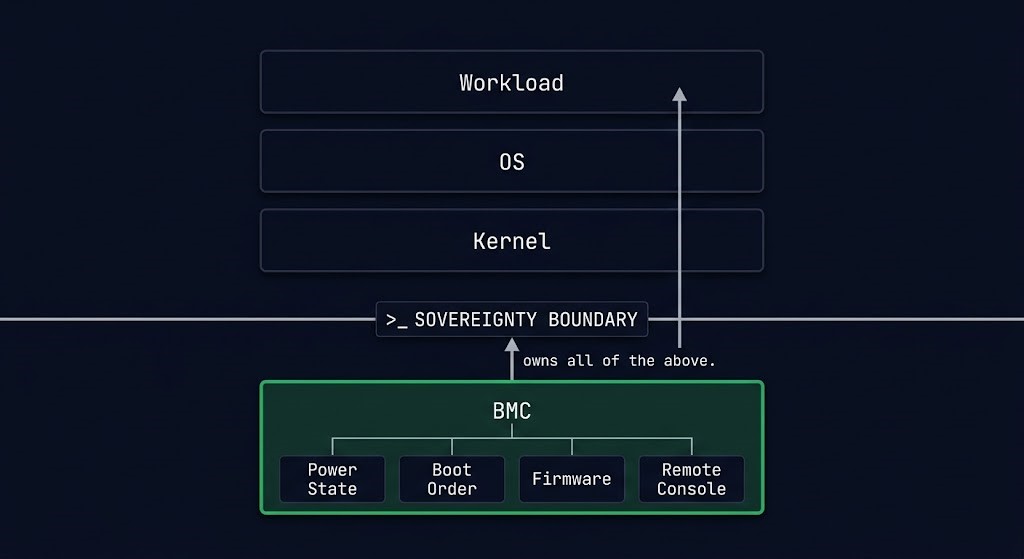
The Baseboard Management Controller does.
The BMC is a dedicated microcontroller embedded on the server motherboard that operates independently of the main CPU, OS, and all software running on the system. It has its own network interface, its own processor, its own memory, and its own firmware. It operates whether the server is powered on or off. It operates whether the OS has booted or not. It operates whether any workload is running or not. And it controls the things that actually determine what a server does: power state, boot order, firmware, remote console access, and virtual media.
This hierarchy has a direct sovereignty implication. An organization that deploys bare metal servers with cloud-managed BMC — where the out-of-band management plane is accessible via a vendor portal, where firmware updates are pulled from a vendor CDN, where remote console access is authenticated against an external identity provider — has not deployed sovereign compute. They have deployed hardware in a rack they own, governed by an out-of-band plane they do not control. The OS is local. The power switch is remote.
IPMI (Intelligent Platform Management Interface) and its successor Redfish are the protocols that expose BMC functionality to management systems. Both are powerful and both are dangerous when improperly secured. IPMI’s legacy protocol has known vulnerabilities — cipher suite weaknesses, authentication bypass conditions, and plaintext credential exposure — that make an exposed IPMI interface on a management network one of the highest-value targets in any data center. Redfish improves on IPMI with a REST-based API and modern authentication — but it exposes the same underlying capabilities. Power cycle, virtual media mount, boot order override, firmware push, and remote console are available to anyone with Redfish access. Designing infrastructure for an adversary that knows your playbook starts with understanding that the BMC is the first target — not the workload, not the OS, not the backup catalog.
The management network architecture follows directly. The BMC network must be physically isolated from the production network, the provisioning network, and any network segment with external reachability. A flat management network where the BMC interface shares a VLAN with production workload traffic is not a security misconfiguration — it is an architectural failure that creates a lateral movement path from any compromised workload directly to the out-of-band control plane of every server in the environment. Lock-in and exposure in infrastructure environments accumulate through networking before they accumulate anywhere else — and the BMC network is the most privileged network segment most organizations have never audited.
The hardware security execution layer — TPM 2.0 attestation, secure boot chain, firmware signing verification, and HSM-anchored key custody for provisioning credentials — is covered in the Hardware Security (HSM) Architecture sub-page. That page covers the cryptographic layer. This section covers the architectural reality that makes it necessary: the BMC is the real control plane, and if it is not sovereign, nothing above it is.
The Rack2Cloud Bare Metal Sovereignty Stack
Sovereign bare metal orchestration requires four components. Each must operate within the sovereign boundary. Any single component that escapes the boundary breaks the model — not degrades it. The compute plane is not partially sovereign. It is sovereign or it is not.
This is the Rack2Cloud Bare Metal Sovereignty Stack.
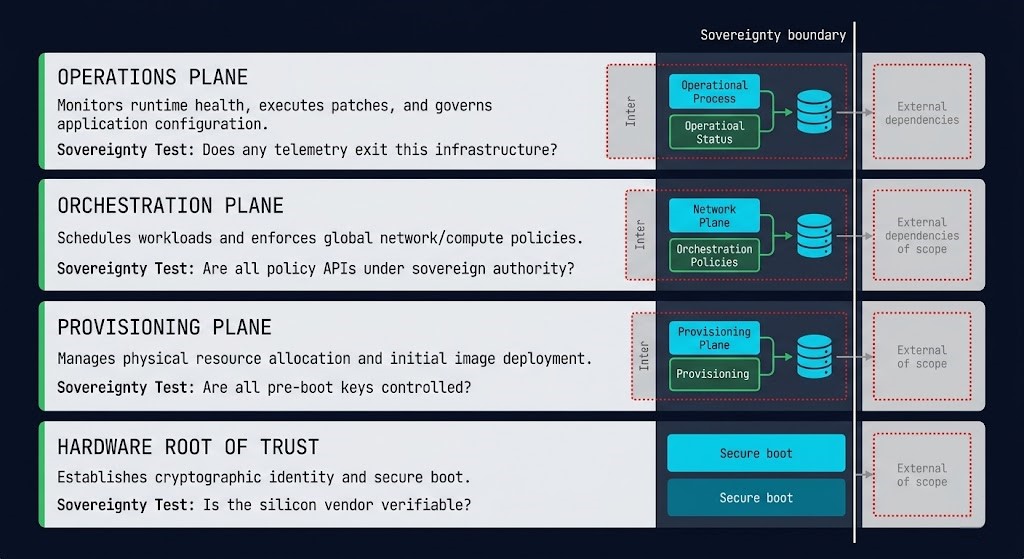
| Layer | What It Controls | External Dependency Risk | Sovereignty Test |
|---|---|---|---|
| Hardware Root of Trust | BMC credentials, secure boot chain, TPM attestation, firmware integrity verification | Vendor cloud portal for BMC access; external firmware repository; remote attestation service outside boundary | Can you verify hardware identity and boot integrity without any external network call? |
| Provisioning Plane | PXE/iPXE boot, DHCP, image delivery, OS bootstrapping, initial configuration | External TFTP/HTTP server for boot images; cloud-hosted OS repositories; external DNS for provisioning resolution | Can you provision a server from bare disk to OS ready with all external network paths severed? |
| Orchestration Plane | Lifecycle state management, workload scheduling, desired state enforcement, configuration reconciliation | Cloud-hosted orchestration control plane; external API endpoint for state management; SaaS-based CMDB | Can orchestration decisions — provision, assign, decommission — be made and executed within the boundary? |
| Operations Plane | Firmware lifecycle, monitoring, drift detection, decommission, hardware return-to-pool | Vendor update service for firmware; external SIEM for operational telemetry; cloud-managed monitoring agent | Can you detect and remediate configuration drift without external tooling or vendor reachability? |
The Hardware Root of Trust layer is the foundation. It is the layer most consistently skipped in bare metal sovereign deployments — teams focus on provisioning automation and orchestration tooling, and treat BMC security and firmware integrity as operational concerns rather than architectural ones. The consequence: a beautifully automated bare metal orchestration stack sitting on a hardware plane that any attacker with management network access can own completely.
The Provisioning Plane is where sovereignty is most commonly tested and most commonly found to have failed. The provisioning plane is the layer that operates when the server is empty — blank disk, no OS, no workload, no running software that could enforce access controls. It is the layer that determines whether the infrastructure can rebuild itself without external help. And it is the layer that most implementations depend on external infrastructure to operate.
The Operations Plane is the layer that sovereign bare metal architectures most commonly get right in documentation and most commonly fail in practice. Drift detection that requires external tooling to report. Firmware updates that require vendor cloud reachability. Monitoring agents that phone home. Each of these represents a sovereignty escape in the operational layer — invisible under normal conditions, consequential under the conditions that sovereign architecture was designed to handle. Configuration drift is an architectural problem before it is an operational one — and in bare metal environments, drift that reaches the firmware layer survives every remediation procedure that doesn’t include hardware re-flashing.
Bare Metal Orchestration Platforms
Three platforms dominate sovereign bare metal orchestration deployments. Each solves the same core problem — declarative lifecycle management of physical servers — with different architectural assumptions, different operational models, and different sovereignty postures. The right choice depends on what the surrounding infrastructure looks like, not on which platform has the most features.
| Platform | Deployment Complexity | GitOps Support | K8s Integration | Sovereignty Posture | Right For |
|---|---|---|---|---|---|
| Ironic (OpenStack) | High — requires OpenStack ecosystem or standalone deployment with significant operational overhead | Via external tooling (Flux, ArgoCD) | Via Cluster API provider — not native | Strong — fully self-hostable, no external dependency requirement, mature air-gap support | Large-scale sovereign deployments already running OpenStack; telecoms; national infrastructure |
| MAAS (Canonical) | Medium — fastest path to operational bare metal orchestration; manageable standalone deployment | Partial — API-driven, integrates with IaC tooling | Via Juju or manual K8s install on provisioned nodes | Good — self-hostable; some Canonical telemetry considerations for strict sovereign environments | Mid-scale enterprise; teams needing fastest time-to-operational; Ubuntu-aligned infrastructure |
| Tinkerbell (CNCF) | High — Kubernetes-native, requires platform engineering capability; not a quick-start tool | Native — built on Kubernetes CRDs, GitOps-first design | Native — designed as K8s provisioning substrate (Metal3 integration) | Strongest — CNCF-graduated, fully air-gap capable, no external dependency in core architecture | K8s-native platform teams; sovereign cloud builds; edge/disconnected environments |
The platform choice is secondary to the network architecture. Any of these three platforms can be deployed in a sovereign configuration — and any of them can be deployed with external dependencies that break sovereignty. MAAS with all telemetry disabled and no external repository dependencies is more sovereign than Tinkerbell deployed with cloud-hosted container images in the boot workflow. The platform establishes the capability. The deployment architecture determines the sovereignty posture. For teams approaching bare metal orchestration through a GitOps lens, applying SDLC discipline to physical hardware lifecycle covers the operational model that makes declarative bare metal state management tractable at scale. For IaC practitioners managing bare metal alongside cloud resources, OpenTofu adoption as a control plane migration addresses the state management patterns that extend to physical infrastructure.
It is tested when the server is empty.
Bare Metal + Kubernetes
Kubernetes and bare metal are not alternatives. They are complementary layers — one handles workload orchestration, the other handles compute orchestration. The combination is increasingly common in sovereign and high-performance environments where the benefits of Kubernetes-native operations are required without the overhead of a hypervisor between the workload and the hardware.
Running Kubernetes on bare metal means physical servers are Kubernetes worker nodes directly — no VM layer, no hypervisor, no NUMA topology abstraction. The workload scheduler sees physical NUMA boundaries, physical NIC queues, and physical GPU PCIe lanes without translation overhead. For AI training, HPC, and latency-sensitive networking workloads, this matters. The Kubernetes abstraction layer adds operational overhead but does not add a performance boundary — the performance characteristics of the bare metal hardware are directly accessible to the workload. The networking layer deserves specific attention: bare metal Kubernetes environments benefit significantly from eBPF-based networking, and the Cilium vs Calico decision has different implications on bare metal than it does on cloud-managed Kubernetes where the underlying network fabric is abstracted. For AI and HPC clusters specifically, deterministic networking is a hard requirement — not a configuration preference — and bare metal is the only compute model where it is achievable without vendor-specific hardware abstractions.
Metal3 and Cluster API are the Kubernetes-native path to bare metal orchestration. Metal3 (Metal³) is a Kubernetes operator that manages bare metal hosts as custom resources — using Ironic as the provisioning backend and exposing server lifecycle management through Kubernetes API objects. Cluster API’s bare metal provider builds on Metal3 to provide declarative Kubernetes cluster lifecycle management on physical hardware. The operational model: bare metal servers are declared as BareMetalHost objects, Kubernetes clusters are declared as Cluster objects, and the control plane reconciles actual state against declared state — the same GitOps operational model that governs any other Kubernetes workload. For platform teams already operating Kubernetes, this is the most natural path to bare metal orchestration. The Kubernetes Cluster Orchestration pillar covers the Day-2 operational model that bare metal K8s clusters inherit — the failure loops are the same, but the hardware lifecycle adds a layer below the OS that cloud-managed clusters never surface.
What Kubernetes does not solve: the BMC security plane, the provisioning network isolation, the firmware sovereignty requirements, and the hardware root of trust. Kubernetes orchestrates workloads on bare metal. It does not secure the hardware lifecycle below the OS. Those concerns belong to the Bare Metal Sovereignty Stack — and they must be addressed before the first Kubernetes node boots, not after.
This is the general form of a companion argument about Kubernetes and virtualization: Kubernetes took over application placement, not infrastructure ownership — and that’s true whether the infrastructure underneath is virtualized or bare metal. The division of labor is identical either way. Kubernetes’ node lifecycle (registration, readiness, scheduling eligibility) depends on the infrastructure layer being ready but never replaces it. Bare metal simply removes the hypervisor from that infrastructure layer; it doesn’t remove the layer itself, or the sovereignty and lifecycle obligations that come with it.
Failure Modes
These are not operational risks. They are attack paths — the specific failure modes that bare metal sovereign environments experience in practice, framed as an adversary would approach them. Unlike a misconfiguration that produces visible errors, these are structural conditions that maintain the appearance of sovereignty while creating exploitation surfaces that most bare metal security audits never reach.
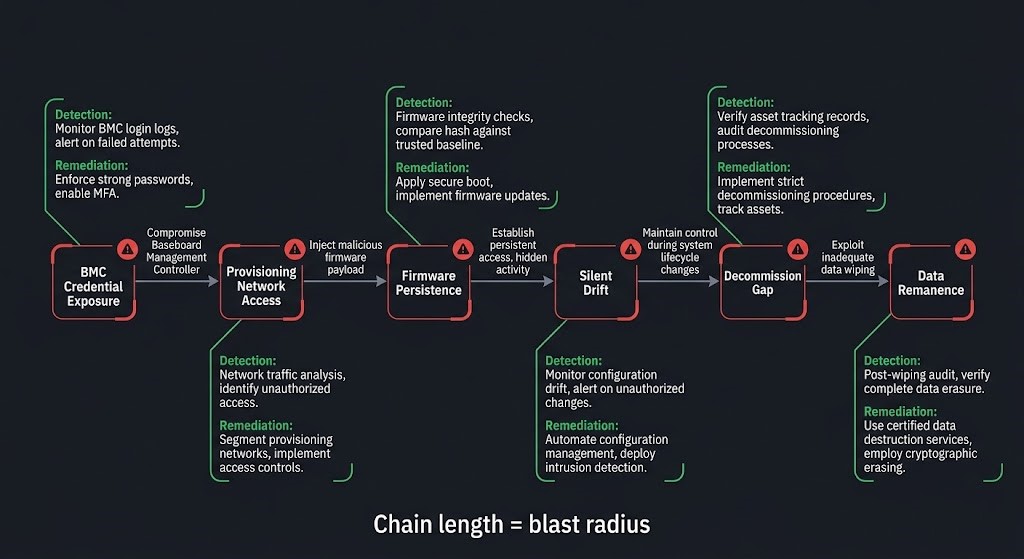
The Bare Metal Sovereignty Test
Before treating bare metal orchestration as sovereign, run this test. It is not a checkbox — it is a diagnostic. The scoring reveals where the architecture actually stands versus where the documentation claims it stands.
Sever all external network paths. Then answer:
Can you provision a server from bare disk to OS ready with no external network reachability?
If yes: the provisioning plane is sovereign. If no: the compute boundary depends on external infrastructure at its most vulnerable moment — when the server has no running software to enforce access controls.
Are BMC credentials unique per server, rotated on schedule, and stored in a locally controlled vault?
Default or shared credentials are a single-credential compromise away from full hardware-layer control loss across every server sharing that credential.
Is the BMC/management network physically isolated from production and provisioning networks?
If a compromised production workload can reach the BMC interface, the workload-layer compromise has hardware-layer consequences. Network isolation is not optional.
Are firmware packages staged locally and cryptographically verified before application?
If firmware is pulled from vendor CDN at update time: degraded sovereignty. The hardware update chain has an external dependency. Firmware that is not cryptographically verified before installation is an unverified software installation at the most privileged layer.
Is measured boot with TPM 2.0 attestation producing expected PCR values on every boot?
Without attestation, boot chain integrity is assumed. A firmware-level compromise or modified bootloader is undetectable until the implant takes an observable action — which may be never, from the perspective of the monitoring stack.
Can you decommission a server with cryptographic data destruction verification and an auditable record?
Manual decommission without automated verification creates data remanence. In regulated environments, the inability to produce a cryptographic destruction record for decommissioned hardware is itself a compliance failure independent of whether any data was actually recovered.
When did you last test offline provisioning under simulated external network loss?
Never tested = assumed sovereignty. The provisioning plane that has never been run offline is a provisioning plane that has never proven it can run offline. Sovereignty is provable or it is assumed.
Decision Framework
| Scenario | Bare Metal Requirement | Minimum Architecture | Risk if Skipped |
|---|---|---|---|
| AI / ML training — GPU-intensive workloads | Strong — NUMA locality and PCIe lane access require no hypervisor in the path | Bare metal GPU nodes + DPDK or SR-IOV networking + bare metal K8s for workload scheduling. See: Sovereign AI Mandate and GPU Fabric Physics for the infrastructure requirements. | 10–30% GPU utilization loss from hypervisor NUMA abstraction; NVLink fabric performance degraded |
| Regulated data — HIPAA, FedRAMP, DORA, NIS2 | Often required — physical isolation mandate, hypervisor-shared kernel unacceptable for certain classification levels | Bare metal Sovereignty Stack (all four layers) + TPM attestation + auditable decommission | Regulatory non-compliance; audit failure on physical isolation requirement. The Data Protection Architecture pillar covers the full compliance stack these workloads sit within. |
| Sovereign cloud or national infrastructure | Required — physical boundary is the sovereignty anchor; hypervisor adds external vendor dependency | Full Bare Metal Sovereignty Stack + offline provisioning capability + firmware sovereignty controls | Sovereignty claim invalidated by vendor-managed hypervisor or cloud-connected BMC |
| HPC / deterministic latency workloads | Strong — microsecond latency sensitivity eliminates hypervisor scheduling jitter as acceptable overhead | Bare metal nodes + DPDK for network stack bypass + NUMA-aware workload placement | Scheduling jitter from hypervisor VCPU multiplexing; unpredictable latency spikes under resource contention |
| Edge / disconnected environments | Required — external dependency in provisioning or operations is unacceptable when connectivity is intermittent | Full offline provisioning capability + local firmware mirror + air-gap capable orchestration platform | Infrastructure becomes unrecoverable during connectivity loss. Cloud-dependent AI in disconnected environments documents exactly this failure mode at the application layer. |
| General enterprise compute (mixed workloads) | Optional — evaluate hypervisor overhead against workload requirements; bare metal justified only for specific workload classes | Selective bare metal for performance-critical workloads; virtualization for general compute | Operational complexity without proportional benefit for workloads where hypervisor overhead is within acceptable range |
Bare Metal Orchestration Maturity Model
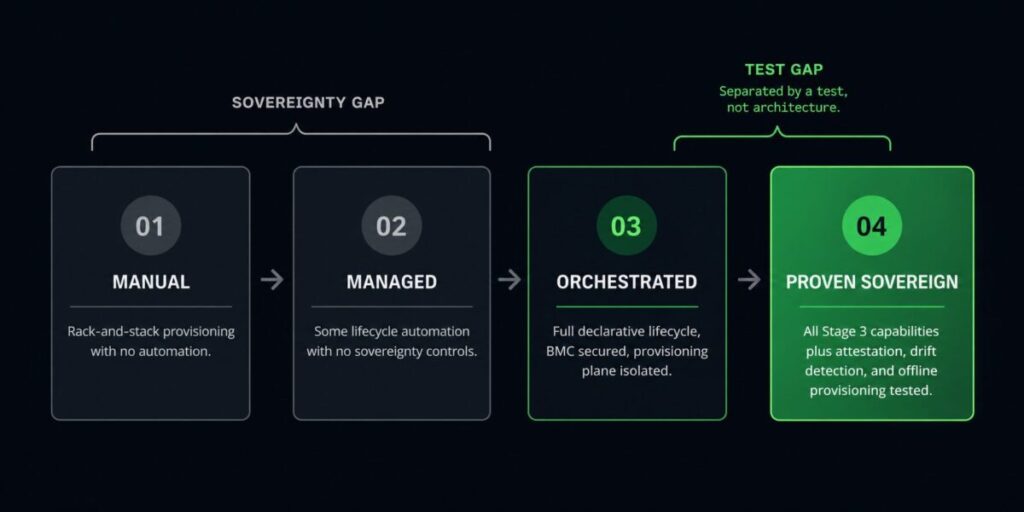
| Stage | State | What Exists | What’s Missing | Sovereignty Test |
|---|---|---|---|---|
| 1 | Manual | Physical servers provisioned by hand; OS installed via USB or manual PXE; no lifecycle automation; BMC accessed ad-hoc via vendor portal | Everything — no declarative state, no drift detection, no decommission automation, no BMC security governance | Take a server offline. How long to reprovisioning? Days = Stage 1. |
| 2 | Managed | PXE provisioning automated; MAAS or similar provides server lifecycle UI; some configuration management via Ansible or Chef; BMC credentials set but not rotated | Declarative desired state; firmware sovereignty controls; management network isolation; drift detection; automated decommission verification | Disconnect external network. Does provisioning work? No = Stage 2 at best. |
| 3 | Orchestrated | Full declarative lifecycle via Ironic/MAAS/Tinkerbell; BMC credentials unique and managed in local vault; management network isolated; firmware staged locally; automated decommission with verification | TPM attestation and measured boot not implemented; offline provisioning documented but not tested; no cryptographic decommission audit trail | Full network isolation test: provision, assign, decommission — does the entire lifecycle complete without external calls? |
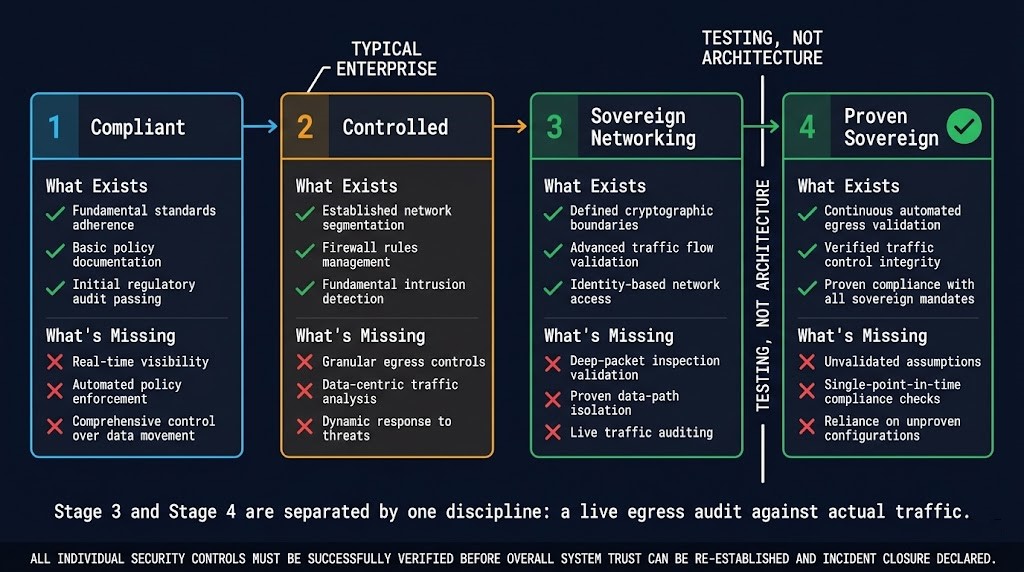
| 4 | Proven Sovereign | All Stage 3 components plus: TPM 2.0 attestation with PCR baseline; measured boot on every server; offline provisioning tested quarterly; cryptographic decommission audit trail; firmware integrity verified before application | Ongoing discipline — sovereign bare metal requires active maintenance, rotation schedules, attestation baseline updates, and regular offline tests | All Bare Metal Sovereignty Test questions answered PASS — with test results, not assumptions. |
Stage 3 and Stage 4 are separated by testing, not architecture. Most organizations that invest in bare metal orchestration reach Stage 3. The declarative lifecycle is in place. The BMC is secured. The provisioning plane exists. The gap between Stage 3 and Stage 4 is a single discipline: executed validation under the conditions that sovereignty was designed to handle. An offline provisioning test that has never been run is an assumption. A firmware baseline that has never been verified against measured boot is a belief. Sovereign bare metal is provable or it is assumed — and the test takes a day, not a quarter.
When Bare Metal Is the Wrong Tool
The strongest argument for bare metal is specific. When the workload requires performance determinism that hypervisors cannot guarantee, when physical isolation is a regulatory mandate, or when the sovereignty of the compute plane cannot be delegated — bare metal is the correct answer. When those conditions are not present, it often is not.
Workloads with highly variable demand that need to scale from zero to peak and back — web applications, APIs, batch processing triggered by events. Bare metal provisioning latency cannot match the elastic scaling model that cloud-native compute handles in seconds. Cloud-native architecture and container orchestration exist precisely for this pattern — the hypervisor and abstraction overhead that is unacceptable for an HPC workload is irrelevant for a stateless service that scales by replica count.
Bare metal orchestration requires operational maturity that many teams do not have. BMC credential rotation, firmware lifecycle management, provisioning network isolation, and attestation baseline maintenance are not lightweight operational tasks. Teams that cannot maintain these disciplines will reach Stage 2 and call it done — creating a security liability that looks like sovereign infrastructure but is not.
CRM, HR systems, collaboration tools, and other SaaS workloads have no performance or isolation requirement that bare metal addresses. Running SaaS-adjacent infrastructure on bare metal adds operational overhead without architectural benefit. The sovereignty argument does not apply to workloads where the application itself is externally hosted.
Not every workload needs sovereign compute. Development environments, internal tooling, and non-regulated workloads without performance-sensitive requirements are better served by virtualized infrastructure or cloud compute. Applying bare metal sovereignty controls to workloads that don’t require them is an operational cost decision as much as an architecture decision — the BMC credential rotation, firmware governance, attestation baseline maintenance, and offline provisioning discipline that Stage 3 and Stage 4 require carry real overhead. Cloud cost is now an architectural constraint, and so is operational cost. Before committing a workload class to bare metal, the question isn’t whether bare metal is technically possible — it’s whether the sovereignty or performance requirement justifies the operational weight. For most general enterprise compute, it doesn’t. The workloads where it does are specific: AI training, regulated data under physical isolation mandates, sovereign cloud builds, and edge environments where connectivity cannot be assumed. Everything else belongs on infrastructure that was designed for flexibility, not physical trust boundaries.
Stateless web services and APIs designed around horizontal scaling benefit from the density and flexibility of containerized infrastructure. The hypervisor overhead that is unacceptable for an AI training job or an HPC simulation is irrelevant for a web service that scales by adding replicas. The cloud-native compute model exists for this pattern specifically.
This is the most important constraint. If the organization cannot operationally secure the out-of-band management plane — unique credentials, network isolation, rotation discipline, firmware governance — bare metal is a security liability, not a security asset. Unsecured bare metal infrastructure gives attackers hardware-layer persistence that virtualized environments do not offer. The performance and sovereignty benefits of bare metal require the security prerequisites. Without them, a hypervisor with proper security controls is architecturally safer.
Bare metal orchestration is the Physical Plane of the Rack2Cloud Sovereignty Control Plane Model. The pages below own the adjacent planes — the identity, management, data, and network layers that sovereign bare metal depends on and protects.
You’ve Read the Architecture.
Now Test Whether Your Hardware Plane Actually Holds.
BMC credential exposure, provisioning network gaps, firmware sovereignty failures, and unverified boot chains — most bare metal sovereign deployments look correct in documentation and surface their failure modes during the first real network isolation event, incident response procedure, or regulatory audit. The triage session validates whether your specific environment passes the Bare Metal Sovereignty Test before a failure event does it for you.
Bare Metal Sovereignty Audit
Vendor-agnostic review of your bare metal orchestration posture — BMC credential and network audit, provisioning plane sovereignty test, firmware lifecycle assessment, boot chain integrity validation, and decommission procedure review.
- > BMC credential and network isolation audit
- > Provisioning plane offline capability test
- > Firmware sovereignty and supply chain review
- > Boot chain integrity and attestation baseline
Architecture Playbooks. Every Week.
Field-tested blueprints from real bare metal sovereign environments — BMC compromise post-mortems, provisioning network exposure incidents, firmware persistence case studies, and the orchestration patterns that held under real network isolation.
- > BMC Security Architecture & Credential Governance
- > Offline Provisioning Design & Test Procedures
- > Firmware Sovereignty & Supply Chain Patterns
- > Bare Metal + Kubernetes Sovereign Architecture
Zero spam. Unsubscribe anytime.
Architect’s Verdict
There are two ways to think about bare metal. The first is that it is legacy infrastructure — the thing you ran before virtualization made compute flexible, before containers made it portable, before cloud made it elastic. The second is that it is the only compute architecture where the trust boundary is physically enforced, where performance determinism is not negotiated with a scheduler, and where the sovereignty of the compute plane does not depend on a software layer you do not control. The organizations that understand the second framing use bare metal deliberately. The organizations that understand only the first framing use it reluctantly or not at all — and then discover that their regulated workloads, their AI training infrastructure, or their sovereign cloud requirements needed it all along.
The most consequential gap in bare metal sovereign deployments is not the provisioning automation or the orchestration platform. It is the hardware plane that sits below all of it — the BMC that controls power, boot order, firmware, and remote console, sitting on a management network that most organizations have never audited for lateral movement risk. An organization that has deployed Tinkerbell for declarative lifecycle management, Metal3 for Kubernetes-native provisioning, and GitOps for configuration enforcement — but left BMC credentials at factory defaults, management network accessible from production VLANs, and firmware pulled from vendor CDN without cryptographic verification — has built a sophisticated orchestration layer on top of an unsecured hardware control plane. The sophistication of the upper layers does not compensate for the exposure at the base.
Sovereignty is not tested when the server is running. It is tested when the server is empty — blank disk, no OS, no WAN, no vendor portal. Can you rebuild it? That test, run against a real server with real network isolation, takes a day. Most organizations that describe their bare metal infrastructure as sovereign have never run it. Stage 3 and Stage 4 are not separated by architecture. They are separated by that test. Run it. The result is the accurate answer to the question of whether your compute plane is sovereign — not the architecture diagram, not the compliance documentation, and not the vendor’s assurance that the tooling supports air-gap deployment.
Frequently Asked Questions
Q: Is bare metal always more secure than virtualized infrastructure?
A: No — and this is one of the most dangerous misconceptions in sovereign infrastructure design. Bare metal provides physical isolation and removes the hypervisor attack surface. But unsecured bare metal infrastructure — exposed BMC interfaces, default credentials, unverified firmware, unprotected provisioning networks — gives attackers hardware-layer persistence that virtualized environments with proper security controls do not offer. A well-secured virtualized environment is architecturally safer than poorly secured bare metal. The security advantage of bare metal requires the security prerequisites: BMC credential governance, management network isolation, firmware integrity controls, and measured boot. Without those, bare metal is a liability, not an asset.
Q: What is the BMC and why does it matter for sovereign bare metal?
A: The Baseboard Management Controller (BMC) is a dedicated microcontroller embedded on the server motherboard that operates independently of the main CPU, OS, and any workload software. It controls power state, boot order, firmware, remote console access, and virtual media — the fundamental operations that determine what a server does. It operates whether the server is on or off, whether an OS has booted, and whether any workload is running. In sovereign bare metal environments, the BMC is the real control plane. If an attacker has BMC access, they own the hardware completely — OS reinstalls, workload isolation, and network security controls are all irrelevant. Securing the BMC plane is not an operational detail. It is the foundational security requirement for any bare metal sovereignty claim.
Q: What is the difference between bare metal automation and bare metal orchestration?
A: Automation executes tasks on physical servers — it runs a script, installs an OS, configures a service, and stops. It has no model of ongoing desired state. Orchestration enforces desired state across the hardware lifecycle — it continuously reconciles actual server state against declared state, detects deviation, and remediates it. A PXE boot script is automation. A declarative lifecycle system where servers move through hardware discovery, secure provisioning, workload assignment, drift detection, and cryptographic decommission as a managed state machine is orchestration. The practical distinction: automation tells you what happened. Orchestration tells you what is.
Q: Can Kubernetes run on bare metal without a hypervisor?
A: Yes — and this is increasingly the deployment model for sovereign and high-performance environments. Physical servers become Kubernetes worker nodes directly, with no VM layer between the Kubernetes scheduler and the hardware. The Kubernetes abstraction handles workload scheduling, scaling, and lifecycle management; the bare metal orchestration layer (Ironic, MAAS, or Tinkerbell) handles hardware lifecycle management below the OS. Metal3 and Cluster API provide the integration point — managing bare metal hosts as Kubernetes custom resources and providing declarative cluster lifecycle on physical hardware. What Kubernetes does not solve: the BMC security plane, provisioning network isolation, firmware sovereignty, and hardware root of trust. Those must be addressed before the first Kubernetes node boots.
Q: What is the minimum viable bare metal orchestration stack?
A: The minimum viable configuration for bare metal orchestration — not sovereign orchestration, just functional orchestration — is a local DHCP and PXE server, an OS image repository, a provisioning platform (MAAS is the fastest path), and BMC access with non-default credentials. That gets a team to Stage 2. For sovereign bare metal — Stage 3 — add: unique BMC credentials in a locally managed vault, physically isolated management network, locally staged firmware packages, automated decommission with data destruction verification, and orchestration control plane within the boundary. Stage 4 adds TPM attestation, measured boot with PCR baseline, and quarterly offline provisioning tests.
Q: How does bare metal orchestration relate to sovereign infrastructure?
A: In the Rack2Cloud Sovereignty Control Plane Model, bare metal orchestration is the Physical Plane — the foundational layer that all other sovereignty planes depend on. If the physical boundary is not sovereign, the identity plane, management plane, data plane, and network plane that sit above it inherit the physical plane’s external dependencies. Sovereign identity requires an identity provider within the physical boundary. Sovereign data requires storage physically within the boundary. Sovereign networking requires the network control plane to operate within the boundary. None of those claims hold if the physical layer — the servers, the BMC, the provisioning plane — has external governance dependencies. Bare metal orchestration is the foundation. Everything else is built on top of it.
Q: When does bare metal not make sense architecturally?
A: Bare metal is not the right answer when: the workload is bursty and elastic (bare metal provisioning latency cannot match cloud-native scaling); the team lacks the operational discipline to secure the BMC plane (unsecured bare metal is worse than secured virtualized infrastructure); sovereignty is not a requirement (hypervisor overhead is acceptable for non-regulated, non-performance-critical workloads); the workload is stateless and horizontally scalable (cloud-native container infrastructure exists precisely for this pattern); or the organization cannot maintain the operational requirements — credential rotation, firmware governance, attestation baseline updates, and regular offline testing. The performance and sovereignty benefits of bare metal require the security and operational prerequisites. Without them, it is complexity without proportional benefit.