

VMWARE EXIT & MIGRATION
OPERATIONAL TOOLING FOR BROADCOM-ERA MIGRATION PLANNING, LICENSING ANALYSIS, AND HCI READINESS.
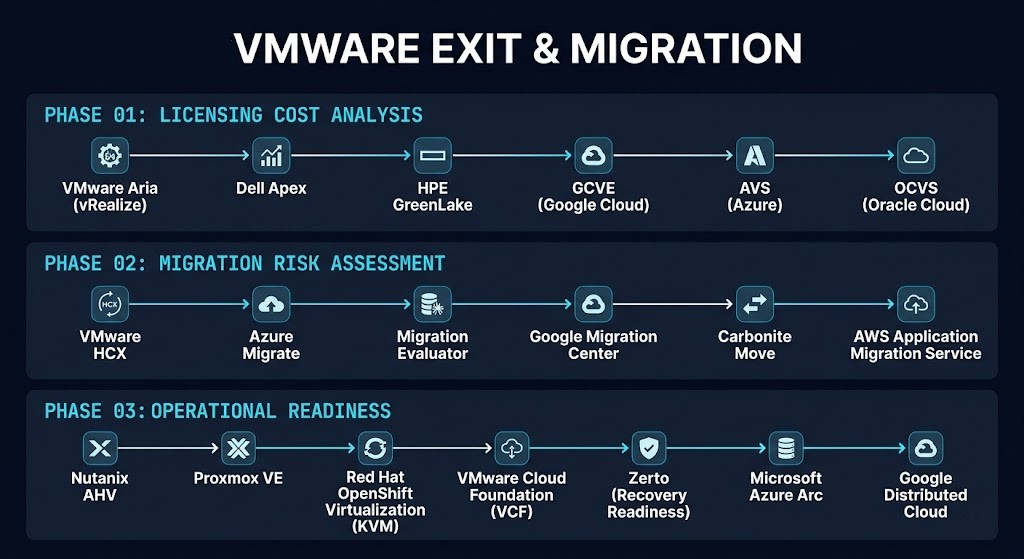
>_ Operational Framework
Most VMware exits fail before migration tooling is ever deployed. The failure originates in licensing assumptions that haven’t been stress-tested, renewal pressure that compresses the decision timeline, operational debt that doesn’t surface until the first wave of workloads moves — and, increasingly, tooling access itself changing mid-project on terms nobody’s cost model accounted for. The sequence below is designed to surface those gaps in order — cost exposure first, migration risk second, operational readiness third.
The tools below map to each of those phases. Working through them in sequence surfaces the gaps early — before the cutover window, not during it.
>_ Operational Phase 01 Licensing Cost Analysis
VVF / VCF Core Exposure
Calculate VCF and VVF core counts against your actual socket topology. Surfaces the licensing delta between your current estate and the Broadcom subscription model before the renewal conversation starts.
Comparative Cost Model
Model the cost delta between VCF subscription, VVF subscription, and alternative platform paths across your environment’s actual workload profile. Produces a defensible comparison for budget and architecture review.
Once the licensing model is clear, the next question is not “which platform” — it’s “what does this environment actually require to migrate safely.” Most environments carry constraints that don’t appear in workload inventories: snapshot chains that invalidate cutover windows, RDM dependencies that block conversion, NSX-T policy coverage that has no direct equivalent in the target platform. Phase 02 surfaces those constraints before the architecture decision is final.
>_ Operational Phase 02 Migration Risk Assessment
HCI Readiness & Risk Analysis
Surfaces migration blockers, snapshot debt exposure, RDM dependencies, cutover sequencing risks, and infrastructure hygiene gaps before the migration window opens. Covers the operational exposure that migration tooling documentation omits.
NSX-T to Flow Translation
Translate NSX-T microsegmentation policies to Nutanix Flow equivalents. Identifies policy coverage gaps and translation conflicts before the migration removes the source platform. Security policy continuity is one of the most common migration failure modes.
With migration risk quantified, operational readiness is the final validation layer before the cutover window opens. For environments with metro cluster deployments, the latency requirement is a hard constraint — not a recommendation. A cluster that passes pre-migration validation but exceeds the 5ms threshold under production load will split at witness arbitration. Phase 03 validates the conditions the migration depends on before the maintenance window is committed.
>_ Operational Phase 03 Operational Readiness
Metro Cluster Pre-Flight
Validates inter-site latency against Nutanix Metro availability thresholds in real time. The 5ms requirement is not a guideline — breaching it triggers witness arbitration failures that a green dashboard will not surface until the cluster splits.
When the three phases surface a constraint that deterministic tooling cannot resolve alone — a migration sequence with conflicting dependencies, a snapshot debt that invalidates the cutover window, a policy translation conflict with no clean equivalent in the target platform — the assessment layer is the next step. Architectural review layered on top of the tooling output, not a replacement for it.
Tool output is most useful when it triggers the next analysis. These paths map signal to next step.
| If This Tool Detects | Run Next | Why |
|---|---|---|
| VVF / VCF Core Exposure Calculator — core count exceeds budget threshold after hardware refresh | → VMware Licensing Cost Model | Core exposure alone doesn’t surface the 3-year subscription delta — model the full cost path before the renewal conversation |
| HCI Migration Advisor — snapshot debt invalidating cutover window, RDM dependencies blocking conversion | → NSX-T to Flow Translator | Migration blockers often co-occur with policy translation gaps — surface both before finalizing the sequence |
| NSX-T to Flow Translator — policy coverage gaps with no clean equivalent in target platform | → HCI Migration Advisor | Policy translation conflicts affect cutover sequencing — re-run the migration risk assessment with the gap profile in scope |
| VMware Licensing Cost Model — 3-year VCF path exceeds alternative platform TCO | → HCI Migration Advisor | Economics confirm the exit case — run pre-flight before committing the migration sequence |
| Metro Latency Scout — inter-site latency approaching or breaching 5ms threshold | → HCI Migration Advisor | Latency violations affect metro cluster viability — reassess migration sequencing before the cutover window is committed |
Operational characteristics at each maturity level. The tools above map to the transitions between levels — not to a single maturity state.
| Maturity Level | Operational Characteristic |
|---|---|
| Foundation | Licensing cost baseline established — core exposure and subscription delta are known |
| Operational | Migration risk quantified — snapshot debt, RDM dependencies, and NSX-T coverage gaps surfaced |
| Strategic | Cutover sequence designed — window constraints, sequencing conflicts, and policy translation gaps resolved |
| Resilient | Operational readiness validated — metro latency, witness arbitration tolerance, and failback paths confirmed |
| Sovereign | Post-VMware operational authority established — control plane continuity on target platform, coexistence window closed |
START WITH A BASELINE. ESCALATE WHAT THE TOOLING CAN’T RESOLVE.
The readiness brief baselines the source environment. Migration sequences with conflicting constraints, snapshot debt that invalidates a cutover window, and policy translation conflicts with no clean equivalent require architectural review layered on top of deterministic tooling, not another iteration through it.
Migration Readiness Assessment
A free, script-based readiness score for your vSphere estate, with a ranked Fix This First roadmap sequenced for Nutanix Move.
- > Snapshot debt and RDM blocker audit
- > Storage reclaim estimate (zombie VMs, orphaned ISOs, snapshot bloat)
- > Readiness score and risk band
- > Fix This First roadmap sequenced for Nutanix Move
Need the sequencing and policy work done live? Upgrade to The Architect’s Review →
Architecture Playbooks.
Field-tested blueprints for virtualization and migration architecture from production environments.
- > VMware exit sequencing and failure modes
- > HCI control plane architecture
- > Post-Broadcom migration patterns
- > Operational readiness and cutover design
Zero spam. Unsubscribe anytime.