

ENGINEERING WORKBENCH.
DECISION WORKFLOWS.
INFRASTRUCTURE DECISIONS. BACKED BY DETERMINISTIC TOOLING.
The Engineering Workbench infrastructure toolkit exists because enterprise infrastructure decisions carry consequences that spreadsheet estimates and vendor calculators don’t capture. Broadcom licensing math that ignores socket topology. Egress models that assume clean traffic patterns. Recovery cost estimates that omit restore sequence dependencies.
The Engineering Workbench is organized around the operational problems architects actually face — mid-migration, mid-renewal, mid-incident — not around the product categories vendors use to organize their sales motions. Each toolkit maps to a specific trigger state: the moment when a decision cannot be deferred and you need a number, a gap analysis, or a readiness assessment that holds up under scrutiny.
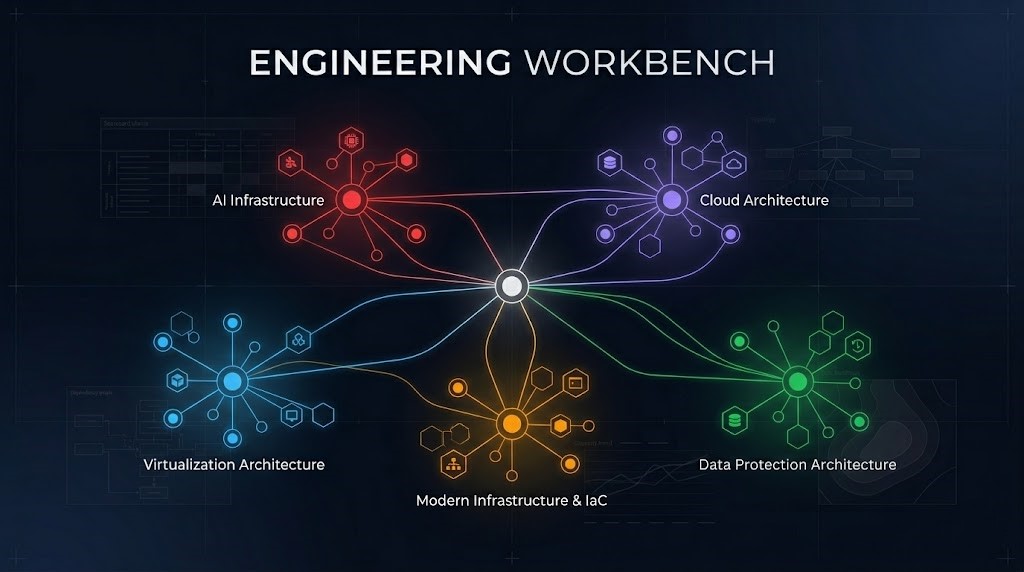
>_ Select Your Trigger State
VMware Exit & Migration
Broadcom renewal math is wrong. Migration sequencing is unvalidated. The cutover window is approaching. Licensing cost projection, core footprint audit, HCI migration readiness, Nutanix sizing, metro latency validation, and NSX-T policy translation.
Cloud Cost Governance
Cloud spend is growing faster than workloads and nobody can explain why. Idle resource detection, Kubernetes density analysis, egress cost modeling, refactoring economics, Azure Private Endpoint auditing, sovereignty dependency detection, and repatriation viability analysis.
Recovery Readiness
The DR test passed. The recovery architecture has never been validated. Readiness scoring, dependency sequencing, immutable storage economics, cloud restore cost modeling, platform TCO analysis, and recovery authority survivability.
IaC Governance
Terraform, ArgoCD, and the platform team all think they own the same object. Drift is accumulating. Nobody has validated whether OpenTofu is actually ready to replace Terraform in your environment. Ownership boundary mapping, policy drift detection, migration readiness analysis, and provider lag quantification.
AI Infrastructure
GPU utilization looks fine on the dashboard. Inference latency is climbing. Nobody can explain where the capacity went. GPU yield analysis, placement economics, storage throughput modeling, inference saturation detection, fabric pressure analysis, runtime governance, and distributed survivability.
Each toolkit on the Engineering Workbench follows the same structure: a defined trigger state that identifies when the tool applies, a workflow sequence that moves through the decision phases in order, and a direct path to structured assessment when the tool surfaces a gap that requires architectural review. Tools are free to use and require no account. The architecture behind each one is covered in the corresponding pillar — every toolkit links back to the domain content that explains the decisions the tool is quantifying.
The distinction between a tool and an assessment matters here. A tool surfaces a number — a licensing delta, a cost model, a readiness score. It tells you where the gap is. An assessment interprets that gap in the context of your specific environment, sequencing constraints, and operational risk tolerance. The Engineering Workbench is designed so both are available at the same decision point: run the tool first, request the assessment when the output requires architectural interpretation. Most decisions only need the tool. The ones that don’t are usually the ones that cost the most when they go wrong.
When the Tool Surfaces a Gap
Structured assessments for infrastructure teams facing decisions with consequences — migration readiness, recovery architecture, and cloud governance posture.
[+] View Assessment Services →