

VIRTUAL NETWORKING ARCHITECTURE
Overlay models, distributed switching, and security policy — where hypervisor decisions become network consequences
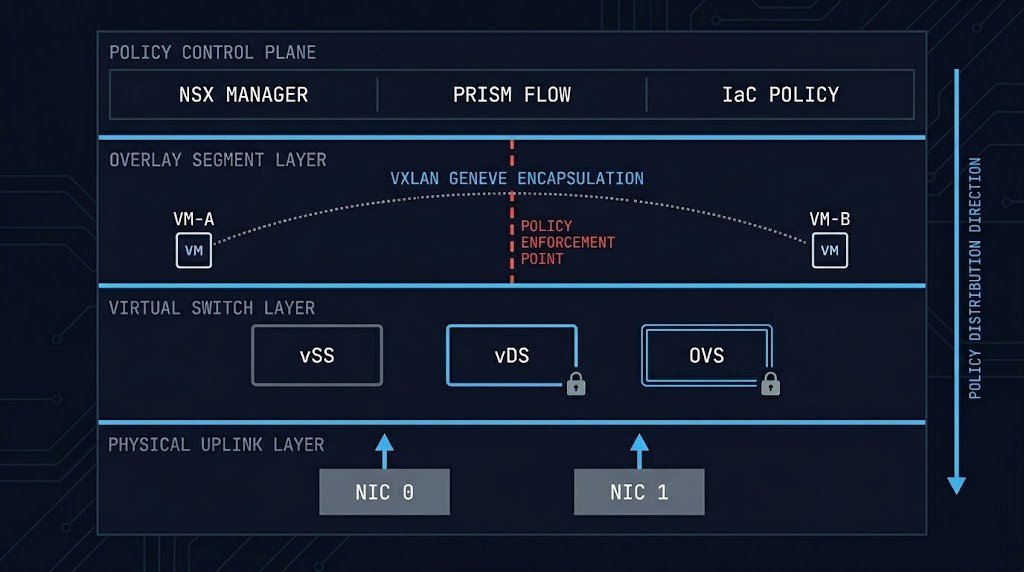
SPECIALIZATION TRACK — NETWORKING ARCHITECTURE
- Track Discipline: How the network layer is created, governed, and migrated across hypervisor platforms — the software-defined overlay stack and the policy models that govern it.
- Primary Architectural Tension: Overlay flexibility vs. operational complexity — every abstraction layer that simplifies provisioning adds a failure domain that operations must own and a policy boundary that migrations must translate.
- Architectural Boundary: This Track does not govern physical underlay design, routing protocol selection, or WAN architecture — those disciplines live in the Modern Infrastructure & IaC path. This Track governs the overlay: where enforcement happens, who owns the intent, and what breaks when the model changes.
- Domain Path Relationship: Deepens Stage 03 (Storage & Network Architecture) and Stage 04 (Deterministic Platform Operations) of the Virtualization Architecture Path — both stages treat networking at breadth; this Track provides the depth those stages assume.
- Who This Track Is For: You’re mid-migration and your network reachability issues aren’t compute or storage — they’re policy translation artifacts from moving a network-centric security model into a platform that enforces security by workload identity, not by topology.
- Architectural Failure Signal: Workloads remain reachable but policy intent no longer matches enforcement reality — segmentation boundaries exist in configuration but not in behaviour.
Virtual networking architecture is the last infrastructure layer that gets treated as configuration rather than design — and the first one that breaks silently when platforms change. The decisions made at the overlay layer determine where security policy is enforced, who owns policy intent, and whether that intent survives when the enforcement model underneath it is replaced. When those decisions are deferred to migration week, the Policy Translation Boundary becomes a production incident.
Specialization Tracks deepen specific architectural disciplines across multiple maturity stages without replacing the progression logic of the Domain Path itself. Stage 03 of the Virtualization Architecture Path introduces networking as one half of a joint storage-and-network integration problem — the right scope for a maturity stage. What it cannot cover at that depth is the architectural consequence of treating the overlay as a transport layer rather than a policy distribution system: the failure modes that only surface when you move from a platform that enforces security by network topology to one that enforces it by workload identity. That operational condition — a live migration with a security model mismatch — is precisely when Track-level depth becomes necessary.
>_ WHY THIS TRACK EXISTS
Virtual networking architecture has a hidden dependency that most platform migrations ignore: every overlay model is a policy distribution system, and policy is not platform-neutral. When the overlay changes — vDS to OVS, NSX-T to Flow, or any cross-platform transition — the Policy Translation Boundary (#108) becomes the point where network security policy ceases to be portable, because the destination platform expresses segmentation, traffic control, and identity through a fundamentally different architectural model than the source. The boundary is invisible during migration validation because connectivity survives. Security intent does not. The Virtualization Architecture Path covers network integration across Stages 03 and 04, but breadth-level coverage cannot resolve the philosophical difference between network-centric and workload-centric enforcement models, or prepare an architect for the governance consequences of overlay state during live migration. This Track provides the architectural depth to design, migrate, and operate virtual networking across hypervisor transitions — with the Policy Translation Boundary as the diagnostic lens that makes silent failures visible before they become production incidents.
WHAT THIS TRACK IS NOT
01 — NOT A PHYSICAL SWITCHING GUIDE
Physical underlay design, spine-leaf topology, BGP/ECMP, and WAN architecture are out of scope — this Track governs the overlay: where enforcement happens, who owns intent, and what breaks when the model changes.
02 — NOT A VENDOR CONFIGURATION TUTORIAL
It covers the architectural consequences of switch model decisions — vSS vs. vDS vs. OVS, NSX-T vs. Flow — not step-by-step port-group configuration or vendor CLI procedures.
03 — NOT A SECURITY ARCHITECTURE TRACK
Microsegmentation is covered as a networking policy model — the overlay mechanism through which security intent is expressed — not as a zero-trust security program; that discipline belongs in the Data Protection path.
04 — NOT A MIGRATION TOOLING GUIDE
The NSX-to-Flow Translator is referenced as a tool that automates policy translation — the subject of this Track is the Policy Translation Boundary (#108) that makes that translation architecturally non-trivial in the first place.
NETWORKING ARCHITECTURE — READING SCOPE
| Scope | Coverage | Estimated Time |
|---|---|---|
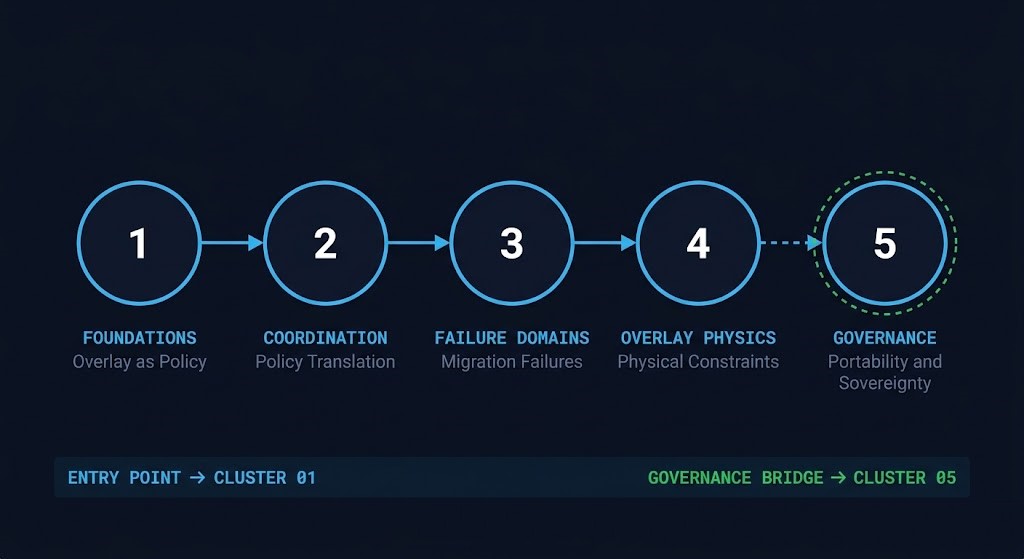
| Core Reading Sequence | Clusters 01–03 — overlay foundations, policy translation models, and migration failure patterns | ~3–4 hr |
| Full Track | All five clusters — including overlay physics constraints and governance portability for sovereign infrastructure | ~5–7 hr |
>_ WHERE TO ENTER THIS TRACK
Start at Cluster 01 if you are approaching virtual networking architecture as a discipline for the first time, or if you are mid-migration and encountering network behaviour that doesn’t match your pre-migration model. The foundational cluster establishes the argument that the overlay is a policy distribution system before the later clusters apply that lens to specific failure conditions.
You can likely skip to Cluster 02 if all three of the following are true:
- You can accurately describe the architectural difference between vSphere Distributed Switch and Open vSwitch — not just the feature delta, but what each one means for where policy enforcement lives
- You have operated NSX-T in a production environment and understand how DFW rules attach to network constructs rather than workload identity
- You have already completed Stage 03 of the Virtualization Architecture Path and understand storage-network convergence at the overlay layer
If any of these require translation, start at Cluster 01. The Policy Translation Boundary becomes expensive when it is encountered in production rather than in this sequence.
>_ READING SEQUENCE
Each cluster below is organized by architectural problem. Every cluster answers: what becomes architecturally unstable if this discipline is misunderstood?
Virtual Networking Is Policy Distribution, Not Transport
Virtual networking in enterprise platforms isn’t switching — it’s policy distribution. Every platform decision (vDS, OVS, NSX, Flow) is a decision about where enforcement happens and who owns intent. These articles establish the execution model across the three major platform architectures: the vSphere distributed switching model, the AHV/OVS integrated stack, and the Stage 03 Domain Path integration that connects networking to storage at the overlay layer. The discipline framework — what makes the overlay a governance system rather than a transport layer — follows in Cluster 02. Read this cluster first if the distinction between enforcement location and policy intent is not yet operational in your decision-making.
Where Overlay Design Decisions Become Policy Translation Problems
This is the architectural core of the Track. The Policy Translation Boundary (#108) is the point where network policy ceases to be portable — not because the rules cannot be re-expressed, but because the destination platform enforces segmentation through a different model than the source. NSX-T attaches security policy to network constructs: IP sets, security tags, port groups, DFW rules tied to topology. Nutanix Flow attaches policy to workload identity: VM categories, attributes, application tiers. Moving from one to the other is not a firewall rule export — it is a philosophy migration. Connectivity survives the boundary. Security intent does not. These three articles establish the translation mechanics, the policy migration sequencing, and the cross-platform context for the Modern Infrastructure networking layer where these decisions propagate.
Where Virtual Networking Failures Hide Until Production
Virtual networking failures rarely appear as network outages. They emerge as policy-enforcement mismatches where reachability, segmentation, and observability diverge from architectural intent — often days or weeks after cutover, when a lateral movement event or compliance audit reveals the gap. The most common source is vDS feature dependency blindness: teams spend years building port mirroring configurations, private VLANs, and NetFlow collection inside vCenter without inventorying those dependencies before migration. When they move to AHV’s OVS architecture, those constructs don’t translate — and the operational tools built on them break on Day 1. These two articles cover the Day 2 network failure landscape from both angles: the immediate post-migration reachability failures and the AHV operational networking model that replaces the constructs teams relied on.
The Physical Constraints That Software-Defined Overlays Cannot Abstract Away
Software-defined overlays abstract the physical layer — but they do not eliminate it. MTU mismatches, LACP configuration errors, and jumbo frame assumptions inherited from the source environment become silent performance constraints after migration, concentrating on high-throughput VMs where storage and network traffic compete on the same physical uplinks. The deeper constraint is fabric-level: as the network layer transitions from hardware-defined performance to software-defined policy, the overlay becomes responsible for guarantees the physical layer used to enforce. The InfiniBand vs. RoCEv2 architecture analysis makes this precise — the lesson for virtual networking architects is that every overlay model carries an implicit assumption about the physical substrate beneath it, and those assumptions must be validated explicitly, not inherited.
Who Owns Policy Intent When the Platform Changes
The Policy Translation Boundary (#108) is not only a migration problem — it is an ongoing governance problem. Every overlay model creates a policy authority: a platform that owns the expression of segmentation intent. When that platform is proprietary, policy portability becomes constrained by vendor architecture decisions. When the overlay is the only place where security intent is expressed — and it is expressed in vendor-specific constructs — the organisation’s security posture becomes as portable as its licensing contract. Overlay sovereignty is the condition where policy intent can survive a platform transition — where the security model is expressed at a level of abstraction that the underlying overlay enforces but does not own. The sovereign networking article covers the control plane isolation model that makes this possible; the planned Framework #108 anchor post — The Policy Translation Boundary — will provide the full governance portability framework when published.
>_ TRACK FAILURE PATTERNS
Five failure patterns that emerge when virtual networking architecture is handled at Domain Path breadth without Track-level depth.
| Failure Pattern | Architectural Consequence |
|---|---|
| Policy Translation Boundary Violation (#108) — source and target platforms enforce segmentation through different models; migration treats the boundary as a rule-export problem | Policies migrate successfully but security intent does not — enforcement model mismatch is invisible until a lateral movement event or compliance audit surfaces the gap |
| vDS Feature Dependency Blindness — port mirroring, private VLANs, and NetFlow configurations built on vDS without dependency inventory before migration | AHV OVS does not carry vDS feature parity — operational tooling built on those constructs breaks on Day 1 without pre-migration inventory to surface the exposure |
| Overlay State Loss During Migration — live VM migration across overlay segments without explicit state synchronisation planning | Intermittent post-cutover connectivity that is not reproducible in pre-migration validation — the failure mode only appears under specific flow patterns after the overlay segment context changes |
| Policy Sprawl After Microsegmentation — microsegmentation deployed without a lifecycle governance model for policy ownership and review cadence | Policy count grows unbounded across ownership changes; no audit trail; rules accumulate until a security review cannot determine which rules are still intentional |
| Underlay Assumption Inheritance — overlay designed assuming physical underlay properties (MTU, LACP, jumbo frames) from the source environment without explicit validation on the target | Silent performance degradation under load concentrated on high-throughput VMs where storage and network uplink contention surfaces as intermittent latency spikes, not as a network failure |
>_ CROSS-TRACK DEPENDENCIES
Tracks share foundational mechanics across disciplines. Understanding which Tracks compound with this one prevents siloed architectural analysis.
| Depends On | Dependency Direction | Why It Matters |
|---|---|---|
| HCI Architecture Track | Upstream Constraint | HCI node topology and CVM placement constrain overlay segment design — NIC bonding, LACP mode, and uplink redundancy models are fixed at the HCI layer before the overlay is built on top of them |
| Migration Strategy Track | Bidirectional | Network policy migration is consistently the hardest execution problem in any VMware exit — the Policy Translation Boundary (#108) is the specific failure mode that makes it harder than compute or storage migration; both Tracks inform the other’s scope |
| Storage Architecture Track | Upstream Constraint | Storage traffic (NFS, iSCSI, Nutanix CVM replication) competes on the same physical uplink fabric as VM network traffic — storage overlay design and VM overlay design share bandwidth and must be modelled together |
| Modern Infrastructure & IaC Path | Downstream Consumer | Network policy expressed as IaC inherits the overlay model defined in this Track — IaC drift detection for network policy requires understanding the Policy Translation Boundary to know what drift looks like |
| Data Protection — Sovereign Networking | Governance Dependency | Sovereign networking control plane isolation operationalises governance decisions made at the overlay design stage — portability of policy intent across platforms determines whether sovereignty constraints can be enforced at the network layer |
| Virtualization Architecture Path | Domain Path Parent | Stage 03 introduces storage-network integration at breadth; this Track provides the overlay model depth, policy translation framework, and failure pattern analysis that Stage 03 cannot cover in a single maturity stage |
>_ TRACK GRADUATES CAN NOW
Having worked through the virtual networking stack — from overlay model selection through policy translation, failure domain analysis, overlay physics, and governance portability — you can now reason about the network as a policy-bearing architectural layer, not a provisioning task. The operational consequences of platform decisions are now predictable rather than discovered post-cutover: the Policy Translation Boundary is a diagnostic tool, not a surprise. The final capability bridges the overlay model directly into the IaC and sovereignty layers where these decisions propagate.
- Design overlay segment models aligned to workload-centric security policy — not inherited from physical topology or source-platform network constructs
- Identify the Policy Translation Boundary before migration — map NSX-T network-centric constructs to Flow workload-centric equivalents in the design phase, not during a Day 1 reachability incident
- Inventory vDS feature dependencies (port mirroring, private VLANs, NetFlow configurations) before committing to a target overlay model — so operational tooling breakage is a planned migration task, not an unplanned outage
- Diagnose post-migration network failures by failure domain — overlay state loss, policy translation artifact, underlay assumption violation, or policy sprawl — and trace each to its architectural root cause
- Apply virtual network policy governance to overlay models expressed as IaC — the overlay design decisions from this Track determine what network policy drift looks like in the Modern Infrastructure path, and whether sovereignty constraints at the network layer can actually be enforced
>_ WHERE DO YOU GO FROM HERE
YOUR NETWORK POLICIES MAY NOT SURVIVE THE PLATFORM TRANSITION
Most overlay migrations validate connectivity and never validate policy intent. The Infrastructure Architecture Review identifies Policy Translation Boundaries, governance portability gaps, and operational ownership risks before they become production incidents.
|
>_ Architectural Guidance
Infrastructure Architecture ReviewA structured review of your overlay governance model, policy translation exposure, and network authority ownership — before the migration surfaces the boundary the hard way.
|
>_ The Dispatch
Architecture Playbooks. Field-Tested Blueprints.Field-tested blueprints for virtual networking architecture — overlay migration sequencing, policy translation patterns, and the failure modes that only surface after cutover.
Zero spam. Unsubscribe anytime. |
>_ FREQUENTLY ASKED QUESTIONS
Q: What is virtual networking architecture in the context of enterprise hypervisor platforms?
A: Virtual networking architecture is the discipline governing how network policy is created, distributed, and enforced across a virtualised infrastructure stack — from the virtual switch model (vSS, vDS, OVS) through the overlay encapsulation layer (VXLAN, Geneve) to the security enforcement model (NSX DFW, Nutanix Flow). It is distinct from physical network design: the subject is not routing protocols or underlay topology, but where policy intent lives, who owns it, and whether it survives when the platform underneath it changes. In enterprise environments, virtual networking architecture is where hypervisor platform decisions become security posture consequences.
Q: What is the Policy Translation Boundary, and why does it cause migration failures?
A: The Policy Translation Boundary is the point where network security policy ceases to be portable across platforms — not because the rules cannot be re-expressed, but because the destination platform enforces segmentation, traffic control, and identity through a different architectural model than the source. NSX-T enforces policy through network constructs: IP sets, security tags, port groups, and DFW rules tied to topology. Nutanix Flow enforces policy through workload identity: VM categories, attributes, and application tiers. When a migration treats this as a rule-export problem rather than a philosophy translation problem, connectivity is validated but security intent is not. The Policy Translation Boundary is invisible until a lateral movement event or compliance audit surfaces the enforcement model mismatch.
Q: How does NSX-T differ architecturally from Nutanix Flow, and why does the distinction matter during migration?
A: NSX-T is a network-centric security model: policy is expressed in terms of the network — what traffic is allowed between which IP ranges, VLANs, or port groups. Nutanix Flow is a workload-centric model: policy is expressed in terms of the workload — which VM categories can communicate, regardless of their network position. The distinction matters during migration because a 1:1 rule translation fails to preserve intent. A policy that blocks lateral movement in NSX-T by IP range will not block the same movement in Flow if the target VM is miscategorised or if the workload attribute model was not designed before the migration executed. The architectural preparation required is designing the Flow category model before touching the migration tooling — not after reachability failures surface the gap.
Q: Who should complete this Track versus the Virtualization Architecture Domain Path Stage 03?
A: Stage 03 of the Virtualization Architecture Path covers storage and network integration at the breadth required for maturity stage progression — it establishes that the overlay layer exists, how it integrates with the storage fabric, and what the operational model looks like. This Track is for architects who need to go deeper: teams planning or mid-execution on a hypervisor migration where network policy translation is the primary risk, architects responsible for overlay governance and microsegmentation lifecycle management, or anyone who has encountered the Policy Translation Boundary in a production environment and needs the architectural framework to diagnose and prevent recurrence. If Stage 03 is theory, this Track is the applied failure-mode analysis.
Q: What breaks architecturally when overlay networking is treated as physical switching with a software interface?
A: Three failure categories emerge: policy enforcement divergence, where security rules reference physical constructs that do not exist in the overlay model; operational tool breakage, where monitoring, port mirroring, NetFlow, and private VLAN configurations built on vDS constructs have no equivalent in OVS and break on Day 1; and underlay assumption inheritance, where MTU, LACP, and jumbo frame settings from the source environment are violated silently on the target fabric under load. The common thread is that the overlay creates an abstraction boundary that tooling and policy designed for the physical layer cannot cross without explicit translation. Treating that boundary as transparent concentrates the failure at the worst possible time — after migration cutover, under production load.
>_ RELATED SYSTEMS
Automates the translation of NSX-T Security Tags, IP Sets, and DFW rules to Nutanix Flow Categories and Security Policies — the tooling layer for the Policy Translation Boundary problem this Track covers architecturally.
Open Tool →The full virtualization pillar — hypervisor architecture, platform decision frameworks, and the overlay models each platform uses to implement networking at the infrastructure layer.
Open Pillar →The OVS/Flow integrated networking model — how AHV embeds the network layer into the hypervisor stack and what that integration means for policy ownership and operational management.
Open Article →vDS architecture, NSX positioning in the post-Broadcom VCF/VVF licensing model, and the networking capability tier that each subscription level grants or removes.
Open Article →The Modern Infrastructure & IaC networking layer — where overlay policy decisions made in this Track propagate into declarative configuration, drift detection, and IaC-governed network management.
Open Strategy Guide →Control plane isolation architecture for sovereign infrastructure — the network sovereignty model Cluster 05 points toward; enforcement depends on overlay governance decisions made at design time.
Open Strategy Guide →Authoritative NSX architecture reference — DFW rule structure, security tag model, and overlay encapsulation specifics for architects mapping the Policy Translation Boundary from the source side.
External Reference →Authoritative Flow Microsegmentation reference — VM category model, security policy structure, and Application Security Policy specifics for architects mapping the Policy Translation Boundary from the target side.
External Reference →