

TERRAFORM & IaC ARCHITECTURE
Terraform is the declaration engine. The control plane is the governance model wrapped around it.
Terraform is not an infrastructure control plane. It is a state reconciliation engine — and that distinction is the most important thing an architect can understand about terraform IaC before making any governance decision.
The failure mode that surfaces in nearly every enterprise IaC estate is not a Terraform problem. It is a mental model problem. Teams adopt Terraform, write .tf files, run terraform apply, and believe they now have infrastructure governance. What they have is infrastructure declaration. Those are not the same thing. Declaration without governance produces environments where state diverges silently, where console changes accumulate invisibly, where policy enforcement is aspirational rather than enforced, and where the infrastructure that actually exists at 3am on a Wednesday night is meaningfully different from the infrastructure the code claims to describe.
Terraform alone cannot provide governance. This is not a limitation — it is an architectural fact. Policy enforcement is not a feature of Terraform. Execution authority is not enforced by Terraform. Drift detection does not happen because Terraform exists. Identity controls on who is permitted to modify state are not built into the tool. These are the layers of the governance model you build around Terraform. Without them, Terraform is a very effective way to provision infrastructure you will gradually lose control of.
This page introduces the IaC Control Plane Model — the four governance layers that determine whether infrastructure remains governable at scale. At the center of the model is the Reconciliation Triangle: the three-node relationship between declared state, recorded state, and actual infrastructure that every IaC failure ultimately traces back to. It covers state ownership, policy enforcement, pipeline authority, the shadow control plane, and drift governance. It also covers the OpenTofu fork — which matters not because of which tool you choose, but because the BSL decision ended the era of inheriting a governance model from HashiCorp and required every enterprise to make an explicit architectural choice about who owns their IaC control plane.
The organizations that get IaC right at scale are not the ones with the most sophisticated Terraform modules. They are the ones that built the governance model first and treated the .tf files as the output of that model, not the model itself.
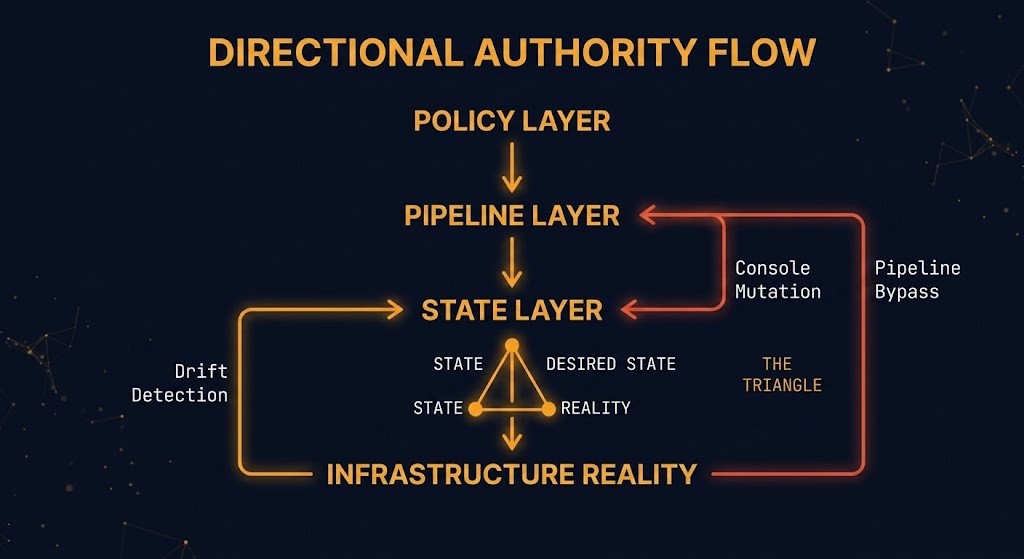
Placement: Featured image
What Terraform IaC Actually Is
Terraform operates on a declarative model: you describe the desired end state of your infrastructure in .tf files, and Terraform computes the difference between that description and the current recorded state, then executes the changes required to reconcile them. That reconciliation mechanic is Terraform’s core value. It is also the source of every significant IaC governance failure, because most teams understand the declaration side and systematically underestimate the state side.
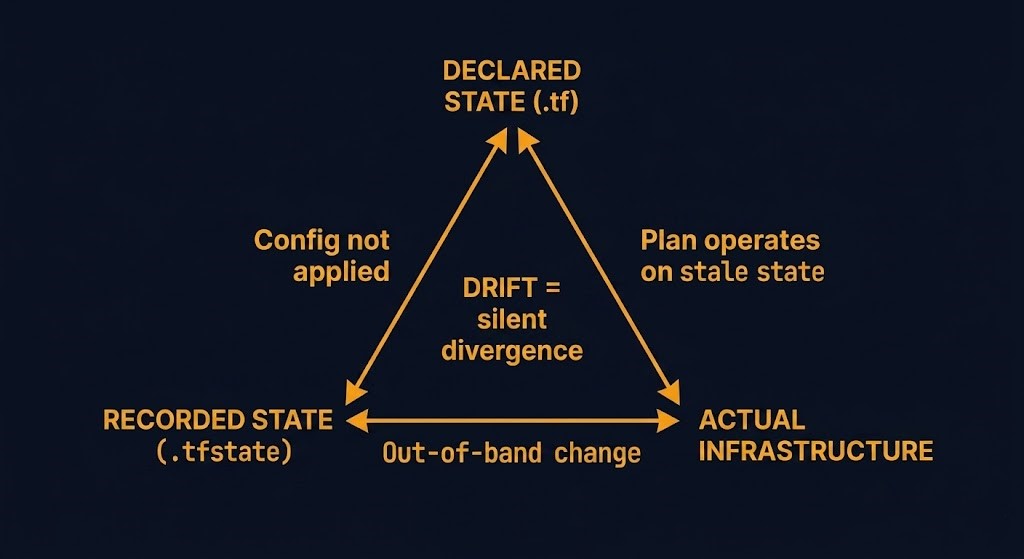
The Reconciliation Triangle is the operational mechanism at the center of every Terraform-managed environment. It has three nodes:
- Declared State — what your
.tffiles say the infrastructure should be - Recorded State — what the
.tfstatefile believes the infrastructure currently is - Actual Infrastructure — what the cloud provider, hypervisor, or platform actually has running
Drift occurs whenever one of these nodes diverges from the others without governance visibility. The most dangerous divergence is between Recorded State and Actual Infrastructure — because it is invisible to Terraform until the next plan or apply operation surfaces it. An engineer makes a change in the AWS console. The Actual Infrastructure changes. The Recorded State does not. Terraform’s next plan will either try to revert the change or, if the change modified something outside Terraform’s tracked resources, will produce no signal at all. Either way, the environment is no longer in the state the code claims to describe.
        Declared State (.tf)
               ↕
        Recorded State (.tfstate)
               ↕
        Actual Infrastructure

 Drift = silent divergence between any two nodes
The second most dangerous divergence is between Declared State and Recorded State — the state corruption failure mode. This happens when terraform apply partially fails, when state is edited manually, when workspaces are merged incorrectly, or when remote state locking fails and two concurrent applies execute simultaneously. A corrupted state file does not produce an obvious error. It produces a Terraform plan that proposes changes you didn’t intend, potentially including resource destruction.
Understanding why terraform plan is a proposal and not a preview is critical to this model. A plan is accurate to the degree that Recorded State accurately reflects Actual Infrastructure. If those two nodes have diverged, the plan is operating on a stale understanding of reality. Reviewing the plan and clicking apply does not validate it against actual infrastructure — it validates it against the state file. The enforcement gap between a reviewed plan and a safe apply is exactly where policy-as-code sits.
The IaC Control Plane Model
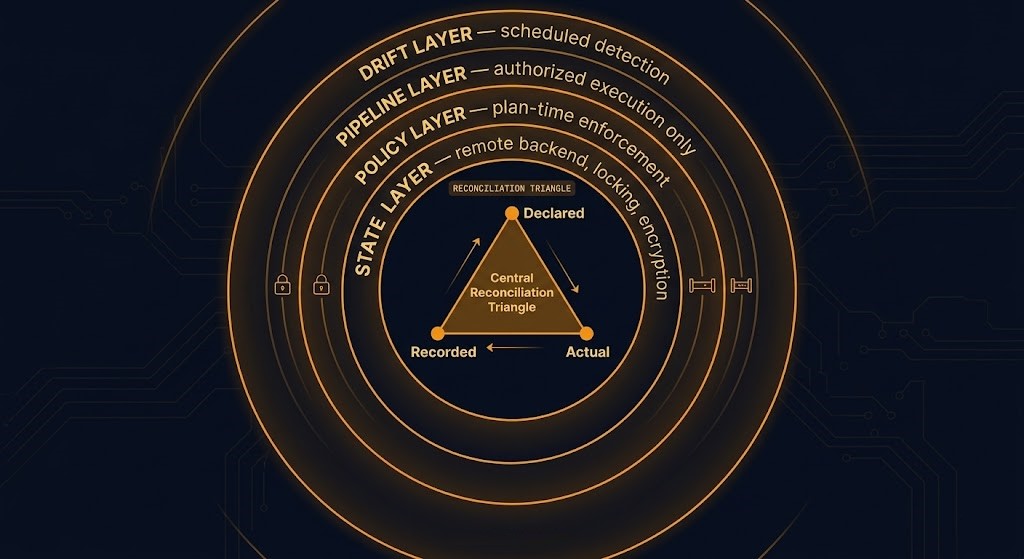
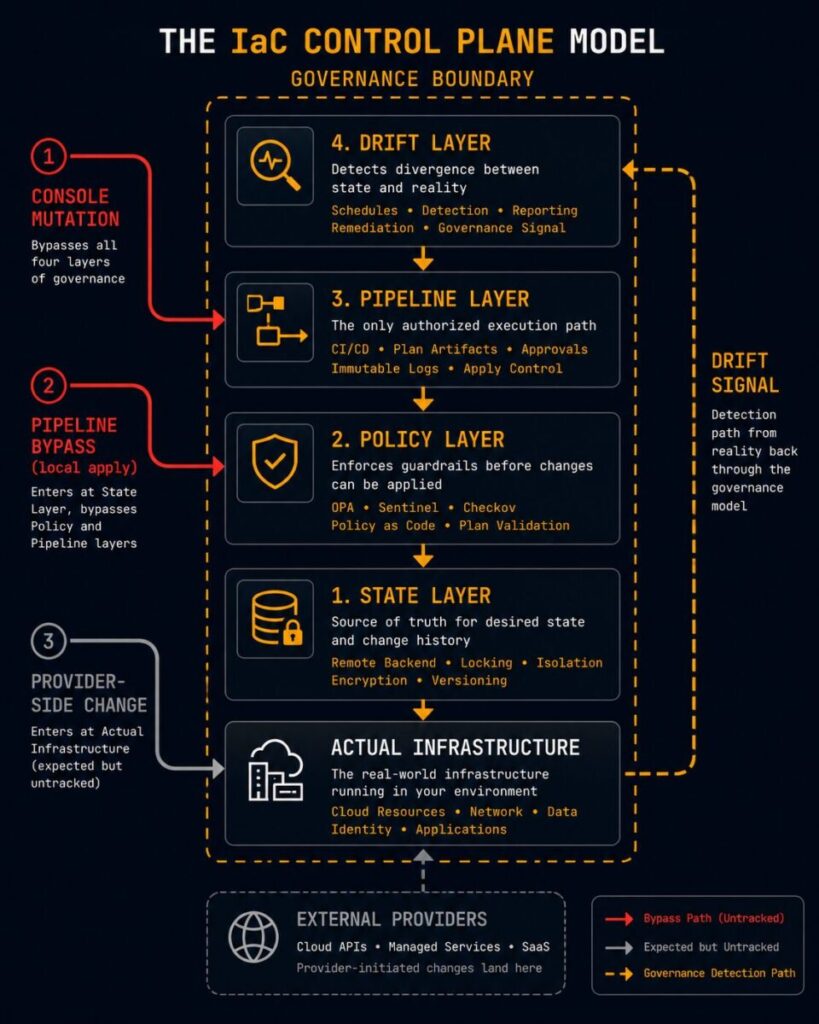
The IaC Control Plane Model is the governance architecture that keeps the Reconciliation Triangle consistent. Terraform provides the reconciliation engine. The four layers of the model provide the controls that make it safe to operate at enterprise scale.
Without these layers, Terraform is a powerful tool operated without guardrails. With them, it is a deterministic, auditable, and recoverable system for managing infrastructure state. The difference between those two things is the governance model.
THE IaC CONTROL PLANE MODEL — FOUR GOVERNANCE LAYERS
01 — STATE LAYER
Remote backend with locking, workspace isolation, state encryption, and access controls. The state file is the authority record for the Reconciliation Triangle. Without a governed state layer, nothing else in the model is reliable.
02 — POLICY LAYER
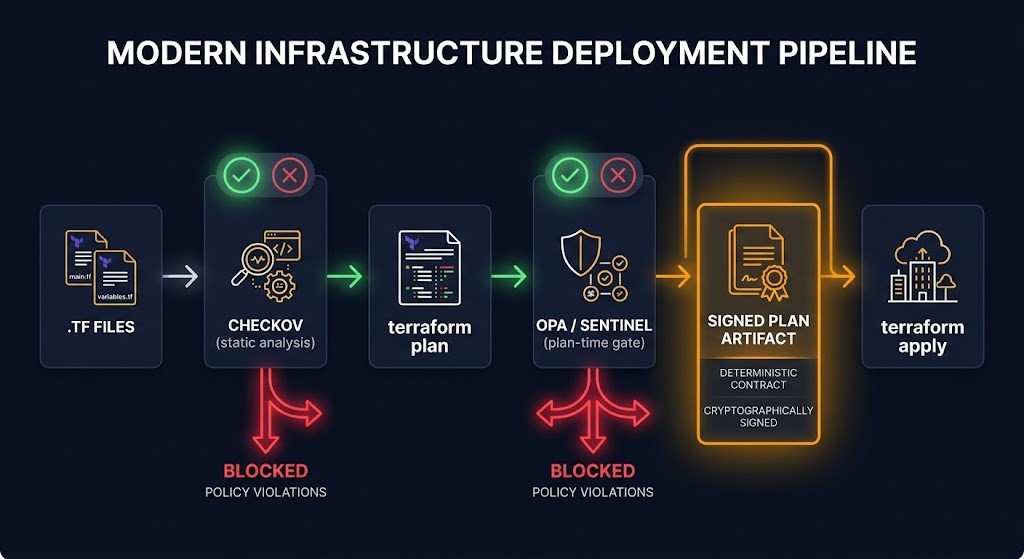
OPA, Sentinel, or Checkov enforcing policy at plan time — before apply. Signed plan artifacts create a deterministic contract between what security reviewed and what operations executes. The policy layer is what converts a human-reviewed plan into an enforced one.
03 — PIPELINE LAYER
CI/CD as the only authorized execution path for terraform apply. No manual applies. No local applies in production. Every state mutation passes through the pipeline where it is logged, policy-checked, and attributed to a specific commit and identity. The pipeline is the control plane’s enforcement boundary.
04 — DRIFT LAYER
Scheduled drift detection that diffs Recorded State against Actual Infrastructure on a cadence — not reactively after a failure. Drift remediation runbooks that define the response: revert, reconcile, or accept with documentation. Drift is a governance signal, not an ops ticket.
The four layers address the Reconciliation Triangle from different angles. The State Layer protects the Recorded State node — ensuring it is accurate, locked, and access-controlled. The Policy Layer sits between Declared State and the execution that modifies Actual Infrastructure — enforcing that only reviewed, policy-compliant changes reach the environment. The Pipeline Layer controls who and what is permitted to trigger those executions. The Drift Layer monitors the gap between Recorded State and Actual Infrastructure continuously, rather than discovering it during an incident.
The comparison below names what ad-hoc Terraform operation looks like without these layers versus what governed IaC operation looks like with them:
| Dimension | Ad-Hoc Terraform | IaC Control Plane Model |
|---|---|---|
| State storage | Local .tfstate or unmanaged remote | Remote backend with locking and encryption |
| State access | Whoever has file access | IAM-controlled, workspace-isolated |
| Plan enforcement | Human review — no machine enforcement | Policy-as-code gate before every apply |
| Execution path | Local terminal, any engineer | CI/CD pipeline only — logged and attributed |
| Drift detection | Discovered during incidents | Scheduled detection on defined cadence |
| Console changes | Invisible until next plan | Detected as drift, remediated on policy |
| Apply rollback | Manual state manipulation | State history + pipeline revert capability |
| Audit trail | terraform.log if someone remembered | CI/CD log + policy artifact + state history |
Terraform vs OpenTofu — The Control Plane Decision
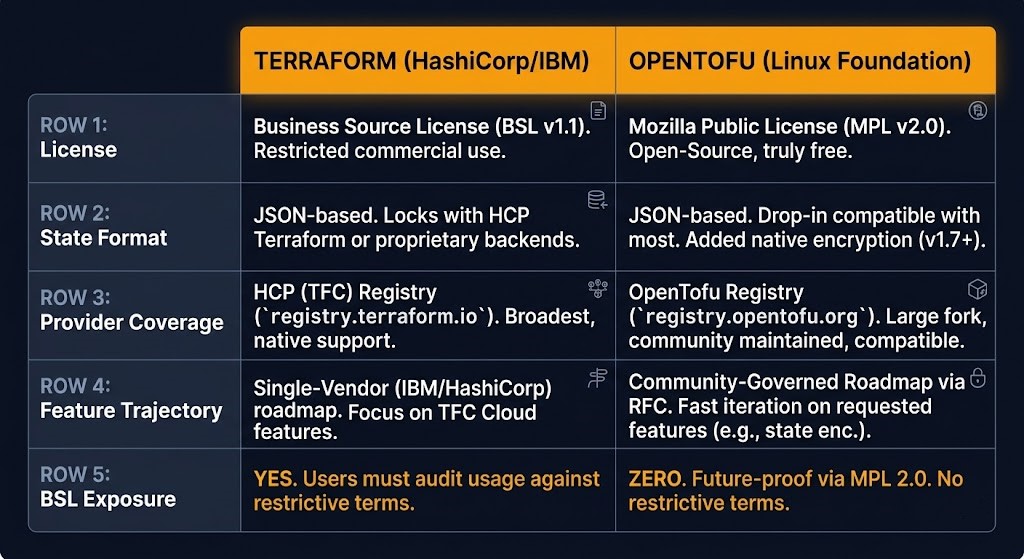
The Terraform BSL change in August 2023 was widely covered as a licensing story. Architecturally, it is a control plane story. When HashiCorp moved Terraform from Mozilla Public License 2.0 to the Business Source License, it changed the terms under which the tool could be used to build products or services that compete with HashiCorp. The OpenTofu fork — launched by the Linux Foundation in response — created a genuine architectural fork in the IaC control plane that every enterprise using Terraform must now resolve explicitly.
The decision between Terraform and OpenTofu is not primarily about features. Both tools currently share the same core codebase. The decision is about governance: provider ecosystem trajectory, enterprise support model, feature lag as divergence compounds over time, and the degree to which your IaC control plane is coupled to a single vendor’s roadmap decisions.
| Dimension | Terraform (HashiCorp/IBM) | OpenTofu (Linux Foundation) |
|---|---|---|
| License | BSL 1.1 — use restrictions for competing products | MPL 2.0 — fully open source |
| State format | HCL state — current standard | Compatible with Terraform state — same format |
| Provider ecosystem | Registry.terraform.io — widest current coverage | OpenTofu registry — growing, most major providers covered |
| Feature trajectory | HashiCorp/IBM roadmap | Community-governed, Linux Foundation stewardship |
| Enterprise support | Terraform Cloud / Enterprise — mature, commercial | OpenTofu Cloud (emerging) + third-party tooling |
| Feature lag | N/A — source | Potential lag as codebases diverge over time |
| Migration path | N/A — source | State-compatible migration — tofu CLI drop-in |
| BSL exposure | Present for competing product use cases | None — MPL 2.0 |
The migration from Terraform to OpenTofu is not a license change with a CLI swap. It is a control plane migration. Every provider in your estate must be audited for OpenTofu compatibility. Every module must be reviewed for BSL-sensitive constructs. Every workspace must be migrated with state integrity verification. The state format compatibility is genuine — but the operational sequencing of the migration matters significantly. The Project Phoenix enterprise migration field manual documents this sequencing in full.
For teams evaluating the decision right now: the Terraform vs OpenTofu 2026 post-BSL decision covers the current divergence state and what it means architecturally. The OpenTofu Readiness Bridge tool scopes compatibility between your existing Terraform codebase and OpenTofu before you commit to migration. The Terraform Feature Lag Tracker visualizes the gap between cloud provider API releases and Terraform/OpenTofu provider support — the dimension most likely to create operational pain as the codebases diverge.
State Management at Enterprise Scale
The state file is not a log. It is not a record of what happened. It is the current authoritative record of what Terraform believes the infrastructure is — and Terraform’s behavior on every subsequent plan and apply operation is entirely determined by that belief. A state file that diverges from actual infrastructure is not a minor inconsistency. It is a corrupted source of authority that will produce incorrect plans until it is reconciled.
Remote backend selection is the first governance decision and the one with the widest blast radius if deferred. Local state is not a valid option for any production environment — not because the file is hard to manage, but because local state eliminates locking, eliminates shared access controls, and eliminates the version history required for recovery operations. The three primary remote backend options for enterprise environments are:
- S3 + DynamoDB (AWS) — object storage for state with DynamoDB for distributed locking. Mature, well-understood, operationally simple. Locking is pessimistic — a lock is held for the duration of the apply. If the apply process dies mid-execution, the lock may need manual release.
- Terraform Cloud / Enterprise — HashiCorp’s managed state backend with integrated run management, policy enforcement via Sentinel, and team access controls. The BSL decision affects this service directly — teams concerned about vendor lock-in on the control plane should model this dependency explicitly.
- OpenTofu-compatible backends — Terraform Cloud alternatives including Scalr, Spacelift, and self-hosted OpenTofu with S3/GCS backends. All support the same state format.
Workspace strategy is the blast radius decision. A workspace is a separate state file with its own resource inventory. The wrong workspace strategy — too coarse or too fine — produces either excessive blast radius per change or unmanageable operational overhead. Three patterns:
- Per-environment — one workspace per deployment environment (dev/staging/prod). Simple. Blast radius of a failed apply is limited to the environment. Works until the environment grows large enough that a single state file becomes a bottleneck.
- Per-service — one workspace per logical service or application stack. Blast radius is bounded to the service. Operational overhead grows with the number of services. Remote state data sources become the mechanism for sharing outputs between stacks.
- Per-team — one workspace per owning team. Reflects org structure rather than architectural boundaries. Tends to produce ownership fragmentation where teams can independently make changes that affect shared infrastructure.
State locking prevents concurrent applies from corrupting the state file. The concurrent apply failure mode — two engineers or two pipeline runs executing terraform apply simultaneously against the same state — produces one of the most expensive recovery operations in IaC operations. The first apply reads state, computes a plan, and begins modifying resources. The second apply reads the same pre-modification state, computes a different plan against that stale baseline, and begins making conflicting changes. The result is infrastructure that neither plan fully describes, in a state that neither apply expects. Locking is non-negotiable in production environments.
State encryption covers the at-rest contents of the state file. State files frequently contain sensitive values — database passwords, API keys, certificate private keys — written to state by resource providers and not automatically redacted. An unencrypted state file in a shared storage location is a credential exposure event waiting for the right access misconfiguration. Terraform’s native state encryption (introduced in 1.7) and backend-level encryption (S3 SSE-KMS) both address this, but neither prevents the underlying issue: sensitive values should not be in state at all. The correct architecture uses Vault or SSM Parameter Store references rather than inline sensitive values in resource configurations.
Policy as Code — The Enforcement Layer Between Plan and Apply
Human review of terraform plan output is not policy enforcement. A reviewed plan that is manually approved before apply is a best-effort governance control — it catches what the reviewer notices, under the conditions present at review time. It does not scale. It does not produce a signed artifact that proves what was reviewed. It does not fail the apply if a policy-violating change appears in the plan. It is a process, not a control.
Policy-as-code is the architectural replacement for that process. The three primary tools operate at different layers of the enforcement stack:
Checkov is a static analysis tool that scans Terraform configuration files before plan — catching security misconfigurations, compliance violations, and policy deviations at the code level. Checkov runs against .tf files and terraform plan JSON output. It is the earliest enforcement point in the pipeline and the cheapest to fail — catching a violation before plan is significantly less disruptive than catching it after a partial apply.
OPA (Open Policy Agent) is a general-purpose policy engine that evaluates Terraform plan JSON against rego policies you define. OPA operates on the plan output — after terraform plan but before terraform apply. Policies can enforce arbitrary conditions: no resources in unapproved regions, all S3 buckets must have encryption enabled, no security group rules permitting 0.0.0.0/0 inbound on port 22. OPA is tool-agnostic — the same policy engine that governs Terraform plans can govern Kubernetes admission, API gateway decisions, and application authorization logic.
Sentinel is HashiCorp’s commercial policy framework — tightly integrated with Terraform Cloud and Enterprise. It provides the same plan-time enforcement as OPA but with native integration into the Terraform Cloud run workflow. Sentinel policies are first-class citizens in the Terraform Cloud execution model. For teams on Terraform Cloud/Enterprise, Sentinel is the most operationally integrated option. For teams on open tooling or OpenTofu, OPA is the independent equivalent.
Signed plan artifacts are the mechanism that converts policy review into a verifiable contract. After a plan passes all policy gates, it is signed and stored as an immutable artifact. The apply step is permitted only against the signed plan artifact — not against a freshly regenerated plan. This prevents the failure mode where a plan passes policy review at time T, circumstances change between T and T+30 minutes, and an apply at T+30 executes against different actual infrastructure than the plan assumed. The deterministic IaC pipelines post covers this pattern in full — including the specific pipeline architecture required to make signed plan artifacts operationally viable rather than aspirational.
The Shadow Control Plane
Terraform says one thing. The AWS console says another. Nobody knows which is authoritative.
That is not a drift problem. It is a control plane authority problem — and it is the most common unacknowledged failure mode in enterprise IaC estates. The shadow control plane is every mechanism through which infrastructure state gets modified outside the IaC Control Plane Model. It does not announce itself. It accumulates.
The operational debt that accumulates from shadow control plane activity — untracked console changes, pipeline bypasses, module version drift — doesn’t disappear after detection. It transfers directly into the Day 2 operations layer, where it surfaces as configuration state you didn’t provision and can’t fully govern through Terraform alone. The Day 2 Operations Debt You Inherited From Terraform maps the specific debt categories that accumulate in the shadow control plane gap and how they compound over time.
The three vectors through which the shadow control plane operates:
Console access as a mutation path. Every action taken in the AWS console, Azure portal, or GCP console that modifies a resource managed by Terraform is an undocumented state mutation. It modifies Actual Infrastructure without modifying Declared State or Recorded State. The Reconciliation Triangle’s two lower nodes have diverged. Terraform does not know this until the next plan, at which point it either proposes to revert the change (if the change affected a Terraform-tracked attribute) or produces no signal at all (if the change affected something outside Terraform’s resource model). Console access is not the problem. Console access as the execution path for production infrastructure changes is the problem.
Manual terraform apply outside the pipeline. An engineer with credentials and access to the state backend runs terraform apply from their local terminal. The apply succeeds. The change is not in version control. The plan was not policy-checked. The apply is not logged in the CI/CD audit trail. The change is in state, in Actual Infrastructure, and effectively invisible to the governance model. This is the Pipeline Bypass failure mode — covered in the Failure Modes section below — and it is the most common way that policy enforcement is defeated in environments where the policy layer exists but the pipeline layer does not.
Provider-side changes. Cloud providers make changes to resource configurations that Terraform does not track. Auto-scaling events, managed service patches, provider-side security group modifications, certificate rotations. These changes modify Actual Infrastructure without any action in the IaC layer. Some are expected and intentional. All of them represent a potential divergence between Recorded State and Actual Infrastructure that the Drift Layer exists to detect.
The shadow control plane cannot be eliminated entirely. Console access will always exist for emergency operations. Provider-side changes are inherent to managed services. What can be eliminated is the undetected shadow control plane — the changes that accumulate without generating a governance signal. The CI/CD control plane post establishes the pipeline authority model that makes the Pipeline Layer operational. The upcoming Shadow Control Plane post (May 19 — pending) covers this in full as part of the Authority Layer series.
Drift — The Governance Signal
Drift is the symptom. The shadow control plane is the cause. The distinction matters because teams that treat drift as an operational annoyance — something to clean up during quarterly maintenance — are misunderstanding what drift is telling them about the health of their governance model.
Every instance of drift is evidence that the Reconciliation Triangle has a node divergence that the IaC Control Plane Model did not catch. It is a governance failure signal, not a routine infrastructure variance. The DORA 2023 State of DevOps research finding — 2.3× higher change failure rate in teams with frequent drift versus teams maintaining IaC hygiene — reflects exactly this: drift accumulates complexity, and complexity under change produces failures.
Scheduled drift detection is the operational model that makes drift a governance signal rather than a discovery. A scheduled CI/CD job runs terraform plan against each workspace on a defined cadence — daily for production, more frequently for environments with high change velocity. The plan output is compared against the expected state. Any proposed changes that were not initiated through the pipeline are drift candidates. This is not reactive diagnosis. It is continuous state verification.
Drift remediation has three valid responses:
- Revert — apply the Terraform plan to bring Actual Infrastructure back into alignment with Declared State. Appropriate when the console change or out-of-band modification was unintended, unauthorized, or untested. The default posture for unattributed changes.
- Reconcile — update Declared State to reflect the change, bringing the code into alignment with Actual Infrastructure. Appropriate when the out-of-band change was intentional, valid, and should be preserved — but was made without going through the pipeline. Requires code review and merge before the state is considered governed.
- Accept with documentation — explicitly acknowledge the divergence, document why it is acceptable, and record the decision. Appropriate for provider-managed changes outside Terraform’s control scope — certificate rotations, managed service patches. Creates a documented exception rather than an untracked variance.
The IaC drift detection post (May 16 — pending) covers the specific pipeline architecture for scheduled drift detection. The Sovereign Drift Auditor tool quantifies unmanaged drift across your terraform plan output and audits for unencrypted storage or non-sovereign configurations. The configuration drift immutability post covers the cross-infrastructure treatment of drift governance.
Failure Modes — Where IaC Governance Breaks
IaC failures in production follow predictable patterns. The seven below represent the failure modes observed most consistently across enterprise Terraform estates — each traceable to a specific gap in the IaC Control Plane Model.
When to Use Terraform vs When Not To
Terraform is not the answer to every infrastructure management problem. The IaC Control Plane Model is expensive to build and operate correctly — it requires pipeline investment, policy engineering, state governance, and ongoing drift management. That investment is justified when the infrastructure complexity, compliance requirements, and change frequency warrant it. It is not always justified.
| Scenario | Terraform Fit | Alternative to Consider |
|---|---|---|
| Multi-cloud, multi-region infrastructure at scale | Strong — provider-agnostic state model handles heterogeneous estates | — |
| Single-cloud environment heavily invested in cloud-native tooling | Moderate — CloudFormation (AWS) or Bicep (Azure) have tighter native integration | CloudFormation, Bicep, Pulumi |
| Application-layer configuration management | Weak — Terraform provisions infrastructure, not application configuration | Ansible, Chef, Puppet |
| Kubernetes resource management | Moderate — Terraform can manage K8s resources but Helm and Crossplane are more idiomatic | Helm, Kustomize, Crossplane |
| Rapid prototyping and experimentation | Weak for governance overhead — not worth full pipeline investment | Direct console, Pulumi, CDK |
| Compliance-driven environments with audit requirements | Strong — state history, pipeline attribution, and policy-as-code produce auditable records | — |
| Small team, simple environment, low change frequency | Moderate — governance overhead may exceed value for very small estates | Pulumi, CDK, cloud-native IaC |
Day-0 vs Day-2. Terraform excels at Day-0 provisioning: declarative resource creation, dependency resolution, provider abstraction. It is meaningfully weaker at Day-2 mutation — ongoing configuration changes to running resources, in-place upgrades of stateful services, and lifecycle management of resources with complex dependency graphs. The Ansible & Day 2 Ops Logic sub-page (pending ~Jun) covers the specific boundary between Terraform’s provisioning authority and Ansible’s configuration management authority — the two tools are complementary, not competing.
The OpenTofu fork changes the calculus for BSL-sensitive industries. Financial services, healthcare, and government organizations subject to specific open-source licensing requirements now have a compliance reason — not just an architectural preference — for evaluating OpenTofu over Terraform. The OpenTofu enterprise adoption post covers the governance model transition in full.
The IaC Control Plane Model does not govern infrastructure in isolation. The compute it provisions, the network it must model to enforce policy, and the Day-2 operations layer that follows provisioning all depend on the same governance discipline. The pages below cover each adjacent layer.
YOU’VE READ THE MODEL.
NOW VALIDATE WHETHER YOUR ENVIRONMENT HOLDS.
Most IaC estates have Terraform. Far fewer have the governance model wrapped around it. A vendor-agnostic IaC architecture review maps your current state against the IaC Control Plane Model and surfaces where the State, Policy, Pipeline, and Drift layers are absent, partial, or bypassed — before an incident does it for you.
IaC Architecture Review
A vendor-agnostic review of your IaC estate against the IaC Control Plane Model — state backend architecture, policy enforcement gaps, pipeline authority, drift posture, and shadow control plane exposure. Whether you’re on Terraform, OpenTofu, or evaluating the fork, the review surfaces where the governance model holds and where it doesn’t.
- > State backend architecture and locking review
- > Pipeline authority and bypass exposure audit
- > Drift posture and shadow control plane assessment
- > BSL/OpenTofu compliance posture review
Architecture Playbooks. Every Week.
Field-tested IaC governance blueprints — state corruption recovery, pipeline bypass incidents, drift remediation patterns, and the OpenTofu migration scenarios that surface governance gaps teams didn’t know they had.
- > IaC state governance and drift patterns
- > Policy-as-code enforcement architecture
- > OpenTofu migration and control plane decisions
- > Shadow control plane detection and response
Zero spam. Unsubscribe anytime.
Architect’s Verdict
Terraform is not the control plane. It is the declaration engine — and that distinction is the most important architectural clarification an IaC practitioner can make. The governance failure that surfaces in enterprise IaC estates is not caused by Terraform’s limitations. It is caused by the belief that Terraform’s existence constitutes governance. It does not. Governance is the model you build around the tool.
The IaC Control Plane Model — State, Policy, Pipeline, Drift — is the governance architecture that transforms Terraform from a powerful provisioning tool into a deterministic, auditable, and recoverable infrastructure system. The Reconciliation Triangle is the operational mechanism that makes the model’s purpose concrete: declared state, recorded state, and actual infrastructure must remain consistent, and the four governance layers exist specifically to maintain that consistency under operational pressure.
The shadow control plane is the most significant ongoing threat to that consistency. Console access, pipeline bypasses, and provider-side changes are not edge cases — they are the operational norm in enterprise environments. The organizations that maintain IaC hygiene at scale are not the ones that eliminated all out-of-band changes. They are the ones that built detection and response into their governance model, so every divergence generates a signal rather than accumulating silently into a debt that surfaces during an incident.
The BSL decision was a forcing function that ended the era of passive IaC governance. It required every enterprise to make an explicit architectural choice about who owns the IaC control plane, what tooling it runs on, and what governance model surrounds it. That decision is now a first-class architectural decision — as consequential as the choice of cloud provider or container runtime — and it deserves to be treated as one.
The infrastructure that fails during an incident is rarely the infrastructure you declared. It is the infrastructure your control plane actually allowed to exist.
Frequently Asked Questions
Q1: What is the difference between Terraform state and Terraform configuration?
A: Terraform configuration (.tf files) describes the desired end state — what you want the infrastructure to be. Terraform state (.tfstate) is the recorded current state — what Terraform believes the infrastructure is right now. The two are not the same document, and they can diverge. Configuration is what you write. State is what Terraform maintains as its authority record for computing subsequent plans. The gap between them — and the gap between recorded state and actual infrastructure — is where IaC governance failures originate.
Q2: Why isn’t Terraform itself an infrastructure control plane?
A: Because Terraform provides reconciliation capability without governance controls. It can compute the difference between desired and recorded state and execute the changes required to close that gap. What it does not provide: enforcement of who is permitted to execute applies, policy gates between plan and apply, detection of out-of-band state mutations, or any mechanism to prevent the Reconciliation Triangle from diverging without visibility. Those controls — the State, Policy, Pipeline, and Drift layers — are the governance model you build around Terraform. Without them, Terraform is a reconciliation engine operated without guardrails.
Q3: Should I use Terraform Cloud, Terraform Enterprise, or self-managed remote state?
A: It depends on whether you need managed execution or managed state only. Terraform Cloud and Enterprise provide both: managed state backend, integrated policy enforcement via Sentinel, team access controls, and a run management layer. Self-managed remote state (S3 + DynamoDB, GCS) provides the state backend only — you build the execution and policy layers separately. The BSL consideration: Terraform Cloud/Enterprise is a HashiCorp commercial product under BSL terms. Organizations with BSL compliance concerns should evaluate OpenTofu-compatible alternatives including Spacelift and Scalr before committing to the Terraform Cloud execution model.
Q4: Is OpenTofu a drop-in replacement for Terraform in 2026?
A: For most workloads, yes — with caveats. The state format is compatible. The HCL syntax is compatible. The provider ecosystem covers most major cloud providers. The caveats: some newer Terraform features (post-fork) are not yet in OpenTofu, some providers may lag on OpenTofu certification, and the migration from Terraform to OpenTofu requires a controlled state migration process — not just a CLI swap. The OpenTofu Readiness Bridge scopes your specific codebase compatibility before you commit to the migration path.
Q5: What is policy as code and do I need it before I
A: Policy as code is the enforcement layer between terraform plan and terraform apply — automated checks that verify the planned changes conform to defined security, compliance, and operational requirements before execution. You don’t need it to use Terraform in production. You need it to use Terraform in production with governance. The distinction matters at scale and under compliance requirements. Without policy-as-code, plan approval is a manual process that doesn’t scale, doesn’t produce auditable artifacts, and can’t catch all policy violations consistently. With it, plan enforcement is deterministic, auditable, and automated.
Q6: How do I prevent configuration drift in a Terraform-managed environment?
A: You can’t prevent it entirely — provider-side changes, emergency console access, and out-of-band operations are operational realities. What you can do is detect it continuously and respond to it with defined remediation paths. Scheduled drift detection via CI/CD pipeline — running terraform plan on a cadence and alerting on unexpected proposed changes — turns drift from a discovery event during incidents into a continuous governance signal. Pipeline-only applies reduce the primary drift injection vector. The Sovereign Drift Auditor tool surfaces current drift state across your Terraform estate.
Q7: What happens to Terraform state during a failed apply?
A: It depends on where the failure occurred and what Terraform had already modified. Terraform applies are not atomic — they execute resource changes sequentially, and a failure mid-apply leaves the environment in a partially modified state. Resources that were successfully created or modified before the failure exist in both the state file and actual infrastructure. Resources that were not yet processed are unchanged. Resources that failed during modification may be in a degraded state. Recovery requires identifying which resources are in the expected state, which have been partially modified, and then either re-running the apply (if idempotent) or manually correcting state to reflect reality before attempting again. This is why state backups before high-risk operations and remote state with version history are not optional governance controls.