

STRATEGIC RESILIENCE
What survives when authority disappears? — The Resilient Stage of Cloud Strategy
MATURITY POSITION — CLOUD ARCHITECTURE STAGE 07 OF 07
- Current Stage: Strategic Resilience — Maturity Stage 07 of 07 (final stage)
- Primary Architectural Concern: Whether the architecture continues operating when the authority that governs it — a cloud provider control plane, an identity provider, a platform team, a vendor relationship — becomes unavailable, not whether that authority was well-governed while it existed
- Primary Failure Mode: Authority Collapse Event — the condition where the entities responsible for governing, executing, or providing authority become unavailable, leaving the architecture dependent on authority that no longer exists
- Stage Outcome: Ability to place the Authority Survivability Boundary; ability to distinguish authority that is governed from authority that is survivable; ability to identify authority dependencies before an Authority Collapse Event surfaces them
- Previous Stage: CS6 — Strategic Governance — Who governs authority?
- Next Stage: None — this is the final stage of the Cloud Architecture Learning Path. See the completed path below.
Strategic resilience is the discipline of confirming whether an architecture continues operating when the authority that governs it — defined at CS4, confirmed to execute at CS5, and evaluated for legitimacy at CS6 — becomes unavailable. The question this stage answers is not whether authority is well-governed. CS6 answered that. The question is whether the architecture depends on that authority remaining available at all. Strategic resilience is not the absence of failure. It is the absence of dependency on a single entity continuing to function.
The first six stages of this path build a progressively complete authority model. CS1 through CS3 establish what the architecture is dependent on, what controls its movement, and what determines its economics. CS4 identifies where authority resides. CS5 confirms that authority reaches the execution plane. CS6 evaluates whether the governance structures claiming ownership of that authority can actually exercise it — audit it, challenge it, delegate it, revoke it. Every one of those stages assumes the authority in question remains available to be identified, executed, or governed. Strategic Resilience is where that assumption is tested. Cloud architectures rarely fail because authority is poorly governed. They fail because authority itself becomes unavailable.
WHY THIS STAGE EXISTS — AUTHORITY AS A DEPENDENCY
Cloud architectures rarely fail because authority is poorly governed. They fail because authority itself becomes unavailable.
CS4 identified where authority resides. CS5 confirmed it reaches the execution plane. CS6 evaluated whether the governance structures claiming ownership of that authority can exercise it. Strategic Resilience asks the question none of those stages can answer: what happens when the authority itself — the provider, the identity system, the platform team, the vendor relationship — disappears? A governance structure that has never been confirmed to function cannot be expected to survive the loss of the authority it governs.
Stage Anchor Question
What survives when authority disappears?
Architectures are not made resilient by the legitimacy of the authority that governs them. They are made resilient by their ability to continue operating after that authority — legitimate or not — becomes unavailable. The gap between governed authority and survivable authority is where Authority Collapse Events originate.
How Strategic Resilience Anchors the Full Path
| Stage | Name | Question |
|---|---|---|
| 01 | Dependency Architecture | What do you depend on? |
| 02 | Movement Architecture | What can move? |
| 03 | Economic Architecture | What drives cost? |
| 04 | Control Plane Architecture | Who actually holds authority? |
| 05 | Operational Architecture | How does authority become action? |
| 06 | Strategic Governance | Who governs authority? |
| 07 | Strategic Resilience | What survives when authority disappears? |
The first three stages establish what the architecture depends on, what controls its movement, and what determines its economics. CS4 through CS6 build a progressively complete authority model — where it resides, whether it executes, whether it is legitimately governed. Strategic Resilience asks the question that completes the arc: does the architecture survive when the authority itself disappears? This is the only stage in the path concerned with the absence of authority rather than its presence.
Stage Anchor Framework — Strategic Resilience
Authority Survivability Boundary (#156)
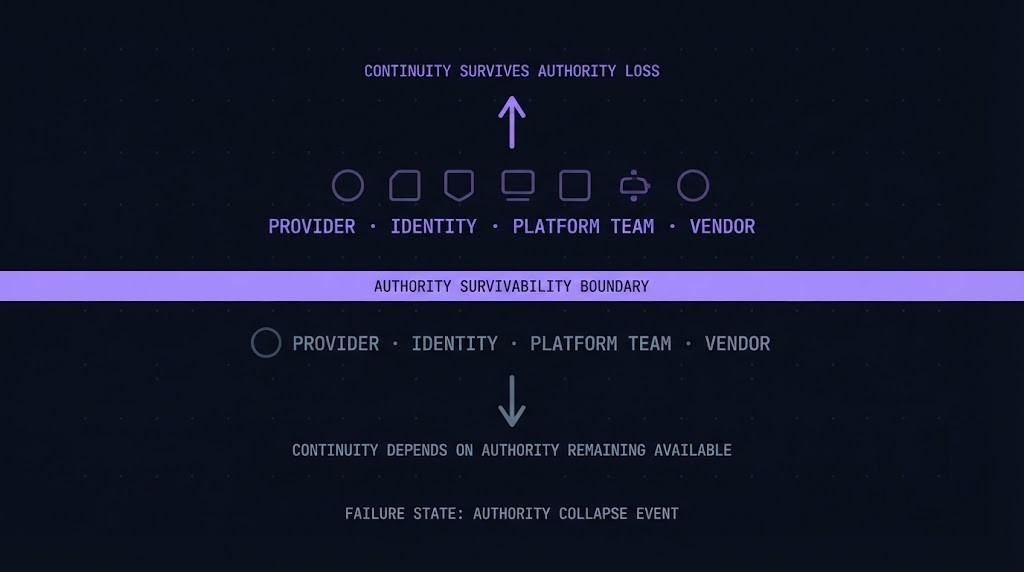
The point at which an architecture can continue operating after the authority responsible for governing, executing, or controlling it becomes unavailable. Below the boundary: architectural continuity depends on the continued availability of a governing authority — a cloud provider control plane, an identity provider, a platform team, a vendor relationship. Above it: the architecture survives even when that authority disappears — continuity does not depend on the entity that previously granted, executed, or governed it remaining available.
Named Failure State: Authority Collapse Event — a condition in which the entities responsible for governing, executing, or providing authority become unavailable, leaving the architecture dependent on authority that no longer exists. Distinct from CS4’s Authority-Fragmented Architecture, CS5’s Authority Without Execution, and CS6’s Governance Theater — Authority Collapse Event occurs when authority that was clearly identified, did execute, and was legitimately governed simply ceases to exist.
>_ What This Stage Is Not
Not business continuity planning. Business continuity planning addresses operational disruption broadly — facilities, staffing, communications. Strategic Resilience addresses a narrower architectural question: does the system continue operating when the authority that governs it disappears? A BC plan can be complete while the architecture it covers has never been tested against authority loss.
Not disaster recovery architecture. Disaster recovery — backup integrity, restore design, recovery time objectives — belongs to the Data Protection pillar. Strategic Resilience is upstream of recovery: it asks whether the authority required to execute a recovery plan is itself available when the plan needs to run. A recovery plan that depends on an identity provider that has also failed is not a resilience gap DR can close.
Not CS6 governance architecture, extended. CS6 evaluates whether authority is organizationally legitimate — auditable, challengeable, delegable, revocable — under normal operating conditions. Strategic Resilience is not a continuation of that question. Governance failure is one possible cause of an Authority Collapse Event, not the definition of one. A provider control-plane outage, a sovereignty violation, a platform-team dissolution, and a vendor abandonment are all Authority Collapse Events with no governance failure involved at all.
Not platform operations. CS5 verifies that authority reaches the execution plane under normal conditions — schedulers, pipelines, autoscalers acting as intended. Strategic Resilience asks what happens to that execution plane when the platform team operating it, or the provider hosting it, is no longer available. Operating a platform well is a CS5 concern. Surviving the platform’s operator disappearing is a CS7 concern.
| Section | Estimated Time |
|---|---|
| Cluster 01 — Authority Dependency Discovery | ~50 min |
| Cluster 02 — Identity Survivability | ~45 min |
| Cluster 03 — Control Plane Survivability | ~50 min |
| Cluster 04 — Cross-Cloud Survivability | ~35 min |
| Cluster 05 — Resilience Diagnostics | ~20 min |
| Architectural Practice + Completing the Path | ~20 min |
>_ Where to Enter This Stage
This stage is the correct entry point if CS6 has confirmed your governance structures are organizationally legitimate, but the architecture has never been tested against the loss of the authority those structures govern. Specifically, enter here if:
- Authority has been confirmed legitimate at CS6, but no one has mapped what breaks if the identity provider, cloud provider, or platform team became unavailable tomorrow
- A vendor relationship critical to the architecture’s authority model is ending, or an acquisition or reorganization is pending that will eliminate or replace a governing entity
- A provider control-plane outage, identity provider compromise, or sovereignty event elsewhere in the industry has prompted the question: could this architecture survive the same event?
- Redundancy has been built into the architecture, but it has never been tested specifically against the loss of the authority that governs the redundant systems — failover within one authority model is not survival of that model’s loss
- The architecture spans multiple cloud providers, platforms, or organizational domains, and ownership of a given authority decision cannot be cleanly attributed to one of them
- CS6 produced a verified governance map — Strategic Resilience is the next question: does the architecture survive if the governed authority itself stops existing?
Do not enter this stage expecting a disaster recovery runbook or a business continuity template. Those are addressed elsewhere. Strategic Resilience answers one question: does the architecture depend on authority that might not always be there? The answer is the final output of the Cloud Strategy path.
>_ Architecture Maturity Position
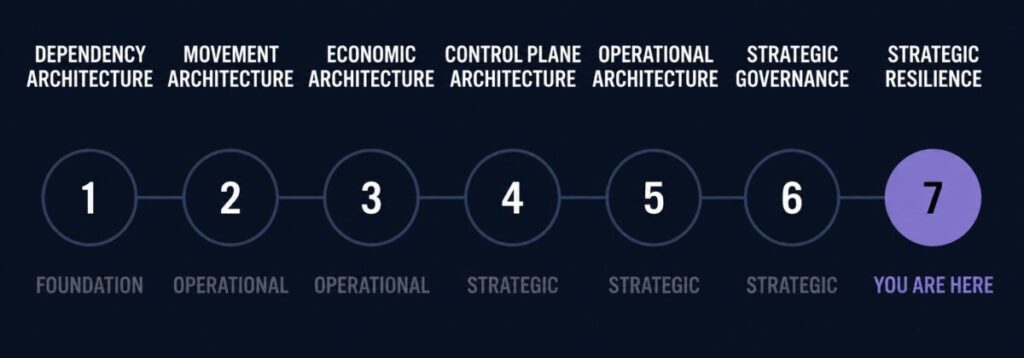
| Stage | Name | Maturity Level | Stage Question |
|---|---|---|---|
| CS1 | Dependency Architecture | Foundation | What do you depend on? |
| CS2 | Movement Architecture | Operational | What can move? |
| CS3 | Economic Architecture | Operational | What drives cost? |
| CS4 | Control Plane Architecture | Strategic | Who actually holds authority? |
| CS5 | Operational Architecture | Strategic | How does authority become action? |
| CS6 | Strategic Governance | Strategic | Who governs authority? |
| CS7 ← YOU ARE HERE | Strategic Resilience | Resilient | What survives when authority disappears? |
>_ Where This Stage Sits
The Cloud Architecture Path Is a Dependency-Progression Model
| Stage | Architectural Question |
|---|---|
| CS1 — Dependency Architecture | What do you depend on? |
| CS2 — Movement Architecture | What can move? |
| CS3 — Economic Architecture | What drives cost? |
| CS4 — Control Plane Architecture | Who actually holds authority? |
| CS5 — Operational Architecture | How does authority become action? |
| CS6 — Strategic Governance | Who governs authority? |
| CS7 — Strategic Resilience | What survives when authority disappears? |
The first three stages establish what exists, what it costs to move, and what those costs structure. The final four test authority: where it resides, whether it executes, who governs it, and whether it survives. CS6 confirmed that authority is legitimate. CS7 determines whether legitimate authority is still a dependency. Strategic resilience is not the existence of authority. It is the architecture’s ability to continue operating without it.
>_ Stage Reading Sequence
AUTHORITY SURVIVABILITY BEGINS HERE
Strategic Resilience reads the architecture for evidence of whether it depends on authority remaining available. The sequence moves from identifying hidden authority dependencies, through the two surfaces where authority loss is most consequential — identity and the control plane — to cross-cloud ownership questions, and concludes with diagnostics: how to measure survivability before an Authority Collapse Event does it for you. Each cluster answers: what becomes architecturally unstable if this authority disappeared tomorrow?
Note: the identity articles in Cluster 02 also appear on the CS6 stage page. CS6 reads them through the legitimacy lens — who governs identity, and can that governance be audited and revoked. CS7 reads the same articles through the survivability lens — does identity, and the authority delegation it carries, survive if the identity provider itself becomes unavailable. Same articles, different architectural question — consistent with how CS6 treats cross-pillar material it references without redefining.
Architectural question: What authority does the architecture still depend on?
What authority does the architecture still depend on?
Resilience begins with dependency visibility — an architecture cannot survive the loss of an authority it has never explicitly mapped itself as depending on. This is the anchor cluster: it introduces Framework #156 Authority Survivability Boundary and surfaces the hidden authority dependencies — provider, governance, identity, control plane — that the rest of the stage tests for survivability. The three articles here move from a specific, recent case (a completed VMware exit, tested by its first real incident) to a general principle (the cloud provider as a single point of failure) to a common misconception (multi-region deployment mistaken for high availability). Each demonstrates the same pattern: authority that executed correctly and was governed legitimately, until the moment its continued availability could no longer be assumed.
Architectural question: Can authority survive identity failure?
Can authority survive identity failure?
Identity is where most architects first discover the distinction between governed authority and survivable authority. CS6 asked who governs identity — whether the governance structures over the identity layer can audit, challenge, delegate, and revoke. Strategic Resilience asks a different question of the same surface: does authority delegation survive if the identity provider itself becomes unavailable? An identity system can be governed with full legitimacy and still represent the architecture’s single largest survivability dependency, because every other authority claim in the environment is authenticated through it.
Architectural question: Can decisions still be made when control planes fail?
Can decisions still be made when control planes fail?
This cluster is a direct bridge back to CS4. CS4 identified where authority resides — which systems can authorize, deny, enforce, or override architectural decisions. Strategic Resilience asks whether authority can survive losing those systems. The three articles here move along a progression of who or what holds the control plane: hidden authority in an unofficial console, shifting authority as cloud providers redraw control-plane boundaries at scale, and human authority concentrated in a single team. Each represents a different shape of the same risk — a decision-making capability the architecture depends on, residing somewhere that has never been tested for its own availability.
Architectural question: Does authority survive crossing provider boundaries?
Does authority survive crossing provider boundaries?
An architecture spanning multiple cloud providers introduces a specific survivability failure mode: ownership of a given authority decision can no longer be cleanly attributed to a single entity. This is the one cluster on this page where Framework #157 Cross-Cloud Ownership Boundary applies — it is not referenced in the stage’s Framework section, maturity discussion, or failure-state header, only here. The boundary identifies the point at which authority transitions across providers or organizational domains; the named failure state, Cross-Cloud Ownership Ambiguity, is what emerges when that boundary was never explicitly designed — conflicting accountability and unresolved operational responsibility precisely when a failure condition requires fast, unambiguous decisions.
>_ Why Architects Misjudge Survivability
Governed authority is assumed to be survivable authority. CS6 confirms that authority is auditable, challengeable, delegable, and revocable. None of those properties say anything about whether the authority remains available. A governance structure can satisfy every legitimacy dimension and still depend entirely on a single provider, identity system, or team continuing to exist. Legitimacy and survivability are independent conditions, evaluated by different stages for a reason.
Redundancy is mistaken for resilience. Multi-region deployment, failover clusters, and backup control planes are common architectural patterns — but most of them are redundancy within a single authority model, not survival of that model’s loss. A multi-region deployment on one cloud provider does not survive that provider’s control plane becoming unavailable. The distinction is not academic: it is the difference between an architecture that tolerates a component failing and one that depends on every component, including the authority governing it, remaining intact.
Authority loss is treated as a tail risk, not a design input. Identity provider outages, cloud provider control-plane incidents, sovereignty events, platform-team reorganizations, and vendor abandonment are common occurrences in enterprise environments, not exotic scenarios reserved for disaster planning. Treating authority disappearance as unlikely is itself the condition that produces an Authority Collapse Event when it inevitably happens — the architecture was never designed to ask the question.
>_ Strategic Resilience Failure Patterns
>_ Live Diagnostics
Architectural question: How do you measure survivability?
How do you measure survivability?
The stage’s synthesis cluster — a structured diagnostic process for mapping every authority the architecture currently depends on, and testing whether continuity survives the loss of each one. Which dependencies are tolerable, and which represent an unmapped Authority Collapse Event waiting for a provider outage, an identity compromise, or a reorganization to surface it? This cluster anchors around ASA — the Authority Survivability Analyzer — currently in development. Authority Survivability Boundary is the diagnostic model; the output is a dependency map that distinguishes authority the architecture can lose without consequence from authority it cannot currently function without.
>_ Strategic Resilience as Architectural Practice
Strategic resilience is not a state. It is a maintenance discipline. An architecture confirmed survivable against today’s authority model is not confirmed survivable against tomorrow’s — providers change terms, identity systems are replaced, platform teams reorganize, vendor relationships end. Authority Assumption Drift is what happens when the survivability confirmation is treated as permanent rather than perishable.
Three practices establish ongoing survivability as an architectural discipline rather than a one-time assessment. First, dependency mapping cadence: the architecture’s authority dependencies — provider, identity, control plane, cross-cloud ownership — are re-mapped on a defined schedule, not only after an incident reveals one that was missed. An authority dependency that has not been re-mapped since the last major platform change is a dependency whose survivability status is assumed rather than confirmed. Second, authority-loss tabletop exercises: the organization rehearses what happens if a specific authority — the primary identity provider, the cloud provider’s control plane, the platform team — became unavailable without warning, before that scenario occurs under real operational pressure. A tabletop exercise that has never modeled authority loss specifically is testing disaster response, not strategic resilience. Third, exit-readiness verification: the architecture’s ability to operate, even in degraded form, without a given authority is tested directly rather than assumed from contractual terms or documented intent. An exit clause in a vendor contract is not evidence that the architecture can actually exit.
>_ Completing the Cloud Strategy Path
| Stage | Question Answered |
|---|---|
| CS1 | What are we dependent on? |
| CS2 | What controls movement? |
| CS3 | What determines economics? |
| CS4 | Who holds authority? |
| CS5 | How is authority operationalized? |
| CS6 | Who governs authority? |
| CS7 | What survives when authority disappears? |
Cloud Strategy begins with dependency awareness and ends with authority survivability. Every stage between exists to explain why architectures become dependent on authority, and what happens when that authority is no longer available.
>_ Stage Graduates Can Now
CS1 graduates understand dependencies. CS2 graduates understand movement. CS3 graduates understand economics. CS4 graduates understand authority. CS5 graduates understand whether authority executes. CS6 graduates understand whether authority is legitimate. CS7 graduates understand whether authority is a dependency the architecture can survive losing. They can place the Authority Survivability Boundary, distinguish governed authority from survivable authority, and identify an Authority Collapse Event before a provider outage, identity compromise, or reorganization surfaces it. This is the final stage of the Cloud Strategy Learning Path — there is no Stage 08. Completing it means completing the full CS1–CS7 arc: from what the architecture depends on, to what survives when the authority it depends on disappears.
- Place the Authority Survivability Boundary (#156) and identify the point at which architectural continuity stops depending on any single governing authority remaining available
- Distinguish governed authority (CS6) from survivable authority (CS7) as independent conditions, and recognize that redundancy within one authority model is not survival of that model’s loss
- Identify an Authority Collapse Event before it surfaces as an outage, a compromise, or a reorganization: recognize Provider Authority Lock, Identity Single-Authority Failure, Control Plane Orphaning, Cross-Cloud Ownership Ambiguity, and Authority Assumption Drift in any environment
- Read identity, control-plane, and cross-cloud architecture through the survivability lens — evaluate whether continuity depends on a specific entity remaining available, rather than evaluating governance or execution alone
- Treat strategic resilience as a maintenance discipline rather than a one-time confirmation — dependency mapping cadence, authority-loss tabletop exercises, and exit-readiness verification sustain survivability against an authority model that will continue to change
>_ Where Do You Go From Here
>_ Frequently Asked Questions
What is strategic resilience in cloud architecture?
Strategic resilience is the discipline of confirming whether a cloud architecture continues operating when the authority that governs it — a provider control plane, an identity provider, a platform team, a vendor relationship — becomes unavailable. It is the final stage of the Cloud Strategy Learning Path, answering the question CS4 through CS6 cannot: not whether authority is identified, executed, or legitimately governed, but whether the architecture depends on that authority remaining available at all. Strategic resilience is not the absence of failure. It is the absence of dependency on a single entity continuing to function.
What is the difference between governed authority and survivable authority?
Governed authority, evaluated at CS6, means the governance structures claiming ownership of authority can audit it, challenge it, delegate it, and revoke it. Survivable authority, evaluated at CS7, means the architecture continues operating even if that authority — governed or not — disappears entirely. The two are independent conditions: a governance structure can satisfy every legitimacy dimension and still depend completely on a single provider, identity system, or team continuing to exist. An architecture can also survive the loss of authority that was never well governed. CS6 asks whether authority is legitimate. CS7 asks whether the architecture needs it to remain available at all.
What’s the difference between resilience and redundancy?
Redundancy is built within a single authority model — multiple regions on one cloud provider, failover clusters under one identity system, backup control planes managed by the same platform team. It tolerates a component failing. Resilience, as CS7 defines it, is the architecture’s ability to survive the loss of the authority governing the entire model — the provider itself, the identity system itself, the platform team itself. A multi-region deployment on a single cloud provider is redundancy; it does not survive that provider’s control plane becoming unavailable. Most architectures described internally as resilient have only been tested for redundancy. The Authority Survivability Boundary is what distinguishes the two.
What is an Authority Collapse Event?
An Authority Collapse Event is the signature CS7 failure state: a condition in which the entities responsible for governing, executing, or providing authority become unavailable, leaving the architecture dependent on authority that no longer exists. It is distinct from every prior stage’s failure state — not CS4’s Authority-Fragmented Architecture (authority is unclear), not CS5’s Authority Without Execution (authority does not reach the execution plane), not CS6’s Governance Theater (authority is not organizationally legitimate). An Authority Collapse Event occurs when authority that was clearly identified, did execute, and was legitimately governed simply ceases to exist — caused by events like an identity provider outage, a cloud provider control-plane incident, a sovereignty violation, a platform-team dissolution, vendor abandonment, or an acquisition or reorganization.
How does CS7 differ from CS6 Strategic Governance?
CS6 evaluates whether authority is organizationally legitimate under normal operating conditions — auditable, challengeable, delegable, revocable. CS7 evaluates whether the architecture survives when that authority, legitimate or not, becomes unavailable. CS7 is not an extension of CS6’s governance question; governance failure is only one of several causes of an Authority Collapse Event, alongside provider outages, identity compromise, sovereignty events, platform-team dissolution, vendor abandonment, and reorganization — most of which involve no governance failure at all. CS6 is the prerequisite: governance structures that have never been confirmed to function cannot be expected to survive the loss of the authority they govern. CS7 is the final stage; there is no Stage 08.
What is Framework #157 Cross-Cloud Ownership Boundary, and how does it relate to CS7?
Framework #157 Cross-Cloud Ownership Boundary is the point at which ownership, accountability, and decision authority transition across cloud providers, platforms, or organizational domains. It is a supporting framework referenced only in CS7’s Cluster 04 — Cross-Cloud Survivability — not the stage anchor framework (that is #156 Authority Survivability Boundary), and not referenced in the stage’s Framework section, maturity discussion, or failure-state header. Its named failure state, Cross-Cloud Ownership Ambiguity, occurs when the boundary is never explicitly designed: ownership spans multiple providers without a clearly survivable authority model, producing conflicting accountability exactly when a failure condition requires fast, unambiguous decisions.
What is the Authority Survivability Analyzer (ASA) and when will it be available?
ASA — Authority Survivability Analyzer — is a CS7-specific diagnostic tool in development. It will map an architecture’s authority dependencies across provider, identity, control-plane, and cross-cloud surfaces, scoring how much of the architecture’s continuity depends on each entity remaining available against Framework #156 Authority Survivability Boundary. The output is a dependency map distinguishing survivable authority from authority the architecture cannot currently function without. Until ASA is live, ARGA (AI Runtime and Governance Analyzer) addresses a structurally analogous question in the AI infrastructure domain and is available as a cross-pillar reference.
>_ Related Systems
The prerequisite stage — CS6 confirms whether authority is organizationally legitimate. CS7 cannot meaningfully evaluate survivability of authority that has never been confirmed governed.
Open Stage →The cloud architecture strategy guide — the full decision framework for dependency, movement, cost, control plane, operational, governance, and resilience architecture.
Open Pillar →Framework #157 Cross-Cloud Ownership Boundary’s anchor post — multi-cloud coherence as a failure to explicitly design ownership transitions across providers, the thesis underlying Cluster 04.
Open Page →One of the few articles on the site that directly addresses survivability after provider authority loss — repatriation as a deliberate response to single-provider dependency, CS7’s core thesis applied at the operating-model level.
Open Page →A related but distinct question from this stage’s own: not whether identity authority survives disappearing, but whether the chain that extended it was ever provably legitimate in the first place. Governed, executing authority that nobody can reconstruct after the fact is its own failure mode, adjacent to Authority Collapse Event rather than an instance of it.
Open Page →A narrower instance of this stage’s own question, aimed at a third party rather than an internal system: standing authority a vendor holds inside your environment can remain fully available and technically valid long after the relationship that justified it should have been revisited.
Open Page →The recovery-capability-level parallel to this stage’s authority question: a capability that passed its design review is not the same as one someone is still accountable for confirming still works.
Open Page →Disaster Recovery & Failover Architecture (Stage 5) — the domain-specific instance of “what survives when the event hits” applied to infrastructure failover and continuity dependencies, rather than governing authority.
Open Stage →Data Protection pillar — cross-pillar reference cited in the Framework section. A sovereignty strategy surviving control-plane failure is a direct application of the Authority Survivability Boundary.
Open Page →The structural parallel in the AI path — the equivalent terminal survivability stage, asking the same authority-disappearance question of AI infrastructure that CS7 asks of cloud platform authority.
Open Stage →Cross-pillar diagnostic — structural analog to ASA; addresses the runtime authority dependency-mapping question in the AI infrastructure domain until ASA is live.
Open Tool →Authoritative reference for systems-engineering resilience approaches — federal guidance on designing systems to anticipate, withstand, recover from, and adapt to adverse conditions; relevant context for the Architectural Practice section.
Open Reference →Reference model for cloud native architecture across the lifecycle — relevant context for Cluster 03’s control plane survivability analysis and the multi-entity authority model it depends on.
Open Reference →