

Why Infrastructure Survivability Fails After The Design Review
Infrastructure survivability is not something an architecture has. It’s something an organization keeps proving, on a schedule nobody wrote down, long after the design review that approved it has been forgotten.
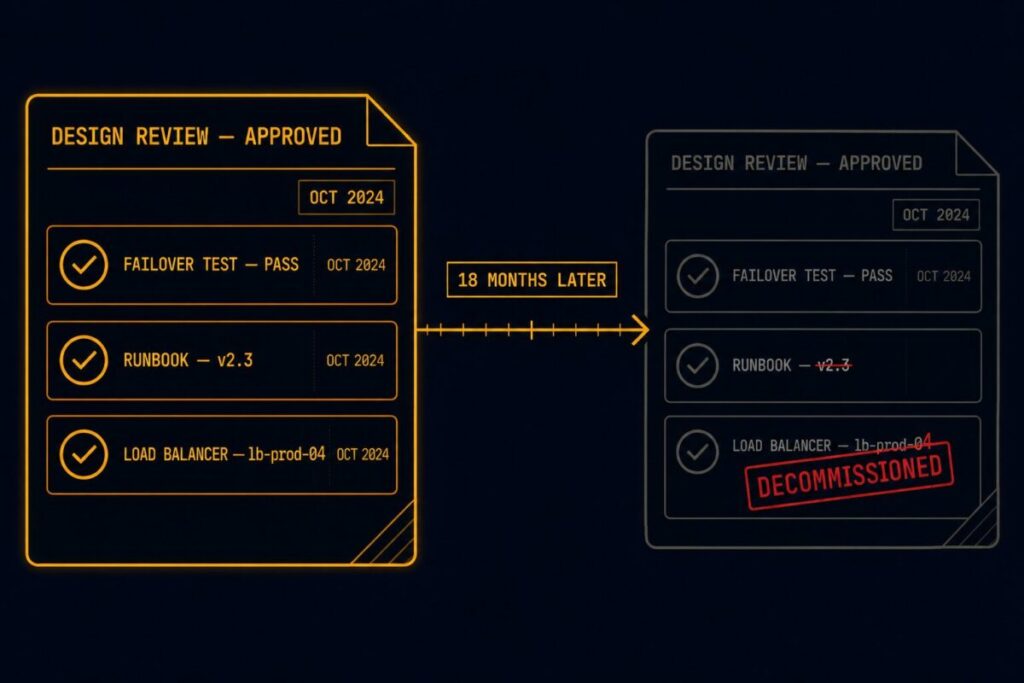
That review happened. Redundancy was designed. Failover was tested — once, under controlled conditions, with the team that built it in the room. Recovery was documented, signed off, and filed. Fourteen months later, none of that matters, because the person who tested the failover left in Q1, the runbook references a load balancer that was replaced in a routine refresh, and nobody has been assigned to find out whether any of it still works. The capability didn’t disappear. The organization simply stopped being able to prove it was still there.
The Assumption: Survivability Is A Design Achievement
Every infrastructure survivability conversation on this site so far has been about architecture — dependency mapping, failover paths, storage isolation, pipeline reconstruction. That’s the right starting point. It’s also an incomplete one, and the incompleteness is invisible at exactly the moment it matters least: the design review.
Design reviews are structurally biased toward the present tense. Is failover designed — yes or no. Is redundancy present — yes or no. Is recovery documented — yes or no. Every one of those questions has a defensible, gradable answer on the day of the review. None of them has any mechanism for asking whether the answer is still yes eighteen months later, under a different team, against a platform that’s been patched forty times since. The review certifies a state. It says nothing about what keeps that state true.
That gap doesn’t fail the day of the review. It fails on whatever day someone needs the capability and discovers, for the first time, that nobody has checked on it since it was built.
What Infrastructure Survivability Already Proved At The Pipeline Layer
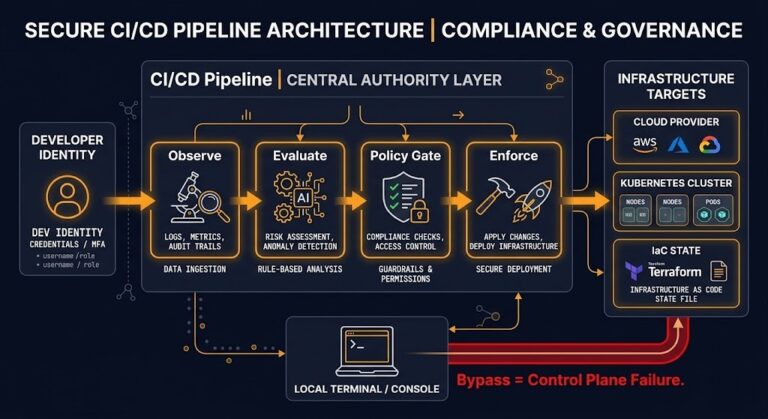
This site’s own doctrine already established half of this argument. The Infrastructure Pipeline Survivability Boundary showed that recovery routinely depends on a pipeline whose own dependencies were never made survivable — the repo, the state file, the secrets store, the identity system the pipeline itself needs to reconstruct anything. Recovery begins by rebuilding the recovery mechanism, at the worst possible moment to discover that gap.
That framework is about a structural dependency nobody mapped. This one is about something adjacent but distinct: infrastructure that is correctly architected for survivability — the dependencies are mapped, the pipeline is reconstructable — and still fails, because the capability was never assigned an owner responsible for confirming it still works. The pipeline boundary is an architecture problem with an architecture fix. This is an architecture problem with an organizational fix, and it shows up even after the first one has been solved.
Survivability Is Treated As A System Property
Here’s the actual discovery underneath this post, and it’s worth stating precisely: infrastructure survivability is not a property that exists independently of the people responsible for exercising, validating, funding, and maintaining it. It behaves like a system property in every design conversation — something the architecture either has or doesn’t — right up until the moment it’s needed, when it reveals itself as something that had to be continuously re-earned by a person nobody assigned to re-earn it.
The clearest way to see the gap is to put the design-review question next to the question that actually determines whether the capability survives:
| Design Review Question | Operational Reality Question |
|---|---|
| Is failover designed? | Who validates it quarterly? |
| Is redundancy present? | Who maintains it? |
| Is recovery documented? | Who exercises it? |
| Is the capability funded? | Who owns proving it still works? |
The left column is what gets asked in the room where the architecture is approved. The right column is what actually determines whether that architecture is still true a year later. Nobody in the design review is being negligent by not asking the right-hand questions — the design review isn’t the place those questions belong. The problem is that no other room asks them either. The capability crosses from architecture into operations and picks up no owner on the way.
Modern Infrastructure Has Already Seen This Failure Pattern
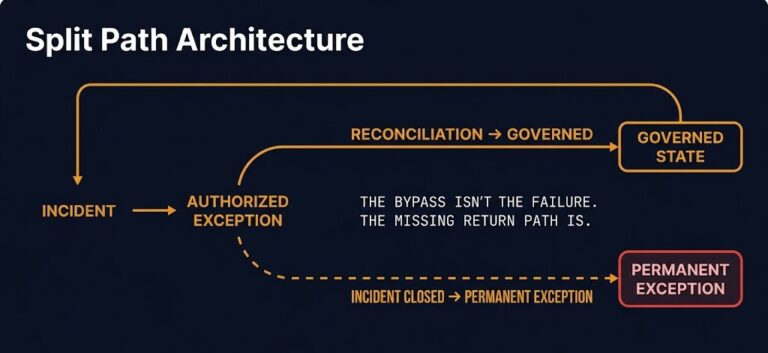
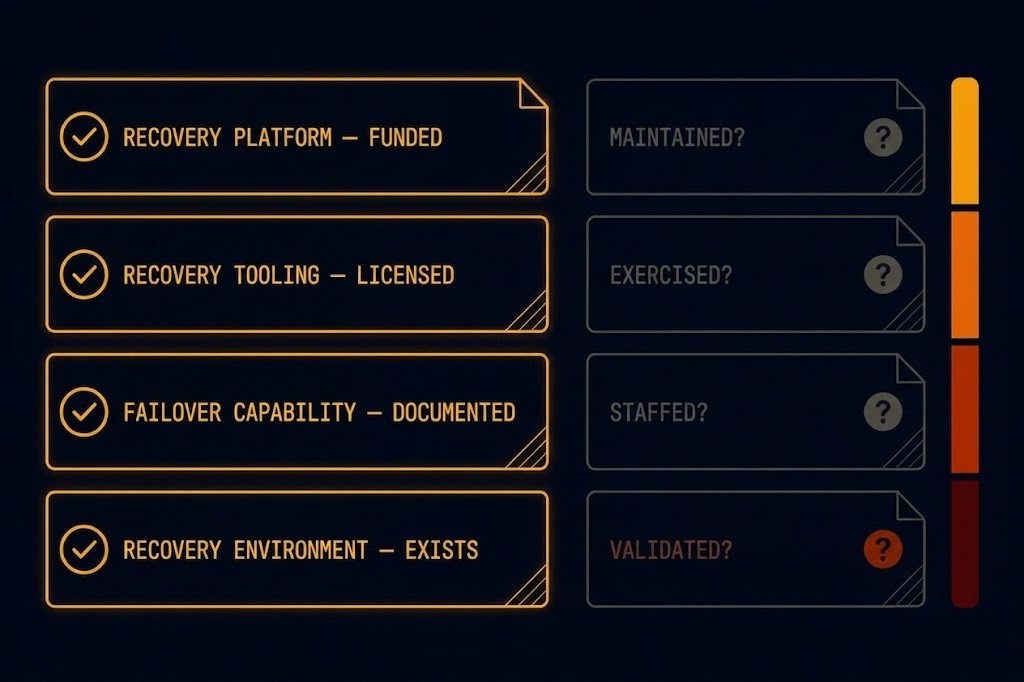
This isn’t a new discovery for this pillar — it’s a recognition. Modern Infrastructure & IaC has already documented what happens when reconciliation ownership is missing from infrastructure state and from emergency exceptions. Configuration drift persists not because detection tooling is absent, but because ownership of reconciliation was never explicitly assigned when the policy was declared. Emergency configuration exceptions become permanent for the identical reason: Reconciliation Ownership and a Closure Deadline were never defined at the moment the bypass was authorized, so the exception never has a mechanism forcing it back to a governed state.
Infrastructure survivability demonstrates the same pattern, applied to recovery capability instead of configuration state. In both cases the technical mechanism exists and is capable of correct behavior. In both cases the organization skipped the same step: naming who is accountable for confirming, on an ongoing basis, that the mechanism still does what it was built to do. Without that sentence, readers of this site’s existing doctrine would reasonably ask why the pipeline survivability boundary wasn’t already a complete answer. It wasn’t, because it was never trying to be — it solved the dependency-mapping half of the problem. This is the other half, and this pillar already had all the pieces before this post connected them.
Failure State: Survivability Theater
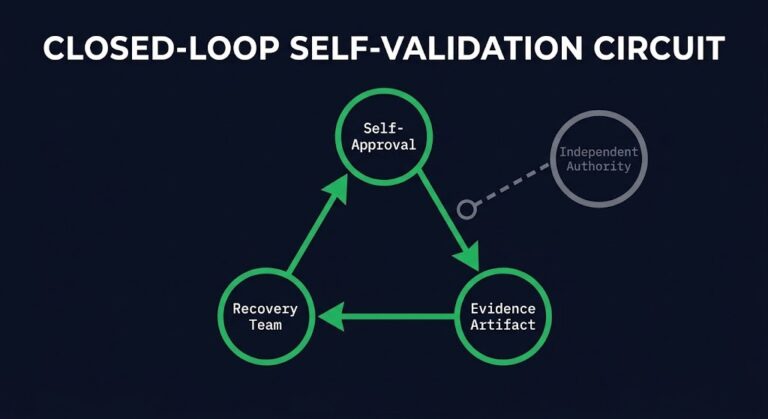
Call the failure state of infrastructure survivability precisely, because the imprecise version — “nobody owns it” — undersells what’s actually happening: the organization can demonstrate the existence of a survivability capability but cannot demonstrate an accountable mechanism for ensuring the capability remains operational over time. That’s a stronger and more specific claim than an absent owner. It says the capability itself is real and was, at some point, verified real — and that verification has no renewal mechanism attached to it.
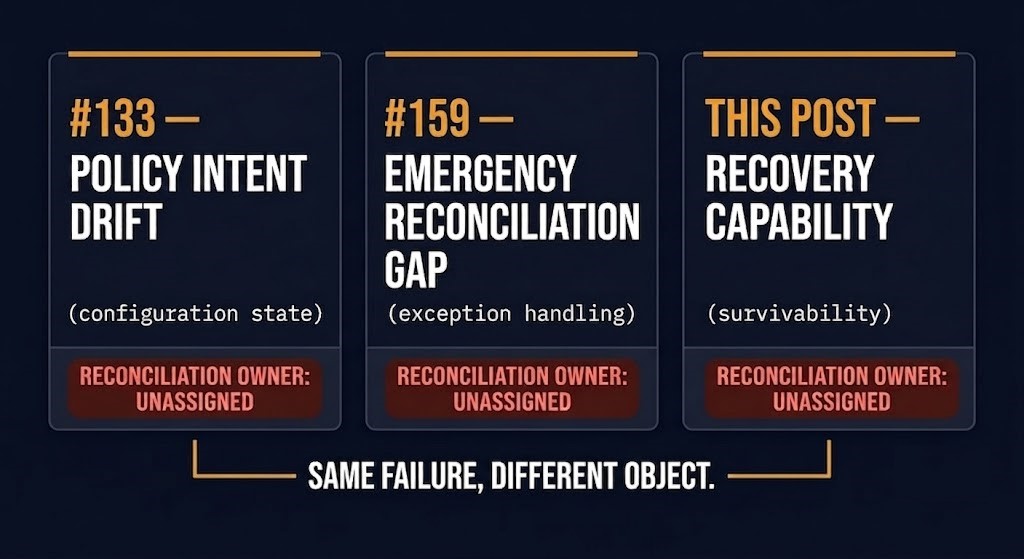
The pattern escalates the same way every time, from quiet operational neglect to an outright governance failure nobody notices until an incident forces the question:
SURVIVABILITY THEATER — HOW IT ACCUMULATES
- The DR platform is funded — but nobody is funded to maintain it
- The recovery tooling is licensed — but nobody is scheduled to exercise it
- The failover capability is documented — but nobody is staffed to run it
- The recovery environment exists — but nobody validates that it still matches production
Each stage on its own looks like an acceptable trade-off — a reasonable place to defer spend, or a task that will obviously get picked up next quarter. The accumulation is the actual failure. By the time an incident forces the question of whether the capability works, the organization discovers it’s been asking the wrong question for years: not “does this exist” but “does anyone still know.”
⚠ COMMON MISTAKE
Treating a successful DR test as proof the capability survives. A single successful test proves the capability existed on that date, under that team, against that platform version. It proves nothing about the eighteen months after, unless someone is explicitly accountable for repeating it.
Cross-Pillar Echo: Authority Survivability
Modern Infrastructure & IaC isn’t the only pillar where this infrastructure survivability shape appears. Cloud Strategy’s Authority Survivability Boundary makes the parallel case at the authority layer: architectures rarely fail because governing authority is poorly designed — they fail because the authority itself becomes unavailable, and nothing was built to continue operating once it did. Swap “authority” for “recovery capability” and the mechanism is identical: a condition that was true at design time silently stops being verified, and nobody notices until it’s tested by an incident instead of a review.
AI Infrastructure has its own version of the same gap, one layer upstream. Deciding that a workload needs Survivability — that its infrastructure failure can’t be allowed to terminate the capability outright — is the design-review question. Whether that decision still holds eighteen months later, under a different team, against a platform that’s been patched forty times since, is this post’s question. The two aren’t the same claim, and a program that only ever answers the first one has survivability theater dressed up as an architecture decision.
Architect’s Verdict
Infrastructure survivability does not fail when redundancy is absent. It fails when nobody is accountable for proving redundancy still works.
The design review is not the point of failure — it was never built to answer a question about eighteen months from now, and it shouldn’t be blamed for that. The failure is structural: organizations treat survivability as something an architecture possesses rather than something a person is assigned to keep re-proving, and the gap between those two models is invisible for exactly as long as nothing goes wrong.
A capability that passed every review and has no one assigned to validate it is not survivable. It is unverified, waiting for an incident to do the verification instead.
Additional Resources
Editorial Integrity & Security Protocol
This technical deep-dive adheres to the Rack2Cloud Deterministic Integrity Standard. All benchmarks and security audits are derived from zero-trust validation protocols within our isolated lab environments. No vendor influence.

R.M.
Senior Solutions Architect with 25+ years of experience in HCI, cloud strategy, and data resilience. As the lead behind Rack2Cloud, I focus on lab-verified guidance for complex enterprise transitions. View Credentials →
Get the Playbooks Vendors Won’t Publish
Field-tested blueprints for migration, HCI, sovereign infrastructure, and AI architecture. Real failure-mode analysis. No marketing filler. Delivered weekly.
Select your infrastructure paths. Receive field-tested blueprints direct to your inbox.
- > Virtualization & Migration Physics
- > Cloud Strategy & Egress Math
- > Data Protection & RTO Reality
- > AI Infrastructure & GPU Fabric
Zero spam. Includes The Dispatch weekly drop.
Architecture Audit Services
Fixed-scope audits for Zero-Trust Azure, VMware migration readiness, and recovery posture — no discovery call required to start.
>_ View Audit Services>_Related Posts
ZFS vs Ceph vs NVMe-oF: Choosing the Right Storage Backend for Modern Virtualization
I still have nightmares about a storage migration I ran back in 2014. >_ Architect’s Brief 60-second read before you commit to the full post · Full post: 7 min Generating brief… We were moving off a monolithic SAN and onto an early “software-defined” storage platform. The sales engineers promised infinite scalability and self-healing magic….
Your Recovery Program Has a Recovery Evidence Boundary
Recovery evidence boundary is the point where a recovery program stops being an engineering question and starts being a governance one — and most organizations cross it without ever finding out, because everything on the way there still looks like success. The backups completed. The DR test passed. The tabletop went well. Somebody wrote a…
Your Kubernetes Cluster Isn’t Out of CPU — The Scheduler Is Stuck
Compute Tier 1 Authority Cascades to ➔ >_ Architect’s Brief 60-second read before you commit to the full post · Full post: 9 min Generating brief… [Storage] [Network] 🚨 Failure Signature Detected Grafana shows cluster CPU utilization is under 50%, but pods are stuck in Pending. Events show: 0/10 nodes are available: 10 Insufficient cpu….
Your Cloud Provider Is Not Your HA Strategy
A Tactical Playbook for Architecting, Testing, and Automating Real Multi-Cloud & Multi-Region Resilience We’ve previously explored why cloud SLAs fail as guarantees in our deep dive, Cloud SLA Failure & Resilience Strategy. This article focuses on how to survive those failures in practice — architecturally, operationally, and financially. >_ Architect’s Brief 60-second read before you…
Your CI-CD Pipeline Is Your Real Infrastructure Control Plane
Terraform defines desired state. Kubernetes reconciles workload state. Cloud consoles expose state. None of those systems decides whether infrastructure state is allowed to change. The ci-cd control plane does — or more precisely, the CI-CD pipeline is the only system in most environments that can hold that authority. That distinction — between storing state and…
Why Configuration Standards Fail During Emergency Changes
Configuration standards emergency changes have one thing in common across every organization we’ve reviewed: the standard survives the incident, and quietly stops applying about ninety seconds into it. >_ Architect’s Brief 60-second read before you commit to the full post · Full post: 11 min Generating brief… It’s 2 a.m. A load balancer rule is…