

Why Configuration Standards Fail During Emergency Changes
Configuration standards emergency changes have one thing in common across every organization we’ve reviewed: the standard survives the incident, and quietly stops applying about ninety seconds into it.
It’s 2 a.m. A load balancer rule is misrouting traffic and customers are timing out. The on-call engineer knows the fix — a two-line change to a security group and a health check threshold. The standard path is a pull request, a peer review, a CI plan, a staged apply. That path exists for good reasons. None of those reasons survive contact with a Sev-1 timer. The engineer opens a console, makes the change by hand, watches the dashboards go green, and closes the incident. Nobody schedules the follow-up. Six months later, an audit finds a load balancer configuration that doesn’t match the Terraform state, and nobody remembers why, because at the time it felt like the right call — because it was.
The Standard Was Never Built for This Moment
Every configuration standard on a mature infrastructure-as-code platform assumes deliberate change: someone has time to write a plan, someone else has time to review it, and the pipeline has time to run. That assumption isn’t a flaw in the standard — it’s the entire point of it. Deliberate change is what makes IaC governance work at all.
Emergency changes don’t violate that assumption casually. They suspend it on purpose. An incident doesn’t just move faster than the standard process — it temporarily transfers authority away from the review-and-approve model to whoever is holding the pager. That’s not a side effect of urgency. It’s a deliberate, if usually unspoken, governance decision: for the duration of this incident, the normal chain of custody for infrastructure change does not apply.
Most infrastructure-as-code architecture doesn’t treat that as a decision at all. It treats it as an exception the standard simply didn’t anticipate — which is exactly backwards. Time-bounded authority transfer during an incident is not an edge case in configuration governance. It’s a load-bearing part of it that almost nobody has actually designed.
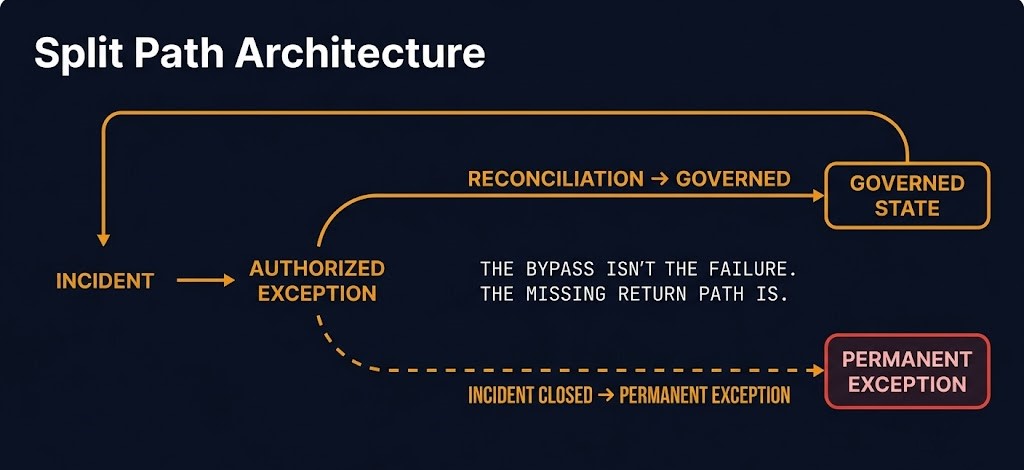
The Bypass Isn’t the Failure. The Missing Return Path Is.
We’ve argued elsewhere that configuration drift is fundamentally an ownership problem — that drift persists not because monitoring failed to detect it, but because nobody was ever assigned to close it (see Configuration Drift Is the Symptom. Ownership Is the Problem.). Emergency changes are the sharpest version of that same gap, because they’re the one drift-origin case where the organization chose to bypass the standard, in the moment, on purpose — and then built nothing to bring the exception back.
That’s the distinction worth sitting with. The bypass itself is rarely the mistake. Bypassing a slow, deliberate-change pipeline during an active outage is usually the correct call. The failure isn’t the exception. The failure is that almost no organization defines, in advance, who owns bringing that exception back into the governed system, or by when.
Emergency changes are not dangerous because they bypass standards. They’re dangerous because most organizations never define how exceptions return to the governed system.
That sentence is the whole argument. Everything else in this piece is what happens when nobody answers it.
Why Configuration Standards Emergency Changes Become Permanent Exceptions
The Emergency Reconciliation Gap (#159) exists when configuration standards emergency changes have no defined path back into the governed system.
Call this gap what it actually is: not a monitoring problem — most organizations can already detect that a resource has drifted — but an ownership and closure problem. Detection was never the hard part.
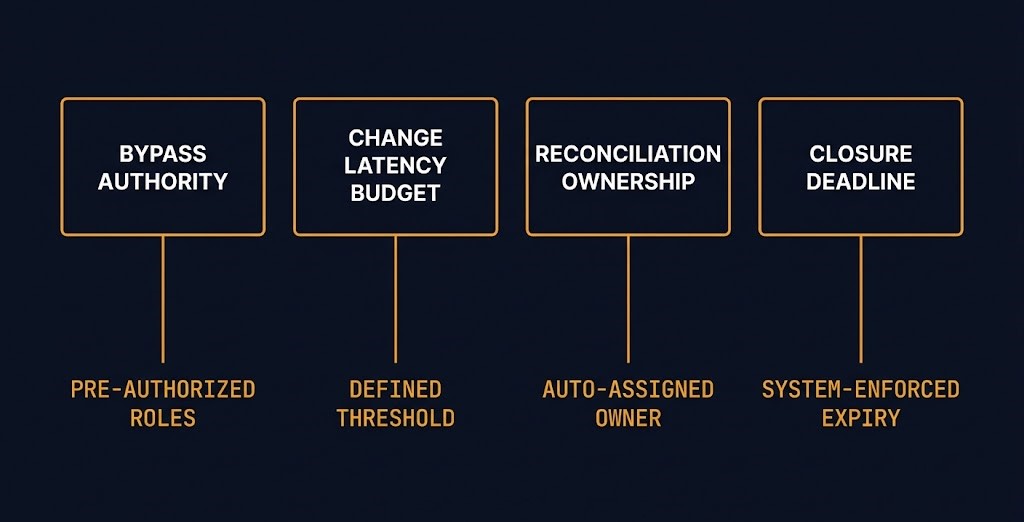
The framework has four variables:
01 — BYPASS AUTHORITY
Who is actually permitted to depart from the standard change path, under what incident severity, and through what mechanism — a named break-glass role, or whoever has console access and nerve.
02 — CHANGE LATENCY BUDGET
The threshold at which the standard pipeline’s review-and-apply latency becomes incompatible with the incident’s SLA — the point where “just wait for CI” stops being a real option.
03 — RECONCILIATION OWNERSHIP
Who is explicitly responsible for returning the exception to code after the incident closes — not “whoever gets to it,” a named owner assigned at the moment the bypass is authorized.
04 — CLOSURE DEADLINE
A hard, system-enforced date by which reconciliation must happen — not an expectation documented in a runbook nobody reopens.
When Reconciliation Ownership and Closure Deadline are both left undefined — which is the default state on most platforms — the exception doesn’t get revisited. It becomes the new steady state without anyone ever deciding that it should.
That failure state is Permanent Exception, and it’s worth being precise about what kind of failure it actually is. Permanent Exception is not a technical state. The firewall rule that stayed, the security group that never got codified, the health check threshold nobody backported into Terraform — those are symptoms, not the failure itself. The failure is governance, not configuration: nobody owns bringing the system back. A resource sitting outside IaC is a technical fact. Nobody being accountable for that fact is the actual architectural problem, and it’s the one that compounds. The Architecture of Premature Closure cites this exact failure state as its Modern Infrastructure & IaC example: an incident closes clean, and the unresolved exception underneath the closure signal is what nobody goes back to verify.
Permanent Exception is the incident-time version of a broader pattern: a capability that was verified correct at one moment and never re-verified after. Why Infrastructure Survivability Fails After The Design Review makes the same argument about recovery capability generally — a design review, like a closed incident, certifies a state on the day it’s checked and has no built-in mechanism for confirming that state still holds a year later.
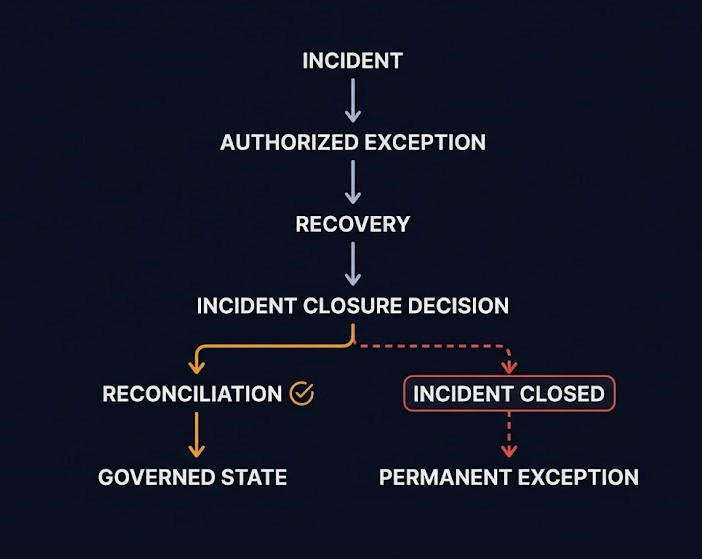
Two paths run from the same starting point. The governed path: Incident → Authorized Exception → Recovery → Reconciliation → Governed State. The failure path: Incident → Authorized Exception → Recovery → Incident Closed → Permanent Exception. The fork happens at exactly one place — the moment the incident is marked resolved. Everything upstream of that moment looks identical in both paths. What determines which path you’re on is whether Reconciliation Ownership and Closure Deadline were ever defined before the incident, not during it.
This is the Emergency Reconciliation Gap’s place in a wider lineage. The Drift Origin Model (#4) established that drift has traceable origins rather than appearing spontaneously. Policy Intent Drift (#133) showed that declared policy and enforced policy diverge even inside supposedly automated systems. Infrastructure Evidence Gap (#151) established that a pipeline can execute successfully while losing the authorization chain behind that execution entirely. The Emergency Reconciliation Gap is what happens when all three collide at the single moment an organization is least equipped to notice: the middle of an incident. That collision is exactly what the Governance & Drift learning path stage is built around — #159 is the stage’s culminating failure state, the point the entire Cluster 02 reading sequence builds toward.
A related but separate failure sits one register up. Governance Cost Inversion (Framework #174) assumes the control works exactly as designed — no missing return path, no structural gap — and still costs more than the risk it prevents. #159 is a control that failed to come back. #174 is a control that never left, and was never re-priced against the risk it still protects.
Permanent Exception has a second life outside incident response, too, once the pattern is named clearly enough to recognize elsewhere. Infrastructure Standards Without Enforcement Become Documentation Debt uses this exact failure state as its own worked example of what happens when Layer 02 — enforcement — goes missing: a standard nobody actively maintains drifts the same way an unreconciled emergency exception does, just slower and without an incident marking the moment it started.
Emergency Changes Prefer Control Planes
Emergency changes don’t distribute evenly across your infrastructure. They concentrate — and not randomly.
Engineers under incident pressure rarely reach for application code. Application changes require a build, a deploy pipeline, a rollback plan of their own — the emergency-change equivalent of the standard path they’re already trying to avoid. What they reach for instead are control planes: security groups, DNS records, IAM policies, load balancer rules, firewall ACLs. These are the fastest levers in the entire stack — a console change, immediate effect, no build step.
That’s precisely the problem. The systems most likely to receive an unreconciled emergency change are the systems with the largest blast radius when they drift. A stale application config might cause a bug. A stale IAM policy or an unreconciled security group rule is a standing security exposure that nobody is tracking, sitting exactly where an attacker or an auditor is most likely to look.
| Standard-Path Change | Emergency-Path Change | |
|---|---|---|
| Review | Peer-reviewed PR | Often none |
| Time pressure | Minimal | Severe (incident SLA) |
| Documentation | Commit message + PR description | Frequently absent or after-the-fact |
| Reconciliation trigger | N/A — already in code | Rarely defined |
| Typical outcome | Governed state maintained | Permanent Exception (without #159 controls) |
This is also where the operational-memory problem compounds the governance problem. Infrastructure can preserve exactly what was configured while losing all record of why — the gap we’ve described as Infrastructure Remembers Configuration. It Forgets Intent.. An emergency change made under pressure is the single most likely configuration event on your entire platform to lose its “why” the moment the person who made it moves on to the next incident.
Closing the Gap Without Slowing Down the Incident
⚠ COMMON MISTAKE
Treating reconciliation as post-incident cleanup — a nice-to-have on a retro action-item list — rather than a required step in closing the incident itself. A retro item with no owner and no deadline is exactly how Permanent Exception gets engineered into your architecture by default.
None of this argues for slowing down incident response. It argues for engineering the return path with the same rigor you’d apply to the standard path — before the next incident, not during it. Each fix maps directly onto one of the framework’s four variables:
| Framework Variable | Control |
|---|---|
| Bypass Authority | Pre-authorized break-glass roles and modules — a defined identity permitted to bypass, not whoever has console access |
| Change Latency Budget | A documented threshold defining exactly when the standard pipeline remains mandatory versus when the emergency path is permitted |
| Reconciliation Ownership | Automatic owner assignment tied to the incident-management workflow itself — the ticket that opens the incident is the ticket that assigns reconciliation |
| Closure Deadline | A system-enforced expiration condition on the exception, not a documented expectation a human is supposed to remember |
That last control matters more than it looks. A documented expectation is exactly how Permanent Exception happens — human memory is not a reconciliation mechanism, it’s the thing the framework exists because you can’t rely on. An emergency IAM policy or security group change should carry a system-enforced expiration the same way a temporary access grant does: if nobody reconciles it by the deadline, the platform itself should flag it, escalate it, or in the highest-risk cases, revert it.
Organizations don’t eliminate emergency changes. They engineer the return path.
Architect’s Verdict
The bypass isn’t the failure. The missing return path is. Every emergency change your team has ever made under pressure was almost certainly the right call in the moment — the mistake was never made at 2 a.m. It was made months earlier, when nobody defined who owns bringing the exception back, or by when.
Most infrastructure teams have excellent tooling for detecting drift and almost no architecture for closing it when the drift was authorized on purpose. That’s the part that gets missed: Permanent Exception isn’t a monitoring failure. It’s a governance failure wearing a technical disguise, and it concentrates precisely in the control-plane systems — IAM, security groups, DNS, load balancers — where the blast radius of an unreconciled change is largest.
Organizations don’t eliminate emergency changes. They engineer the return path.
Additional Resources
View 4 more resources
Editorial Integrity & Security Protocol
This technical deep-dive adheres to the Rack2Cloud Deterministic Integrity Standard. All benchmarks and security audits are derived from zero-trust validation protocols within our isolated lab environments. No vendor influence.

R.M.
Senior Solutions Architect with 25+ years of experience in HCI, cloud strategy, and data resilience. As the lead behind Rack2Cloud, I focus on lab-verified guidance for complex enterprise transitions. View Credentials →
Get the Playbooks Vendors Won’t Publish
Choose the architecture problems you care about. Get field-tested playbooks and frameworks delivered to your inbox.
- > AI Infrastructure & Inference Economics
- > Cloud Strategy & Hidden Cost Models
- > Virtualization & Deterministic Migration
- > Kubernetes, IaC & Modern Infrastructure
- > Data Protection & Recovery Engineering
Zero spam. Includes The Dispatch weekly drop.
Need Architectural Guidance?
Independent review before major infrastructure decisions.
- > Validate assumptions
- > Identify hidden dependencies
- > Quantify migration risk
- > Challenge vendor narratives
Triage · Advisory · Fractional · Direct Hire