


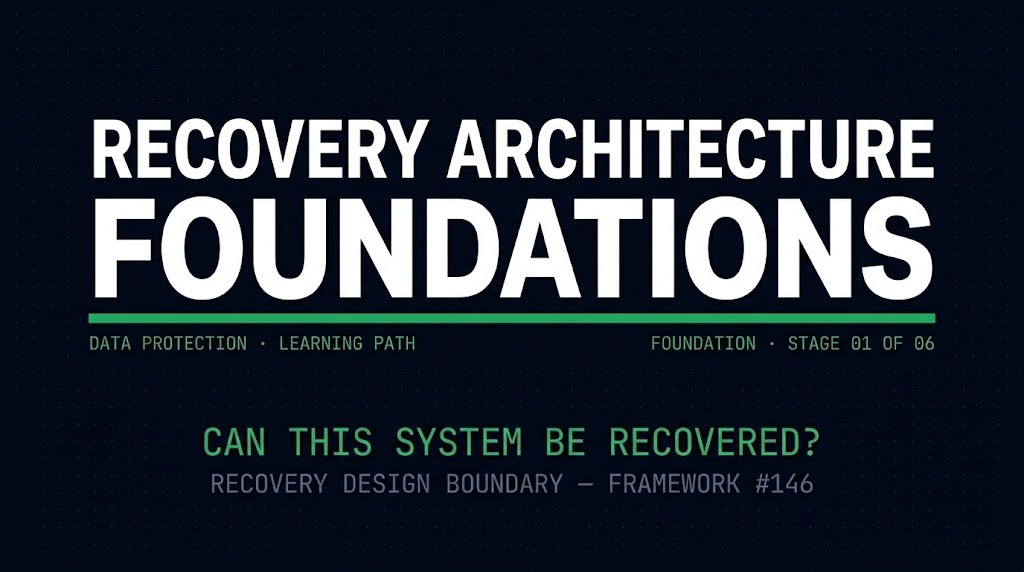
RECOVERY ARCHITECTURE FOUNDATIONS
Recovery is a design outcome, not a backup feature.
MATURITY POSITION — STAGE 1 OF 6
- Current Stage: Recovery Architecture Foundations
- Primary Architectural Concern: Recovery-first design — are systems structured to be recoverable, or merely backed up?
- Primary Failure Mode: Recovery-Blind Architecture — backup coverage exists, but recovery behavior, restore sequencing, authority ownership, and blast-radius boundaries have not been explicitly designed. Recovery characteristics are discovered at restore time, not before it.
- Stage Outcome: Recovery economics understood, blast radius mapped, restore path designed as a first-class architectural artifact, recovery authority ownership established before an incident occurs
- Next Stage: D2 — Recovery Platform Architecture — What platform executes recovery, and who controls it?
Backup architecture foundations define whether your systems are genuinely recoverable — not whether they are backed up. Most enterprise environments run backup software. Far fewer have made explicit architectural decisions about recovery topology: which systems recover in which order, which dependencies collapse under blast radius, and who holds the authority to initiate recovery when the incident is real. The distinction between backup coverage and recoverability is not a nuance. It is the gap that produces 72-hour restores, failed DR tests, and recovery processes that succeed technically but fail operationally.
This stage addresses the architectural decisions that determine recoverability before any recovery platform is selected. Recovery economics, blast radius design, restore path architecture, and recovery authority ownership are not outputs of platform implementation — they are inputs. Organizations that begin with platform selection skip this stage entirely and rebuild it later, under pressure, during an incident. This path starts where architecture starts: with design intent.
WHY THIS STAGE EXISTS — RECOVERY-BLIND ARCHITECTURE
Most organizations do not have a recovery architecture problem. They have a design omission problem. The backup job runs. The test passes. The architecture has never been examined.
Stage Anchor Question
Can this system be recovered?
Not: is this system being backed up? Not: has a recovery test been scheduled? Recovery architecture answers whether the organization has designed for recoverability — or whether recovery is a behavior that will only be discovered at restore time.
The recovery engineering conversation has been dominated by tooling selection for 20 years. Vendor benchmarks, platform comparisons, and feature matrices absorb the architectural budget before any recovery topology has been defined. This stage exists because recovery is determined at design time, not restore time. The decisions that control blast radius, restore sequencing, and recovery authority are made — or not made — before any incident begins. Recovery-Blind Architecture is not a failure of execution. It is a failure to design.
The earlier stages of adjacent paths established what exists, what it costs, and what governs it. D1 begins the Data Protection path by asking the foundational question that precedes all of those: can this system actually be recovered? The path that follows — platform selection, immutability design, ransomware survival, DR failover, governance assurance — only has meaning once recovery has been deliberately designed rather than assumed.
How Recovery Architecture Foundations Anchors the Full Path
| Stage | Name | Question |
|---|---|---|
| D1 | Recovery Architecture Foundations | Can this system be recovered? |
| D2 | Recovery Platform Architecture | What platform executes recovery — and who controls it? |
| D3 | Immutability & Cyber-Vaulting | How is recovery isolated from compromise? |
| D4 | Ransomware Survival Architecture | How does recovery survive adversarial attack? |
| D5 | Disaster Recovery & Failover Architecture | How does recovery survive infrastructure failure? |
| D6 | Governance & Recovery Assurance | How does the organization continuously prove recoverability? |
D1 establishes the design vocabulary and recovery economics model that all subsequent stages assume. Platform selection (D2), isolation architecture (D3), adversarial survival (D4), failover design (D5), and assurance (D6) are only meaningful once recoverability has been deliberately designed — not assumed from backup coverage.
Stage Anchor Framework — Recovery Architecture Foundations
Recovery Design Boundary (#146)
The line between systems whose recovery characteristics have been intentionally designed and systems whose recovery behavior is only discovered during restoration. Backup exists on both sides. Recoverability only exists on the designed side. Below the boundary: recovery topology, blast radius, restore sequencing, and authority ownership have been explicitly decided. Above it: the organization can demonstrate backup coverage, but has no validated recovery architecture — and will not discover the gap until restore time. This stage’s anchor post, Your Backup Completed. Your Recovery Architecture Didn’t., covers the framework in full — the four gaps backup completion never reaches.
Named Failure State: Recovery-Blind Architecture · Indicators: backup jobs complete without a defined restore sequence · DR tests pass without validating authority ownership · blast radius has never been mapped for the recovery platform itself · “who can declare a recovery” has no consistent answer across teams
Why Architects Misjudge Recovery Architecture
Backup coverage is mistaken for recoverability. A backup job completing successfully is evidence that data has been written to a secondary location. It is not evidence that the data can be restored, that the restoration sequence is valid, that the dependencies required by the restore are available, or that anyone has the authority to execute the recovery. These are separate architectural facts that require separate design decisions. The backup job’s green checkmark says nothing about any of them.
A passed DR test is mistaken for a validated recovery architecture. DR tests validate execution mechanics — that the runbook steps work, that credentials are current, that RTO is achievable in test conditions. They do not validate the architecture. A test that passes every time and still fails in production when the incident is large enough to involve authority fragmentation, blast radius collapse, or restore sequencing errors is not a testing failure. It is a design failure that the test was never equipped to expose.
Platform selection is treated as architecture. Choosing Veeam, Rubrik, Cohesity, or Commvault is a platform decision. It implements a recovery topology. It does not define one. An organization that selects a recovery platform before designing its recovery topology is asking the platform to make architectural decisions by default — decisions about blast radius boundaries, restore sequencing, isolation design, and authority ownership that the platform’s defaults are almost certainly wrong about for that specific environment.
What This Stage Is Not
Not backup software training. Job configuration, scheduling logic, retention policy management, and deduplication tuning belong in vendor documentation. This stage covers the architectural decisions that exist above and before any specific platform — decisions that remain valid regardless of which platform is eventually selected.
Not a vendor comparison. Platform selection follows architecture; it does not substitute for it. Veeam, Rubrik, Cohesity, and Commvault each implement a recovery topology — they do not define one. This stage defines the topology those platforms will be asked to execute. D2 — Recovery Platform Architecture — is where platform evaluation enters the path.
Not compliance coverage. Regulatory retention schedules, audit artifact requirements, and compliance reporting frameworks are a policy layer that sits above recovery architecture. Meeting a retention requirement does not mean recovery has been designed. A system can be fully compliant with every applicable regulation and still be Recovery-Blind.
Not a DR runbook. Operational runbooks document recovery procedures — the steps, credentials, and decision trees that teams follow when an incident is in progress. They are outputs of recovery architecture, not a substitute for it. A runbook written without a designed recovery topology is a script for a process that has never been validated against the architecture it is supposed to execute.
>_ Estimated Reading Depth
| Format | Count | Estimated Time | Notes |
|---|---|---|---|
| Architecture articles — Group 01 | 4 | ~49 min | Recovery design fundamentals — economics, metrics, restore path, blast radius |
| Failure States Grid | 1 | ~10 min | Five named failure states — read between Group 01 and Group 02 |
| Architecture articles — Group 02 | 4 | ~47 min | Recovery protection architecture — isolation, immutability, adversarial design, authority |
| Total stage depth | 8 | ~96 min | Foundation stage — complete before entering D2 Recovery Platform Architecture |
>_ Where to Enter This Stage
This is Stage 1 — there are no prerequisites. Enter here if you are beginning the Data Protection & Resiliency path, or if you have never made explicit architectural decisions about recovery topology: blast radius, restore sequencing, or recovery authority ownership.
Specifically, enter here if:
- Your organization runs backup software but has never defined a recovery topology — which systems recover first, in what sequence, under what dependencies
- A DR test has passed without anyone asking which system holds the authority to declare a recovery
- The blast radius of your recovery platform has never been mapped against the systems it is meant to protect
- RPO and RTO exist as SLA targets but have never been used to design infrastructure
- Platform selection happened before restore path design
Skip-ahead criteria: Architects who can define Recovery-Blind Architecture as a named failure mode, articulate blast radius as a recovery topology problem (not just a network problem), and have documented a restore path sequence for at least one production workload cluster may consider entering at D2. If any of those three conditions is uncertain, start here. Do not enter this stage expecting a platform comparison or a compliance checklist — those are downstream outputs at best. Recovery Architecture Foundations answers one question: can this system be recovered? The answer is the precondition for everything D2 through D6 address.
>_ Architecture Maturity Position
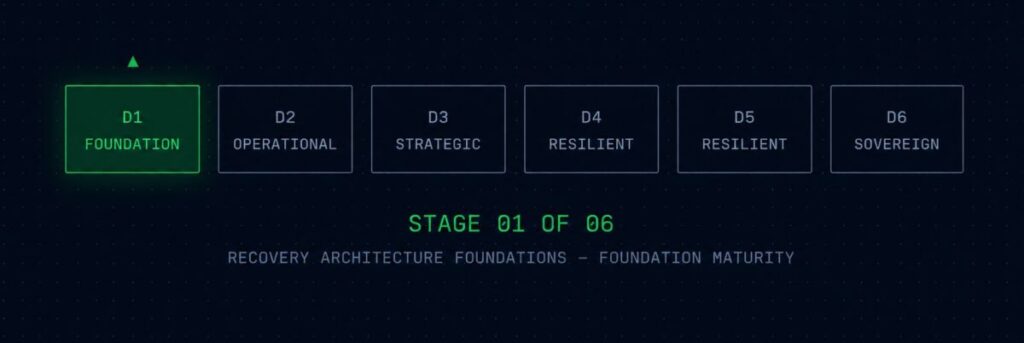
| Stage | Name | Maturity Level | Stage Question |
|---|---|---|---|
| D1 ← YOU ARE HERE | Recovery Architecture Foundations | Foundation | Can this system be recovered? |
| D2 | Recovery Platform Architecture | Operational | What platform executes recovery — and who controls it? |
| D3 | Immutability & Cyber-Vaulting | Strategic | How is recovery isolated from compromise? |
| D4 | Ransomware Survival Architecture | Resilient | How does recovery survive adversarial attack? |
| D5 | Disaster Recovery & Failover Architecture | Resilient | How does recovery survive infrastructure failure? |
| D6 | Governance & Recovery Assurance | Sovereign | How does the organization continuously prove recoverability? |
>_ Where This Stage Sits
The Data Protection Path Is a Recovery Lifecycle Progression
| Stage | Architectural Question |
|---|---|
| D1 — Recovery Architecture Foundations | Can this system be recovered? |
| D2 — Recovery Platform Architecture | What platform executes recovery — and who controls it? |
| D3 — Immutability & Cyber-Vaulting | How is recovery isolated from compromise? |
| D4 — Ransomware Survival Architecture | How does recovery survive adversarial attack? |
| D5 — Disaster Recovery & Failover Architecture | How does recovery survive infrastructure failure? |
| D6 — Governance & Recovery Assurance | How does the organization continuously prove recoverability? |
D1 establishes whether recovery is possible. D2 through D6 progressively address how it executes, survives compromise, survives attack, survives infrastructure failure, and is continuously proven. Each stage inherits the design vocabulary D1 builds.
>_ Stage Reading Sequence
RECOVERY ARCHITECTURE BEGINS HERE
The sequence below is organized as a two-part design process. Group 01 builds the economic model and the design vocabulary — the framework for asking whether a system is recoverable. Group 02 applies that framework to the conditions that determine whether recovery remains possible under pressure: isolation boundaries, immutability design, adversarial topology, and authority ownership. Every stage that follows in this path — platform selection, cyber-vaulting, ransomware survival, DR failover, assurance — assumes the vocabulary and economics from Group 01 exist.
Reading out of sequence is possible. The failure states grid between groups gives the architectural reason to read in order.
Architectural question: What determines recoverability before a backup product is selected?
What determines recoverability before a backup product is selected?
Recovery economics, restore path design, and blast radius architecture are the three decisions that determine whether a system is recoverable. None of them are made by choosing a backup platform. These four articles establish the design vocabulary and the economic model that every subsequent stage assumes.
>_ Recovery Design Failure States
>_ Common Recovery Design Failure States
Architectural question: What must survive for recovery to remain possible?
What must survive for recovery to remain possible?
Isolation, immutability, and authority ownership are the three properties that determine whether recovery remains executable when an incident is large enough to matter. These four articles examine each condition and the specific failure modes that occur when it is absent or only partially implemented.
>_ Recovery Design as an Ongoing Practice
Recovery architecture is not a project deliverable. The topology designed today becomes outdated as systems change, teams reorganize, platforms evolve, and vendors alter default behavior. A recovery architecture designed once and never revisited has the same shelf life as the infrastructure diagram it was meant to protect — accurate on the day it was drawn, and progressively less valid after.
The practice this stage establishes combines incident-driven verification with periodic architectural review. Every recovery event — planned or unplanned — is an opportunity to confirm whether the systems that executed the recovery matched what the architecture said should execute it. When they don’t match, that divergence is data: about where blast radius assumptions were wrong, where restore sequencing broke down, or where authority ownership was unclear when it mattered.
Periodic review — independent of incidents — closes the gap that event-driven verification leaves open: the dependencies, systems, and authority structures that have changed without anyone validating the recovery architecture against those changes. A quarterly pass through the major recovery design questions (who can declare recovery, which systems are inside the blast radius, what is the restore sequence for the three most critical workloads) surfaces design drift before it becomes the explanation for a failed recovery.
>_ Stage Graduates Can Now
Backup architecture answers whether recovery is possible. Recovery Platform Architecture (D2) answers how recovery is executed. The capabilities below are what make that transition meaningful — each one requires the design vocabulary and economic framework this stage builds. D2 graduates understand platforms. D1 graduates understand what platforms are being asked to execute.
- Model recovery economics before platform selection — total cost of recovery, not cost of storage
- Map backup blast radius across workload dependency chains and confirm the recovery platform sits outside it
- Design restore path sequencing as a named architectural artifact, not an incident-time decision
- Identify recovery authority gaps before an incident surfaces them
- Evaluate platform isolation claims against the air gap failure modes covered in this stage
- Distinguish backup coverage from recoverability — and hold the distinction under vendor pressure
- Enter D2 — Recovery Platform Architecture — with a defined recovery topology to implement
>_ Live Diagnostics
Continue to D2 to evaluate recovery execution authority using the Disaster Recovery Authority Analyzer (DRAA).
>_ Where Do You Go From Here
ARCHITECTURE REVIEW
Recovery Readiness Assessment
A structured review of your recovery topology, blast radius design, restore path architecture, and authority ownership — before the next incident exposes the gaps.
[+] Request Assessment →WEEKLY DISPATCH
Weekly Dispatch
Architecture signals, framework updates, and new content from across the five pillars — delivered weekly for senior infrastructure architects.
[+] Subscribe →>_ Frequently Asked Questions
Q: What is recovery architecture?
A: Recovery architecture is the discipline of designing systems to be genuinely recoverable — not merely backed up. It covers recovery topology (which systems recover in which order), blast radius design (which systems sit inside the failure domain the recovery platform is meant to protect), restore path sequencing (the named, documented order in which dependencies must be restored), and recovery authority ownership (who holds the standing to declare and execute a recovery). Recovery architecture answers whether recovery is possible. Recovery platform selection answers how it executes.
Q: What is the difference between backup coverage and recoverability?
A: Backup coverage is evidence that data has been written to a secondary location. Recoverability is evidence that the data can be restored, in the right sequence, from an isolated location, under a defined authority structure, within an acceptable time window. An organization can have complete backup coverage and zero recoverability. Recovery-Blind Architecture is the failure state where that gap has never been examined.
Q: What is the Recovery Design Boundary (Framework #146)?
A: The Recovery Design Boundary is the line between systems whose recovery characteristics have been intentionally designed and systems whose recovery behavior is only discovered during restoration. Backup exists on both sides. Recoverability only exists on the designed side. The primary failure state for architectures that have not crossed this boundary is Recovery-Blind Architecture — backup coverage exists, but the topology, sequencing, isolation, and authority required to actually recover have never been explicitly decided.
Q: What is Recovery-Blind Architecture?
A: Recovery-Blind Architecture is the named failure state for this stage — the condition in which backup coverage exists, but recovery behavior, restore sequencing, authority ownership, and blast-radius boundaries have not been explicitly designed. The organization has data protection. It does not have a recovery architecture. Recovery characteristics, including whether they are adequate, are discovered at restore time rather than designed before it.
Q: What is blast radius in the context of backup architecture?
A: Blast radius defines which systems are affected by a given failure event. When the recovery platform is inside the blast radius — on the same network, managed by the same credentials, or protected by the same backup policy as the systems it is meant to restore — a failure large enough to require recovery also disables or compromises the recovery infrastructure. Blast radius design must determine recovery platform placement and isolation architecture, not just workload placement.
Q: When should restore path design happen in an infrastructure project?
A: Before platform selection. The restore path defines which workloads recover first, in which sequence, with which dependencies satisfied before the next step can proceed. Platform selection determines which product will execute that sequence. Starting with platform selection means the restore path is defined by the product’s own recovery model — by default — rather than by the organization’s architectural requirements. Defaults are almost always wrong for a specific environment.
Q: What is recovery authority, and why does it matter architecturally?
A: Recovery authority is the defined standing — the explicit organizational designation — of who can declare that a recovery event is in progress and initiate the recovery sequence. When authority is undefined, recovery decisions are made ad hoc under pressure, often by whoever is present rather than whoever is designated. Recovery Authority Fragmentation (Framework #144) is the failure state where authority exists in theory but is distributed across teams with no defined resolution model — producing decision latency or paralysis at exactly the moment when speed of recovery is the only metric that matters.
>_ Related Systems
Your Backup System Is Part of the Blast Radius — Recovery Dependency Collapse (Framework #122) and why backup infrastructure must sit outside the failure domain it is meant to protect.
Open Post →Disaster Recovery Authority: The Missing Layer in Most Recovery Plans — Recovery Authority Fragmentation (Framework #144) and the architecture of recovery decision-making.
Open Post →The Restore Path Is the Most Neglected Part of Backup Design — restore sequencing as an explicit design artifact and what happens when it is treated as an incident-time decision instead.
Open Post →Disaster Recovery Authority Analyzer — evaluates recovery execution authority, control-plane ownership, and operational recovery decision paths against the Recovery Execution Boundary (Framework #147).
Open Tool →The Hypervisor Is Not the Migration Target — The Operating Model Is. How virtualization architecture determines the operational context the recovery platform is asked to protect.
Open Post →NIST SP 800-34 Rev. 1 — Contingency Planning Guide for Federal Information Systems. The federal framework for recovery planning, test cadence, and contingency plan documentation standards.
Open Reference →CISA — Cyber Resilience Review. The capability-based assessment framework for evaluating operational resilience, including recovery management, situational awareness, and service continuity.
Open Reference →