

DISASTER RECOVERY & FAILOVER ARCHITECTURE
Recovery can succeed. Continuity can still fail.
MATURITY POSITION — STAGE 5 OF 6
- Current Stage: Disaster Recovery & Failover Architecture
- Primary Architectural Concern: Does operation survive recovery — not whether recovery technically executes, but whether the business actually resumes once it does?
- Primary Failure Mode: Continuity Theater — failover mechanisms exist and pass every test, but continuity depends on dependency and ownership assumptions that have never been validated under real conditions.
- Stage Outcome: Reader can evaluate a disaster recovery architecture across five continuity domains — execution boundary, dependency survival, state survivability, validation and determinism, and recovery authority — rather than treating a passed failover test as proof continuity holds
- Next Stage: Stage 6 — Governance & Recovery Assurance — can the continuity claim itself survive independent challenge?
Disaster recovery and failover architecture is the discipline of testing whether an organization actually resumes operating once a technical failover completes — not whether the failover itself executes cleanly. The previous stage asked whether recovery survives a compromise deliberately engineered against it. This stage asks a different question, one that applies even when there’s no adversary at all: infrastructure fails, a failover executes exactly as designed, every technical metric passes — and the business still isn’t running, because something the recovery plan assumed would just be there wasn’t.
That gap is easy to miss because failover tests are usually built to catch exactly the thing they’re designed to catch. A regional outage drill proves the platform can redirect traffic and rehydrate storage. It says nothing about whether the identity provider that authenticates the failed-over workload lives in the region that just went dark, whether DNS actually propagates the change inside the window anyone’s counting on, or whether the person with authority to declare the incident over is reachable at 3 a.m. Recovery is a technical claim. Continuity is an operational one. This stage exists because an architecture can satisfy the first and still fail the second — completely, and expensively, at the exact moment it matters most.
WHY THIS STAGE EXISTS — THE CONTINUITY EXECUTION BOUNDARY
Recovery succeeding and continuity holding are not the same claim, and testing one has never validated the other.
Stage Anchor Question
Does continuity survive infrastructure failure?
Not: did the failover execute? Not: did the DR test pass? Disaster recovery and failover architecture answers whether the dependencies and ownership decisions required for the business to actually resume operating were separately validated — under the specific conditions an unplanned infrastructure failure creates, not the conditions a scheduled failover drill assumes.
Stages 1 through 4 built and hardened the recovery architecture itself: designed, executable, isolated, and adversarially survived. None of them asked whether continuity — the business actually resuming, not the workload technically restoring — holds once that architecture executes. That is a separate, untested claim even in an organization that has passed every prior stage cleanly, because a recovery architecture can be entirely sound and still depend on dependencies and ownership decisions that were never modeled against a real failure.
That is the actual maturity jump this stage represents. Stage 1 asked whether a system could be recovered. Stage 2 asked whether a platform could execute the recovery. Stage 3 asked whether isolation held under compromise. Stage 4 asked whether the full authority chain behind recovery survives adversarial attack. Stage 5 asks whether the dependencies and ownership decisions surrounding a technically successful failover were ever separately tested — the property none of the earlier stages checked for, because none of them needed to. An architecture can be adversarially hardened and still fail this stage completely, because Continuity Theater has nothing to do with whether an attacker is present.
How Disaster Recovery & Failover Architecture Anchors the Full Path
| Stage | Name | Question |
|---|---|---|
| Stage 1 | Recovery Architecture Foundations | Can this system be recovered? |
| Stage 2 | Recovery Platform Architecture | How is recovery executed? |
| Stage 3 | Immutability & Cyber-Vaulting | How is recovery isolated from compromise? |
| Stage 4 | Ransomware Survival Architecture | How does recovery survive adversarial attack? |
| Stage 5 | Disaster Recovery & Failover Architecture | Does continuity survive infrastructure failure? |
| Stage 6 | Governance & Recovery Assurance | Can the continuity claim itself survive independent challenge? |
Stage 5 takes the recovery architecture the earlier stages built, executed, isolated, and adversarially proved, and asks whether continuity — not recovery — holds once that architecture actually runs. Governance and continuous assurance (Stage 6) assume the continuity this stage validates is already in place.
Stage Anchor Framework — Disaster Recovery & Failover Architecture
Continuity Execution Boundary
The point at which infrastructure recovery has been validated as executable and survivable, but the dependencies and ownership decisions required for the business to actually resume operating have not been separately tested.
Named Failure State: Continuity Theater · Indicators: failover mechanisms pass every scheduled test · dependency chains (identity, DNS, certificates, network) have never been deliberately broken during a drill · no named owner exists for declaring continuity, not just recovery, restored · the last real incident revealed a dependency nobody had mapped
Why Architects Misjudge Continuity
A passed failover test is treated as proof of continuity. It proves the platform can execute a failover under the specific conditions the test simulated. It says nothing about whether the dependencies outside the platform’s own control — identity, DNS, certificates, network paths — travel with that failover automatically, or have to be separately re-established by someone who wasn’t in the room when the test was designed.
Replication is mistaken for recoverability. Data existing in a second location is a state fact. Whether that state is actually restorable — free of propagated corruption, free of silently broken dependencies, recoverable within the window anyone’s counting on — is a separate, untested claim. Replication preserves availability. Recovery preserves recoverability. These are not the same outcome, and most disaster recovery programs never test the difference.
Recovery authority is assumed to be self-evident at incident time. Most failover runbooks assume whoever is on call has the standing to declare the incident resolved, redirect traffic permanently, or escalate a partial failure. That assumption holds until the person who actually has that authority is unreachable, or until two people with overlapping authority disagree about whether the failover succeeded. The Architecture of Premature Closure names this same substitution at the cross-pillar level — a process closing clean on the signal that’s easiest to observe, standing in for the outcome nobody separately confirmed.
>_ Recovery vs. Continuity
Stage 4 and Stage 5 are the two stages most likely to be conflated, because both deal with the word “survival” and both assume the recovery architecture underneath already works. They are not the same claim. Stage 4 protects recovery from an adversary who is actively working against it. Stage 5 protects continuity from infrastructure failure that isn’t adversarial at all — and asks whether the dependencies and authority decisions around a clean technical failover were ever independently tested.
| Stage 4 — Survival | Stage 5 — Continuity |
|---|---|
| Tests recovery against deliberate compromise | Tests continuity against infrastructure failure, no adversary required |
| Assumes a clean technical failover if the attack is survived | Assumes the technical failover succeeds — asks whether the business actually resumes |
| Protects the recovery process itself | Protects the dependencies and authority decisions around the process |
| Crosses the Recoverability Gap | Crosses the Continuity Execution Boundary |
The Reading Sequence below moves through this distinction across five continuity domains — execution boundary, dependency survival, state survivability, validation and determinism, and recovery authority.
>_ Recovery Metrics Primer
Before entering the clusters below, three terms recur throughout this stage and are worth locking down. They are not this stage’s subject — they’re the vocabulary the rest of the stage assumes.
- Recovery Time Objective (RTO) — the maximum acceptable time between failure and restored operation.
- Recovery Point Objective (RPO) — the maximum acceptable data loss, measured backward in time from the failure.
- Recovery Time Actual (RTA) — what recovery time actually measures out to under real conditions, as opposed to what the design assumed.
Full primer on all three terms, and why the gap between RTO and RTA is where most disaster recovery programs quietly fail: RTO, RPO, and RTA: Why Recovery Metrics Should Design Your Infrastructure.
>_ Estimated Reading Depth
| Format | Count | Estimated Time | Notes |
|---|---|---|---|
| Recovery Metrics Primer | 1 | ~11 min | Terminology only — RTO / RPO / RTA |
| Cluster 1 — Continuity Execution | 2 | ~22 min | The stage doctrine and anchor framework |
| Cluster 2 — Dependency Continuity | 3 | ~33 min | What has to survive for recovery to matter |
| Cluster 3 — Replication & State Survivability | 3 | ~33 min | Does surviving the outage preserve the ability to recover |
| Failure States Grid | 1 | ~10 min | Named continuity failure states — read before the framework reveal |
| Cluster 4 — Validation & Determinism | 4 | ~44 min | Can the outcome be predicted before the event occurs |
| Cluster 5 — Authority & Recovery Design | 3 | ~33 min | Who owns continuity execution |
| Total stage depth | 17 | ~186 min | Resilient stage — complete before entering Stage 6 Governance & Recovery Assurance |
>_ Where to Enter This Stage
Enter here once recovery has already been validated against adversarial compromise — once the Stage 4 authority chain (identity, credential, control plane, backup, governance, storage) has been confirmed to survive a deliberate attack. If that hasn’t been established, start at Stage 4: Ransomware Survival Architecture. Testing continuity against infrastructure failure before recovery itself has been proven adversarially sound produces an answer built on an unconfirmed foundation.
Specifically, enter here if:
- Failover mechanisms pass every scheduled test, but no drill has ever deliberately broken a dependency — identity, DNS, certificates, network — mid-failover
- Replicated data exists in a second location, but no one has tested whether that replica is actually restorable within the RTO anyone’s counting on
- No named owner exists for declaring continuity, not just technical recovery, restored
- Recovery outcomes vary between drills depending on who runs them and what they discover mid-incident, rather than producing the same result every time
- The organization has never modeled which specific dependencies — beyond the workload itself — have to survive for the business to actually resume operating
Skip-ahead criteria: Architects who have run the Recovery Readiness Analyzer (or an equivalent dependency-and-authority audit) against their actual environment, confirmed the Continuity Execution Boundary is closed across dependency and authority domains, and validated at least one failover drill that deliberately broke a dependency — not just infrastructure — may consider entering at Stage 6. If any of those three conditions is uncertain, start here. Disaster Recovery & Failover Architecture answers one question: does continuity survive infrastructure failure? Stage 6 assumes that question has already been answered yes.
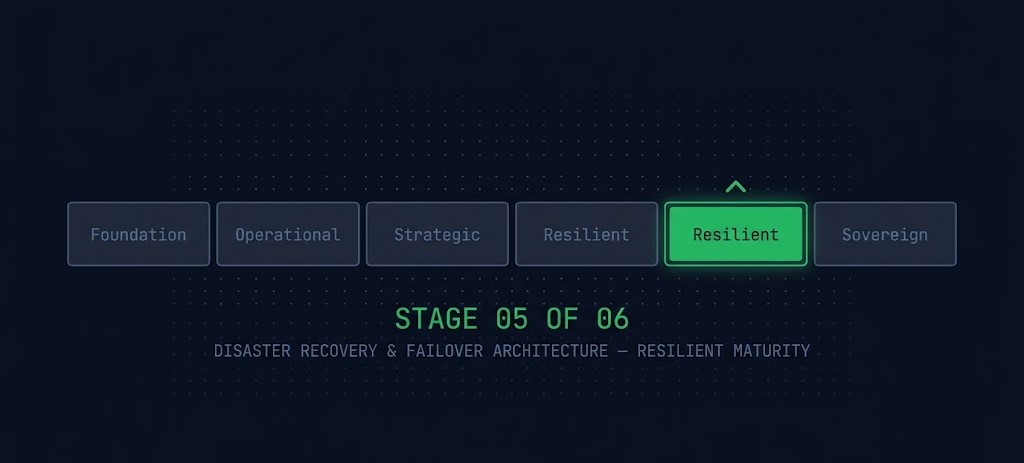
>_ Architecture Maturity Position
| Stage | Name | Maturity Level | Stage Question |
|---|---|---|---|
| Stage 1 | Recovery Architecture Foundations | Foundation | Can this system be recovered? |
| Stage 2 | Recovery Platform Architecture | Operational | How is recovery executed? |
| Stage 3 | Immutability & Cyber-Vaulting | Strategic | How is recovery isolated from compromise? |
| Stage 4 | Ransomware Survival Architecture | Resilient | How does recovery survive adversarial attack? |
| Stage 5 ← YOU ARE HERE | Disaster Recovery & Failover Architecture | Resilient | Does continuity survive infrastructure failure? |
| Stage 6 | Governance & Recovery Assurance | Sovereign | Can the continuity claim itself survive independent challenge? |
>_ Where This Stage Sits
The Data Protection Path Is a Recovery Lifecycle Progression
| Stage | Architectural Question |
|---|---|
| Stage 1 — Recovery Architecture Foundations | Can this system be recovered? |
| Stage 2 — Recovery Platform Architecture | How is recovery executed? |
| Stage 3 — Immutability & Cyber-Vaulting | How is recovery isolated? |
| Stage 4 — Ransomware Survival Architecture | How does recovery survive attack? |
| Stage 5 — Disaster Recovery & Failover Architecture | Does continuity survive infrastructure failure? |
| Stage 6 — Governance & Recovery Assurance | Can the continuity claim itself survive independent challenge? |
Stages 1 through 4 build a recovery architecture that is designed, executable, isolated, and adversarially survived. Stage 5 is the first to ask whether continuity — not recovery — holds once that architecture executes. Stage 6 assumes the continuity this stage validates is already in place.
>_ Stage Framework Progression
| Stage | Framework | Question |
|---|---|---|
| Stage 3 | Isolation Survivability Boundary | How is recovery isolated from compromise? |
| Stage 4 | Recoverability Gap | Does recovery survive compromise? |
| Stage 5 | Continuity Execution Boundary | Does continuity survive infrastructure failure? |
| Stage 6 | To be determined | Can continuity be proven? |
>_ Stage Reading Sequence
CONTINUITY VALIDATION BEGINS HERE
The sequence below moves through five continuity domains in order. Cluster 1 establishes the stage doctrine. Cluster 2 asks what has to survive for recovery to matter. Cluster 3 asks whether surviving the outage actually preserves the ability to recover — the strongest framework concentration on this page. The failure states grid names how continuity breaks, read before Cluster 4’s framework reveal so the determinism argument lands as an explanation, not a restatement. Cluster 5 closes at authority — who owns the call.
Reading out of sequence is possible. Cluster 3 lands with more force if Cluster 2’s dependency argument is read first.
Architectural question: When does recovery stop being a technical process and become an operational one?
When does recovery stop being technical and become operational?
This cluster establishes the stage doctrine. Everything after it should be read as crossing the continuity execution boundary — the line where a technically successful failover either does or doesn’t translate into the business actually resuming.
Architectural question: What has to survive for recovery to matter?
What has to survive for recovery to matter?
This is where this stage becomes genuinely different from Stage 4. The infrastructure can come back online completely and continuity still never starts, because identity didn’t come back, DNS didn’t repoint, or a certificate chain silently broke mid-failover.
Cross-pillar citations, referenced but not counted in this cluster’s reading total: Your Migration Succeeded. The Identity Chain Didn’t. (Virtualization pillar — migration-specific identity chain failure) and Infrastructure Survivability Starts In The Pipeline (Modern Infrastructure & IaC — whether the mechanism that would execute a failover survives in the first place).
Architectural question: Does surviving the outage actually preserve the ability to recover?
Replication preserves availability. Recovery preserves recoverability. These are not the same outcome.
Does surviving the outage actually preserve the ability to recover?
Most disaster recovery content treats replication as inherently protective — a second copy of the data equals safety. This is the strongest framework concentration on the page, and it argues the opposite is often true: replication, done without the right validation, can actively destroy the thing it was built to protect.
>_ Continuity Failure States
>_ Common Continuity Failure States
Architectural question: Can the outcome be predicted before the event occurs?
Can the outcome be predicted before the event occurs?
By now the reader understands continuity, dependencies, and the specific ways replication can quietly undermine recoverability. This cluster explains why so many DR tests pass while the actual recovery they’d produce remains unpredictable, and reveals the framework that names the determinism gap directly.
Architectural question: Who owns continuity execution?
Who owns continuity execution?
Technology can satisfy every domain covered so far and this cluster still closes the stage on a different note entirely: authority. The same way Stage 2 ends at ownership and Stage 4’s governance lineage ends at accountability, Stage 5 ends at the question of who is actually responsible when continuity itself, not just the technical failover, is on the line.
Even when continuity execution authority is clearly defined, recovery still depends on trust in the evidence proving that execution actually occurred. The next stage examines how that trust itself gets governed, validated, and continuously verified — not as a one-time audit, but as an ongoing organizational practice. That next stage now has a live anchor: Recovery Evidence Boundary (#167) names the condition directly — recovery evidence existing without any authority structurally independent of the team that produced it having standing to reject the claim.
>_ Recovery Architecture Workbench
The three domains this stage covers — execution boundary, dependency mapping, and validation and determinism — each have a live diagnostic built against them. Run these against an actual environment rather than treating the frameworks above as descriptive only.
>_ Stage Graduates Can Now
Ransomware Survival Architecture (Stage 4) answers whether recovery survives adversarial compromise. Disaster Recovery & Failover Architecture (Stage 5) answers whether continuity survives infrastructure failure that isn’t adversarial at all — a distinct and, for most organizations, entirely untested claim. The capabilities below are what make that distinction operational.
- Evaluate a disaster recovery architecture across five continuity domains — execution boundary, dependency survival, state survivability, validation and determinism, and recovery authority
- Determine whether the Continuity Execution Boundary is open or closed against the organization’s actual dependency and authority chain
- Distinguish a passed failover test (technical) from validated continuity (operational) as two separate, independently testable architectural facts
- Identify Continuity Theater before a real infrastructure failure does
- Enter Stage 6 — Governance & Recovery Assurance — with a dependency-and-authority-validated continuity architecture, ready to evaluate how recoverability is continuously proven rather than validated once
>_ Where Do You Go From Here
ARCHITECTURE REVIEW
Recovery Readiness Assessment
A structured review of your continuity dependency chain, failover design, replication state, and recovery authority — before the next infrastructure failure exposes the gaps.
[+] Request Assessment →WEEKLY DISPATCH
Weekly Dispatch
Architecture signals, framework updates, and new content from across the five pillars — delivered weekly for senior infrastructure architects.
[+] Subscribe →>_ Frequently Asked Questions
Q: What is disaster recovery and failover architecture?
A: It’s the discipline of testing whether an organization actually resumes operating once a technical failover completes — not whether the failover itself executes cleanly. It evaluates continuity across five domains: execution boundary, dependency survival, state survivability, validation and determinism, and recovery authority.
Q: What is the Continuity Execution Boundary?
A: The point at which infrastructure recovery has been validated as executable and survivable, but the dependencies and ownership decisions required for the business to actually resume operating haven’t been separately tested. Its named failure state is Continuity Theater — failover mechanisms pass every test, but continuity depends on assumptions that have never been validated under real conditions.
Q: What’s the difference between disaster recovery and continuity?
A: Disaster recovery is a technical claim — the workload, data, or platform can be restored. Continuity is an operational claim — the business actually resumes running once that restoration completes. An architecture can satisfy the first and fail the second, because the dependencies and authority decisions around a technically successful failover are rarely tested on their own terms.
Q: Why do DR tests often pass when continuity would actually fail?
A: Most DR tests simulate infrastructure loss alone — a region goes dark, a disk fails — while every dependency the recovery plan assumes (identity, DNS, certificates, network) stays healthy throughout the test. A test that never breaks one of those dependencies mid-failover validates execution capability, not continuity.
Q: Does replication guarantee recoverability?
A: No. Replicated data existing in a second location is a state fact, not a recovery guarantee. Corruption can propagate silently through replication, dependencies can go unmapped until restore time, and the replica’s actual recoverability within a given time window is a separate, untestable-by-inspection claim. Replication preserves availability; recovery preserves recoverability.
Q: How do you measure whether a disaster recovery process is deterministic?
A: Across four variables: sequence (restore order fixed and validated, not operator-chosen), dependency (required dependencies known and bounded, not discovered at restore time), authority (decision rights invariant under incident conditions), and validation (success criteria predefined and repeatable, not adjudicated ad hoc). A process failing any one of these produces variable outcomes against an unchanged failure input.
>_ Related Systems
Ransomware Survival Architecture (Stage 4). The adversarial-survival evaluation this stage’s continuity work assumes has already been completed.
Open Stage →Your Ransomware Recovery Plan Has a Recoverability Gap. The Stage 4 anchor framework this stage’s Continuity Execution Boundary depends on.
Open Post →Recovery Dependency Mapper — maps the identity, DNS, certificate, and network dependency chain a recovery plan assumes but rarely tests.
Open Tool →Your Recovery Program Has a Recovery Evidence Boundary (#167). The D6 anchor EP, now live — independent validation authority as the terminal claim above continuity, execution, and survival.
Open Stage →Strategic Resilience (Stage 7 of the Cloud Architecture Path) — Authority Survivability Boundary. Same “does authority survive the event?” question applied to cloud control planes rather than recovery specifically.
Open Stage →Infrastructure Survivability Starts In The Pipeline — Infrastructure Pipeline Survivability Boundary. Adjacent question: does the mechanism that would execute a failover survive in the first place.
Open Post →NIST SP 800-34 Rev. 1 — Contingency Planning Guide for Federal Information Systems. Federal guidance on recovery planning, testing, and improvement at the execution layer.
Open Reference →CISA Continuity of Operations guidance — federal guidance on dependency mapping and continuity planning under real infrastructure failure conditions.
Open Reference →