

CONTROL PLANE BOUNDARIES
Where the right to change infrastructure state is assigned, not assumed.
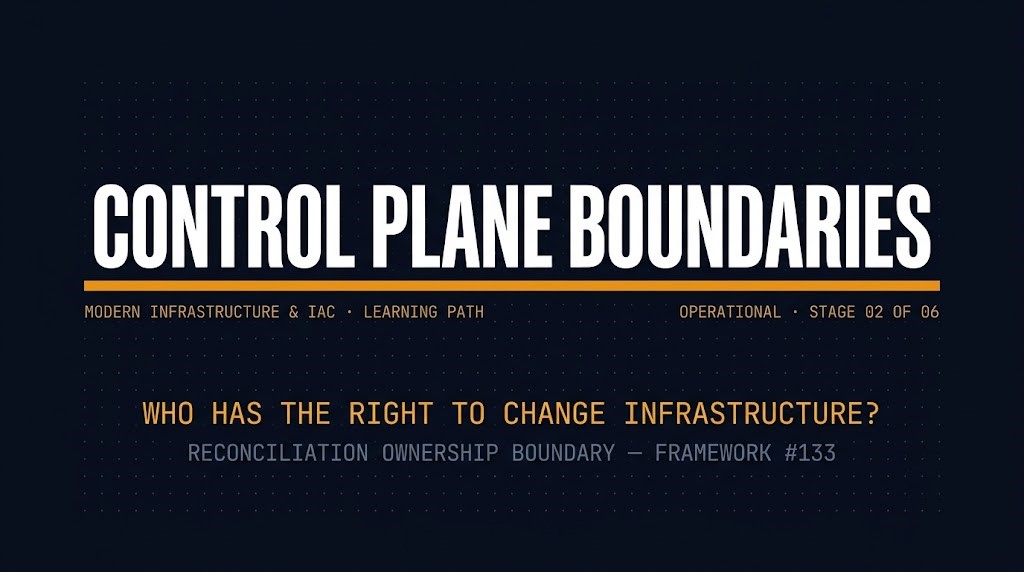
MATURITY POSITION — STAGE 2 OF 6
- Current Stage: Control Plane Boundaries
- Primary Architectural Concern: Which system holds enforcement authority over a given infrastructure change, and what happens when more than one system believes it does
- Primary Failure Mode: Control Plane Ambiguity — multiple systems can modify infrastructure state, but ownership of enforcement authority cannot be unambiguously identified
- Stage Outcome: Reader can identify competing control-plane claimants, assign authoritative ownership, and recognize Policy Intent Drift before it becomes operational drift
- Next Stage: MI3 — State & Dependency Architecture — How does infrastructure become a platform product?
Control plane ownership is the point at which infrastructure changes stop being a capability multiple systems can exercise independently and become a decision authority one system is responsible for enforcing. Terraform can change infrastructure. A console can change infrastructure. A CI/CD pipeline, a GitOps controller, an internal developer platform — all of them can. MI1 taught you to decide whether infrastructure deserves to become code. MI2 exists because that decision, once made, creates a new problem nobody assigned an owner to: which of the systems now capable of executing that declared intent is actually responsible for it.
This stage doesn’t argue for GitOps over ClickOps, or Terraform over OpenTofu, or Kubernetes operators over platform APIs. Every one of those is a mechanism. This stage teaches you to separate the mechanism from the authority — to name, deliberately, which system’s decision to change infrastructure state is the one that counts, and to recognize the moment that authority becomes ambiguous before it shows up as drift, an incident, or an argument in a postmortem about whose change actually won.
The Modern Infrastructure & IaC Path Is an Intent-Governance Progression
| Stage | Architectural Question |
|---|---|
| MI1 — Declarative Infrastructure | When does infrastructure deserve to become code? |
| MI2 — Control Plane Boundaries | Who has the right to change infrastructure? |
| MI3 — State & Dependency Architecture | How does infrastructure become a platform product? |
| MI4 — Governance & Drift | How is infrastructure governed? |
| MI5 — Economics of Automation | How does infrastructure survive change? |
| MI6 — Infrastructure Survivability | How is infrastructure continuously proven? |
MI2 assumes MI1’s declarative/imperative test has already been applied. It does not assume every claimant to control-plane authority has been reconciled — that reconciliation is this stage’s entire job, and MI3 through MI6 all inherit whichever ownership model MI2 leaves you with.
WHY THIS STAGE EXISTS — CONTROL PLANE AMBIGUITY
Most organizations believe adopting GitOps or a platform API solves the ownership question. In practice, they’ve usually just added a fourth system capable of changing infrastructure state — without retiring the other three’s ability to do the same thing.
Stage Anchor Question
Who has the right to change infrastructure?
Not: which system executed the last change? Not: which tool is officially sanctioned? MI2 answers which system’s decision to modify infrastructure state is the authoritative one — independent of which systems are technically capable of making that change, and independent of which one happened to win this time.
Control Plane Ambiguity is the named failure state for this stage: multiple systems possess the ability to modify infrastructure state, but ownership of enforcement authority cannot be unambiguously identified. Terraform plans apply cleanly. The GitOps controller reconciles without error. The console still works. Each system is functioning exactly as designed — the failure isn’t in any one of them, it’s in the fact that nobody decided which one gets the final word when they disagree.
This maps directly onto Framework #133’s core finding: declared infrastructure intent and enforced infrastructure behavior diverge silently whenever ownership of reconciliation was never explicitly assigned. The tooling didn’t fail. The assignment was never made.
Stage Anchor Framework — Policy Intent Drift
Reconciliation Ownership Boundary (#133)
The point at which declared infrastructure intent and enforced infrastructure behavior diverge because ownership of reconciliation was never explicitly assigned. Below the boundary, policy exists, but multiple systems can modify state and no authoritative reconciler exists. Above the boundary, policy exists, one authoritative system owns reconciliation, and declared intent and enforced state remain aligned.
Named Failure State: Control Plane Ambiguity — multiple systems possess the ability to modify infrastructure state, but ownership of enforcement authority cannot be unambiguously identified · Cross-Pillar Reference: Framework #135 Control Plane Ownership Boundary (Cloud Strategy, CS4) — same coordination-density lineage (#132), addresses the authority question at the strategic/organizational layer this stage addresses at the execution layer
Why Architects Misjudge Control Planes
Tools are mistaken for authority. Terraform, GitOps, CI/CD, and internal developer platforms are mechanisms — they describe how a change gets executed, not who was authorized to decide it should happen. Owning the pipeline is not the same as owning the decision the pipeline carries out.
Reconciliation is mistaken for governance. A system can enforce policy without owning policy. A GitOps controller reconciling state toward what’s in Git is executing someone else’s authority correctly — it isn’t evidence that the controller itself is the governing system, only that it’s a faithful executor of whatever authority fed it.
Visibility is mistaken for control. Dashboards, drift detectors, and observability tools can show you exactly what changed and when — without any of that visibility making the observing system authoritative over what should happen next. Seeing the state is not the same as owning it.
What This Stage Is Not
Not a Terraform vs. GitOps vs. Kubernetes operators tool comparison. Tool selection is out of scope — MI2 evaluates who is authorized to decide, independent of which tool executes the decision.
Not a certification-track curriculum or vendor training. No badges, no vendor-specific best-practice checklists.
Not an argument that GitOps automatically solves ownership. Reconciliation is frequently mistaken for governance — treating a working control loop as proof the ownership question is settled is exactly the misjudgment named above.
Not a mandate to centralize all infrastructure changes into a single tool. The mandate is to centralize the decision of who’s authorized — multiple systems can retain execution capability without competing for enforcement authority.
>_ Estimated Reading Depth
| Format | Count | Estimated Time | Notes |
|---|---|---|---|
| Architecture articles — Cluster 01 | 2 | ~22 min | Ownership claims — who believes they own the change, from GitOps policy drift to platform-API deferral |
| Architecture articles — Cluster 02 | 1 | ~11 min | Competing authorities — what happens when multiple systems believe they’re authoritative |
| Control Plane Ambiguity Failure Patterns Grid | 1 | ~8 min | Five failure patterns — read immediately after Cluster 02, before the framework reveal |
| Architecture articles — Cluster 03 | 3 | ~33 min | Execution authority — which system actually wins, and drift as the symptom of an unresolved answer |
| Architecture articles — Cluster 04 | 1 | ~10 min | Emergent control planes — warning section on authority appearing without anyone designing it |
| Total stage depth | 7 | ~84 min | Operational stage — assumes MI1’s declarative/imperative qualifying test is already applied |
Reading Depth: ~84 min estimated across 7 articles. Final duration recalculated after article publication based on actual word count.
>_ Where To Enter This Stage
Enter here if your organization already has multiple systems capable of changing infrastructure — Terraform, a GitOps controller, a CI/CD pipeline, a platform API — and nobody has explicitly decided which one wins when they disagree. If you already know exactly which system holds final reconciliation authority for every class of infrastructure change, and can explain why, skip to MI3.
Skip-ahead criteria: Architects who can name their organization’s single authoritative reconciler for every control-plane claimant already in production, who aren’t seeing Control Plane Ambiguity symptoms — competing applies, undocumented override paths, disagreement about which system’s state is “real” — and who have already resolved Framework #133’s reconciliation-ownership question, may consider entering at MI3 — State & Dependency Architecture.
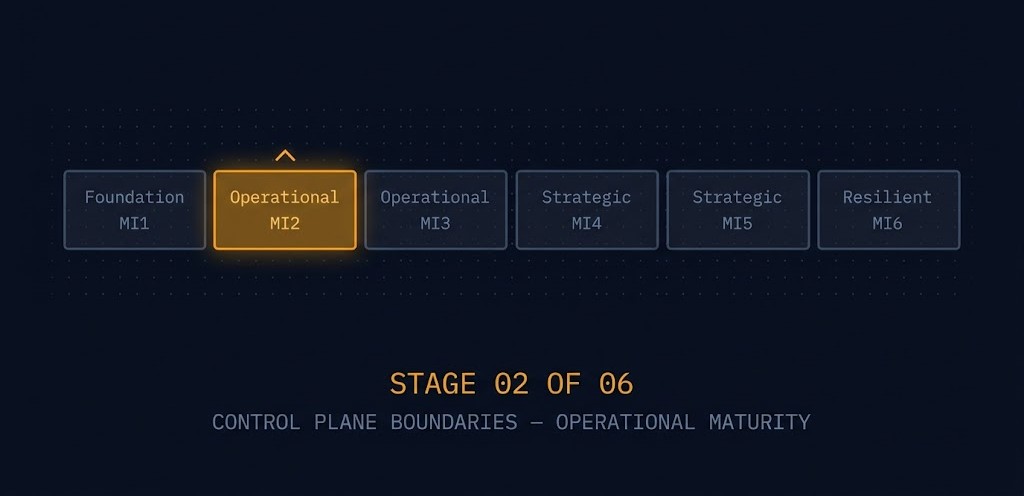
>_ Architecture Maturity Position
| Stage | Name | Maturity Level | Stage Question |
|---|---|---|---|
| MI1 | Declarative Infrastructure | Foundation | When does infrastructure deserve to become code? |
| MI2 ← YOU ARE HERE | Control Plane Boundaries | Operational | Who has the right to change infrastructure? |
| MI3 | State & Dependency Architecture | Operational | How does infrastructure become a platform product? |
| MI4 | Governance & Drift | Strategic | How is infrastructure governed? |
| MI5 | Economics of Automation | Strategic | How does infrastructure survive change? |
| MI6 | Infrastructure Survivability | Resilient | How is infrastructure continuously proven? |
>_ Stage Reading Sequence
CONTROL PLANE BOUNDARIES BEGINS HERE
The sequence below moves through four architectural questions in order. Cluster 01 establishes who believes they own the change — GitOps’s policy-drift problem and the internal developer platform’s deferred-ownership problem. Cluster 02 raises the stakes: what happens when a second system, outside the pipeline entirely, believes it’s just as authoritative. The failure patterns grid sits immediately after, because it names what breaks when that conflict goes unresolved — before the framework that explains why. Cluster 03 answers the practical question of which system actually wins when the conflict plays out in production, including drift as the symptom rather than the disease. Cluster 04 closes the stage with a warning: control planes that nobody designed, appearing anyway.
Reading out of sequence is possible. The failure patterns grid gives the architectural reason to read Clusters 01–02 before the resolution and warning content that follows them.
Architectural question: Who believes they own the change?
Who believes they own the change?
Framework #133’s own anchor post shows how declared and enforced policy diverge inside GitOps itself. The IDP article extends the same problem one layer up — a platform team can defer the ownership question, but deferring it isn’t resolving it.
Architectural question: What happens when multiple systems believe they are authoritative?
What happens when multiple systems believe they are authoritative?
The console never stopped being a control plane just because Terraform arrived. It’s the clearest case of two systems both technically capable of changing state, with neither one formally deprecated as authoritative over the other.
>_ Common Control Plane Ambiguity Failure Patterns
Architectural question: Which system actually wins?
Which system actually wins?
The pipeline is frequently the real control plane, whether anyone designed it that way or not. Drift is what unresolved ownership looks like operationally — a symptom, not the underlying conflict. Terraform’s own Day-2 operations debt is where accumulated ownership ambiguity compounds into real cost.
Architectural question: How do control planes appear without anyone designing them?
How do control planes appear without anyone designing them?
Closes the stage as a warning rather than core doctrine: the same ownership ambiguity this stage names in Terraform and GitOps is already forming in AI tooling, faster and with less scrutiny, because nobody set out to build a control plane at all.
>_ Stage Graduates Can Now
You can now identify competing control-plane claimants and assign infrastructure ownership deliberately, rather than letting it default to whichever system executed last. What Strategic maturity adds is the question MI2 cannot answer: once ownership is established, how does infrastructure become a platform product consumed by others?
- Identify competing control-plane claimants — pipelines, consoles, APIs, and identity systems all capable of changing infrastructure state
- Distinguish enforcement authority from execution authority
- Recognize Control Plane Ambiguity before it becomes drift
- Assign infrastructure ownership to a single authoritative system without eliminating other systems’ execution capability
- Place Framework #133 — Reconciliation Ownership Boundary — and its cross-pillar counterpart, Framework #135, at CS4
>_ Where Do You Go From Here
ARCHITECTURE REVIEW
Infrastructure Architecture Review
A structured review of who actually holds enforcement authority across your infrastructure estate, and whether Control Plane Ambiguity is already costing you in drift, incidents, or disputed ownership.
[+] Request Assessment →WEEKLY DISPATCH
Weekly Dispatch
Architecture signals, framework updates, and new content from across the five pillars — delivered weekly for senior infrastructure architects.
[+] Subscribe →>_ Frequently Asked Questions
Q1: What’s the difference between a control plane and a source of truth?
A: A source of truth describes intended state. A control plane possesses authority to enforce state. In mature architectures the two are often connected, but they are not automatically the same thing — Git can be an accurate source of truth while three different systems all claim the right to reconcile production toward it. MI2 is about resolving that second question, not the first.
Q2: What is Framework #133 — Reconciliation Ownership Boundary?
A: The point at which declared infrastructure intent and enforced infrastructure behavior diverge because ownership of reconciliation was never explicitly assigned. Below the boundary, multiple systems can modify state and no authoritative reconciler exists. Above it, one authoritative system owns reconciliation and declared intent stays aligned with enforced state.
Q3: What is Control Plane Ambiguity?
A: The named failure state for this stage — multiple systems possess the ability to modify infrastructure state, but ownership of enforcement authority cannot be unambiguously identified. Every individual system may be functioning correctly. The failure is that nobody decided which one wins when they disagree.
Q4: Isn’t GitOps supposed to solve this problem?
A: GitOps solves reconciliation mechanics — converging production toward what’s declared in Git, automatically and repeatably. It doesn’t automatically solve ownership. A GitOps controller can faithfully execute whatever authority feeds it while the organization has never actually decided that the controller, rather than the console or the pipeline, is the authoritative system. Reconciliation working is not evidence that ownership is resolved.
Q5: How is this different from Framework #135 at CS4?
A: Same architectural lineage, different layer. Framework #135 (Control Plane Ownership Boundary, Cloud Strategy) defines who holds ownership authority at the strategic, organizational level. Framework #133 (Reconciliation Ownership Boundary, this stage) applies that same boundary to infrastructure execution — which system actually enforces the change once organizational authority has been assigned. Both trace back to Framework #132’s coordination-density lineage.
Q6: When should you skip ahead to MI3?
A: When you can name your organization’s single authoritative reconciler for every control-plane claimant already in production, aren’t seeing Control Plane Ambiguity symptoms — competing applies, undocumented override paths, disagreement about which system’s state is real — and have already resolved Framework #133’s reconciliation-ownership question. If any of those is untested, complete this stage first. MI3 assumes the ownership model this stage teaches has already been assigned.
>_ Related Systems
MI1 — Declarative Infrastructure. The prerequisite stage — whether infrastructure deserves to become code, before this stage asks who controls it once it is.
Open Stage →MI3 — State & Dependency Architecture. The next stage — how infrastructure becomes a platform product once control-plane ownership is settled.
Open Stage →GitOps Boundary Mapper (GBM). This stage’s own live diagnostic — maps which system actually holds reconciliation authority across a real environment.
Open Tool →The Network Is Becoming the AI Control Plane. Related warning reading — the same emergent-authority pattern as Cluster 04, one layer down the stack.
Open Post →CS4 — Control Plane Architecture. Framework #135 Control Plane Ownership Boundary — the same ownership question, addressed at the strategic/organizational layer.
Open Stage →Coordination Density (#132). The upstream explanatory framework for both #133 and #135 — rising orchestration and governance overhead is what forces the ownership question.
Open Post →OpenGitOps — GitOps Principles. The CNCF-backed reference for the reconciliation-loop model this stage’s Cluster 01 and Cluster 03 content builds on.
Open Reference →Kubernetes — Operator Pattern documentation. Vendor-neutral primer on how operators claim reconciliation authority over custom resources — the Kubernetes-native version of this stage’s control-plane question.
Open Reference →