

Infrastructure Architecture Review
WHAT YOUR ESTATE ASSUMES VS. WHAT IT ACTUALLY DOES.
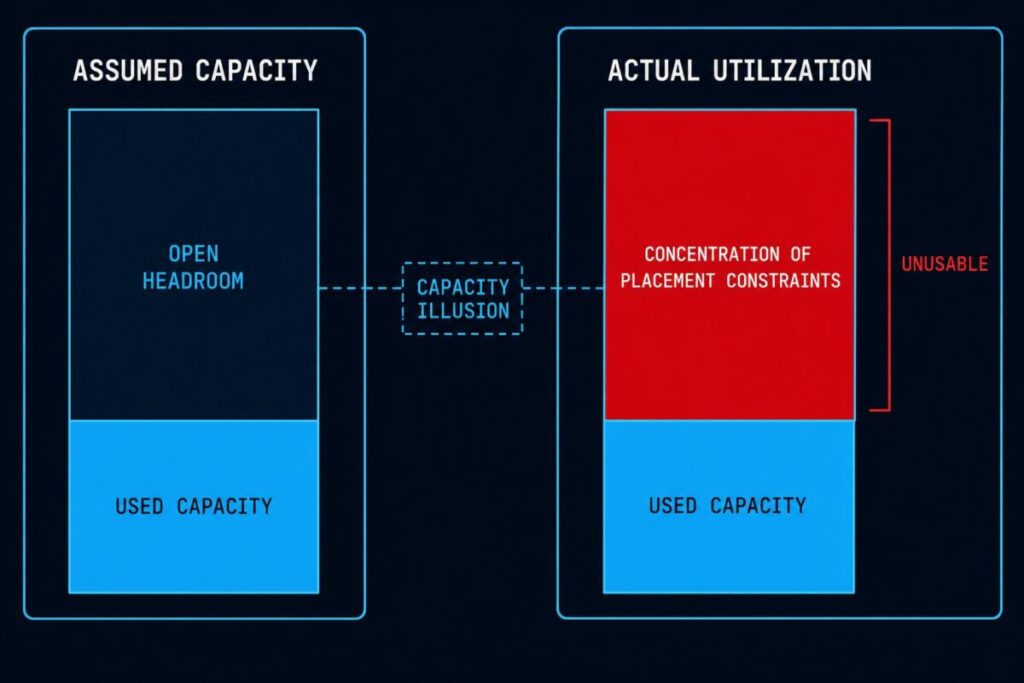
Most infrastructure estates run on inherited assumptions — capacity plans built for a different growth curve, resilience designs sized for workloads that no longer exist, governance models nobody has re-validated since the last platform migration. None of that shows up in a dashboard. It shows up during a renewal negotiation, a modernization budget cycle, or the outage that reveals a dependency nobody mapped.
The Infrastructure Architecture Review evaluates how an estate is expected to behave under growth, contention, and failure — and identifies where architectural assumptions are unsupported, unvalidated, or creating operational risk. Seven domains. A scored architecture profile. Findings your team can act on — not a vendor-funded recommendation dressed up as independent advice.
This is an assessment, not a sales process. No vendor relationships influence findings. No implementation is sold as part of the engagement.
>_ Seven Assessment Domains
Resource utilization patterns, workload placement efficiency, capacity sustainability, virtualization density, and the compute layer’s ability to support projected growth without operational or economic constraints.
Performance characteristics, resilience design, growth trends, data protection alignment, storage efficiency, and long-term platform sustainability under changing workload demands.
East-west and north-south traffic patterns, segmentation strategy, dependency concentration, operational resilience, and the network’s ability to support future application and infrastructure requirements.
Cluster density, node balance, resource contention, fault domain design, operational scalability, and long-term sustainability of the HCI operating model under projected growth.
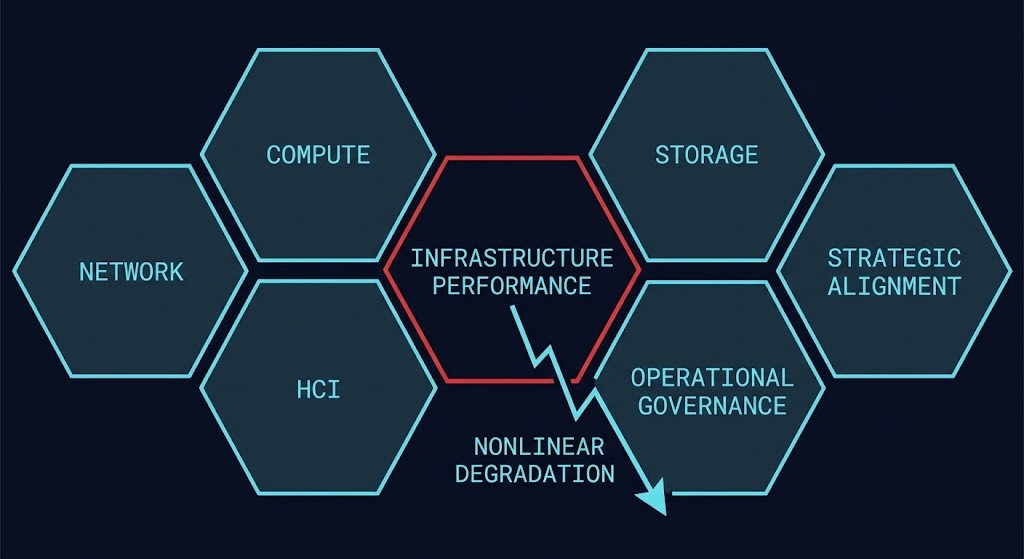
Performance survivability under growth, degradation pathways, hidden bottlenecks, failure propagation risk, and operational behavior during stress or change.
Visibility, lifecycle management, architecture ownership, platform standards, upgrade eligibility, exit optionality, and the processes used to sustain infrastructure decisions over time.
Alignment between current infrastructure investments, business objectives, growth expectations, modernization timelines, and the architectural decisions required to reach the target operating model.
The Infrastructure Architecture Review does not evaluate vendor selection, does not recommend specific products, and does not perform implementation work. The scope is architectural condition — not procurement guidance.
>_ Common Architectural Findings
Available headroom appears healthy on paper, but usable capacity is materially lower due to workload concentration, active contention, or architectural placement constraints.
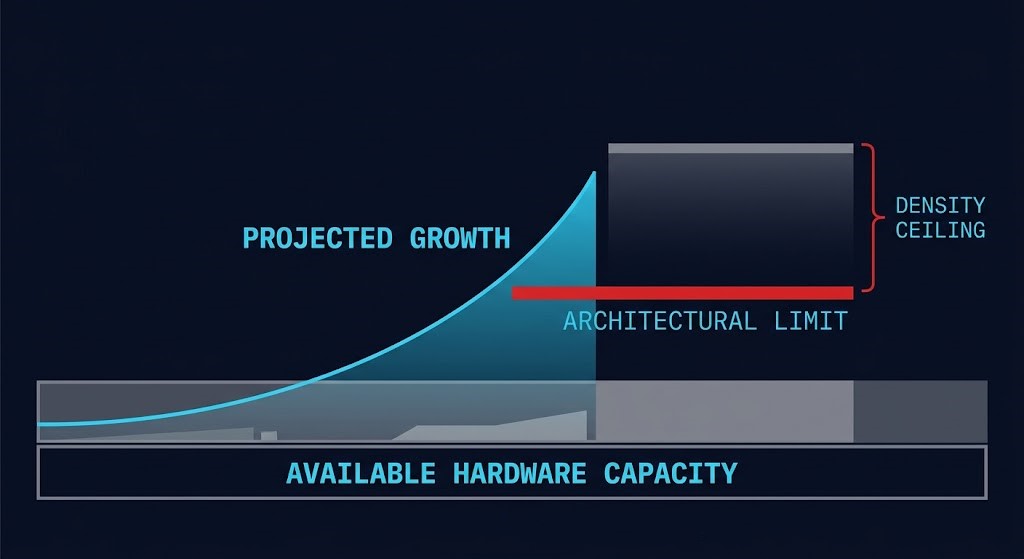
Infrastructure growth is approaching an architectural limit rather than a hardware limit, reducing expansion flexibility and increasing operational complexity.
Systems remain stable under normal operating conditions but exhibit nonlinear degradation during peak demand, maintenance events, or component failures.
Critical business services rely on a small number of infrastructure components, creating an outsized operational blast radius when disruptions occur.
Infrastructure standards exist but are applied inconsistently, resulting in growing operational variance, hidden technical debt, and reduced architectural predictability.
The review is designed to surface conditions that are often invisible during normal operations but become critical during growth, modernization, migration, or recovery events.
>_ Built for Infrastructure Leaders
Typical engagements include:
- VMware renewal evaluation
- Post-acquisition infrastructure reviews
- Nutanix and HCI modernization planning
- Capacity and performance investigations
- New leadership inheriting an existing environment
- Platform strategy validation before major investment
Three-Tier Service Model
| Tier | Name | Starting Price | Scope |
|---|---|---|---|
| 1 | Infrastructure Health Review | $4,500 | High-level review across primary domains — findings register, risk summary |
| 2 | Infrastructure Architecture Review ★ Featured Engagement | $12,500 | Full 7-domain assessment — featured engagement |
| 3 | Strategic Architecture Assessment | $25,000+ | Multi-site, complex environments — 36-month modernization roadmap |
No range shown on Tier 2. Tier 3 shows an open ceiling — complexity-based pricing confirmed on the intake call.
Assessment Outputs
The Infrastructure Architecture Assessment Report contains:
- Executive Summary — plain-language condition summary for CIO/CFO/board presentation
- Executive Risk Summary — domain-level risk ratings (Low/Moderate/High) with directional indicators
- Architecture Scorecard — per-domain letter grade ratings across all 7 domains
- Risk Matrix — all findings plotted against probability and impact
- Findings Register — top 5–10 findings with named architectural conditions, domain attribution, severity
- Capacity Sustainability Profile — headroom vs. growth trajectory
- Performance Survivability Profile — operating boundary assessment
- Strategic Recommendations — prioritized actions across 12, 24, and 36-month horizons
- Executive Readout Session — live findings walkthrough with technology leadership
Sample Output
The Architecture Scorecard and Executive Risk Summary are the two documents most commonly presented upward — to a CIO, a CFO, or a board. The sample below reflects the format of a real engagement output.
Infrastructure Architecture Assessment Report
Architecture Scorecard — Example Output
Assessment Scope: Example Organization
Report Date: August 2026
Architecture Scorecard
| Domain | Rating |
|---|---|
| Compute Architecture | B |
| Storage Architecture | A− |
| Network Architecture | C+ |
| Hyperconverged Infrastructure | B− |
| Infrastructure Performance | C |
| Operational Governance | B |
| Strategic Alignment | C+ |
Executive Risk Summary
| Area | Risk Rating | Direction |
|---|---|---|
| Compute Sustainability | Moderate | → Stable |
| Storage Sustainability | Low | ↓ Improving |
| Network Resilience | Moderate | ↑ Increasing |
| HCI Density Outlook | High Risk | ↑ Increasing |
| Operational Governance | Moderate | → Stable |
| Performance Survivability | High Risk | ↑ Increasing |
Top Findings — Example
Example output — ratings and findings reflect a representative engagement scenario, not an actual client.
Focus Engagements (Add-On Scope)
Not standalone products — depth extensions where Architecture Review findings warrant a closer look. Scope confirmed on the intake call.
| Focus Engagement | Starting Price |
|---|---|
| Compute Architecture Deep Dive | $4,500 |
| Storage Architecture Deep Dive | $4,500 |
| Network Architecture Deep Dive | $4,500 |
| HCI Sustainability Analysis | $4,500 |
| Performance Survivability Modeling | $5,000 |
| On-Site Technical Deep Dive (1 day) | $4,000 + travel |
>_ Infrastructure Architecture Review Options
High-level condition check across primary domains. Right-sized for smaller estates or early-stage exploratory reviews.
- Multi-domain condition review (condensed scope)
- Prioritized risk summary
- Executive-readable findings summary
- Recommendation for full Architecture Review if warranted
The full engagement. All 7 domains. All 9 named deliverables. The anchor offering.
- Full 7-domain architecture evaluation
- Executive Risk Summary + Architecture Scorecard
- Risk Matrix + Findings Register
- Capacity Sustainability Profile
- Performance Survivability Profile
- Strategic Recommendations (12/24/36-month horizons)
- Executive Readout Session
Multi-site, multi-environment engagements requiring a longer modernization horizon.
- Everything in the Architecture Review
- Multi-site / multi-environment scope
- Extended 36-month modernization roadmap as primary strategic deliverable
- Complexity-based pricing confirmed on intake call
The Infrastructure Architecture Review follows a three-phase process. The clock starts at artifact delivery, not at contract signature.
Discovery (1–2 weeks) — Remote data collection. No production access required or accepted. Architecture diagrams, HLDs/LLDs, BOMs, platform inventories, and performance exports establish the current-state baseline.
Analysis (1–2 weeks) — Domain evaluation against the Rack2Cloud Architecture Framework library. Domain ratings, risk classifications, and findings produced. The Executive Readout Session is scheduled during this phase — not at report delivery.
Findings (1 week) — Report delivered. Executive Readout Session conducted — a live walkthrough with your technology leadership team, with time allocated for priority discussion and strategic recommendations review.
>_ Get Started
Not sure which tier fits? Reach out directly to scope the engagement.
Talk to an Architect →Frequently Asked Questions
Q: How is the Infrastructure Architecture Review different from a vendor health check?
A: Vendor health checks are performed by the company that sold you the platform, with an inherent interest in the outcome. The Infrastructure Architecture Review is independent — no vendor relationships influence findings, and the engagement includes no implementation or vendor selection work. The output is an architectural condition assessment, not a renewal justification.
Q: What access do you need to our environment?
A: None. Discovery is artifact-based — architecture diagrams, HLDs/LLDs, BOMs, platform inventories, and performance exports. No production access is required or accepted, which protects both sides of the engagement.
Q: How long does the engagement take?
A: 3–5 weeks from artifact delivery — not from contract signature. Discovery runs 1–2 weeks, Analysis 1–2 weeks, Findings 1 week, ending in a live Executive Readout Session with your technology leadership team.
Q: What happens to our data after the engagement?
A: Artifacts are retained only as long as needed to complete the engagement, then destroyed with written confirmation provided to the client. Access is limited to the assessor — no third-party access.