

GOVERNANCE & RECOVERY ASSURANCE
Recovery is not complete when the system returns. Recovery is complete when the evidence supporting that return can withstand independent examination.
MATURITY POSITION — STAGE 6 OF 6
- Current Stage: Governance & Recovery Assurance
- Primary Architectural Concern: Can recovery evidence survive challenge from a party that did not create, execute, or validate the recovery outcome — not whether a test passed, but whether the claim the test produced deserves trust?
- Primary Failure Mode: Evidence Theater — recovery evidence exists, looks complete, and satisfies every internal review, but no party with actual standing to reject the conclusion has ever been given the opportunity to.
- Stage Outcome: Reader can determine whether recovery evidence survives challenge from a party that did not create, execute, or validate the recovery outcome — platform-generated evidence versus independent authority, automation-generated evidence versus human validation, vendor attestation versus organizational proof.
- Path Status: Terminal stage — Governance & Recovery Assurance completes the Data Protection & Resiliency Learning Path. No Stage 7.
Governance and recovery assurance is the discipline of determining whether recovery evidence survives challenge from a party that did not create, execute, or validate the recovery outcome — not whether a disaster recovery program can produce evidence at all. The previous stage asked whether continuity itself holds once infrastructure fails. This stage asks a different question, one that applies even to a program that has passed Stage 5 cleanly: the failover succeeded, the dependencies held, the business resumed — and the organization still cannot prove any of it to anyone who wasn’t in the room, because every artifact confirming the outcome was generated, reviewed, and accepted by the same team that ran the recovery.
That gap is easy to miss because it doesn’t look like a failure. Recovery occurred. Evidence exists. A report was generated, a dashboard went green, a drill was signed off. But evidence existing and evidence surviving independent examination are two different claims, and a recovery program can satisfy the first completely while never once testing the second. Testing produces evidence. Authority evaluates evidence. Independent examination determines whether the evidence can be trusted. This stage exists because most recovery programs stop at the first step and call it proof.
WHY THIS STAGE EXISTS — THE RECOVERY EVIDENCE BOUNDARY
Recovery evidence existing and recovery evidence surviving challenge are not the same claim, and no prior stage in this path tests the difference.
Stage Anchor Question
Can the continuity claim itself survive independent challenge?
Not: did continuity hold? Not: did the failover drill pass? Governance and recovery assurance answers whether the evidence produced by recovery activity — test results, restore logs, sign-offs, metrics — was ever evaluated by an authority structurally independent of the team that produced it, or whether the organization has simply been accepting its own homework.
Stages 1 through 5 built, executed, isolated, adversarially survived, and continuity-validated the recovery architecture itself. None of them asked whether the evidence documenting any of that holds up once someone with no stake in the outcome is given standing to reject it. That is a separate, untested claim even in an organization that has passed every prior stage cleanly, because a recovery program can be genuinely sound and still have never once been examined by anyone who wasn’t responsible for making it look sound.
That is the actual maturity jump this stage represents. Stage 1 asked whether a system could be recovered. Stage 2 asked whether a platform could execute the recovery. Stage 3 asked whether isolation held under compromise. Stage 4 asked whether the full authority chain survives adversarial attack. Stage 5 asked whether continuity itself survives infrastructure failure. Stage 6 asks whether any of the evidence supporting those five answers would survive being challenged by someone who didn’t produce it. An architecture can pass every earlier stage and still fail this one completely, because Evidence Theater has nothing to do with whether recovery actually worked — it’s about whether anyone independent was ever allowed to check.
How Governance & Recovery Assurance Anchors the Full Path
| Stage | Name | Question |
|---|---|---|
| Stage 1 | Recovery Architecture Foundations | Can this system be recovered? |
| Stage 2 | Recovery Platform Architecture | How is recovery executed? |
| Stage 3 | Cyber Vault Architecture | How is recovery isolated from compromise? |
| Stage 4 | Ransomware Survival Architecture | Does recovery survive adversarial attack? |
| Stage 5 | Disaster Recovery & Failover Architecture | Does continuity survive infrastructure failure? |
| Stage 6 | Governance & Recovery Assurance | Can the continuity claim itself survive independent challenge? |
Stage 6 takes the recovery architecture the earlier stages built, executed, isolated, adversarially proved, and continuity-validated, and asks whether the evidence behind all five of those claims would survive an independent party’s challenge. This is the terminal stage — the path is complete once this question is answered.
Stage Anchor Framework — Governance & Recovery Assurance
Recovery Evidence Boundary
The point at which recovery evidence exists but no authority structurally independent from the team that produced it has standing to reject the claim it makes.
Named Failure State: Evidence Theater · Indicators: recovery reports are reviewed only by the team that generated them · no named authority exists with standing to reject a recovery claim · platform-generated dashboards are treated as independent confirmation · the last real incident revealed evidence nobody outside the recovery team had ever examined
Why Architects Misjudge Evidence
The party that produced the evidence becomes the party that judges it. Recovery evidence generated by the platform being evaluated — a dashboard, a completion log, a self-issued report — is treated as independent confirmation. It isn’t. It’s the evidence producer grading its own work, and no formal review process changes that if the reviewer and the producer are the same team.
A passed test is treated as proof, rather than as evidence awaiting examination. A test result is an input to a validation authority’s decision, not the decision itself. Most recovery programs never separate the two — the test passing and the claim being validated collapse into the same event, when they’re actually two different steps performed by two different parties.
Recovery metrics measure activity, not recoverability. A backup success rate, a completion percentage, a dashboard uptime figure — these describe that a process ran. None of them describe whether the outcome the process was supposed to produce would survive being independently re-examined after the fact.
Audit readiness is mistaken for recoverability assurance. Having documentation prepared for an auditor is not the same claim as having evidence that would survive a genuinely adversarial examination of whether recovery actually works. The first is a compliance artifact. The second is architecture. The Architecture of Premature Closure names the substitution underneath both failures — a process closing clean on the signal that’s easiest to observe, standing in for the outcome nobody separately confirmed.
This stage’s evidence-authority question assumes the organization knew what its recovery depended on before evaluating whether the claim survives challenge. Cloud-Based Recovery Didn’t Eliminate USB Drives. It Eliminated Recovery Independence. covers the design-stage version of that gap: a vendor default absorbing a recovery-dependency decision nobody voted on, upstream of any evidence question this stage exists to test.
>_ Recovery vs. Continuity vs. Evidence
Stage 5 and Stage 6 are the two stages most likely to be conflated, because both assume the recovery architecture underneath already works and both use the language of “proof.” They are not the same claim. Continuity asks whether operations actually resume. Evidence asks whether anyone can prove they did — to someone who wasn’t in the room when it happened.
| Dimension | Recovery | Continuity | Evidence |
|---|---|---|---|
| Core question | Can we restore? | Can operations continue? | Can we prove restoration? |
| Primary concern | Execution | Availability | Trust |
| Failure mode | Recovery fails | Business impact occurs | Confidence exceeds proof |
| Validation | Test execution | Service outcome | Independent examination |
| Ownership | Recovery operators | Business/service owners | Evidence authority |
The last row is the boundary this stage exists to enforce. Recovery operators own execution. Business owners own continuity. Neither can own the evidence authority role for their own work — that’s the structural condition Evidence Theater exploits.
>_ Estimated Reading Depth
| Format | Count | Estimated Time | Notes |
|---|---|---|---|
| Cluster 1 — Recovery Evidence | 2 | ~22 min | The stage doctrine and anchor framework |
| Cluster 2 — Validation Authority | 2 | ~22 min | Who is allowed to reject the claim — testing is the mechanism, not the boundary |
| Failure Patterns Grid | 1 | ~10 min | Named evidence failure states — converges on Evidence Theater |
| Cluster 3 — Metrics & Assurance | 2 | ~22 min | Measurable indicators, not proof substitutes |
| Total stage depth | 6 | ~76 min | Terminal stage — completes the Data Protection & Resiliency Learning Path |
>_ Where to Enter This Stage
Enter here once continuity has already been validated against infrastructure failure — once Stage 5’s dependency, replication, and authority domains have been confirmed to hold under real conditions. If that hasn’t been established, start at Stage 5: Disaster Recovery & Failover Architecture. Asking whether recovery evidence survives challenge before continuity itself has been proven produces an examination of evidence for a claim that was never actually validated.
Specifically, enter here if:
- Recovery drills and DR tests pass consistently, but the same team that runs them also reviews and signs off on the results
- No named authority exists with standing to reject a recovery claim — only to confirm it
- Recovery metrics (success rates, completion percentages, readiness scores) are reported upward as proof of recoverability rather than as inputs an independent party still needs to evaluate
- The organization has never asked what would happen if a board member, regulator, insurer, or acquirer’s technical team challenged a recovery claim directly
- Platform-generated dashboards or vendor attestations are the only evidence behind the organization’s recoverability claims
Terminal-stage note: There is no Stage 7 to skip ahead to. Governance & Recovery Assurance is the final maturity stage in the Data Protection & Resiliency Learning Path — this stage’s own reading sequence is the destination, not a gate to something further.
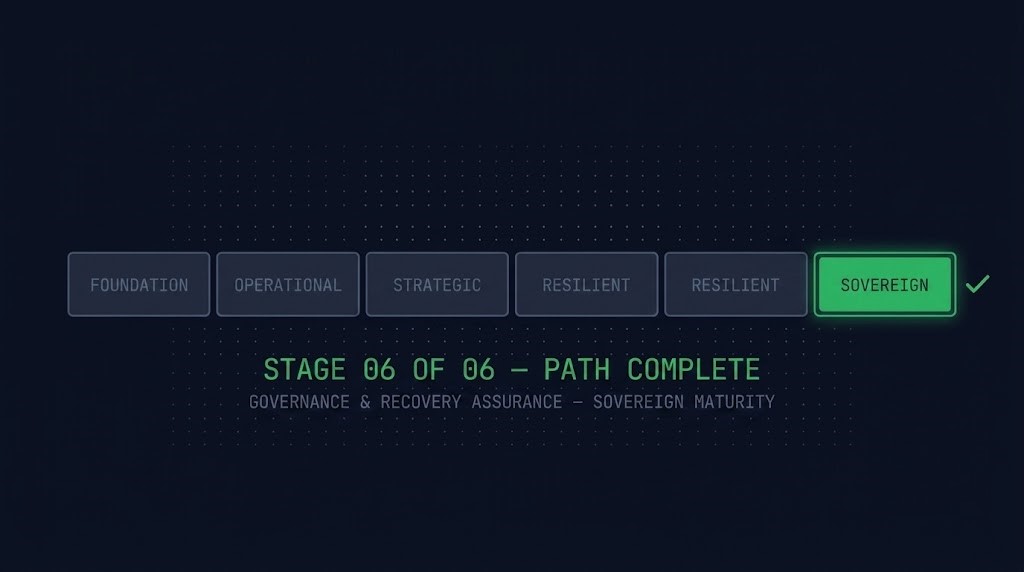
>_ Architecture Maturity Position
| Stage | Name | Maturity Level | Stage Question |
|---|---|---|---|
| Stage 1 | Recovery Architecture Foundations | Foundation | Can this system be recovered? |
| Stage 2 | Recovery Platform Architecture | Operational | How is recovery executed? |
| Stage 3 | Cyber Vault Architecture | Strategic | How is recovery isolated from compromise? |
| Stage 4 | Ransomware Survival Architecture | Resilient | Does recovery survive adversarial attack? |
| Stage 5 | Disaster Recovery & Failover Architecture | Resilient | Does continuity survive infrastructure failure? |
| Stage 6 ← YOU ARE HERE | Governance & Recovery Assurance | Sovereign | Can the continuity claim itself survive independent challenge? |
>_ Where This Stage Sits
The Data Protection Path Is a Recovery Lifecycle Progression
| Stage | Architectural Question |
|---|---|
| Stage 1 — Recovery Architecture Foundations | Can this system be recovered? |
| Stage 2 — Recovery Platform Architecture | How is recovery executed? |
| Stage 3 — Cyber Vault Architecture | How is recovery isolated? |
| Stage 4 — Ransomware Survival Architecture | How does recovery survive attack? |
| Stage 5 — Disaster Recovery & Failover Architecture | Does continuity survive infrastructure failure? |
| Stage 6 — Governance & Recovery Assurance | Can recovery evidence survive independent challenge? |
Stages 1 through 5 build a recovery architecture that is designed, executable, isolated, adversarially survived, and continuity-validated. Stage 6 is the first — and last — to ask whether the evidence behind all of it would survive being challenged by someone who didn’t produce it.
>_ Stage Framework Progression
| Stage | Framework | Question |
|---|---|---|
| Stage 4 | Recoverability Gap | Does recovery survive compromise? |
| Stage 5 | Continuity Execution Boundary | Does continuity survive infrastructure failure? |
| Stage 6 | Recovery Evidence Boundary | Can the continuity claim itself survive independent challenge? |
>_ Stage Reading Sequence
EVIDENCE VALIDATION BEGINS HERE
Testing produces evidence. Authority evaluates evidence. Independent examination determines whether the evidence can be trusted. The sequence below moves through three clusters in order. Cluster 1 establishes what evidence actually is, as distinct from assumption. Cluster 2 establishes who has standing to challenge it — testing is the mechanism that produces evidence for challenge, not the boundary itself. The failure patterns grid names how evidence claims break, converging on Evidence Theater. Cluster 3 closes at measurement — what recoverability signals actually mean, and what they don’t.
Reading out of sequence is possible. Cluster 3 lands with more force if Cluster 1’s evidence-vs-assumption distinction is read first.
Architectural question: What actually counts as proof?
What actually counts as proof?
This cluster establishes the stage doctrine. A successful recovery is not evidence. Evidence is evidence — a distinct artifact, produced, preserved, and available for someone else to examine.
Architectural question: Who has standing to reject the recovery claim?
Internal validation is not independent validation. Testing is the mechanism that produces evidence — it is not, by itself, the authority that decides whether the evidence holds.
Who has standing to reject the recovery claim?
This is where the stage becomes genuinely sovereign. The first article shows what it looks like to build a real challenge mechanism into recovery testing. The second names the deeper failure underneath it — the substitution that happens when the easiest-to-observe signal replaces the outcome nobody separately confirmed, the same substitution that lets internal review pass for independent authority.
>_ Evidence Failure Patterns
>_ Common Evidence Failure States
Architectural question: How does recoverability become governance information?
How does recoverability become governance information?
This is where recovery stops being purely an engineering discussion and becomes something a board, an insurer, a regulator, or an acquirer’s technical team will ask about directly. Both articles here answer the same underlying question: which signals actually indicate readiness, and which ones merely create the appearance of it.
Existing recovery assessment tooling can evaluate authority boundaries and operational readiness, but Evidence Theater cannot be eliminated by tooling alone. It requires independent examination of the evidence produced by recovery activities — a standing question, not a score. This closes the Data Protection & Resiliency Learning Path: recovery designed, executed, isolated, adversarially survived, continuity-validated, and now, evidence-tested against independent challenge.
>_ Completing the Data Protection Path
Disaster Recovery & Failover Architecture (Stage 5) answers whether continuity survives infrastructure failure. Governance & Recovery Assurance (Stage 6) answers whether the evidence behind that claim — and every claim made across all six stages — survives independent challenge. This is the terminal stage. The capabilities below are what completing the full Data Protection & Resiliency Learning Path makes possible.
- Distinguish recovery evidence existing from recovery evidence surviving independent examination — two separate, independently testable claims
- Determine whether a named authority, structurally independent of the recovery team, has actual standing to reject a recovery claim
- Identify Evidence Theater before a board, regulator, insurer, or acquirer’s technical team discovers it first
- Distinguish a recovery metric from recovery proof, and know which questions a metric can and cannot answer
- Evaluate a recovery program end-to-end across all six Data Protection maturity stages — designed, executed, isolated, adversarially survived, continuity-validated, and evidence-tested
>_ Where Do You Go From Here
ARCHITECTURE REVIEW
Recovery Evidence Assessment
A structured review of your recovery program’s evidence chain — who produces it, who reviews it, and whether any of it would survive a challenge from someone who wasn’t in the room.
[+] Request Assessment →WEEKLY DISPATCH
Weekly Dispatch
Architecture signals, framework updates, and new content from across the five pillars — delivered weekly for senior infrastructure architects.
[+] Subscribe →>_ Frequently Asked Questions
Q: What is governance and recovery assurance?
A: It’s the discipline of determining whether recovery evidence survives challenge from a party that did not create, execute, or validate the recovery outcome. It’s the terminal stage of the Data Protection & Resiliency Learning Path — the point where a recovery program’s evidence, not just its execution, gets tested.
Q: What is the Recovery Evidence Boundary?
A: The point at which recovery evidence exists but no authority structurally independent from the team that produced it has standing to reject the claim it makes. Its named failure state is Evidence Theater — recovery evidence exists, looks complete, and satisfies every internal review, but no independent party has ever actually been given the opportunity to challenge it.
Q: What’s the difference between recovery evidence and recovery proof?
A: Evidence is an artifact — a test result, a restore log, a metric. Proof requires that evidence to survive examination by an authority independent of the party that produced it. A recovery program can generate abundant evidence and still have zero proof, if the same team that ran the recovery is also the only party that ever reviewed the evidence.
Q: Why doesn’t a passed recovery test count as proof of recoverability?
A: A test result is an input to a validation decision, not the decision itself. Most recovery programs collapse the two into a single event — the test passing and the claim being validated happen simultaneously, performed by the same party. Proof requires a second, independent party to separately evaluate that result.
Q: Are backup success rates or recovery readiness scores evidence of recoverability?
A: No, not on their own. These metrics measure that a process ran or that a scoring model produced a number — they don’t measure whether the underlying recovery claim would survive independent challenge. They’re inputs an evidence authority still has to evaluate, not proof substitutes.
Q: What comes after Governance & Recovery Assurance?
A: Nothing — it’s the terminal stage. The Data Protection & Resiliency Learning Path is complete once a recovery program has been designed, executed, isolated, adversarially survived, continuity-validated, and evidence-tested against independent challenge.
>_ Related Systems
The systems below aren’t further reading — they’re the same architectural pattern Recovery Evidence Boundary names, expressed at a different layer or in a different pillar. Each one reinforces the same underlying boundary: a claim’s validity and its producer’s confidence in that claim are not the same thing.
Disaster Recovery & Failover Architecture (Stage 5). The continuity-survival evaluation this stage’s evidence-authority work assumes has already been completed.
Open Stage →Cloud-Based Recovery Didn’t Eliminate USB Drives. It Eliminated Recovery Independence. Names the same evidence-authority gap one layer earlier — an inherited dependency nobody reviewed, discovered before any recovery evidence claim is even made.
Open Post →Infrastructure Auditability — Infrastructure Evidence Gap (#151). Chain-of-custody parallel at the infrastructure layer: did execution match approved intent, and can anyone but the executor prove it.
Open Post →Governance Legitimacy Boundary (#154). The authority-to-accept-or-reject-a-claim question, applied to operational governance decisions generally rather than recovery evidence specifically.
Open Stage →Strategic Resilience (Stage 7, Cloud Architecture Path) — Authority Survivability Boundary (#156). Whether decisions remain valid under challenge, same question as Evidence Theater applied to cloud control-plane authority.
Open Stage →Sovereignty Strategy Control Plane: Why Most Initiatives Fail Before Architecture Begins. The false-completion pattern — a program closing at symbolic completion (certifications obtained) rather than operational completion (authority never actually audited) — same substitution, different domain.
Open Post →ISO 22301 — Business Continuity Management Systems. International standard covering independent auditability requirements for continuity claims.
Open Reference →Veeam 2026 Data Trust Report. Industry survey data on the gap between internally reported recovery confidence and independently validated recovery outcomes.
Open Reference →