

Restore Testing Is Becoming An Adversarial Discipline
Adversarial restore testing exists because recovery used to assume cooperation, and modern incidents assume interference. For fifteen years, restore testing asked three questions: can the backup restore, can the VM boot, can the database recover. Those questions still matter, but they no longer describe the conditions recovery actually happens under. The questions that matter now are different: can recovery continue if credentials are revoked mid-restore, can recovery continue if the control plane is degraded, can recovery continue if the backup repository itself is unavailable, can recovery continue if the team executing the restore is working from incomplete information about what’s actually still standing.
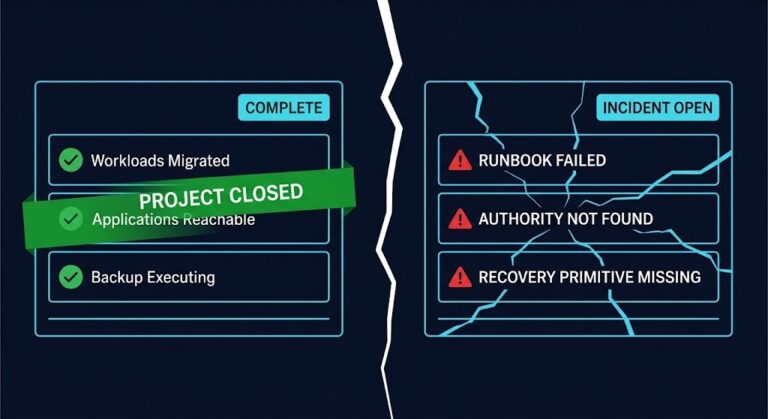
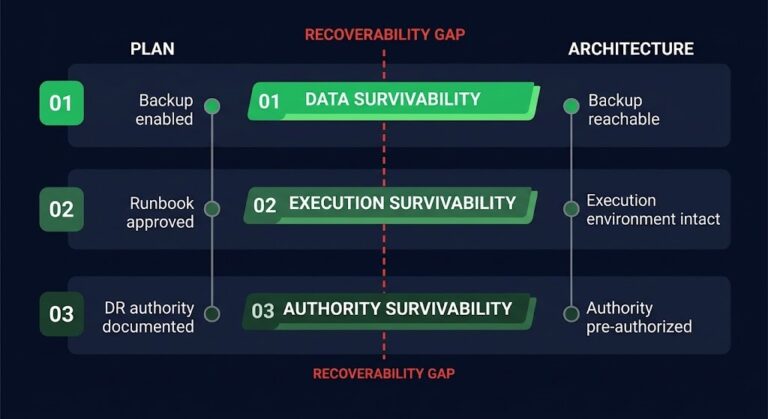
That shift exists because of a gap that’s already been named and registered: the Recoverability Gap is the distance between a recovery plan validated under clean-failure conditions and a recovery architecture that survives adversarial compromise across identity, credential, control plane, backup, governance, and storage authority. A clean restore test proves the backup works. It says nothing about whether the authority chain required to execute that restore survives the same event that triggered it. That’s the entire argument for testing under hostile conditions instead of cooperative ones — clean restores stopped proving recoverability the moment ransomware started targeting the recovery infrastructure itself, not just the primary data.
The Three Eras of Recovery Validation
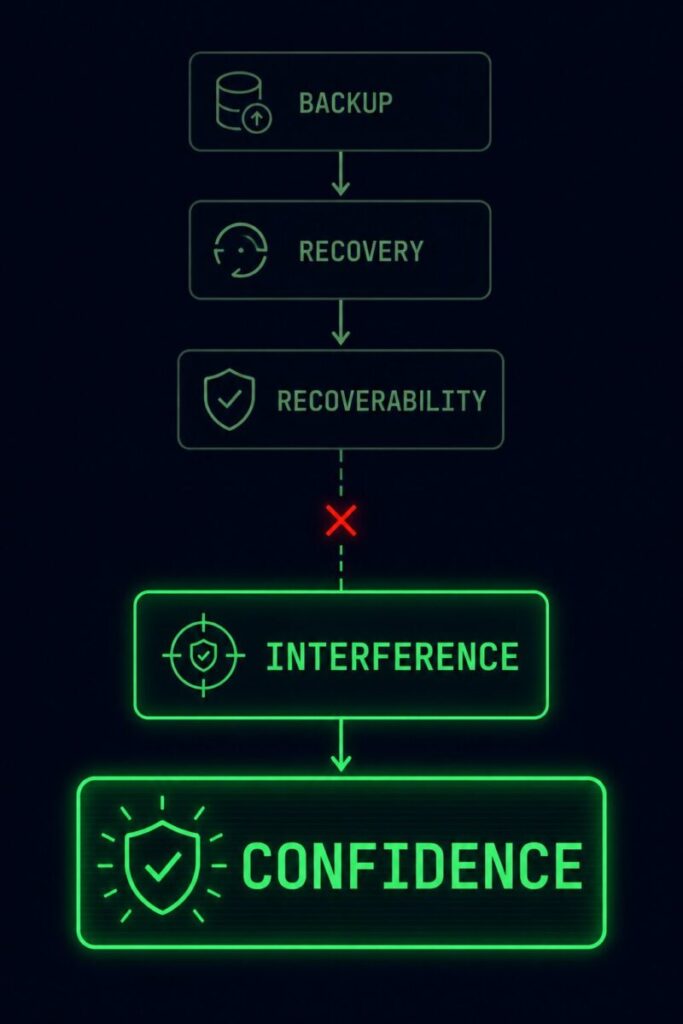
Restore testing has gone through three distinct eras, and most DR programs are still operating in the second one.
| Era | Core Question |
|---|---|
| Backup Era | Did the backup complete? |
| Recovery Era | Did the system restore? |
| Adversarial Era | Did recovery survive interference? |
Each era didn’t replace the one before it — it absorbed it and asked a harder question on top. A program stuck in the Recovery Era isn’t wrong, it’s incomplete. It has already answered “did the system restore” and stopped there, treating that answer as proof of something it was never designed to prove.
This is also where the registry needs a clean separation, because it’s easy to read this argument as a restatement of an existing framework. It isn’t. Recovery Validity Boundary — the doctrine that many DR tests validate the test procedure rather than actual recovery — is a different claim than the one this post makes. That framework diagnoses tests that fail on their own terms: the runbook says restore the database, the test restores a database, and nobody checks whether it’s the right database, the right point-in-time, or a database anyone downstream can actually use. Adversarial restore testing operates one level up from that. It assumes the test already passes on its own terms — the procedure is valid, the runbook is correct, the restore genuinely restores what it claims to — and asks whether that procedurally valid test still means anything once the conditions turn hostile. A test can clear Recovery Validity Boundary’s bar entirely and still tell you nothing about whether recovery survives an adversary who’s read the same runbook.
Why Cooperative Restore Tests Stopped Being Enough
A cooperative restore test is designed, scheduled, and executed by the same organization that will one day need the recovery to work under attack. Everyone involved wants the test to succeed. Nobody is trying to revoke access mid-restore, saturate the control plane, or make the backup repository unreachable at the worst possible moment — because that’s not what the test is for. It’s a rehearsal with a cooperative cast.
Real incidents don’t cast cooperative actors. A ransomware event doesn’t wait for the recovery team to finish authenticating before it locks the identity provider. An outage doesn’t pause control-plane contention until the restore job has priority. This is where data protection architecture as a discipline has to stop treating restore testing as a backup-admin checkbox and start treating it as an architecture question: does the system you built to recover survive the same conditions that made recovery necessary in the first place?
What Adversarial Restore Testing Actually Means
Adversarial restore testing borrows its structure from chaos engineering — fault injection, game days, deliberately breaking things in production to find out what actually happens — and applies it specifically to the restore path rather than to steady-state availability.
WHAT ADVERSARIAL TESTING ADDS TO A RESTORE DRILL
- Simulated corruption injected into the restore target, not just a clean snapshot
- Staged credential revocation timed to land mid-restore, not before it starts
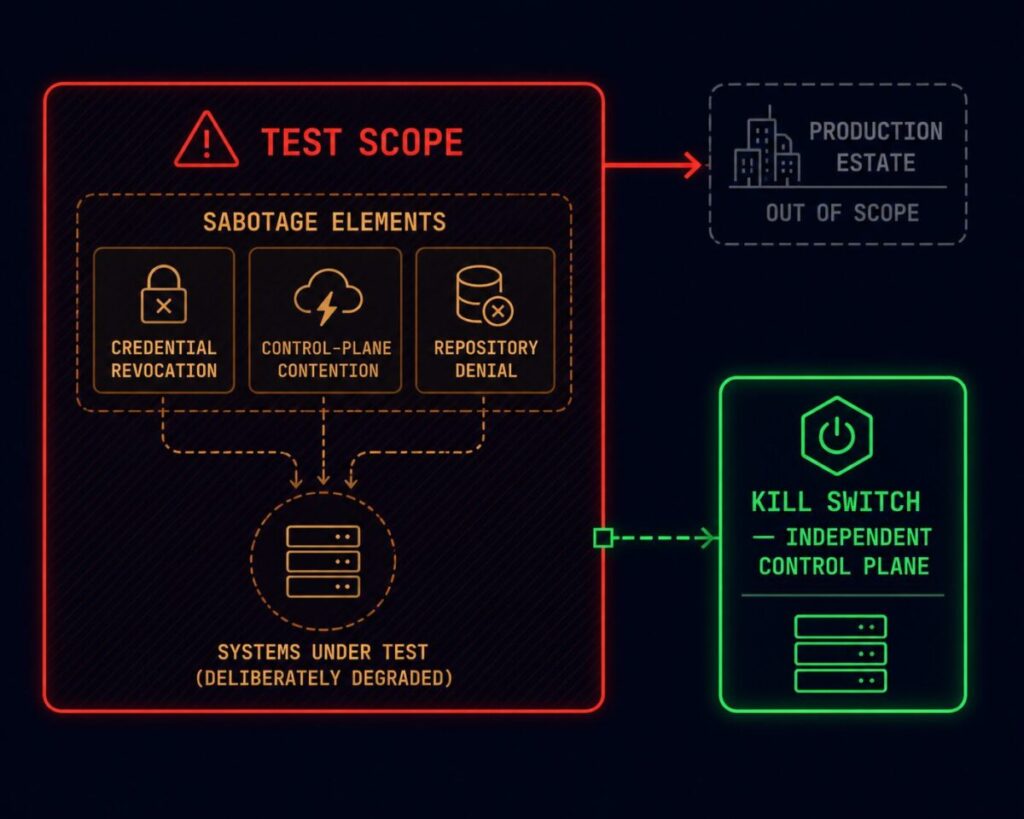
- Control-plane contention introduced deliberately during the restore window
- Repository access degraded or denied while the restore is actively reading from it
- Incomplete-information drills — the recovery team works from partial status, not a full picture
None of this is exotic. It’s the same discipline that made chaos engineering standard practice for availability, applied to a part of the estate that mostly hasn’t been touched by it yet.
The Failure Modes Cooperative Testing Never Surfaces
This is the section that earns adversarial restore testing its place in a DR program, because it’s the one where most architects realize how much of their “tested” recovery has never actually been tested.
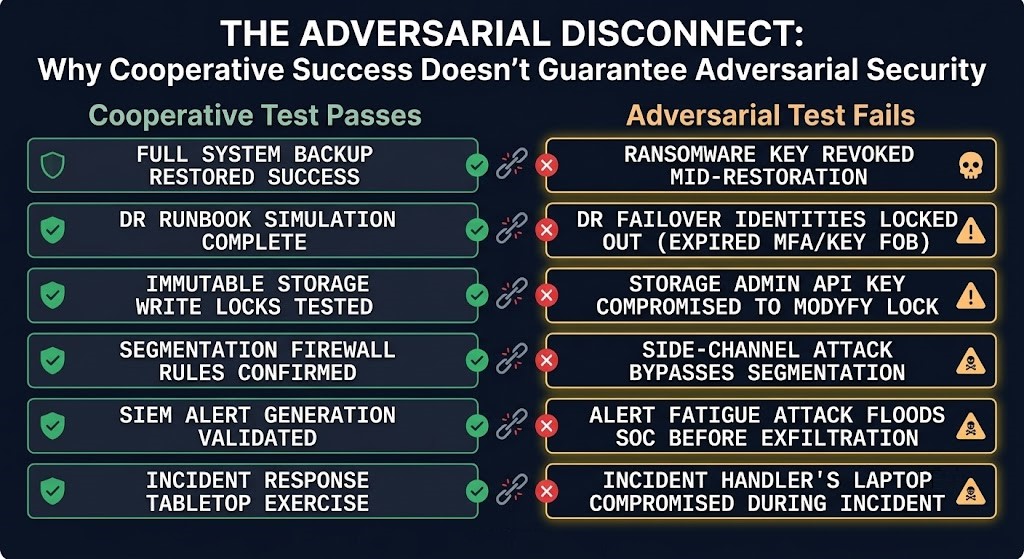
| Cooperative Test Passes | Adversarial Test Fails |
|---|---|
| Backup restores | Recovery credentials revoked mid-restore |
| VM powers on | DNS unavailable during failover |
| Database restores | Identity provider unavailable |
| Control plane reachable | Control plane degraded under load |
| Repository reachable | Repository under active denial |
| Staff available and briefed | Key operator unavailable, team works from partial context |
Every row on the left is a real, valid pass. None of them are false. That’s what makes this uncomfortable rather than obvious — the cooperative test isn’t lying, it’s just answering a narrower question than the one leadership assumes it answered.
This is exactly the territory D5 — Disaster Recovery & Failover Architecture was built to hold. D5 treats validation as an architectural discipline rather than an operational checkbox — Cluster 04 of that stage exists specifically because “did the test pass” and “does the architecture survive” are different questions requiring different evidence. Adversarial restore testing is, practically speaking, how that cluster’s doctrine gets operationalized rather than left as an abstract distinction.
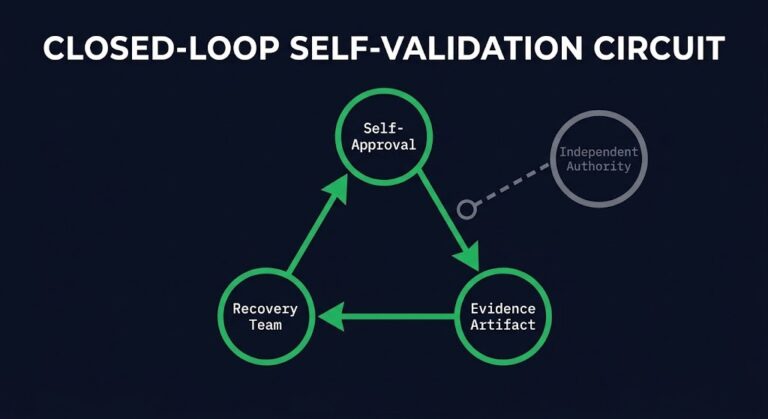
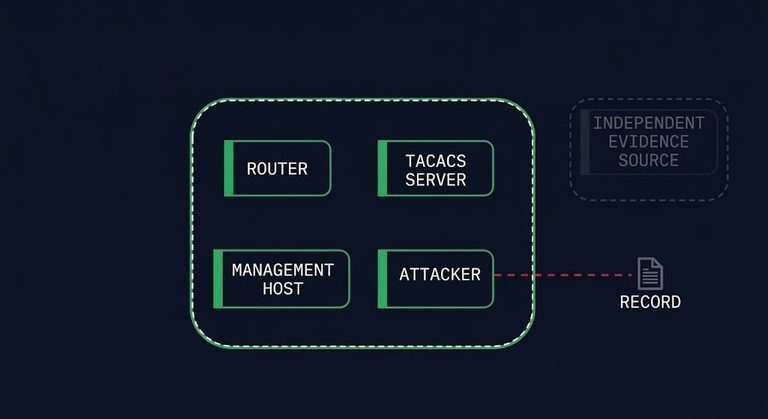
One question adversarial conditions don’t settle on their own: who grades whether recovery survived the interference. A restore that holds up under staged credential revocation is still a claim made by the team that staged the revocation and ran the drill — hostile conditions raise the bar the test has to clear, not who gets to decide whether it cleared it. That’s the separate axis the Recovery Evidence Boundary (#167) names: adversarial rigor and independent validation authority are different properties, and a program can have the first without the second.
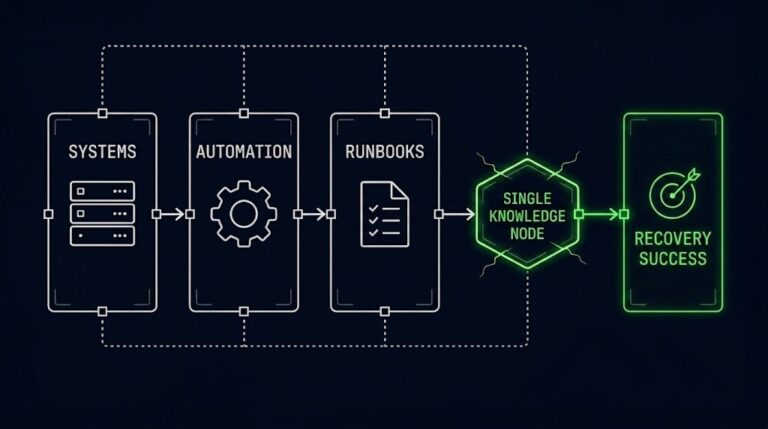
The table above already names this without pointing at it directly — “Key operator unavailable, team works from partial context” is a bus-factor failure wearing an adversarial-testing costume. Recovery bus factor is what that row is actually measuring: staged credential revocation and control-plane contention test whether the system survives interference, but they don’t test whether the operator running the drill is one of only one or two people who understand the sequencing exceptions well enough to adapt when the interference lands somewhere the runbook didn’t anticipate. A program can pass every adversarial condition on this list and still fail the night its two most experienced engineers are both unreachable.
Why Successful Restore Tests Create False Confidence
Here’s the uncomfortable part most practitioners haven’t fully sat with: it’s not that restores can fail — everyone already knows that. It’s that successful restore tests actively create false confidence, and they do it precisely because they succeed.
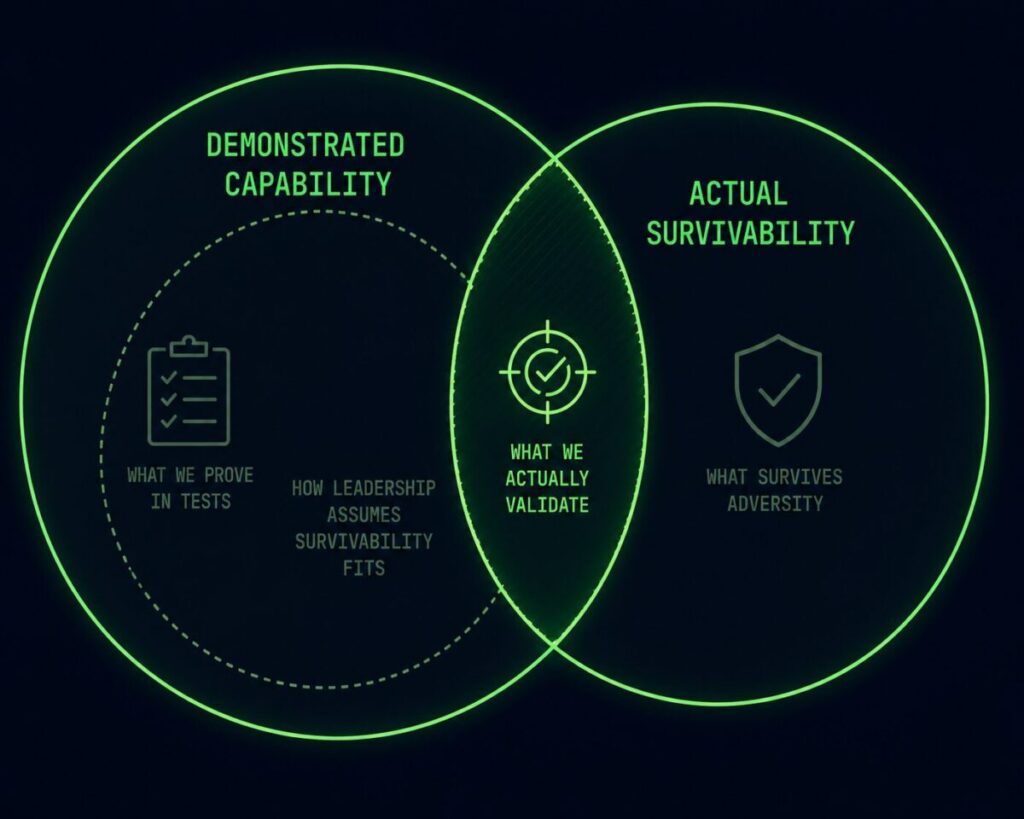
A cooperative restore test that passes demonstrates one thing: recovery worked under ideal conditions, with cooperative timing, available credentials, a reachable control plane, and a fully-briefed team. Leadership routinely reads that result as evidence recovery will work under incident conditions. Those are not the same statement, and the gap between them doesn’t show up anywhere in the test report — because the test was never designed to surface it.
Capability is not the same thing as recoverability. A successful restore test demonstrates capability. It does not automatically demonstrate survivability. That distinction is the entire argument for adversarial restore testing: the only way to know whether recovery survives interference is to introduce interference before an incident does it for you.
Building the Adversarial Test Program
DIAGNOSTIC QUESTION
“If we revoked the recovery team’s credentials right now, mid-restore, would the runbook tell them what to do — or would the runbook itself be the first casualty?”
Designing an adversarial restore program means answering that question before an attacker does, and it means containing the blast radius of the test itself so the drill doesn’t become the incident. A few load-bearing design decisions:
Staged sabotage needs a kill switch independent of the systems being tested — if the control plane you’re degrading is also the control plane governing the test’s own rollback, you’ve built a drill that can’t stop itself. Cadence matters more than intensity: a quarterly adversarial drill against one failure mode at a time surfaces more real gaps than an annual all-at-once exercise that nobody can accurately diagnose afterward. And scope discipline is non-negotiable — adversarial restore testing targets the restore path specifically, not the entire production estate, which is what separates it from an uncontrolled chaos experiment.
Related failure modes worth reading directly: Designing Backup Systems for an Adversary That Knows Your Playbook covers the adversarial-design side of the backup architecture itself, not just the restore test. Your DR Test Passed. The Assumptions Didn’t. catalogs the specific assumptions that survive cooperative testing unchallenged. Backups Fail at Restore Time Because Restore Is Underdesigned is the architectural precondition — a restore path that’s underdesigned to begin with won’t survive adversarial conditions no matter how the test is structured. And Why Most Disaster Recovery Tests Don’t Test Recovery is Recovery Validity Boundary itself — read it alongside this post to see the full separation between “the test is procedurally valid” and “the test proves survivability.” Your Identity Controls Passed. Your Authorization Chain Failed. examines the same staged-credential-revocation mechanism from the access side rather than the restore side — the same proof-not-assertion argument this post applies to a revocation claim, applied instead to an entire credential’s chain of legitimacy. Cross-pillar, Why Infrastructure Survivability Fails After The Design Review makes the same argument this post makes about restore tests, generalized to recovery capability as a whole — a test, like a design review, only proves the state that existed on the day it ran.
Where This Leaves Recovery Confidence
The Recoverability Gap only closes if the test that claims to close it was actually adversarial. A recovery program can pass every cooperative drill on the books and still be carrying the exact confidence illusion this entire post is describing — capability mistaken for survivability, at every level from the backup admin’s status report up to the board’s risk register.
Architect’s Verdict
Restore testing that only asks whether the backup restores is answering a question nobody’s incident ever asks. The Backup Era question, the Recovery Era question — both still matter, and neither is sufficient on its own anymore.
The real problem most DR programs have isn’t that their restores fail. It’s that their restores succeed, under conditions no real incident will ever offer them, and that success gets read as proof of something it was never designed to prove. Capability is not recoverability. A program that has never tested what happens when credentials are revoked, the control plane is degraded, or the team is working from incomplete information doesn’t know its own recoverability — it knows its capability under cooperation, which is a much smaller and much more comfortable claim.
The goal of adversarial restore testing is not to make recovery fail. The goal is to discover which assumptions recovery depends on before an attacker, an outage, or an operational mistake discovers them first.
Additional Resources
Editorial Integrity & Security Protocol
This technical deep-dive adheres to the Rack2Cloud Deterministic Integrity Standard. All benchmarks and security audits are derived from zero-trust validation protocols within our isolated lab environments. No vendor influence.

R.M.
Senior Solutions Architect with 25+ years of experience in HCI, cloud strategy, and data resilience. As the lead behind Rack2Cloud, I focus on lab-verified guidance for complex enterprise transitions. View Credentials →
Get the Playbooks Vendors Won’t Publish
Field-tested blueprints for migration, HCI, sovereign infrastructure, and AI architecture. Real failure-mode analysis. No marketing filler. Delivered weekly.
Select your infrastructure paths. Receive field-tested blueprints direct to your inbox.
- > Virtualization & Migration Physics
- > Cloud Strategy & Egress Math
- > Data Protection & RTO Reality
- > AI Infrastructure & GPU Fabric
Zero spam. Includes The Dispatch weekly drop.
Need Architectural Guidance?
Unbiased infrastructure audit for your migration, cloud strategy, or HCI transition.
>_ Request Triage Session