

RANSOMWARE SURVIVAL ARCHITECTURE
Recovery only counts if it survives the compromise that triggered it.
MATURITY POSITION — STAGE 4 OF 6
- Current Stage: Ransomware Survival Architecture
- Primary Architectural Concern: Does the recovery architecture survive the same adversarial compromise that triggered recovery in the first place?
- Primary Failure Mode: Recovery Authority Collapse — the identities, credentials, and control planes recovery depends on don’t survive the same event that triggered recovery in the first place.
- Stage Outcome: Reader can evaluate recovery architecture against adversarial survival — across identity, credential, control plane, backup, governance, and storage authority — rather than clean-failure assumptions alone
- Next Stage: D5 — Disaster Recovery & Failover Architecture — How does recovery survive infrastructure failure?
Ransomware survival architecture is the discipline of testing whether recovery still succeeds after the identities, credentials, and control planes it depends on have already been compromised — not whether backups exist, and not whether a recovery plan is documented. D3 established that isolation can be engineered: object lock, air-gapped storage, immutable retention. This stage asks the harder question D3 doesn’t answer. Isolation protects the data. It does not, by itself, prove that the systems required to declare a recovery, authenticate the recovery process, and orchestrate it back into production will still be standing when the same attacker who compromised production also came for the identity provider, the backup console, and the approval chain.
Most organizations validate recovery against a clean-failure scenario — a disk fails, a region goes dark, a job doesn’t run. Ransomware doesn’t produce a clean failure. It produces an adversary who has studied the recovery path and moved against it deliberately, often before triggering the encryption event that makes recovery necessary in the first place. This stage builds the evaluation framework for a recovery architecture that assumes the adversary already knows where recovery lives — and tests survival against that assumption, not against a assumption that everything except the primary data is still healthy.
WHY THIS STAGE EXISTS — RECOVERY AUTHORITY COLLAPSE
Isolating the backup is not the same claim as proving recovery survives the attack that made recovery necessary.
Stage Anchor Question
Does recovery survive the same compromise that triggered it?
Not: is the backup immutable? Not: did the DR test pass? Ransomware survival architecture answers whether the identity, credential, control-plane, backup, governance, and storage authority recovery depends on will still be standing after the same event that made recovery necessary — under the specific conditions a ransomware actor creates, not the conditions a tabletop exercise assumes.
D3 crossed the Isolation Survivability Boundary — the line between recovery isolation that depends on the same authority systems an attacker would compromise, and isolation that continues to function after that compromise. That boundary is necessary. It is not sufficient. Isolating the data from compromise says nothing about whether the identities, credentials, and control planes required to actually execute a recovery from that isolated data will still have standing once the attacker has moved through the environment. D3 is preventative — it assumes the goal is stopping the attacker from reaching the backup. D4 assumes the attacker already reached everything else, and asks whether recovery still executes anyway.
That is the actual maturity jump this stage represents, and it’s a different kind of question than any prior stage asked. D1 asked whether a system could be recovered. D2 asked whether a platform could execute the recovery. D3 asked whether isolation held under compromise. D4 asks whether the full authority chain behind recovery — not just the isolated copy of the data — survives the same event that made recovery necessary. An organization can pass every earlier stage and still fail this one, because none of the earlier stages test against an adversary who is actively working against the recovery path, not merely against an infrastructure fault that happens not to care.
How Ransomware Survival Architecture Anchors the Full Path
| Stage | Name | Question |
|---|---|---|
| D1 | Recovery Architecture Foundations | Can this system be recovered? |
| D2 | Recovery Platform Architecture | How is recovery executed? |
| D3 | Immutability & Cyber-Vaulting | How is recovery isolated from compromise? |
| D4 | Ransomware Survival Architecture | How does recovery survive adversarial attack? |
| D5 | Disaster Recovery & Failover Architecture | How does recovery survive infrastructure failure? |
| D6 | Governance & Recovery Assurance | How does the organization continuously prove recoverability? |
D4 takes the isolation D3 built and tests it against the specific adversary it was built for. Failover design (D5) and continuous assurance (D6) both assume the authority chain this stage validates already survives adversarial pressure — D4 is where that assumption is either confirmed or exposed.
Stage Anchor Framework — Ransomware Survival Architecture
Recoverability Gap (#148)
The recoverability gap is the distance between a recovery plan validated under clean-failure scenarios and a recovery architecture that survives adversarial compromise across identity, credential, control plane, backup, governance, and storage authority.
Named Failure State: Recovery Authority Collapse · Indicators: backups exist and identity systems test healthy in isolation · recovery runbooks are documented but never tested against a compromised-identity scenario · DR drills pass without ever simulating an adversary who reached the backup console or approval chain · Identity and Credential authority domains have never both been scored below the hard-failure threshold in the same exercise
Why Architects Misjudge Survivability
Recovery success is measured against clean-failure assumptions. Organizations test outages, not adversaries. A DR drill that fails over a workload after a simulated region loss proves the platform can execute a recovery when everything except the primary workload is healthy. It proves nothing about what happens when the identity provider, the backup console, and the approval chain have all been touched by the same actor who triggered the event.
Backup availability is mistaken for recoverability. An immutable, air-gapped, object-locked copy of the data existing is a D3 fact. It says nothing about whether the credentials needed to authenticate against it, the control plane needed to orchestrate the restore, or the governance approval needed to declare the recovery in scope will still function after the same compromise. Backups existing does not mean recovery succeeds — it means the data survived. Whether the process around it did is a separate, untested claim. The Architecture of Premature Closure names this same substitution at the cross-pillar level — a process closing clean on the signal that’s easiest to observe, standing in for the outcome nobody separately confirmed.
Recovery authority is assumed to survive the incident. Most recovery plans assume the identities, credentials, and control planes required for recovery remain available when recovery is needed. Ransomware actors specifically target identity providers and administrative consoles early, often before triggering encryption — precisely because compromising the authority chain behind recovery is more valuable than compromising the data itself. A plan that never modeled that sequence isn’t wrong. It’s answering a question the attacker didn’t ask.
SURVIVAL IS NOT RECOVERY
- Recovery architecture (D1–D3) assumes systems can be restored — that a topology, a platform, and an isolation mechanism exist and function.
- Survival architecture (D4) asks a separate question: does recovery itself remain possible once the same event that necessitated it has already moved against the systems recovery depends on?
- Recoverability Gap conditions appear precisely when recovery depends on identities, credentials, platforms, or authorities that fail in the same event that triggered recovery — not in some unrelated, later failure.
What This Stage Is Not
Not a ransomware threat-intelligence or attack-vector catalog. How ransomware groups gain initial access, move laterally, or select targets is threat-intelligence content, and it changes constantly. This stage evaluates recovery architecture’s survivability against the class of adversary described, not the current tactics of any specific group.
Not incident response or forensics consulting. Containment, eradication, and forensic timeline reconstruction happen during and after an active incident. This stage evaluates whether the architecture survives before an incident occurs — the design work, not the response.
Not a substitute for D3. This stage assumes the Isolation Survivability Boundary has already been crossed — that vault access authority, air gap enforcement, and object lock retention already function correctly on their own terms. Evaluating adversarial survival against isolation that was never validated produces an answer to the wrong question.
Not a vendor ransomware-protection feature bake-off. Vendor marketing around “ransomware-proof” or “cyber-resilient” storage describes product features. This stage evaluates whether the authority chain around those features — identity, credential, control plane, governance — survives the same compromise the features were built to withstand.
>_ Estimated Reading Depth
| Format | Count | Estimated Time | Notes |
|---|---|---|---|
| Architecture articles — Card 1 | 2 | ~22 min | Why traditional recovery planning fails against an adversary |
| Architecture articles — Card 2 | 2 | ~22 min | What survival architecture actually requires — isolation and blast radius under attack |
| Failure States Grid | 1 | ~10 min | Named survival failure states — read before the framework reveal |
| Architecture article — Card 3 | 1 | ~11 min | The Recoverability Gap (Framework #148) — the framework explaining the failures just covered |
| Architecture articles — Card 4 | 2 | ~22 min | Recovery reality — validation against actual restore performance and metrics |
| Architecture article — Card 5 | 1 | ~11 min | Platform survivability under ransomware-specific pressure |
| Total stage depth | 9 | ~98 min | Resilient stage — complete before entering D5 Disaster Recovery & Failover Architecture |
>_ Where to Enter This Stage
Enter here once recovery isolation has already been designed and validated on its own terms — once object lock, air-gap enforcement, and vault access authority function correctly in isolation from a compromise scenario. If isolation itself hasn’t been established, start at D3: Immutability & Cyber-Vaulting. Testing adversarial survival against an isolation mechanism that was never validated produces an answer with nothing solid underneath it.
Specifically, enter here if:
- Backup isolation exists and has been validated, but no one has tested whether the recovery authority chain survives the same compromise that isolation was built to defend against
- DR drills have consistently passed, but every drill has simulated infrastructure failure rather than a compromised identity provider or backup console
- No one can confirm whether the identity, credential, and governance approval systems recovery depends on would still function after a ransomware-class event
- Ransomware-specific recovery metrics have never been modeled — only generic RPO/RTO figures that assume a clean failure
- The Recoverability Gap has never been evaluated against the organization’s actual six-domain authority chain: identity, credential, control plane, backup, governance, storage
Skip-ahead criteria: Architects who have run the Ransomware Recovery Survivability Analyzer (or an equivalent six-domain authority audit) against their actual environment, confirmed the Recoverability Gap is closed across all six domains, and validated recovery execution under at least one adversarial-compromise tabletop — not just an infrastructure-failure drill — may consider entering at D5. If any of those three conditions is uncertain, start here. Ransomware Survival Architecture answers one question: does recovery survive the same event that made recovery necessary? Everything D5 and D6 address assumes that question has already been answered yes.
>_ Architecture Maturity Position
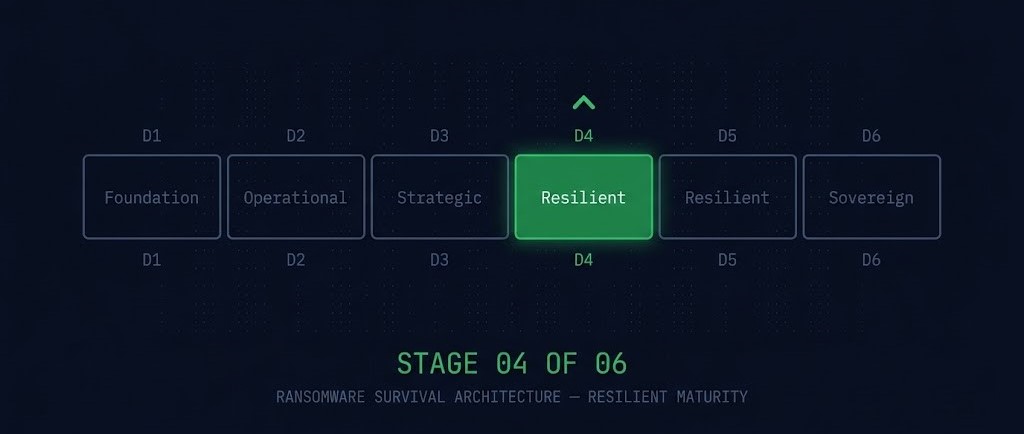
| Stage | Name | Maturity Level | Stage Question |
|---|---|---|---|
| D1 | Recovery Architecture Foundations | Foundation | Can this system be recovered? |
| D2 | Recovery Platform Architecture | Operational | How is recovery executed? |
| D3 | Immutability & Cyber-Vaulting | Strategic | How is recovery isolated from compromise? |
| D4 ← YOU ARE HERE | Ransomware Survival Architecture | Resilient | How does recovery survive adversarial attack? |
| D5 | Disaster Recovery & Failover Architecture | Resilient | How does recovery survive infrastructure failure? |
| D6 | Governance & Recovery Assurance | Sovereign | How does the organization continuously prove recoverability? |
>_ Where This Stage Sits
The Data Protection Path Is a Recovery Lifecycle Progression
| Stage | Architectural Question |
|---|---|
| D1 — Recovery Architecture Foundations | Can this system be recovered? |
| D2 — Recovery Platform Architecture | How is recovery executed? |
| D3 — Immutability & Cyber-Vaulting | How is recovery isolated? |
| D4 — Ransomware Survival Architecture | How does recovery survive attack? |
| D5 — Disaster Recovery & Failover Architecture | How does recovery survive infrastructure failure? |
| D6 — Governance & Recovery Assurance | How is recoverability continuously proven? |
D1 through D3 build a recovery architecture that is designed, executable, and isolated. D4 is the first stage to test that architecture against an adversary rather than an infrastructure fault. D5 and D6 assume the survival this stage validates is already in place.
>_ Isolation vs. Survival
D3 and D4 are the two stages most often confused, because both deal with ransomware and both deal with the word “survivability.” They are not the same claim. D3 protects a copy of the data from being reached by the attack. D4 protects the process of getting that data back into production from the same attack. An architecture can cross the D3 boundary cleanly and still fail D4 completely.
| D3 — Isolation | D4 — Survival |
|---|---|
| Isolates recovery from compromise | Tests whether recovery survives compromise |
| Assumes recovery is available once isolated | Tests whether that assumption holds under attack |
| Protects the backup | Protects the recovery process |
| Crosses #150 Isolation Survivability Boundary | Crosses #148 Recoverability Gap |
The Reading Sequence below moves through this distinction in five cards — traditional recovery failure, survival architecture design, named failure states, the Recoverability Gap framework, recovery reality, and platform survivability.
>_ Stage Reading Sequence
SURVIVAL VALIDATION BEGINS HERE
The sequence below moves through five cards in order. Cards 1 and 2 establish why traditional recovery planning fails against an adversary and what survival architecture actually requires. The failure states grid names the specific ways survival breaks — read before the framework, not after, so the framework arrives as the explanation for conditions you’ve already recognized. Card 3 reveals the Recoverability Gap. Cards 4 and 5 close with recovery reality and platform-specific validation.
Reading out of sequence is possible. The framework lands with more force if the failure states are read first.
Architectural question: What separates recovery planning from recovery survival?
What separates recovery planning from recovery survival?
Recovery time is treated as a backup problem when it’s actually an architecture problem, and adversary-aware design gets skipped because most recovery planning assumes a cooperative failure mode. These two articles establish why that assumption fails against a ransomware actor specifically.
Architectural question: What does survival architecture actually require?
What does survival architecture actually require?
Immutability alone is not a strategy — recovery has to be engineered into isolated silos, and the backup system itself has to be evaluated as part of the blast radius it’s supposed to protect against. These two articles define what survival design actually requires beyond “keep an immutable copy.”
>_ Recovery Survival Failure States
>_ Common Recovery Survival Failure States
Architectural question: Where does the Recoverability Gap actually live?
Where does the Recoverability Gap actually live?
Every failure state above is a symptom of the same underlying gap. This article names it directly — the distance between a recovery plan validated under clean-failure scenarios and one that survives adversarial compromise across all six authority domains.
Architectural question: Does recovery survive contact with a real ransomware event?
Does recovery survive contact with a real ransomware event?
The Recoverability Gap is a framework. These two articles pressure-test it against real recovery-time performance and the specific metrics that actually predict ransomware recovery survival — as opposed to the generic RPO/RTO figures most plans still rely on.
Architectural question: Which platforms hold up under ransomware-specific pressure?
Which platforms hold up under ransomware-specific pressure?
Everything above is platform-agnostic doctrine. This closing article applies it — evaluating two specific platforms against ransomware-class pressure rather than the general feature comparisons covered back in D2.
>_ Ransomware Survival Architecture as an Ongoing Practice
Survival validated once is not survival maintained. Ransomware actors adapt their targeting the moment a defensive pattern becomes common knowledge — identity-provider compromise as an early-stage move, backup-console targeting before encryption, credential harvesting specifically aimed at recovery infrastructure. A six-domain authority chain confirmed intact this quarter is not guaranteed intact after the next identity federation change, the next backup platform upgrade, or the next org-chart reshuffle that quietly moves approval authority to someone who was never briefed on the recovery runbook.
The practice this stage establishes pairs adversarial tabletop exercises with authority-chain re-audits. A tabletop that simulates only infrastructure loss is a D1/D2 exercise wearing D4’s vocabulary — it has to simulate a compromised identity provider, a compromised backup console, or an unavailable approval chain to actually test what this stage is named for. When a tabletop reveals that recovery depended on a specific person’s mobile phone or a specific administrator’s still-valid session token, that is not a lucky catch. It is the Recovery Authority Collapse pattern surfacing under controlled conditions — the only conditions under which finding it is inexpensive.
Re-audit cadence closes the gap tabletops leave open between exercises: identity provider changes, backup platform version upgrades, and governance approval-chain reorganizations that happen with no incident to force a re-validation. Re-running the Recoverability Gap evaluation after any material change to identity, credential, or governance systems — not just annually — surfaces authority drift before an actual ransomware event does.
>_ Stage Graduates Can Now
Immutability & Cyber-Vaulting (D3) answers whether recovery is isolated from compromise. Ransomware Survival Architecture (D4) answers whether the process of getting that isolated data back into production survives the same compromise. The capabilities below are what make that distinction operational — each one requires testing the authority chain against an adversarial scenario, not confirming a backup exists. D4 graduates have validated survival against the attack this path exists to defend against. What Resilient maturity adds next, at D5, is surviving infrastructure failure that isn’t adversarial at all.
- Evaluate recovery architecture against adversarial survival across identity, credential, control plane, backup, governance, and storage authority
- Determine whether the Recoverability Gap is open or closed against the organization’s actual recovery authority chain
- Distinguish backup isolation (D3) from recovery authority survival (D4) as two separate, independently testable architectural facts
- Identify a Recovery Authority Collapse before a real ransomware event does
- Enter D5 — Disaster Recovery & Failover Architecture — with an adversarially-validated recovery authority chain, ready to evaluate survival against infrastructure failure rather than attack
>_ Live Diagnostics
>_ Where Do You Go From Here
ARCHITECTURE REVIEW
Recovery Readiness Assessment
A structured review of your recovery topology, blast radius design, restore path architecture, and recovery authority survival under adversarial compromise — before the next incident exposes the gaps.
[+] Request Assessment →WEEKLY DISPATCH
Weekly Dispatch
Architecture signals, framework updates, and new content from across the five pillars — delivered weekly for senior infrastructure architects.
[+] Subscribe →>_ Frequently Asked Questions
Q: What is ransomware survival architecture?
A: Ransomware survival architecture is the discipline of testing whether a recovery architecture — already designed (D1), executable (D2), and isolated (D3) — still succeeds after the identities, credentials, and control planes recovery depends on have been compromised by the same event that made recovery necessary. It evaluates survival against an adversary who has moved against the recovery path deliberately, not against a clean infrastructure fault.
Q: What is the Recoverability Gap?
A: The Recoverability Gap (Framework #148) is the distance between a recovery plan validated under clean-failure scenarios and a recovery architecture that survives adversarial compromise across six authority domains: identity, credential, control plane, backup, governance, and storage. Its named failure state is Recovery Authority Collapse — backups exist, identity systems test healthy, and runbooks are documented, but the authority chain required to execute recovery does not survive the same ransomware event that triggered it.
Q: Why do recovery tests often pass when recovery would fail?
A: Most DR tests simulate infrastructure loss — a region goes dark, a disk fails — while every other system stays healthy. That validates execution capability under a cooperative failure mode. Ransomware doesn’t produce a cooperative failure. It produces a compromised identity provider, a compromised backup console, and an approval chain that may not survive the same incident. A test that never simulates those conditions can pass indefinitely while the actual survival property it’s supposed to confirm remains completely untested.
Q: What’s the difference between D3 Immutability & Cyber-Vaulting and D4 Ransomware Survival Architecture?
A: D3 asks whether recovery isolation — object lock, air-gap enforcement, vault access authority — continues to function after identity and management-plane compromise. It protects the data. D4 asks whether the process of getting that isolated data back into production survives the same compromise, across the full authority chain: identity, credential, control plane, backup, governance, storage. An architecture can cross the D3 boundary cleanly (the data is safe) and still fail D4 completely (nobody can actually get it back into production, because the systems needed to authenticate, orchestrate, and approve the recovery were compromised too).
Q: How do you measure ransomware recovery survivability?
A: Against six authority domains, weighted by how much of the recovery-authority surface each one controls: Identity (25%), Credential (20%), Control Plane (20%), Backup (15%), Governance (10%), Storage (10%). Evaluation runs across five ransomware-class threat scenarios — a direct ransomware event, identity provider compromise, management-plane failure, insider action, and backup repository loss — rather than a single generic scenario. A hard-failure rule applies regardless of composite score: if Identity and Credential domains both fall below threshold, the result is Authority Collapsed, full stop.
Q: What does the Ransomware Recovery Survivability Analyzer (RRSA) evaluate?
A: RRSA runs the six-domain authority model against five ransomware-class threat scenarios and produces four signature outputs: a Recoverability Gap Ladder showing where the organization sits along the gap; a dynamic, platform-specific Recovery Kill Switch; an independent Recoverability Horizon metric (not derived from the other scores); and a Bus Factor ceiling model. It’s the primary diagnostic for this stage — distinct from platform comparison tools or TCO calculators, which evaluate features and cost rather than adversarial authority survival.
>_ Related Systems
D3 — Immutability & Cyber-Vaulting. The Isolation Survivability Boundary (Framework #150) this stage’s adversarial-survival evaluation assumes has already been crossed.
Open Stage →Your Ransomware Recovery Plan Has a Recoverability Gap — Framework #148’s anchor post, this stage’s framework reveal.
Open Post →Disaster Recovery Authority: The Missing Layer in Most Recovery Plans — Recovery Authority Fragmentation (Framework #144), the human-authority counterpart to #148’s platform-authority failure.
Open Post →Backups Are Compromised First: Inside Cohesity FortKnox and the Rise of Cyber Vaulting — the D3-to-D4 bridge argument in practice: assume the adversary already knows where recovery lives.
Open Post →Ransomware Recovery Survivability Analyzer — evaluates recovery authority survivability across six domains against five ransomware-class threat scenarios (Framework #148).
Open Tool →Strategic Resilience (CS7) — Authority Survivability Boundary (Framework #156). Same “does authority survive the event?” question applied to cloud control planes rather than recovery specifically.
Open Stage →Why Configuration Standards Fail During Emergency Changes — Emergency Reconciliation Gap (Framework #159). Adjacent survivability question: can operational reconciliation survive emergency conditions, the way #148 asks whether recovery authority survives compromise.
Open Post →NIST SP 800-184 — Guide for Cybersecurity Event Recovery. Federal guidance on recovery planning, testing, and improvement at the execution layer.
Open Reference →CISA StopRansomware Guide — federal guidance on backup architecture requirements and recovery execution under adversarial conditions.
Open Reference →