

SOVEREIGN VIRTUALIZATION ARCHITECTURE
Post-VMware strategic architecture — where governance authority, lifecycle control, and operational continuity become independent of any single platform contract.
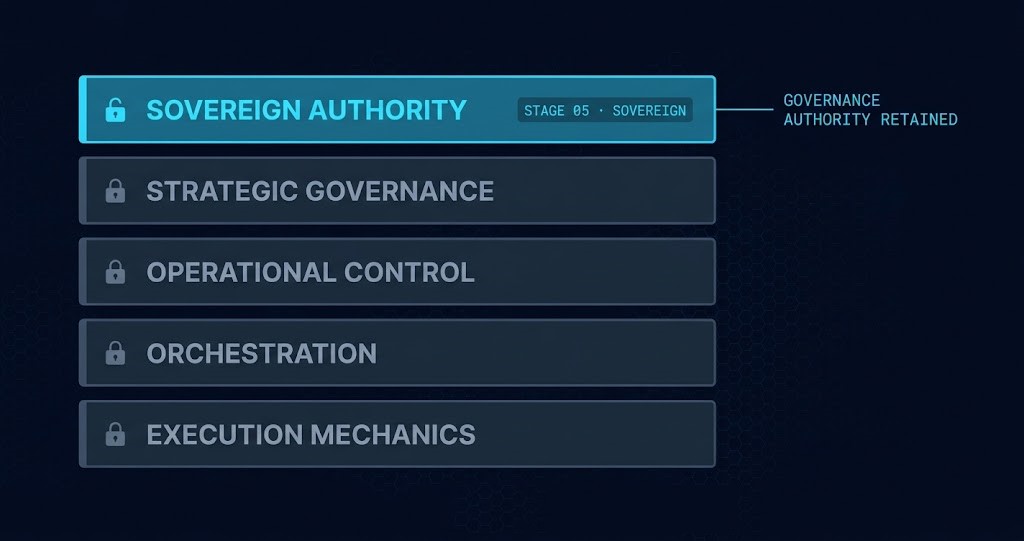
MATURITY STAGE POSITION
- Current Stage: Sovereign — Maturity Stage 05 of 05
- Primary Architectural Concern: Owning governance authority, lifecycle control, and operational continuity after the platform contract ends — transitioning from VMware dependency to an architecture the organization governs directly, independent of any single vendor operating model
- Primary Failure Mode: Migration completed before governance portability existed — workloads move, but governance systems remain vendor-mediated or collapse under platform transition. The platform changes; the dependency doesn’t.
- Stage Outcome: Architects completing this stage can design platforms where control plane authority, lifecycle governance, and operational continuity remain portable across platform transitions — where the organization governs the platform, not the other way around
- Next Stage: Sovereign terminal — cross-domain propagation to Cloud Architecture Path, Modern Infrastructure & IaC Path, and Sovereign Infrastructure
Post-VMware strategic architecture is the point in the maturity sequence where migration competency stops being the measure of progress. Every organization that reaches this stage has already proven it can operate a virtualization platform at scale, govern lifecycle events, and model the cost constraints that force architectural decisions. Those capabilities are the prerequisites. They are not sovereignty.
Sovereign maturity begins when authority inverts. Until this stage, governance authority flows downward from the vendor operating model — licensing terms define what architectures are economically viable, vendor support structures define upgrade sequencing, and external tooling defines the operational control surface. Authority inversion is the architectural condition where that hierarchy reverses: the organization governs the platform lifecycle, and vendors, tooling, and orchestration systems become replaceable implementation layers beneath a control plane the organization controls directly. The defining property of this inversion is Control Plane Replaceability — not that the platform never changes, but that it can change without collapsing governance, operational continuity, or policy authority. That is the terminal maturity test.
>_ SOVEREIGNTY IS NOT ISOLATION
Sovereign infrastructure does not mean eliminating vendors, cloud platforms, or external tooling. It means the architecture retains governance authority when those dependencies change. Sovereignty is the ability to preserve operational continuity, policy enforcement, and lifecycle control without requiring the original platform relationship to remain intact. An organization can run VMware, Nutanix, or a cloud-native stack and be sovereign — or run any of them and not be. The platform is not the variable. The location of governance authority is.
>_ WHY THIS STAGE EXISTS
Migration competency and operational maturity do not automatically produce sovereignty. The most common failure at this stage is not a failed migration — it is a completed migration where governance authority was never transferred. Workloads moved. The control plane didn’t.
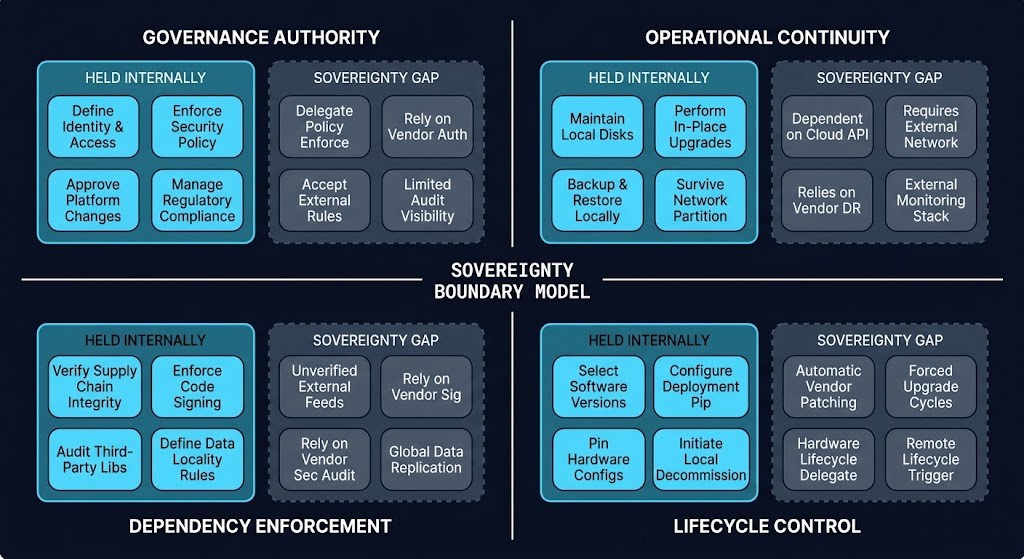
This stage is anchored by The Sovereignty Boundary Model: infrastructure becomes sovereign only when four conditions hold simultaneously — governance authority, operational continuity, lifecycle control, and dependency enforcement remain functional after the original platform contract disappears. Remove any one condition and sovereignty becomes conditional. Conditional sovereignty is not sovereignty; it is a deferred dependency.
This stage exists because the Sovereignty Boundary Model requires deliberate architecture. It does not emerge from a migration program, a licensing decision, or a platform selection. It has to be designed.
WHAT THIS STAGE IS NOT
01 — NOT A VENDOR MIGRATION CHECKLIST
Which hypervisor you migrate to is an implementation decision. Whether governance authority, lifecycle control, and operational continuity remain intact after that migration is an architectural one. This stage addresses the architecture, not the checklist.
02 — NOT A PLATFORM ENDORSEMENT
Nutanix, Proxmox, OpenStack, Kubernetes — the Sovereignty Boundary Model applies to all of them equally. Sovereign architecture is a governance condition, not a product selection. A platform can pass or fail the four-condition test regardless of its vendor lineage.
03 — NOT AN ARGUMENT AGAINST CLOUD
Cloud platforms can be components of a sovereign architecture. The question is whether governance authority remains with the organization or transfers to the cloud provider’s operating model. Workloads in AWS can be sovereign. Workloads in an on-premises VMware cluster can fail the sovereignty test. The deployment location is irrelevant; the governance location is not.
04 — NOT A CAPSTONE TO A COMPLETED MIGRATION
Migration ends when workloads are running on the new platform. Sovereign architecture begins when governance systems are portable across the next platform transition — whenever that occurs. This stage is not the end of the migration. It is architecture for what governs after migration becomes irrelevant.
SOVEREIGN STAGE — POST-VMWARE STRATEGIC ARCHITECTURE READING SCOPE
| Article | Architectural Focus | Est. Read | Pillar |
|---|---|---|---|
| The VMware Exit Has Entered the Coexistence Era | Strategic transition architecture, coexistence period governance, platform decision sequencing | 12 min | Virtualization |
| What Breaks First After You Leave VMware | Post-migration failure patterns, governance gaps, operational continuity under platform transition | 11 min | Virtualization |
| Nutanix AHV Operations After VMware Migration | Operational platform replacement, AHV control plane mechanics, governance continuity during transition | 14 min | Virtualization |
| Beyond the VMDK: Translating Execution Physics from ESXi to AHV | Platform execution model translation, scheduling authority mapping, operational parity after migration | 13 min | Virtualization |
| Policy Translation: Mapping VMware DRS, SRM, and NSX to Nutanix Flow | Policy portability, governance inheritance across platforms, control plane authority translation | 12 min | Virtualization |
| The Architecture of Migration: Why Licensing Isn’t Your Biggest Risk | Governance risk framing, sovereignty failure modes, architectural constraints post-Broadcom | 11 min | Virtualization |
| The Broadcom Exit Strategy | Exit decision framework, migration vs coexistence, governance preservation during platform transitions | 14 min | Virtualization |
| VMware Licensing Costs: The Estimation Framework | Exit economics, cost architecture under per-core models, licensing as architectural constraint | 12 min | Virtualization |
>_ WHERE TO ENTER THIS STAGE
Start here if you completed Stage 4: Virtualization Deterministic Operations and are ready to move from governance determinism (keeping the platform deterministic as it evolves) to governance portability — preserving that determinism when the platform itself changes.
You can likely skip ahead to Card 3 if:
- You have already executed a VMware migration and are now identifying which governance systems survived the transition intact and which collapsed or were rebuilt from scratch on the new platform
- You understand the difference between workload portability and governance portability — and have encountered at least one case where migrating workloads didn’t migrate the governance systems they depended on
- You have mapped where licensing, lifecycle tooling, policy authority, or observability remain externally mediated after migration
If those three statements describe your current operational context, Card 3 (Governance Inheritance & Policy Portability) is the correct entry point. If any of them require translation, start at Card 1 — Transition Architecture & Coexistence.
>_ ARCHITECTURE MATURITY POSITION
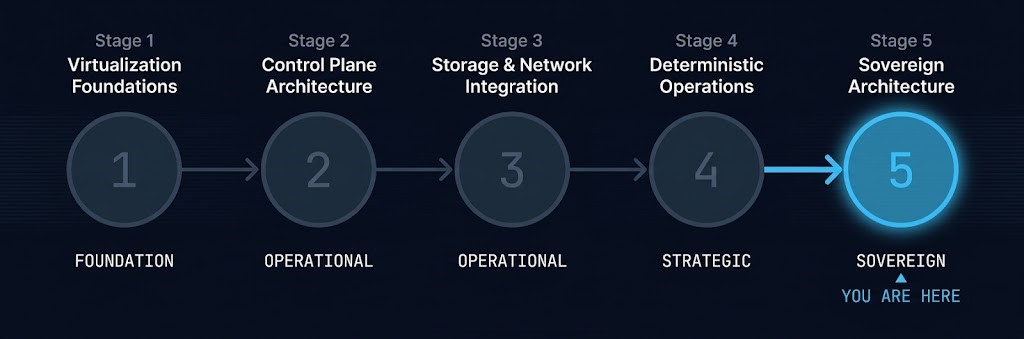
| Stage | Level | Focus | Slug |
|---|---|---|---|
| 01 — Virtualization Foundations | Foundation | Abstraction mechanics, scheduling physics, failure-domain vocabulary, control plane inheritance | /virtualization-foundations/ |
| 02 — Control Plane Architecture | Operational | Cluster coordination, scheduling authority, lifecycle governance, platform authority models | /virtualization-control-plane-architecture/ |
| 03 — Storage & Network Integration | Operational | Storage fabric, distributed switching, failure domain coupling, infrastructure entanglement | /virtualization-storage-and-network-architecture/ |
| 04 — Deterministic Operations | Strategic | Lifecycle governance, drift enforcement, cost architecture, operational determinism | /virtualization-deterministic-operations/ |
| 05 — Post-VMware Strategic Architecture ← YOU ARE HERE | Sovereign | Governance portability, control plane replaceability, authority inversion, sovereignty boundaries | /virtualization-sovereign-architecture/ |
>_ READING SEQUENCE
The six cards below are dependency-ordered. The sequence moves from transition architecture through operational replacement, authority mapping, sovereignty definition, exit economics, and long-term continuity. Each card assumes the prior card’s concepts are in place.
Transition Architecture & Coexistence
The VMware exit is not a single event. For most enterprise environments, it is a sustained coexistence period — running VMware and a replacement platform in parallel, migrating workloads in batches, maintaining policy coherence across two control plane models simultaneously. The architectural question at this stage is not how to migrate workloads. It is how to maintain governance continuity while two platforms share authority over the same production environment. Coexistence creates a split control plane: VMware governs one set of workloads, the replacement platform governs another, and neither has complete authority. The governance gap between them — overlapping policy models, divergent lifecycle tooling, inconsistent observability — is where sovereign architecture either begins to form or begins to fragment. What breaks first after migration is almost never a technical failure. It is a governance failure that was invisible during the coexistence period because both platforms were masking it.
Operational Platform Replacement
The move from VMware to an alternative platform is not a lift-and-shift. Every hypervisor has a distinct execution model — a different way of expressing scheduling authority, handling storage I/O paths, managing the CVM tax on HCI platforms, and sequencing upgrade state. Operational parity is not the same as operational replacement. Running the same workloads on a new platform at the same SLA is parity. Understanding how the new platform’s control plane expresses authority — and where the operational differences create new failure modes — is replacement. AHV, for example, does not implement DRS in the VMware sense. The scheduling model, affinity rule syntax, and storage policy enforcement surfaces are different. Translating workloads without translating execution physics creates a governance gap: the documented architecture says one thing, the actual platform behavior says another. This card establishes the operational foundation that Card 3’s authority mapping depends on.
Governance Inheritance & Policy Portability
Governance portability is the architectural condition where policy authority, lifecycle enforcement, and operational determinism survive a platform transition intact. Most migration programs achieve workload portability — VMs move, applications run, the platform looks operational. Very few achieve governance portability. DRS affinity rules don’t translate automatically to Acropolis placement policies. NSX microsegmentation rules don’t map 1:1 to Nutanix Flow. SRM runbooks that reference vSphere-specific constructs break when the platform that expresses them no longer exists. The skills gap compounds the governance gap. The operational expertise built on VMware — understanding vCenter state transitions, DRS behavior at scale, vSAN performance characteristics — doesn’t transfer to AHV unless deliberate translation work is done. The governance gap is not always a tooling problem. Often it is a knowledge portability problem: the organization’s operational knowledge is encoded in VMware constructs that have no direct equivalent on the replacement platform.
SOVEREIGN ARCHITECTURE FAILURE PATTERNS
— Pattern #5 is the pre-migration root cause. Patterns #1–4 are its downstream manifestations. —
Control Plane Ownership & Sovereignty Boundaries
A sovereign platform is not defined by the hypervisor it runs. It is defined by whether orchestration authority, policy enforcement, lifecycle governance, and operational continuity remain functional after the underlying vendor relationship changes. The Sovereignty Boundary Model makes this testable: for each of the four conditions, either the organization holds it independently, or something external holds it on the organization’s behalf. Any externally-held condition is a sovereignty gap — not necessarily a problem, but a known constraint that needs to be modeled, not assumed away.
The most common sovereignty gaps after VMware migration are not in compute or storage — those are the surfaces the migration program focused on. They are in observability (monitoring that still depends on VMware-specific metrics or vCenter APIs that no longer exist), lifecycle tooling (automation that was built against vSphere constructs and wasn’t rebuilt for the replacement platform), SaaS governance dependency (compliance workflows that route through vendor-managed dashboards), and support structure coupling (operational runbooks that assume VMware support escalation paths). Each of these is a place where the authority hierarchy still runs through the original vendor relationship — even when the workloads don’t.
Note: The architectural thesis of this card maps to a dedicated post — Control Plane Ownership After VMware — currently in the EP commission queue. The Sovereignty Boundary Model and Control Plane Replaceability concept will be developed in full depth there. This card provides the sovereign stage synthesis until that post ships.
Exit Economics & Licensing Architecture
Licensing is the forcing function that made the VMware exit urgent, but it is not the exit’s architectural center of gravity. The cost models behind Broadcom’s per-core licensing structure — ghost cores, support tier escalation, subscription vs perpetual economics — are the surface expression of a deeper architectural constraint: licensing as structural dependency. When the licensing model changes, the platform’s economically viable architectures change with it. Host consolidation decisions, cluster density targets, workload tier structures — all of these were shaped by VMware licensing economics. Migrating to a new platform without modeling how that platform’s licensing economics will force future architectural decisions is not an exit; it is a dependency substitution. The Sovereignty Boundary Model requires that dependency enforcement covers licensing architecture — the organization should be able to model the architectural consequences of a licensing change before that change is announced, not after.
Long-Term Operational Continuity & Cross-Domain Propagation
Sovereign virtualization architecture is not the end state. It is the propagation point. The governance architecture built through Stages 1–5 — execution mechanics, control plane authority, failure domain coupling, operational determinism, sovereignty boundaries — is the foundation from which adjacent domains inherit their architectural constraints. Cloud placement decisions inherit the sovereignty model: which workloads can tolerate externally-governed infrastructure, and which require the four-condition test to pass before deployment. IaC governance inherits it at the code level: declarative state enforcement, drift detection pipelines, and GitOps control planes are sovereign governance expressed as infrastructure code. AI infrastructure inherits it at the workload level: GPU scheduling authority, inference placement decisions, and LLMOps governance all assume an underlying infrastructure governance model exists. The terminal question at this stage is not whether the organization has left VMware. It is whether the governance architecture it built during that process is durable enough to govern whatever platform comes next.
>_ STAGE GRADUATES CAN NOW
You have completed the Virtualization Architecture maturity sequence. Stage 4: Deterministic Operations established that governance authority is an architectural discipline — lifecycle, cost, and drift stop being operational tasks and become architectural dependencies the platform inherits. Sovereign maturity establishes that governance authority is also portable — when authority inverts and the organization governs the platform instead of inheriting governance from it, the platform becomes replaceable. Sovereign architecture begins when the platform becomes replaceable without governance collapse.
- Architect virtualization platforms where control plane authority, lifecycle governance, and operational continuity remain portable across platform transitions — not tied to the survival of any single vendor relationship
- Identify and eliminate residual vendor dependency in the governance layer — licensing structures, lifecycle tooling, policy enforcement surfaces, observability architecture, and support escalation paths that still originate from the original vendor operating model
- Apply the Sovereignty Boundary Model to evaluate whether a platform transition produces genuine sovereignty or relocates dependency — testing all four conditions: governance authority, operational continuity, lifecycle control, and dependency enforcement
- Map control plane authority across the full platform stack — compute, storage, network, orchestration — and validate Control Plane Replaceability at each layer before the next platform transition begins
- Distinguish between infrastructure portability and governance portability — and architect systems where operational authority survives platform transitions regardless of which implementation layer carries the workloads
>_ SPECIALIZATION TRACKS
The Specialization Tracks below provide architectural depth in the specific disciplines the Virtualization Domain Path governs. Where the five-stage sequence establishes platform governance from execution mechanics through sovereign architecture, the Tracks treat each discipline as a standalone deep-dive sequence.
>_ Where Do You Go From Here
YOU’VE GOVERNED THE PLATFORM.
NOW AUDIT WHETHER GOVERNANCE SURVIVES THE TRANSITION.
Sovereign maturity requires that governance authority, lifecycle control, and operational continuity remain intact after the platform changes. The Migration Readiness Assessment audits whether your governance systems pass the four-condition sovereignty test.
Migration Readiness Assessment
Governance portability mapping, sovereignty boundary analysis, and control plane authority review for organizations planning or completing VMware exit.
- > Sovereignty Boundary Model audit
- > Governance portability gap analysis
- > Control plane authority mapping
- > Dependency enforcement review
Architecture Playbooks. Field-Tested Blueprints.
Field-tested blueprints for governance portability design, sovereignty boundary mapping, policy translation frameworks, and exit economics modeling.
- > Sovereignty boundary templates
- > Policy portability frameworks
- > Governance gap audit guides
- > Exit economics modeling
Zero spam. Unsubscribe anytime.
>_ FREQUENTLY ASKED QUESTIONS
Q: What does post-VMware strategic architecture mean in practice?
A: Post-VMware strategic architecture is the design discipline that governs what happens after migration completes — specifically, whether the governance architecture the organization built during the VMware era remains functional when VMware is no longer the operating model. In practice it means auditing which governance surfaces (lifecycle tooling, policy enforcement, observability, compliance workflows, support escalation) still depend on VMware constructs after migration, and rebuilding those surfaces as platform-independent architecture. The migration moves workloads. Post-VMware strategic architecture moves governance.
Q: How is Sovereign maturity different from completing a VMware migration?
A: A completed migration means workloads are running on a different platform. Sovereign maturity means the governance architecture governing those workloads passes the four-condition Sovereignty Boundary Model test: governance authority, operational continuity, lifecycle control, and dependency enforcement are all held by the organization independently of any single vendor relationship. Most organizations complete migrations without achieving sovereign maturity — the platform changes, the governance dependency doesn’t. Sovereign maturity is a measurable architectural condition, not a project milestone.
Q: What is Control Plane Replaceability and why does it matter?
A: Control Plane Replaceability is the terminal architectural property of sovereign infrastructure: the platform can be replaced without collapsing governance, operational continuity, or policy authority. It is the practical test for Sovereign maturity — not “have we left VMware” but “could we replace the current platform in the same way we replaced VMware, without rebuilding governance from scratch?” If the answer is no, the organization has completed a migration but has not achieved replaceability. The governance architecture still has a single point of failure: the current platform contract.
Q: What is the Sovereignty Boundary Model and what are its four conditions?
A: The Sovereignty Boundary Model (Framework #83) defines the architectural standard for infrastructure sovereignty: infrastructure becomes sovereign only when four conditions hold simultaneously after the original platform contract disappears. The four conditions are: (1) governance authority — the organization controls policy enforcement and lifecycle decisions independently; (2) operational continuity — production systems remain governable without the original vendor relationship; (3) lifecycle control — upgrade sequencing and platform evolution follow the organization’s operational model, not the vendor’s release schedule; (4) dependency enforcement — the organization can identify, audit, and replace external dependencies without losing governance coverage. Any condition held externally is a sovereignty gap.
Q: Can organizations reach Sovereign maturity without moving off VMware entirely?
A: Yes. Sovereign maturity is a governance condition, not a platform selection. An organization still running VMware can achieve Sovereign maturity if it has designed governance architecture that passes the four-condition test — meaning VMware could be replaced without collapsing governance, even if no replacement is currently planned. Conversely, an organization that has completed a full VMware migration can fail the sovereignty test if governance authority still flows from externally-mediated lifecycle tooling, SaaS compliance dashboards, or vendor-specific operational dependencies on the replacement platform. The migration is a catalyst. The architecture is the result.
Q: What are the most common governance failures at the Sovereign maturity level?
A: Five patterns account for most sovereign governance failures. Control Plane Continuity Illusion: migration completes but governance dependency migrates with it — the platform changes, the vendor control surface doesn’t. Governance Amnesia: Stage 4 operational discipline erodes as the new platform matures and stops being treated as a governance surface. Sovereignty Proxied: third-party attestations and vendor certifications are treated as sovereign assurance rather than as contractual arrangements with expiry dates. Platform Portability Without Operational Parity: migration succeeds technically while observability depth, policy enforcement coverage, and automation breadth silently regress. And the root cause of all four — Migration Completed Before Governance Portability Existed: workload movement was scoped and executed before governance systems were validated as portable.
Q: How does post-VMware architecture connect to cloud placement, IaC governance, and AI infrastructure?
A: Sovereign virtualization architecture is the propagation point for adjacent domains. Cloud placement decisions inherit the sovereignty model — which workloads can tolerate externally-governed cloud infrastructure, and which require the four-condition test to pass before deployment. IaC governance inherits it at the code level — declarative state enforcement, GitOps control planes, and drift detection pipelines are sovereign governance expressed as infrastructure code. AI infrastructure inherits it at the workload level — GPU scheduling authority, inference placement decisions, and LLMOps governance all assume an underlying governance architecture exists and is portable. The governance architecture built through Stages 1–5 is not Virtualization-specific. It is the infrastructure governance foundation the rest of the stack depends on.
>_ RELATED SYSTEMS
The platform discipline governing hypervisor authority, resource scheduling, and workload resilience across private cloud infrastructure.
Open Pillar →The five-stage maturity sequence — Foundation through Sovereign — for enterprise virtualization platform governance.
Open Domain Path →The Strategic stage this one builds on — lifecycle governance, cost architecture, and drift enforcement that sovereign maturity makes portable.
Open Stage →The cross-domain sovereign architecture pillar — bare metal orchestration, sovereign identity, private cloud authority, and governance beyond the hypervisor boundary.
Open Pillar →Sovereign placement decisions propagate directly into cloud architecture — workload placement, repatriation decisions, and hybrid governance models inherit the sovereignty boundary framework.
Open Domain Path →IaC is sovereign governance at code level — Terraform drift detection, GitOps control planes, and declarative state enforcement are the infrastructure expression of the governance architecture defined here.
Open Domain Path →GPU scheduling authority, inference placement, and LLMOps governance all assume an underlying sovereign infrastructure model — control plane authority defined here governs AI workload placement decisions.
Open Domain Path →Nutanix’s vendor perspective on the post-Broadcom migration landscape — reference documentation for understanding the platform context this stage governs.
Open Reference →NIST’s Zero Trust Architecture framework — the governance authority model that sovereign infrastructure architecture implements at the policy enforcement layer.
Open Reference →