

BROADCOM EXIT STRATEGY
Deterministic Migration. Fiscal Sovereignty.
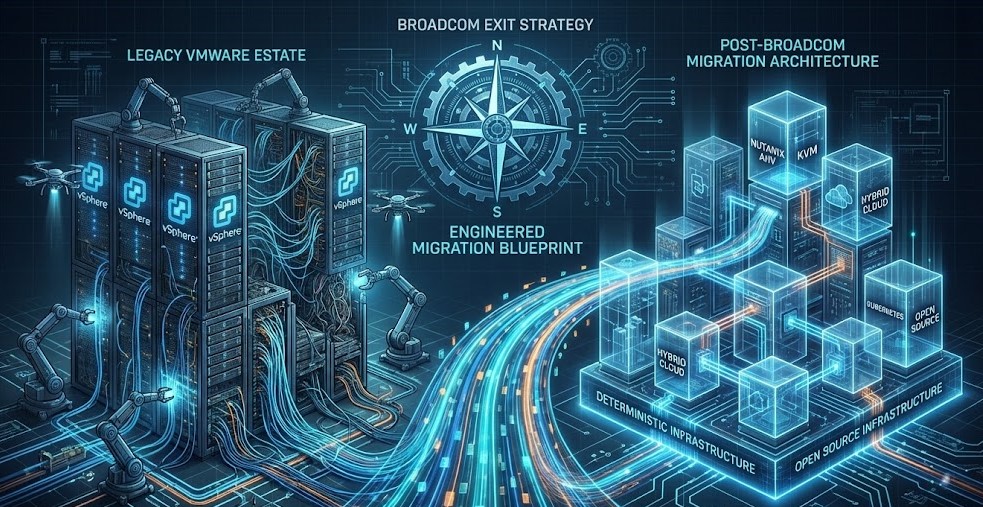
When Broadcom completed its VMware acquisition, it did not inherit a product portfolio. It inherited leverage. The transition from perpetual licensing to mandatory subscription bundles — VVF and VCF — was not a pricing adjustment. It was a structural extraction event designed to monetize years of organizational lock-in at maximum velocity.
Many organizations are still responding to this as a budget problem. It is not. It is an architectural problem with a fiscal symptom. The engineers and architects who recognize that distinction are the ones who will execute clean exits. The ones who don’t will renegotiate their subscriptions, defer the decision, and find themselves having the same conversation again in 18 months at a higher price.
This page is for the architects who are done deferring.
>_ Scope of This Page
This Broadcom exit strategy page is the strategic architecture layer — the why and which path. For the deep technical execution on each migration target, the Post-Broadcom Series runs the physics: scheduler translation, CVM tax modeling, high-I/O cutover sequencing, and policy translation. Those articles are linked throughout as the natural next step from each decision point.
>_ View the Full Post-Broadcom Series →What Broadcom Actually Changed
The licensing shift is a surface event. The architecture shift is what matters.
The removal of perpetual licenses eliminated the concept of a stable, amortized infrastructure cost. Compute, storage, and networking you provisioned five years ago and expected to carry for another three are now attached to a renewal clock that Broadcom controls. That changes your five-year TCO model, your CapEx-to-OpEx ratio, and your exposure to vendor pricing decisions you cannot influence.
Beyond the commercial model, Broadcom’s SKU consolidation eliminated product flexibility. The granular licensing that allowed vSphere Standard for edge workloads, Enterprise Plus for core infrastructure, and NSX selectively is gone. VVF and VCF are all-or-nothing bundles. If you don’t consume 80% of what’s in the bundle, you are subsidizing Broadcom’s portfolio strategy with your infrastructure budget.
This is the architectural problem. The exit strategy is not about finding a cheaper hypervisor. It is about dismantling a dependency structure that was never designed to be dismantled easily, and doing it without breaking production.
3–5×
Reported cost increase for comparable VVF/VCF vs. legacy perpetual licensing for mid-size enterprises
18 mo.
Realistic execution window for a clean, production-safe migration from VMware to an alternative stack
3 Paths
Architecturally distinct exit routes — each with different physics, cost profiles, and operational risk
The Three Exit Paths
There is no universal answer. There is only the right architecture for your workload physics.
Every VMware environment is different. The correct exit path is determined by workload density, networking complexity, storage architecture, team capability, and tolerance for operational disruption during transition. What follows is an honest assessment of each path — not vendor positioning.
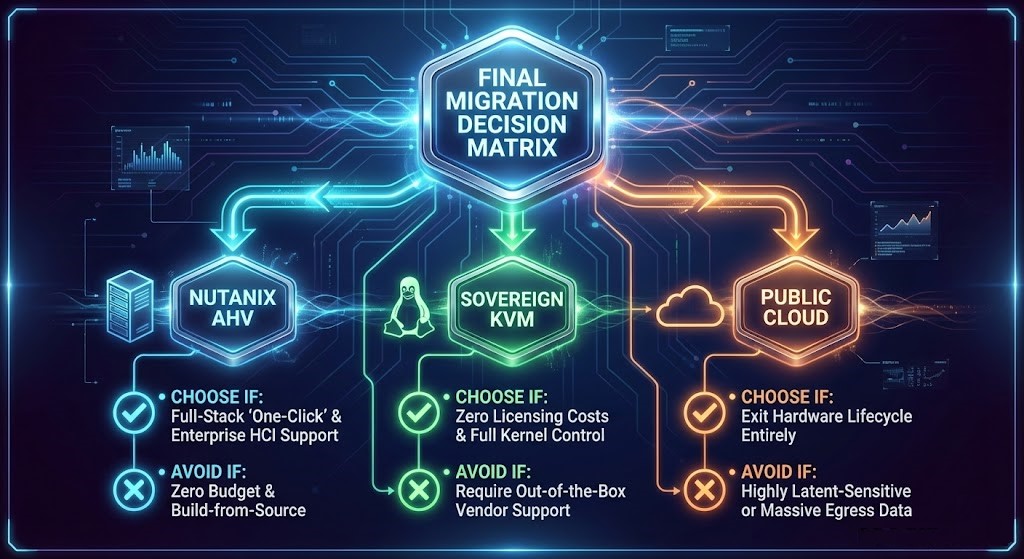
Nutanix AHV → Enterprise Replacement
For organizations running dense, production-critical workloads on HCI infrastructure, Nutanix AHV is the architecturally cleanest replacement. AHV’s hypervisor is embedded in the Nutanix stack — the scheduler, storage fabric, and networking layer are designed as a unified system. This matters for workloads that demand P99 latency predictability and storage convergence without a separately licensed hypervisor.
The migration path from ESXi to AHV is well-documented and Nutanix has matured its Move tooling to handle the conversion physics. The commercial negotiation is now heavily in the buyer’s favor — Broadcom’s pricing has made Nutanix an easier sell at every budget tier than it was 18 months ago. That said, the execution physics still require careful modeling. The CVM tax, scheduler translation, and RBAC policy mapping are where migrations stall — not at the hypervisor layer.
Best fit for:
Organizations already running Nutanix hardware, teams that need enterprise support SLAs, environments with mixed workload density requiring storage convergence, and regulated industries requiring auditable infrastructure controls.
>_ Nutanix AHV Architecture Deep DiveProxmox / KVM → Sovereign Infrastructure
Proxmox VE with Ceph is not a budget compromise. For organizations that have the engineering capability to operate it, it is a genuinely superior architecture from a sovereignty and cost physics standpoint. There are no per-socket licensing fees, no renewal negotiation. The infrastructure cost is the hardware cost, and the operational cost is the engineering investment.
The honest trade-off is operational complexity. Ceph requires careful cluster sizing, replication factor modeling, and rebuild traffic planning. Teams that have never operated at this layer will face a steep ramp. Teams that have will find it liberating.
Best fit for:
Engineering-led organizations with strong Linux operational capability, environments where 5-year TCO is the primary constraint, sovereign or air-gapped infrastructure requirements, and teams comfortable owning the full stack.
>_ Proxmox & KVM Architecture Deep DiveCloud Migration → Hybrid Exit Ramp
For specific workload classes, the Broadcom pricing event is the forcing function for a cloud migration that was already overdue. Stateless applications, development environments, burst workloads, and workloads with unpredictable utilization patterns are legitimate candidates for cloud exit rather than hypervisor replacement.
The critical discipline here is workload classification. Moving the wrong workloads to cloud — latency-sensitive databases, high-throughput storage workloads, anything with egress-heavy data patterns — will produce a cloud bill that exceeds the Broadcom subscription you were trying to escape. The physics of cloud economics must be modeled before the migration, not discovered after it.
Best fit for:
Stateless or cloud-native-ready workloads, organizations already with multi-cloud governance in place, environments using VMware Cloud on AWS seeking a native cloud migration path, and workloads where the on-prem refresh cycle and Broadcom renewal cycle align.
>_ Cloud Strategy ArchitectureThe Migration Physics
Strategy without execution physics is just a presentation.
Regardless of which exit path you choose, there are four execution domains that determine whether the migration succeeds or turns into a production incident. These are not phases in a project plan — they are coupled systems. A failure in any one cascades into the others.
>_ 01 / Inventory & Dependency Mapping
You cannot migrate what you haven’t classified. Every VM needs a workload profile: CPU/memory utilization pattern, storage I/O characteristics, network dependency map, and application-layer coupling. Environments that skip this step discover their dependencies mid-migration.
>_ 02 / Networking & IP Continuity
NSX environments carry the most migration risk. The distributed firewall ruleset, logical switching topology, and micro-segmentation policies are not portable artifacts — they must be re-engineered on the target platform. This is where migrations stall, not at the hypervisor layer.
>_ 03 / Security Integrity During Transition
Hybrid operation — running workloads across VMware and the target platform simultaneously — creates security boundary ambiguity. The micro-segmentation model that enforced east-west controls on vSphere does not automatically extend to AHV or Proxmox. This gap must be explicitly modeled.
>_ 04 / Licensing Transition & Budget Modeling
The migration window creates a period of dual spend — VMware subscriptions running in parallel with new platform acquisition costs. This window must be modeled explicitly. Organizations that treat it as a rounding error find it in their Q3 budget review.
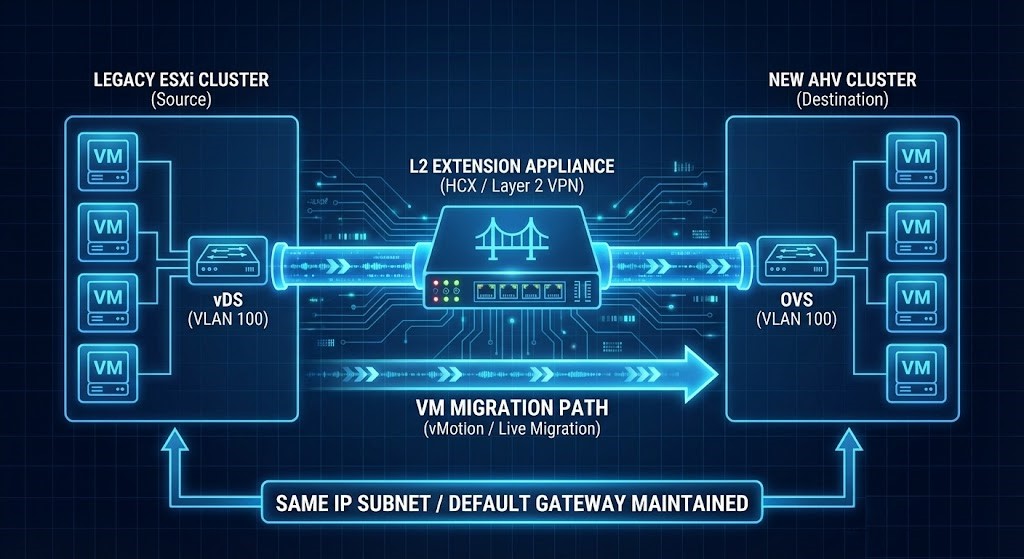
The coexistence phase — the operational window where VMware and the destination platform run simultaneously — is where the Fragmented Control Plane problem emerges. Workloads split across platforms create management plane gaps, security boundary ambiguity, and tooling blind spots that compound with each migration wave. The architecture of that coexistence window, and how to govern it without losing operational visibility, is the subject of The VMware Exit Has Entered the Coexistence Era.
>_ Post-Broadcom Series
The Technical Execution Layer
The four domains above are the strategic summary. The Post-Broadcom Series is where we run the actual physics — scheduler translation from ESXi to AHV, CVM tax modeling, high-I/O cutover sequencing, DRS-to-Flow policy mapping, and Day 2 rolling maintenance design. Each part is a field-deployable technical brief.
How to Choose Your Exit Path
Three questions that eliminate the wrong answers fast.
Organizations that spend months evaluating exit paths typically do so because they haven’t answered three foundational questions. These don’t require a consultant — they require an honest inventory of your environment and your team.
| Question | If Yes → | Implication |
|---|---|---|
| Does your team have the operational capability to run an open-source stack without enterprise support? | Proxmox/KVM is viable | If no: AHV or cloud. Proxmox without operational maturity creates a different kind of risk exposure. |
| Are 30%+ of your workloads stateless, bursty, or already cloud-compatible? | Hybrid cloud exit viable | Model egress costs before committing. Cloud exit for the wrong workloads accelerates spend, not reduces it. |
| Is enterprise support, SLA continuity, and a managed migration toolset non-negotiable? | Nutanix AHV is the path | AHV’s commercial support model, Prism management layer, and Nutanix Move tooling de-risk the execution window. |
Most environments will land on a hybrid answer — some workloads to AHV, some to Proxmox where the team has the capability, and a defined subset to cloud. The discipline is in the workload classification, not in picking a single exit path for the entire estate.
For a full constraint-based comparison of all three platforms — including where each breaks in production and the migration failure modes to plan for — see Proxmox vs Nutanix vs VMware: The Post-Broadcom Constraints No One Explains.
Model Before You Migrate
The Rack2Cloud Engineering Toolkit — infrastructure decisions backed by deterministic tooling.
>_ Continue the Architecture
Where Do You Go From Here?
The exit strategy is the architectural decision. The pages below are the execution layers — pick the path that matches your environment.
Architect’s Verdict
Exiting VMware is not a migration project. It is an architecture replatforming under time and cost pressure — and the organizations that treat it as a like-for-like hypervisor swap are the ones that discover the dependency graph three months into the execution phase.
The dependency map is the actual migration scope. NSX network policies, vCenter orchestration hooks, vSphere Distributed Switches, SRM replication logic, vRealize automation integrations — these are not VMware features that translate cleanly to other platforms. They are control plane dependencies that must be re-architected from first principles. The teams that succeed model the migration as a control plane transition, not a compute replacement. The control plane is where the complexity lives. The hypervisor is the easy part.
Coexistence architecture is the default, not the interim state. Multi-hypervisor environments are not a temporary phase during migration — they are the long-term operational reality for most enterprise environments. The licensing pressure is permanent. The platform fragmentation is permanent. Organizations that architect for eventual consolidation onto a single replacement hypervisor are the ones that end up locked into a new vendor dependency with the same constraints they were trying to escape. Build for coexistence. Architect for portability. The unified platform era is over.
That permanence carries past the migration project’s close: once coexistence is the standing architecture rather than an interim state, each team inherits a different platform, a different tool chain, and a different set of operational assumptions — permanently, with no consolidation event left to reconcile them. Virtualization Sprawl: When Every Team Owns A Different Infrastructure Reality is the mechanism behind that divergence.
Storage and network portability determine the actual migration timeline. Workload migration is fast. Control plane migration is slow. Organizations that select target platforms before validating storage protocol compatibility, network fabric portability, and orchestration API equivalence consistently blow past their original timelines because the infrastructure layer below the hypervisor was never modeled. The hypervisor runs VMs. The storage and network layers determine whether those VMs can migrate without downtime and whether the orchestration layer can manage them after cutover.
The operational learning curve is not a training problem — it is an architecture cost. New hypervisors require new operational discipline, new debugging workflows, and new mental models for how control plane failures propagate. Teams that underestimate the relearning cost treat the first production incident as a vendor failure when it is an architecture transition risk. Budget for it. Plan for it. The platform may be simpler, but the operations are not identical.
You’ve Seen the Exit Paths.
Now Model Your Timeline.
The exit path framework is clear. What determines whether your migration succeeds is the execution detail — your specific switching costs, dual spend window, workload sequencing, and the team capability gaps that don’t show up until you start. That’s the triage conversation.
Migration Execution Audit
Detailed execution planning scoped to your environment — dependency audit, dual spend modelling, platform recommendation, and migration timeline built around your actual renewal window and team constraints.
- > NSX dependency and switching cost audit
- > Dual spend window modelling
- > Platform selection — AHV vs. Proxmox vs. hybrid
- > Migration timeline scoped to your renewal cycle
Architecture Playbooks. Field-Tested Blueprints.
Weekly architecture intel covering the decisions this page frames — Broadcom exit updates, migration execution patterns, AHV and Proxmox production analysis, and failure-mode case studies from real enterprise migrations. No vendor marketing. No filler.
- > Broadcom Exit Strategy Updates
- > Virtualization & Migration Physics
- > AHV & Proxmox Production Patterns
- > Real Migration Failure-Mode Analysis
Zero spam. Unsubscribe anytime.
Frequently Asked Questions
Q: Can we negotiate with Broadcom instead of migrating?
A: Some organizations have achieved short-term pricing relief through enterprise agreements. The risk is that any negotiated discount is subject to renewal at Broadcom’s discretion. Use negotiation to buy migration runway, not to replace the migration decision.
Q: How long does a realistic VMware exit actually take?
A: For a mid-size environment (50–300 VMs), 12–18 months is the realistic window for a production-safe migration that includes inventory, platform buildout, workload conversion, networking migration, and validation. Environments with NSX, vSAN, and complex distributed workloads should plan toward 18 months. Declaring a 6-month exit is how migrations become incidents.
Q: What’s the hardest part of the migration technically?
A: Networking. Every VM conversion tool handles the compute and storage layers reasonably well. NSX policy migration, distributed switch topology mapping, and security boundary reconstruction on the target platform are where migrations stall. Budget more engineering time for the networking layer than the hypervisor layer — it is consistently underestimated.
Q: What is the Post-Broadcom Series?
A: This page is the strategic decision framework. The Post-Broadcom Series covers the technical execution layer — scheduler translation, CVM tax modeling, high-I/O cutover sequencing, DRS-to-Flow policy mapping, and rolling maintenance design. Part 01 is live now; Parts 02–05 are publishing through 2026. View the full series index →