

PRIVATE CLOUD SOVEREIGNTY
The Management Plane Nobody Actually Owns.
The hardware is owned. The management plane is rented. That single distinction is what separates private cloud from private cloud sovereignty — and it is the distinction most private cloud deployments never make.
Private cloud is not a location decision. It is an authority decision. Moving workloads to on-premise hardware does not create sovereignty. Running VMware on owned servers does not create sovereignty. Paying a managed service provider to operate your data center does not create sovereignty. What creates sovereignty — and what private cloud architecture exists to deliver — is operational independence: the ability to run, modify, recover, and audit your entire infrastructure stack without requiring permission from, payment to, or continued relationship with any external vendor.
Most private cloud deployments fail this test. The hardware is owned. The management plane is rented. The automation is vendor-specific. The CMDB is SaaS. The identity plane calls home. The backup platform licenses annually. Strip away the hardware and what remains is a dependency graph with an on-premise datasheet stapled to it.
This page answers one question: What does private cloud sovereignty actually require, and what architectural decisions determine whether you have it?
The Private Cloud Illusion
The private cloud illusion is maintained by a set of beliefs that are individually reasonable and collectively wrong. Each belief describes a real infrastructure investment. None of them describe sovereignty. Recognizing the gap between what was purchased and what was actually achieved is the prerequisite to closing it.
| What Teams Believe | What It Actually Means |
|---|---|
| On-premise = sovereign | Physical location is not operational independence. Sovereignty is determined by who controls the management plane, not where the servers sit. |
| Private cloud = private control | Single-tenant does not mean customer authority. A private cloud operated by a vendor under a managed service agreement transfers operational control to the vendor, not to the customer. |
| VMware on owned hardware = sovereign | Hardware ownership does not remove license dependency. The Broadcom acquisition demonstrated at scale that operational authority over vSphere, vCenter, and DRS is a vendor-controlled capability — not a customer-owned one. |
| Managed private cloud = operational independence | Managed service convenience is outsourced authority. The operational ease of having a vendor manage your infrastructure is the product they sell — and the sovereignty they take in exchange. |
| Repatriation = sovereignty | Moving workloads is not reclaiming control. Cloud repatriation changes the location of the compute. It does not change the authority of the management plane unless that is explicitly designed for. |
| BYOK and encryption = data sovereignty | Encryption protects data in transit and at rest. It does not protect against management plane authority loss. A vendor with orchestration authority over your environment can operate it regardless of who holds the encryption keys. |
The illusion persists because management plane dependency is invisible at steady state. The workloads run. The backups complete. The dashboards show green. The dependency activates only at the moment it would matter most: when a license lapses, a vendor is acquired, a contract is disputed, a jurisdiction asserts authority, or the management plane becomes unreachable during the exact incident that demands its use.
The 90-Day Sovereignty Test
If the vendor relationship terminated today — licenses lapsed, contracts ended, support vanished — could this environment continue operating, recovering, and being audited for the next 90 days without any vendor interaction?
This is not a disaster recovery test. It is a sovereignty test. DR assumes infrastructure continues operating but needs to recover from failure. The 90-day sovereignty test assumes the vendor relationship fails — and asks whether the management plane survives that failure independently of the infrastructure’s physical health.
The Rack2Cloud Private Cloud Sovereignty Model
Private cloud sovereignty is not a single decision. It is a four-layer property — a management plane stack where each layer either operates within the sovereign boundary or exits it.
The layers are not independent. Each layer inherits operational authority from the layer below. A vendor dependency at the substrate breaks orchestration independence above it. A dependency in orchestration breaks control plane authority above that. There is no partial sovereignty in a management plane. There is sovereign authority at every layer, or there is rented authority pretending to be sovereign.
**This is the Rack2Cloud Private Cloud Sovereignty Model.**
| Layer | What It Controls | Sovereignty Test | Fails When |
|---|---|---|---|
| Compute & Storage Substrate | Physical hardware, hypervisor, storage fabric, network underlay — the execution environment for all workloads | Can workloads be scheduled, migrated, and recovered without vendor license or maintenance contract? | Hypervisor requires annual license renewal; storage array needs vendor firmware support; NIC firmware tied to OEM contract |
| Orchestration & Automation | VM and container lifecycle, workload scheduling, IaC execution, Day-2 operations, runbook execution | Can orchestration run entirely from customer-controlled tooling with no proprietary API dependency in the critical path? | vCenter required for HA and DRS; Prism Central cloud-connected features active; automation calls vendor SaaS endpoints |
| Operational Control Plane | Identity resolution, authentication, RBAC, certificate trust, secrets access, service accounts — the authorization layer every workload operation passes through | Can workloads authenticate, authorize, and access secrets without calling external services? | AD Connect requires Microsoft cloud sync; SSO provider is SaaS-hosted; LDAP resolution calls external endpoint; certificates chain to external CA |
| Observability & Audit (Evidence Plane) | Metrics, logs, traces, alerting, compliance evidence, forensic continuity — the complete record that proves operational state and intent | Can the environment be monitored, audited, and forensically examined offline with evidence retained entirely within the sovereign boundary? | Metrics write only to vendor SaaS; audit logs forward to external SIEM with no local copy; compliance evidence depends on third-party platform availability |
The model reads bottom-up architecturally and top-down operationally. Architectures are designed from substrate up — establishing compute independence first, then orchestration, then control plane, then evidence. Failures surface top-down — the evidence plane is the first layer teams notice has failed because observability gaps are immediately visible; the substrate is the last layer they check because physical hardware keeps running even as management authority collapses above it.
Most private cloud sovereignty audits find the same pattern: layers 1 and 2 are partially addressed because they are visible at procurement time. Layers 3 and 4 are assumed because they were never part of the acquisition decision.
What “Private Cloud” Actually Means (And What It Doesn’t)
Three architecture patterns are routinely described as private cloud. All three are real infrastructure investments. None of them constitute private cloud sovereignty.
You own the servers. The management platform licenses annually. vCenter, Prism Central, or a vendor management SaaS controls scheduling, migration, HA, and Day-2 operations. The hardware is an asset on your balance sheet. The operational capability is a subscription.
This is co-located hardware with a rented brain. The Broadcom VMware exit is the canonical case study: thousands of organizations discovered their private cloud required Broadcom’s continued cooperation for basic operational functions. The hardware was theirs. The operational authority was not.
A third party operates your infrastructure — in your facility, a colocation, or theirs. Physical control is variable. Operational control is contractually theirs. Daily management, incident response, change control, and recovery are all vendor-mediated.
Managed private cloud delivers operational simplicity. What it delivers it at the cost of operational authority. You have a contract specifying what the vendor will do. You do not have the capability to do it yourself. Sovereignty requires capability, not contract language.
AWS Outposts, Azure Stack, Google Distributed Cloud. Hardware sits on-premise. Management authority sits in the cloud provider’s control plane. These are purpose-built extensions of public cloud management into customer facilities — useful for specific latency or regulatory scenarios, not private cloud sovereignty.
These are deliberate sovereignty compromises. They are not deceptive — the providers document the dependency model clearly. They fail the sovereignty test not by accident but by design. The compliance trap of provider-anchored management authority applies fully.
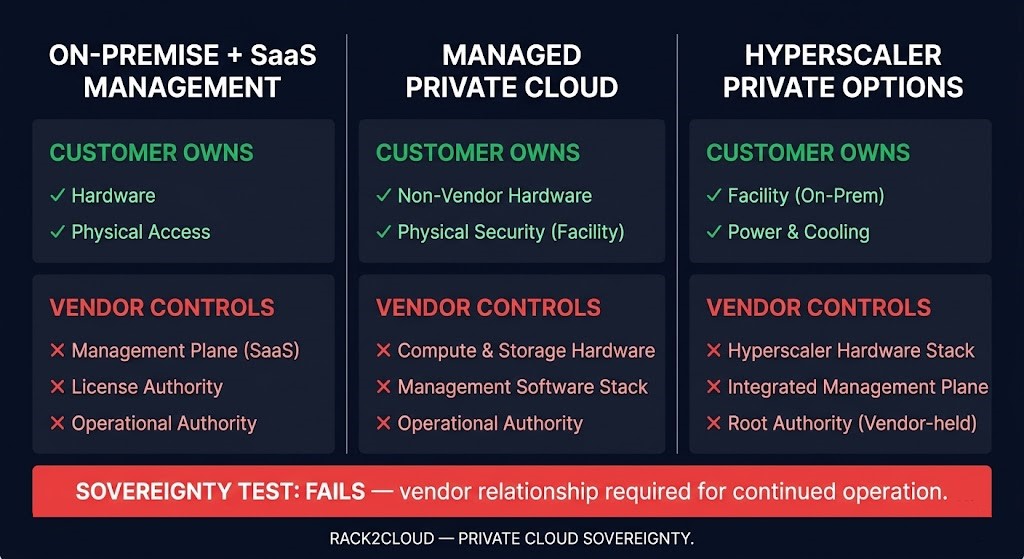
None of these patterns are wrong architectural choices in every context. On-premise hardware with vendor management is appropriate for organizations that accept the license dependency. Managed private cloud is appropriate when operational capability cannot be staffed. Hyperscaler private options are appropriate for hybrid architectures with specific latency or regulatory requirements that don’t require full sovereignty. The error is not choosing these patterns. The error is describing them as sovereign when they are not. Sovereign Infrastructure as a framework is precise about what sovereignty actually requires — and none of these patterns meet the definition.
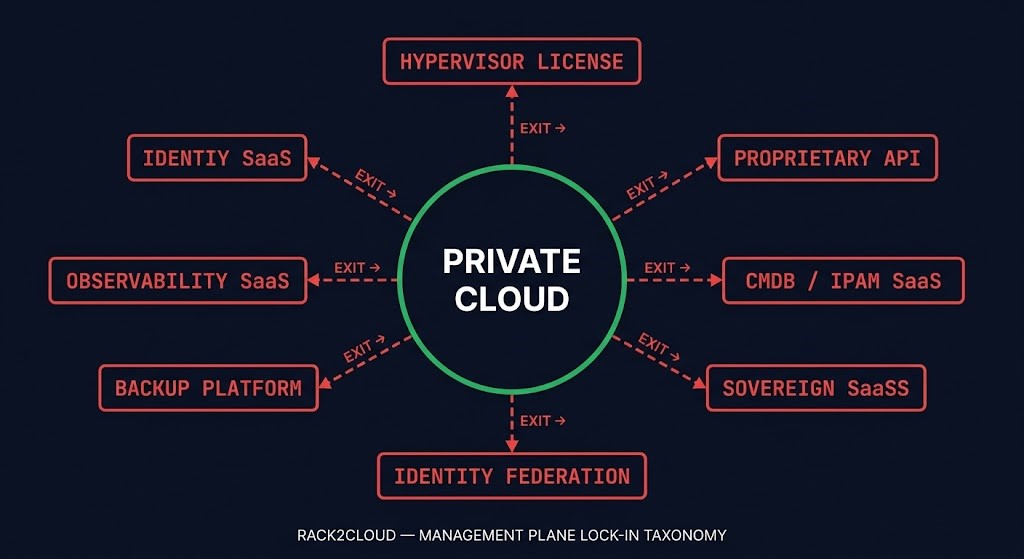
The Management Plane Lock-In Taxonomy
The six dependency vectors below are where private cloud operational authority exits the sovereign boundary. Most architectures have at least three active simultaneously. Each one is individually reasonable at adoption time. Together they create a management plane that cannot survive vendor relationship change.
The Sovereign Stack Reference Architecture
This is not a product stack. It is a control-plane pattern — each layer operable without vendor reachability, each tool replaceable without rebuilding the management plane above it.
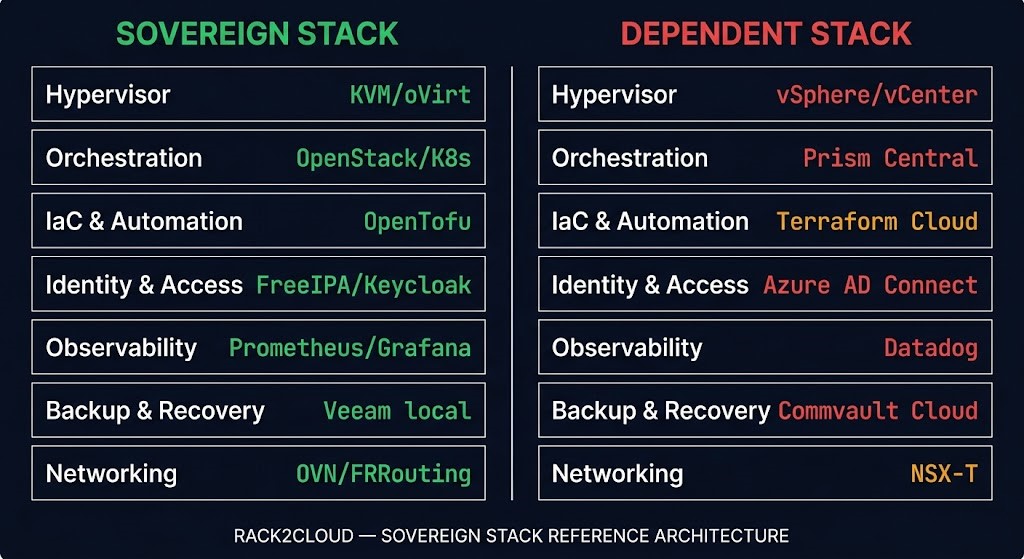
| Management Layer | Sovereignty-Compliant Pattern | Common Dependent Pattern | Why It Matters |
|---|---|---|---|
| Hypervisor | KVM / oVirt / Proxmox — open-source, no license dependency, full operational capability without vendor relationship | VMware vSphere — annual subscription, vCenter required for HA/DRS/migration, Broadcom authority over pricing and licensing | License lapse disables production workload operations. Hardware ownership does not protect against this. |
| Orchestration | OpenStack, Apache CloudStack, or Kubernetes + Cluster API — open-source control planes with no SaaS dependency in the critical path | Nutanix Prism Central (cloud-connected features), VMware vCenter (license dependency), proprietary vendor orchestration APIs | Orchestration is where Day-2 operations live. Vendor authority here means vendor authority over everything the orchestration layer touches. |
| IaC & Automation | OpenTofu with local state backend; Ansible with local inventory; no SaaS API in execution path | Terraform Cloud / HCP Terraform (state in HashiCorp SaaS); vendor-specific automation platforms with proprietary runbook formats | IaC state is the authoritative record of infrastructure intent. External state is external authority over infrastructure decisions. |
| Identity & Access | FreeIPA, self-hosted Keycloak, or open-source LDAP; local certificate authority anchored in HSM; no cloud federation requirement for authentication | Azure AD Connect requiring Microsoft connectivity; Okta cloud-hosted SSO; external CA dependency in certificate chain | Authentication is in the critical path of every management plane operation. External authentication dependency makes sovereign operation impossible under isolation. |
| Observability (Evidence Plane) | Prometheus + Grafana + Loki self-hosted; VictoriaMetrics for long-term retention; local alertmanager with no SaaS dependency | Datadog, Splunk Cloud, New Relic — SaaS-only retention, telemetry exits sovereign boundary, no local forensic path | Without local observability, the management plane cannot prove its operational state during incidents, audits, or compliance reviews. |
| Backup & Recovery | Veeam with on-premise repository; Velero for Kubernetes workloads; immutable local target with vendor-independent restore path | Commvault Cloud, Rubrik Cloud Vault — recovery plane requires vendor cloud reachability to complete restoration | A management plane that cannot recover workloads independently cannot claim sovereignty over them. Recovery authority is management authority. |
| Networking | Open vSwitch, FRRouting, OVN — open-source underlay with no vendor API dependency for daily operations and routing changes | NSX-T (VMware license dependency), Cisco ACI (proprietary controller required for policy changes) | Network policy changes are operational. Requiring vendor tooling for routing or segmentation changes places daily operations under vendor authority. |
The sovereign stack does not require replacing everything simultaneously. The migration path is layer-by-layer, starting at the substrate and working upward — establishing compute independence first, then orchestration, then control plane, then evidence. Each layer completed reduces the total dependency exposure even if the stack above it is still vendor-managed. The goal is a management plane that passes the 90-day test. The path there is incremental. Bare metal orchestration covers the physical layer transition in detail.
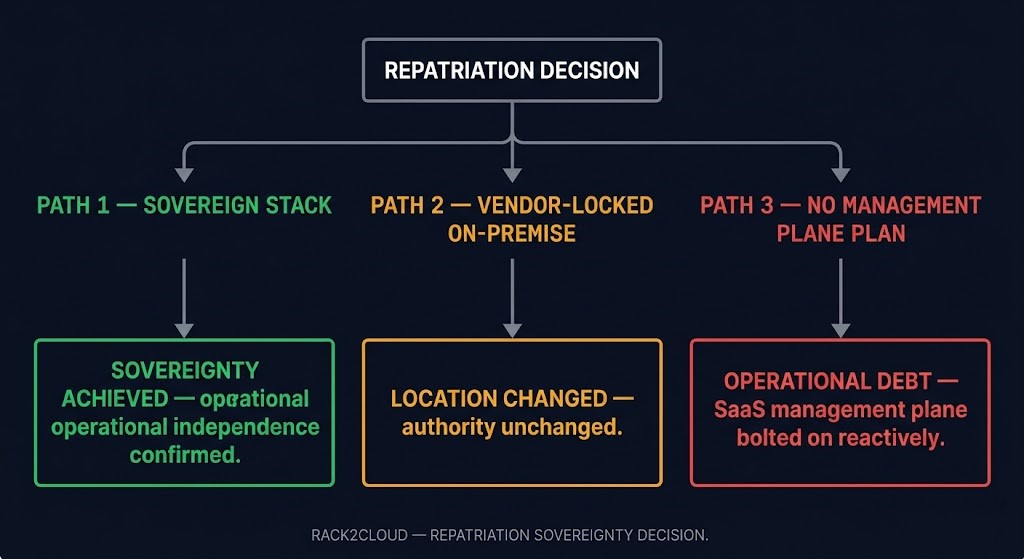
Repatriation as a Sovereignty Decision
Cloud repatriation is not a cost decision. It is an authority recapture operation — and it fails architecturally when treated as a migration project rather than a sovereignty design project. The repatriation calculus documents the financial case. This section covers what most repatriation programs get wrong: they move workloads back to on-premise hardware and then rebuild the same management plane dependencies they had before, just on owned infrastructure.
The exit cost architecture model applies here directly — the cost of leaving cloud is one of the first sovereignty taxes a repatriation program hits, and it must be modeled at Day 0, not discovered at execution. Cloud egress physics are the operational manifestation of that cost.
**The three repatriation failure modes:**
The Control Plane Survivability Test
A private cloud management plane is sovereign only if it can continue scheduling, authenticating, observing, and recovering workloads when vendor systems become unreachable.
The 90-Day Sovereignty Test measures commercial survivability — can the management plane continue operating without the vendor relationship? The Control Plane Survivability Test measures technical survivability — can the management plane continue operating without vendor system reachability? Both tests are required. An environment that passes one and fails the other is not sovereign.
Where Private Cloud Fits in the Sovereign Stack
Private Cloud Sovereignty is the Management Plane in the Rack2Cloud Sovereign Infrastructure model. The model defines four planes — Physical, Cryptographic, Identity, and Management — where each plane either holds its sovereign boundary or compromises the planes built on top of it.
The physical boundary inside which the management plane operates. Hardware ownership, physical access control, and the compute substrate that all management layers run on.
Key custody that protects management plane credentials, secrets, and certificates. The cryptographic substrate every management plane authentication decision inherits from.
The authentication authority that validates every management plane actor. Sovereign identity is the prerequisite that allows the management plane to authorize operations without external dependency.
Orchestration, automation, observability, and recovery operating without vendor dependency. Where sovereign authority becomes operationally real — or where it silently fails.
The management plane is the operational layer where sovereignty is exercised daily. It is also the layer most vulnerable to convenience-driven dependency — vendor SaaS tools are operationally easier to adopt, and the sovereignty cost is invisible at steady state. The physical, cryptographic, and identity planes are prerequisites. Without them, the management plane has nothing sovereign to operate on. With them, the management plane is the layer that makes sovereignty operationally real or operationally hollow. Sovereign networking and control plane isolation addresses the network plane that the management plane depends on for communication between all of its components. The governance portability architecture that determines whether this management plane survives platform transitions is mapped at the virtualization layer in the Sovereign Virtualization Architecture stage — the four-condition Sovereignty Boundary Model applies directly to private cloud management plane design.
When Private Cloud Sovereignty Is the Wrong Answer
Sovereignty has operational costs. Not every environment should pay them. The decision framework below defines when the investment is architecturally justified and when it is not.
Management plane sovereignty overhead exceeds benefit when the primary risk is speed-to-market, not vendor authority loss. Cloud dependency is the correct choice when the sensitivity threshold that justifies sovereign investment has not yet been crossed. The architectural decision worth making at this stage: adopt open-source tooling from Day 1 to preserve the migration path when the sensitivity threshold is reached.
Dev/test environments, public-facing content, and analytics workloads without data sovereignty requirements are appropriate candidates for cloud-managed planes. Sovereignty investment belongs in the regulated, sensitive, or strategically critical tier — not uniformly applied to every workload class in the environment.
A sovereign management plane requires sustained operational discipline — patch management, certificate rotation, key ceremony execution, upgrade planning, dependency auditing. Underfunded teams that adopt sovereign infrastructure and then operate it negligently produce worse outcomes than well-operated cloud dependency. Sovereignty without operational capability is not an architecture. It is a liability.
Organizations using AWS Outposts, Azure Stack, or similar for specific regulatory or latency requirements, or running a genuinely hybrid model where cloud and private cloud serve different workload classes by design. Sovereignty in the private cloud tier does not require eliminating cloud entirely — it requires that the private cloud tier passes both sovereignty tests independently of the cloud tier’s operational status.
Decision Framework
| Scenario | Sovereignty Requirement | Architecture | Risk if Skipped |
|---|---|---|---|
| Regulated data — GDPR, DORA, NIS2, HIPAA | High — jurisdictional authority requirements demand management plane independence | Full sovereign stack reference; local identity; local observability; no SaaS management plane; both sovereignty tests documented | Jurisdictional access order enforceable through vendor management plane; compliance evidence requires vendor availability |
| Post-Broadcom VMware exit | High — replace hypervisor license dependency, not just the hypervisor binary | KVM/Proxmox/oVirt + OpenStack or Kubernetes; OpenTofu local state; sovereign identity retained; no new vendor management platform with same license structure | Recreating the same dependency structure under a different vendor brand — sovereignty theater, not sovereignty architecture |
| Defense or national security workloads | Maximum — air-gapped operations required; vendor system reachability not possible by design | Full sovereign stack; no cloud connectivity in management plane; offline identity and certificate services; HSM-anchored key custody; documented offline recovery ceremonies | Air-gap is operationally impossible with any management component requiring external reachability — classified workloads cannot be operated |
| Financial services with cloud repatriation mandate | High — regulator requires demonstrated operational independence | Sovereign orchestration + backup + identity; cloud for non-sensitive tier only; 90-day sovereignty test documented and executed; external auditor can verify evidence plane independently | Regulator audit finds management plane dependency; repatriation investment fails its compliance objective |
| Enterprise with mixed cloud + on-premise workloads | Medium — sovereign private cloud tier, accepted cloud dependency for commodity workloads | Workload classification first; sovereign stack for regulated/sensitive tier; cloud-managed acceptable for commodity tier; clear boundary between tiers with no management plane bleed-through | Shared management tooling across tiers creates dependency bleed — cloud management plane authority extends into the supposedly sovereign tier |
| Startup or pre-regulated growth stage | Low now, medium later — architect for future sovereignty even if not executing on it today | Open-source management tooling from Day 1; avoid proprietary lock-in even while accepting cloud dependency; document the migration path for when sensitivity threshold is crossed | Proprietary tooling adopted for convenience at early stage creates 3–5 year lock-in that must be unwound at exactly the time regulatory pressure begins |
What Breaks First
The first failure in a private cloud sovereignty event is rarely compute. The servers keep running. Workloads keep executing. The metrics that measure physical infrastructure health show green. What stops being operable is the management plane — and it fails in a consistent sequence that most teams haven’t mapped before they need to respond to it.
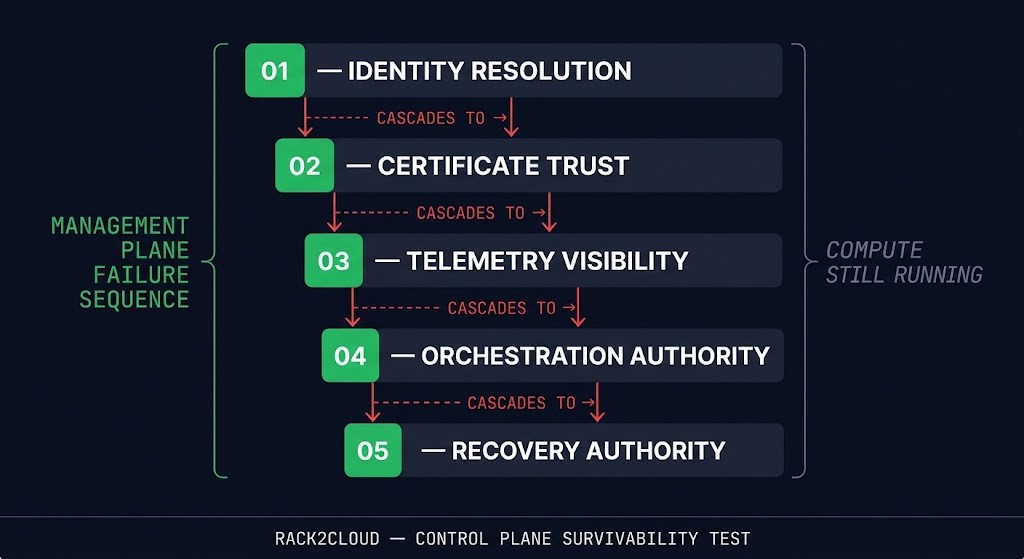
The consistent pattern across all five failures: the architecture was sovereign in documentation and dependent in execution. The dependency was invisible at steady state. It activated under the exact conditions — isolation, vendor incident, license dispute — the sovereign architecture was designed to survive. Designing to pass the Control Plane Survivability Test is designing to prevent all five failures simultaneously. They share the same root cause: external authority embedded in the management plane during a phase when operational convenience was the primary design criterion.
Private Cloud Sovereignty is the Management Plane of the Rack2Cloud Sovereign Infrastructure model. The pages below own the adjacent planes — the physical boundary, cryptographic substrate, identity authority, and network isolation layer that the management plane depends on and operates within.
You’ve Read the Architecture.
Now Test Whether Your Management Plane Actually Holds.
Hypervisor license dependency, proprietary API lock-in, external identity federation, SaaS-only observability, vendor-dependent recovery — most private cloud environments document sovereignty and operate dependency. The triage session runs both sovereignty tests against your specific management plane before an incident does it for you.
Private Cloud Sovereignty Audit
Vendor-agnostic review of your private cloud management plane — 90-Day Sovereignty Test, Control Plane Survivability Test, lock-in dependency mapping, sovereign stack migration planning, and evidence plane validation.
- > Management plane dependency audit — all six vectors mapped
- > 90-Day and survivability test execution
- > Sovereign stack migration path design
- > Evidence plane and recovery authority validation
Architecture Playbooks. Every Week.
Field-tested blueprints from real private cloud sovereignty decisions — repatriation post-mortems, management plane lock-in case studies, post-Broadcom exit architecture patterns, and the sovereign stack migrations that held under real operational pressure.
- > Repatriation Architecture & Sovereignty Design
- > Management Plane Lock-In Post-Mortems
- > Post-Broadcom Private Cloud Patterns
- > Control Plane Survivability Case Studies
Zero spam. Unsubscribe anytime.
Architect’s Verdict
Private cloud sovereignty is not a hardware purchase. It is an authority architecture. The decision to buy servers, build a data center, or repatriate workloads is operationally significant and architecturally irrelevant to sovereignty until the management plane question is answered: who has operational authority over orchestration, authentication, observability, and recovery — and what happens to that authority when vendor relationships change?
The Broadcom acquisition answered this question for thousands of VMware environments simultaneously and without warning. It was not an edge case. It was the predictable outcome of building operational authority on a vendor relationship rather than on a sovereign architecture. Organizations that had designed management planes that could outlast any single vendor relationship did not experience the Broadcom transition as a crisis. They experienced it as a procurement decision. The hardware was theirs. The operational authority was not.
That is the distinction this entire page exists to clarify. The hardware is irrelevant to sovereignty. The management plane — who controls scheduling, who authenticates administrators, who holds the evidence of operational state, who can trigger recovery — is what sovereignty actually means in private cloud. Getting it right does not require replacing everything at once. It requires designing the dependency graph deliberately before the first workload arrives, and auditing it honestly thereafter.
The management plane is the last thing most architects think about and the first thing that fails when sovereignty is tested. Build it to survive the test. Design both sovereignty tests into the architecture review. The test does not announce itself before it arrives.
Frequently Asked Questions
Q: What is the difference between private cloud and private cloud sovereignty?
A: Private cloud describes a deployment location — infrastructure operated for a single organization rather than shared across many. Private cloud sovereignty describes an authority model — operational independence that allows the organization to run, modify, recover, and audit the infrastructure without external vendor dependency. You can have private cloud without sovereignty (on-premise VMware under annual license). You cannot have sovereignty without deliberately designing for it. Location is necessary but not sufficient. The management plane is the deciding layer.
Q: Does running Kubernetes on-premise make a private cloud sovereign?
A: Kubernetes itself is open-source and carries no license dependency — but the management plane around it determines sovereignty. A cluster managed by Rancher Enterprise, OpenShift, or a vendor distribution with SaaS-dependent features may introduce vendor authority into the management plane. The question is not whether Kubernetes runs on-premise but whether orchestration, identity, observability, and recovery can all execute without vendor dependency. The sovereign stack pattern in this guide defines what that requires at each layer.
Q: What does the Broadcom/VMware acquisition reveal about private cloud sovereignty?
A: It reveals that operational authority built on vendor licensing is not sovereign authority — it is rented authority. Thousands of organizations discovered that their private cloud required Broadcom’s continued cooperation for HA, DRS, vMotion, and basic vCenter operations. The hardware was theirs. The operational capability was Broadcom’s. Sovereignty architecture treats that distinction as the primary design constraint, not an afterthought addressed after deployment.
Q: What is the 90-Day Sovereignty Test?
A: The 90-Day Sovereignty Test asks: if the vendor relationship terminated today — licenses lapsed, contracts ended, support vanished — could the environment continue operating, recovering, and being audited for the next 90 days without any vendor interaction? It measures commercial survivability. The companion Control Plane Survivability Test asks whether the management plane can continue all operations when vendor system reachability is severed. Both tests are required. An environment that passes one and fails the other is not sovereign.
Q: How does private cloud sovereignty relate to cloud repatriation?
A: Repatriation moves workloads from public cloud to on-premise infrastructure. Sovereignty determines whether the resulting on-premise environment is operationally independent or a different flavor of vendor dependency. Repatriation without a sovereign management plane design produces on-premise infrastructure with SaaS orchestration, cloud-hosted identity, and vendor-specific backup — a location change, not a sovereignty change. The three repatriation failure modes in this guide cover the most common architectural mistakes that produce this outcome.
Q: What open-source tools form a sovereign private cloud management plane?
A: The sovereign stack reference architecture in this guide covers all layers: KVM/oVirt/Proxmox for hypervisor, OpenStack or Kubernetes with Cluster API for orchestration, OpenTofu with local state backend for IaC, FreeIPA or self-hosted Keycloak for identity, Prometheus and Grafana and Loki self-hosted for observability, and Veeam with on-premise repository or Velero for backup. The specific tools matter less than the design principle: every layer must be operable without calling out to a vendor service.
Q: How does private cloud sovereignty connect to the broader Sovereign Infrastructure model?
A: Private Cloud Sovereignty is the Management Plane in the Rack2Cloud Sovereign Infrastructure model. The Physical Plane (Bare Metal Orchestration) defines the boundary. The Cryptographic Plane (Hardware Security / HSM) protects management plane credentials and keys. The Identity Plane (Sovereign Identity) authenticates management plane actors. The Management Plane — what this page covers — is where operational authority is exercised daily. Weakness in any plane propagates upward; the management plane is where that weakness becomes operationally visible and where recovery authority lives or fails.