

VMWARE MIGRATION STRATEGY
Platform transition architecture — workload execution physics, governance continuity, and operational normalization after VMware exit
SPECIALIZATION TRACK — VMWARE MIGRATION STRATEGY
- Track Discipline: The architectural mechanics of platform transition — workload execution, governance continuity, identity portability, and operational normalization across a VMware exit and replacement stack cutover.
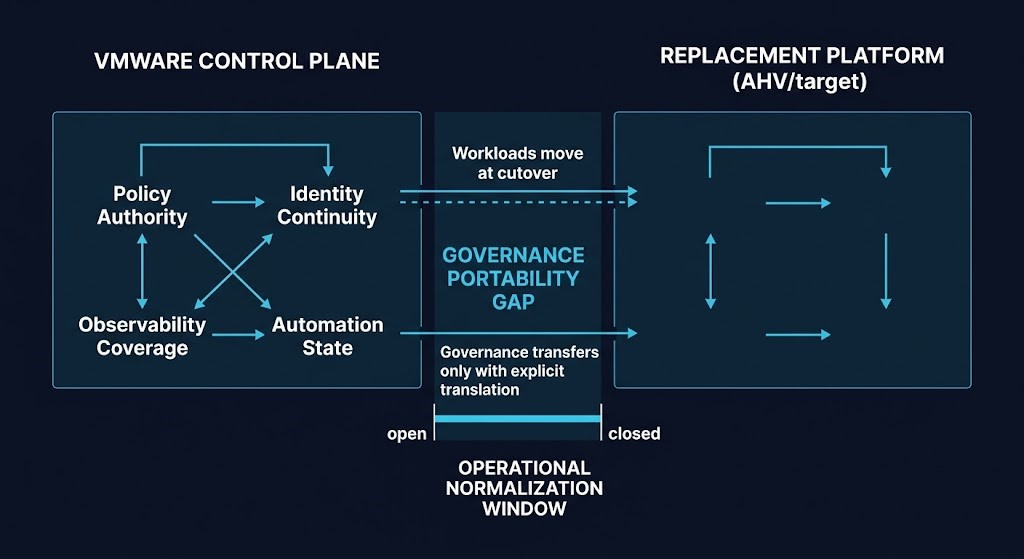
- Primary Architectural Tension: Migration velocity vs. governance continuity — the faster the cutover, the higher the probability that policy, identity, and observability authority gaps persist undetected after completion.
- Architectural Boundary: This Track does not govern post-migration steady-state operations, hardware procurement economics, or the internal architecture of the replacement platform at depth — those belong to the HCI Architecture and Compute Architecture Tracks.
- Domain Path Relationship: Deepens Stages 4–5 of the Virtualization Architecture Path — the stages where operational governance and post-VMware strategic architecture are introduced but platform transition mechanics are treated at breadth only.
- Who This Track Is For: You are actively modeling or executing a VMware exit and have already encountered governance gaps, identity continuity failures, or operational assumptions that the migration checklist didn’t capture — and you need the architectural framework to resolve them before they compound.
VMware migration strategy is an architectural discipline — it governs the physics of workload relocation, the continuity of governance authority, and the operational assumptions that either survive or collapse during platform transition. Most teams treat it as a project management problem; the ones that hit cutover complexity in production discover the distinction. The gap between a completed migration and a closed migration is measured not in workload counts but in how many policy, identity, and observability dependencies were architecturally accounted for before the cutover window opened.
Specialization Tracks deepen specific architectural disciplines across multiple maturity stages without replacing the progression logic of the Domain Path itself. The Virtualization Architecture Path addresses migration within the context of sovereign architecture and platform evaluation — but it covers the transition mechanics at breadth. The operational conditions that create migration debt, governance gaps, and post-cutover drift require the architectural depth this Track provides.
>_ WHY THIS TRACK EXISTS
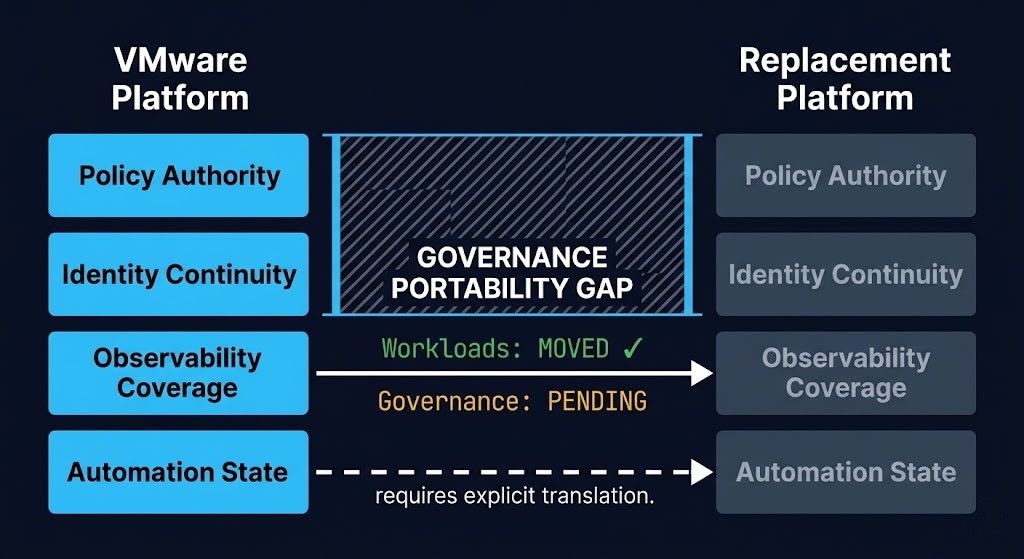
VMware migration carries a hidden architectural dependency: governance authority — policy enforcement, identity continuity, observability coverage, and operational automation — does not transfer automatically when workloads move. When that dependency is ignored, migrations declare completion while governance gaps persist silently, accumulating into the Governance Portability Gap (Framework #86) that surfaces as operational failures months after cutover. The Virtualization Architecture Path covers platform selection, coexistence modeling, and sovereign architecture — but the execution physics of the transition, the identity portability problem, and the Operational Normalization Window (Framework #87) that must be closed after cutover are left at breadth only. This Track provides the architectural sequencing to model, execute, and close a platform transition without leaving governance debt that the post-migration steady state inherits.
WHAT THIS TRACK IS NOT
01 — NOT VENDOR MIGRATION DOCUMENTATION
This Track covers the architectural mechanics of governance continuity, execution physics, and operational normalization — not the procedural steps of a specific vendor’s migration tooling.
02 — NOT A CUTOVER RUNBOOK
This Track addresses why specific cutover failure modes occur and what architectural conditions create them — not the step-by-step sequence of any single migration execution.
03 — NOT THE HCI ARCHITECTURE TRACK
HCI Architecture governs the internal architecture, resource modeling, and operational characteristics of the replacement platform — this Track governs what happens during the transition from VMware to whatever replaces it.
04 — NOT POST-MIGRATION STEADY-STATE OPERATIONS
This Track ends when the Operational Normalization Window closes and governance authority is fully re-established on the replacement platform — steady-state day-2 operations belong to the Domain Path’s Strategic stage.
VMWARE MIGRATION STRATEGY — READING SCOPE
| Scope | Coverage | Estimated Time |
|---|---|---|
| Core Reading Sequence | Clusters 01–03 — execution physics, identity portability, and cutover architecture; the mechanical foundation of migration decision-making | ~3–4 hr |
| Full Track | All five clusters — full depth including governance continuity, Governance Portability Gap modeling, and Operational Normalization Window architecture | ~6–8 hr |
>_ WHERE TO ENTER THIS TRACK
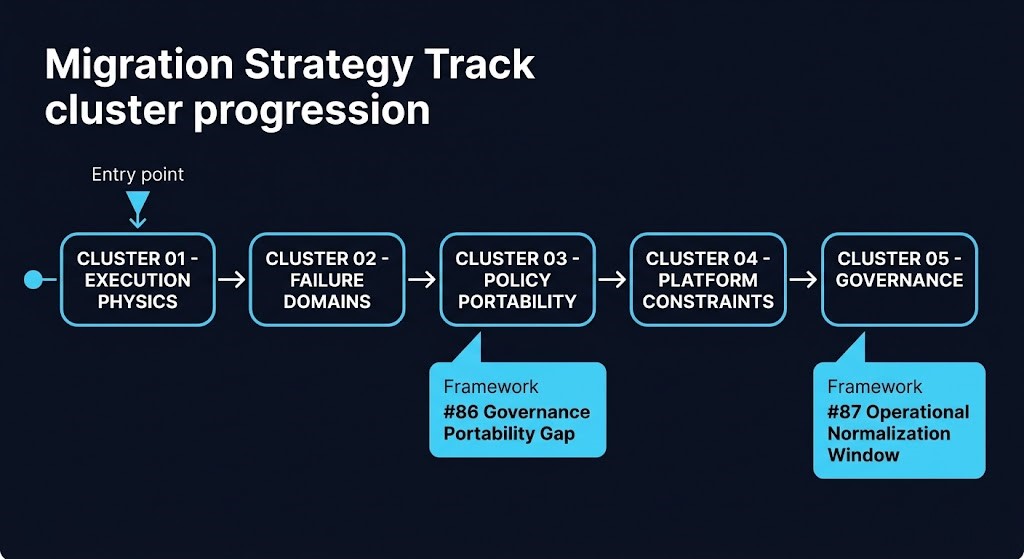
Start at Cluster 01 if you are in the planning or pre-cutover stage of a VMware exit — or if you have completed a migration and are seeing post-cutover failures you didn’t anticipate. Cluster 01 establishes the execution physics that most migration planning skips: the reason workloads move but governance doesn’t.
You can likely skip to Cluster 03 if all of the following apply:
- You have already modeled your workload execution differences across ESXi and your target hypervisor and understand where the behavioral gaps are
- You have a confirmed policy migration plan covering DRS, NSX, and SRM equivalents on the replacement platform
- Your identity and credential architecture has been audited against the post-migration control plane
If any of those require translation work, start at Cluster 01. Cluster 03 depends on the architectural foundation set by the first two clusters — entering there without it will surface gaps in how you interpret the governance continuity material.
>_ READING SEQUENCE
Each cluster below is organized by architectural problem. Every cluster answers: what becomes architecturally unstable if this discipline is misunderstood?
What Actually Moves When a Workload Migrates
Migration tools move compute state. They do not move governance state, policy authority, or operational assumptions. The migration appears complete the moment the VM boots on the new platform — the governance gap accumulates from that same moment forward. This cluster establishes the fundamental execution physics distinction that separates a completed migration from a closed one, and why most post-migration failures trace back to architectural assumptions made in this planning window.
How Migrations Fail in Production
Migration failures in production are not random — they follow predictable architectural patterns that emerge when high-I/O cutover windows, storage I/O physics, and observability gaps compound. The dashboard reports success; the architecture is still transitioning. This cluster maps the specific failure domains that produce post-cutover instability: migration stutter on I/O-bound workloads, dashboard measurement gaps that mask incomplete governance transfer, and the execution physics differences between ESXi and AHV that require active translation rather than assumption of compatibility.
Moving Policy Authority Across Platforms
VMware policy constructs — DRS placement, SRM recovery topology, NSX segmentation — are not vendor-neutral abstractions. They are expressions of governance authority on a specific platform. Migrating workloads without migrating the intent behind those policies creates the Governance Portability Gap (Framework #86): a structural gap between successful workload relocation and successful governance continuity. This cluster covers the translation mechanics for VMware policy to replacement equivalents, the identity gaps that emerge when VM personas lose their VMware-credential grounding, and the licensing architecture that shapes which migration paths remain viable under Broadcom’s post-acquisition model.
Choosing the Replacement Platform Under Constraint
Platform selection in a VMware exit is not a features comparison — it is a constraint analysis. Exit cost, control plane replaceability, licensing risk inheritance, and operational skills gaps function as architectural constraints that narrow the decision space before any capability comparison begins. Teams that skip constraint modeling select platforms they can buy but cannot operate without re-accumulating the dependencies they were trying to exit. This cluster covers the decision frameworks, architectural tradeoffs, and constraint inputs that determine which replacement platform a given architecture can actually support through the Operational Normalization Window.
Closing the Migration — Governance Continuity After Cutover
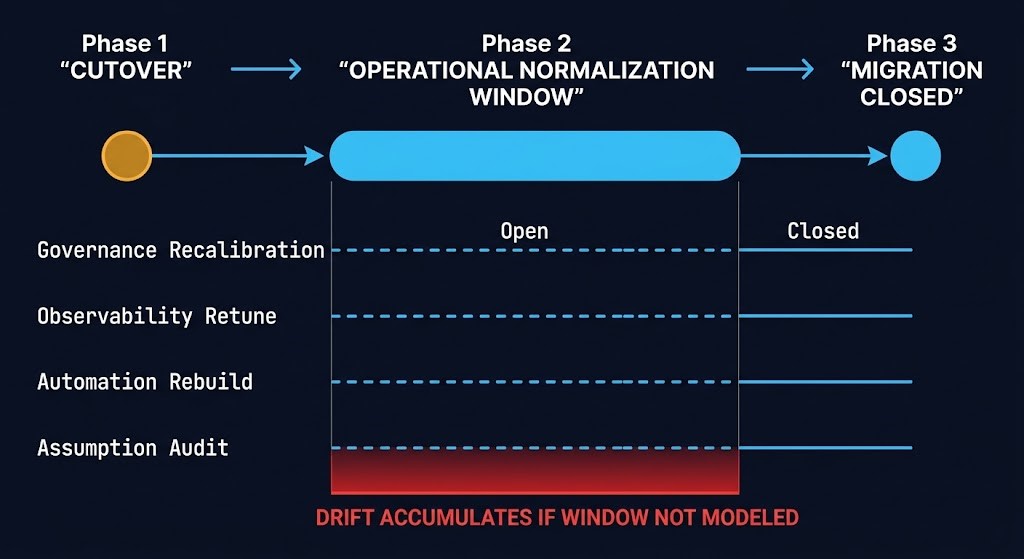
The migration closes when the Operational Normalization Window (Framework #87) closes — not when the last VM boots. That window is the post-cutover period where governance, observability, automation, and operational assumptions are recalibrated to the replacement platform before architectural drift accumulates. Teams that declare migration complete at cutover without modeling the Normalization Window inherit the Governance Portability Gap as permanent steady-state debt. This cluster covers operational continuity during migration, the skills architecture that determines whether the replacement platform can be operated without re-creating VMware-style dependencies, and the governance portability framework that defines what closing the migration actually requires.
>_ TRACK FAILURE PATTERNS
Five failure patterns that emerge when VMware migration strategy is handled at Domain Path breadth without Track-level depth.
| Failure Pattern | Architectural Consequence |
|---|---|
| Migration declared complete at workload cutover | Governance Portability Gap persists undetected; policy, observability, and automation authority remain partially VMware-dependent while the team believes the migration is closed |
| Policy constructs migrated by assumption, not translation | DRS, SRM, and NSX governance intent is not re-expressed on the replacement platform — workloads run but placement, recovery, and segmentation policies are effectively ungoverned |
| VM identity and service account continuity not audited pre-cutover | Credential chain failures and service account authentication errors surface post-cutover as application failures with no obvious migration cause |
| Operational Normalization Window not modeled | The post-cutover recalibration period is treated as standard steady-state; drift accumulates before governance assumptions have been rebuilt for the replacement platform |
| Platform selected on capability comparison without constraint modeling | Exit cost architecture, licensing risk inheritance, and operational skills gaps are discovered post-deployment — the migration resolves vendor lock-in while creating a new dependency surface |
>_ CROSS-TRACK DEPENDENCIES
Tracks share foundational mechanics across disciplines. Understanding which Tracks compound with this one prevents siloed architectural analysis.
| Depends On | Dependency Direction | Why It Matters |
|---|---|---|
| HCI Architecture Track | Downstream Consumer | Migration Strategy defines the transition mechanics and governance requirements that the replacement HCI platform must satisfy — HCI Architecture governs what the platform can do after the Normalization Window closes |
| Compute Architecture Track | Upstream Constraint | Execution physics differences between ESXi and target hypervisors are grounded in compute scheduler architecture — Compute Architecture provides the mechanical foundation for understanding why workload behavior changes at cutover |
| Storage Architecture Track | Upstream Constraint | Migration stutter and high-I/O cutover failures are storage I/O physics problems — Storage Architecture provides the replication mechanics and I/O path understanding that Cluster 02 of this Track depends on |
| Networking Architecture Track | Bidirectional | NSX policy translation and post-migration segmentation continuity are simultaneously a migration governance problem and a networking architecture problem — both Tracks govern overlapping mechanics during the transition window |
| Data Protection & Resiliency Path | Governance Dependency | Recovery topology, SRM equivalent configuration, and backup continuity during migration are all governed by this Track’s Cluster 03 — Data Protection operationalizes those governance outputs in the replacement platform’s backup architecture |
| Virtualization Architecture Path | Domain Path Parent | The Domain Path provides the platform evaluation framework, coexistence modeling, and sovereign architecture context within which migration strategy decisions are made — this Track deepens the transition execution mechanics the Domain Path covers at breadth |
>_ TRACK GRADUATES CAN NOW
Completing this Track means understanding VMware migration not as a project with a completion date but as a governance transition with a closure condition. What changed by going to Track depth is the ability to distinguish between a migration that moved workloads and a migration that transferred governance authority — and to architect the difference before the cutover window opens. The Governance Portability Gap and the Operational Normalization Window are now first-class design inputs, not post-migration discovery items.
- Model the Governance Portability Gap before migration begins — identify which policy, identity, observability, and automation authority transfers automatically and which requires explicit architectural re-expression
- Architect a cutover window for high-I/O workloads that accounts for replication lag physics and avoids data loss at the migration stutter boundary
- Translate VMware policy constructs — DRS, SRM, NSX — to replacement platform equivalents with intent preserved, not just surface-level configuration mapped
- Define and close the Operational Normalization Window post-cutover — establish what governance recalibration completion looks like before declaring the migration finished
- Apply migration constraint architecture to adjacent workload placement and cloud repatriation decisions — the Governance Portability Gap model governs any platform transition, not only VMware exits, and propagates directly into cloud repatriation and hybrid architecture planning
>_ WHERE DO YOU GO FROM HERE
IS YOUR MIGRATION STRATEGY ARCHITECTURALLY COMPLETE?
The Governance Portability Gap and Operational Normalization Window don’t show up in migration dashboards — they show up in the 90 days after cutover. A migration readiness assessment surfaces the architectural gaps before the cutover window opens.
VMware Migration Readiness Assessment
A structured architectural review of your migration strategy against the governance continuity, execution physics, and Normalization Window requirements this Track defines.
- > Governance Portability Gap identification pre-cutover
- > Policy translation audit — DRS, SRM, NSX equivalents
- > Cutover window failure domain modeling
- > Operational Normalization Window closure criteria
Architecture Playbooks. Field-Tested Blueprints.
Field-tested blueprints for migration architecture — governance continuity models, cutover failure pattern libraries, and platform decision frameworks.
- > VMware exit architecture playbook
- > Governance continuity during platform transition
- > Post-cutover normalization framework
- > Platform decision constraint modeling
Zero spam. Unsubscribe anytime.
>_ FREQUENTLY ASKED QUESTIONS
Q: What is VMware migration strategy as an architectural discipline?
A: VMware migration strategy is the set of architectural decisions that govern how governance authority, policy enforcement, identity continuity, and operational assumptions are transferred — not just relocated — during a VMware platform exit. It is distinct from migration project management: the project ends at cutover; the architecture closes when the Governance Portability Gap is resolved and the Operational Normalization Window has been systematically worked through on the replacement platform.
Q: How does this Track differ from the Virtualization Architecture Domain Path?
A: The Domain Path covers platform evaluation, coexistence modeling, and sovereign architecture — it addresses migration as one dimension of a broader strategic decision. This Track addresses only the execution mechanics of the transition itself: the physics of workload cutover, the governance constructs that must be explicitly translated rather than assumed to carry over, and the post-cutover normalization period that determines whether the migration actually closes. The Domain Path provides context; this Track provides depth on the transition window.
Q: What is the Governance Portability Gap and why does it matter for migration planning?
A: The Governance Portability Gap (Framework #86) is the architectural gap between successful workload relocation and successful governance continuity after platform transition. Workloads move when the migration tool completes its job. Governance — policy enforcement, observability coverage, automation authority, identity continuity — requires explicit architectural re-expression on the replacement platform. Teams that don’t model this gap pre-cutover discover it as a series of post-migration operational failures with no apparent migration cause.
Q: What is the Operational Normalization Window?
A: The Operational Normalization Window (Framework #87) is the post-cutover period where governance, observability, automation, and operational assumptions are recalibrated to the replacement platform before architectural drift accumulates. It is not a standard onboarding period — it is a structured architectural closure condition. The migration is not complete until the Normalization Window closes: all VMware-inherited operational assumptions have been either validated as still-correct on the new platform or explicitly replaced.
Q: What breaks architecturally when migration strategy is treated as a project plan rather than a governance transition?
A: When migration is treated as a project with a completion date at cutover, the Governance Portability Gap is inherited as permanent steady-state debt. Policy constructs map by assumption rather than translation; identity continuity failures surface as unexplained application errors; observability gaps persist because monitoring was tuned to VMware constructs that no longer exist; and the replacement platform accumulates operational drift during the Normalization Window because no closure criteria were defined. The architecture declares migration complete; the governance is still fractured.
>_ RELATED SYSTEMS
The full virtualization pillar — platform decision frameworks, hypervisor architecture, and operational models for private cloud. The strategic context within which migration decisions live.
Open Pillar →Stage 5 of the Domain Path — the strategic architecture decisions that define platform independence and governance continuity at the sovereign maturity level. Where migration strategy decisions propagate after the Normalization Window closes.
Open Stage →Framework #112 — Lifecycle Governance Horizon: the upgrade eligibility and exit optionality constraints that determine which migration paths remain viable before a project starts.
Read Post →The VMware Exit toolkit hub — HCI migration advisor, licensing cost modeling, VMware renewal estimator, and NSX policy translation tools aligned to the execution mechanics this Track defines.
Open Workbench →Architectural review of migration strategy against governance continuity and execution physics requirements — surfaces the Governance Portability Gap before the cutover window opens.
View Assessment →The Governance Portability Gap model applies to cloud repatriation and hybrid platform transitions — any workload relocation decision carries the same governance continuity mechanics this Track defines.
Open Path →Vendor documentation for AHV migration tooling — useful for procedural reference after the architectural framework from this Track is in place.
External Reference →Broadcom’s product lifecycle and licensing documentation — the authoritative source for the constraint inputs that Cluster 04 of this Track uses to narrow the platform decision space.
External Reference →