

MODERN INFRASTRUCTURE & IaC GOVERNANCE
FOUR DETERMINISTIC TOOLS FOR OWNERSHIP BOUNDARIES, POLICY DRIFT, PLATFORM READINESS, AND INFRASTRUCTURE LAG.
Diagnostic tooling for IaC governance failure — from contested ownership and silent drift accumulation to platform migration readiness and provider lag exposure across declarative infrastructure environments.
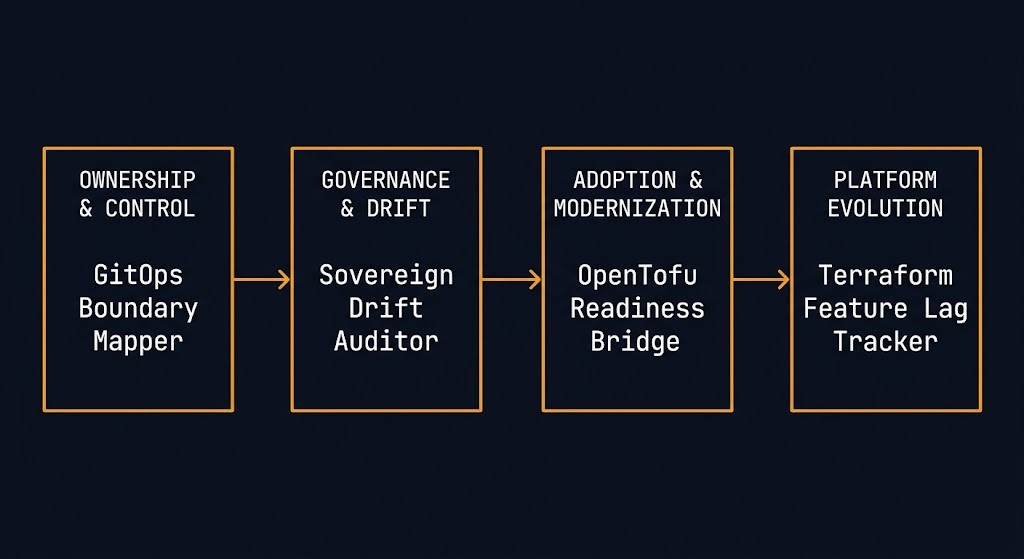
Four phases of IaC governance maturity — from authority establishment through drift control, platform migration, and provider evolution. The tools map to the transitions between phases.
IaC governance failures compound in sequence — contested ownership produces undetected drift, drift accumulates into migration debt, and migration debt hardens into platform lock-in that was never an explicit decision.
>_ Operational Framework
IaC governance failures don’t originate in the tools. They originate in decisions that were never made explicit — about who owns infrastructure intent, what policy enforcement actually verifies, and whether the platform running the control plane has the capability to enforce what governance demands. The four tools below are organized around the sequence in which those decisions compound into structural failure: ownership clarity first, drift detection second, platform migration readiness third, and provider lag quantification fourth. Working through the phases in order traces the governance failure path before it becomes an architecture liability that cannot be unwound without a rebuild.
>_ Operational Phase 01 Ownership & Control
GitOps Boundary Mapper
Maps authority boundaries across your declarative infrastructure environment — identifying where Terraform, ArgoCD, Helm, and the platform team each believe they own the same object, where authority transfers happen without a clear handoff model, and where control plane ownership is contested rather than designed. Produces a Boundary Integrity Index, Ownership Boundary Map, Contested Zone Register, and Authority Transfer Analysis. Start here — contested ownership is the structural precondition for every downstream governance failure.
Phase 01 establishes whether your infrastructure ownership model is designed or assumed. Most environments contain both — explicit authority in some zones, contested ownership in others — and the Contested Zone Register is what separates the two. The harder condition is what happens in the contested zones over time: without explicit ownership, policy enforcement has no authority anchor, and drift accumulates invisibly. Phase 02 surfaces where that drift has already taken hold.
>_ Operational Phase 02 Governance & Drift
Sovereign Drift Auditor
Detects the gap between declared governance intent and observed infrastructure state — surfacing the Policy Intent Drift condition where policies exist but enforcement has decoupled from reality. Analyzes tagging compliance, encryption posture, RBAC alignment, and naming standards against declared policy, producing a Drift Risk Score, Drift Origin Profile, Policy Divergence Matrix, and Governance Remediation Plan. Run after GitOps Boundary Mapper to determine whether contested ownership zones are where drift is accumulating — they almost always are.
Phase 02 makes governance drift measurable instead of anecdotal. A Drift Risk Score gives the organization something to remediate against — not a policy declaration, but an evidence baseline. The question that follows is whether the platform running the control plane is capable of enforcing what governance now requires. For environments evaluating OpenTofu as the migration path, that question has a specific answer: Phase 03 determines what breaks before the commitment is made.
>_ Operational Phase 03 Adoption & Modernization
OpenTofu Readiness Bridge
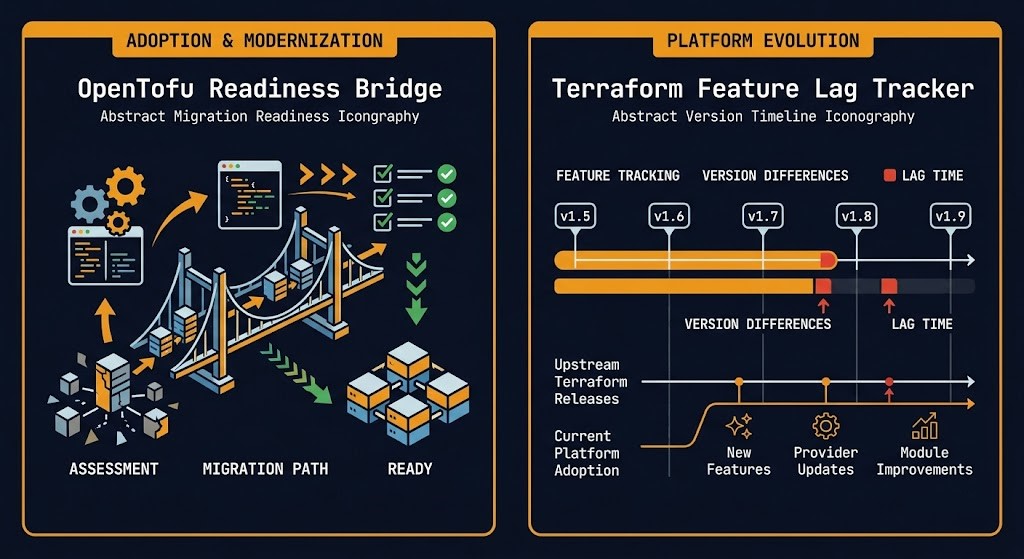
Evaluates migration readiness from Terraform to OpenTofu before the architecture decision is made — surfacing provider compatibility gaps, module compatibility risk, state file migration complexity, and workflow impacts across CI/CD pipelines and GitOps toolchains. The organizations that encounter migration problems after commitment made the commitment without running this analysis first. Run before any architecture decision that treats OpenTofu as a drop-in replacement.
Phase 03 converts a platform migration from an assumption into an evidence-based decision. Migration readiness is not the same as migration intent — and for environments that remain on Terraform rather than migrating, the question is not whether to move but whether the current Terraform version has the capability to enforce what governance now requires. Phase 04 quantifies that gap.
>_ Operational Phase 04 Platform Evolution
Terraform Feature Lag Tracker
Quantifies the gap between your current Terraform version and current provider capability — surfacing which features, provider behaviors, and governance controls your pinned version cannot access and how that gap compounds over time as providers advance. Infrastructure organizations that pin Terraform versions for stability accumulate feature lag invisibly. The lag only becomes visible when a governance requirement demands a capability the pinned version cannot deliver. Run this before that discovery happens at a compliance or architecture review.
IaC governance failures compound in sequence. Each unresolved condition creates the structural precondition for the next — what starts as an ownership question becomes a platform liability.
| Initial Condition | Escalation Path |
|---|---|
| Ownership not explicitly designed | → Control Plane Ownership Boundary contested across tools |
| Contested ownership zones | → Policy enforcement has no authority anchor — drift accumulates silently |
| Silent drift accumulation | → Policy Intent Drift — declared and enforced state diverge |
| Policy Intent Drift | → Platform capability insufficient to enforce governance requirements |
| Platform capability gap | → Migration pressure without readiness validation |
| Unvalidated migration commitment | → Platform lock-in under governance debt that cannot be unwound without rebuild |
Named failure patterns that appear across IaC governance failures. Each represents a structural condition — not an operational mistake made at change time.
The condition where no team holds explicit authority over infrastructure intent — ownership was inherited, inferred, or assumed across tools, never assigned. Changes happen. Nobody can be held accountable for the outcome.
The progressive divergence between declared infrastructure state and operational reality — where drift accumulates in ownership gaps, missed enforcement cycles, and unreviewed manual changes until the gap between policy and practice cannot be closed without a remediation program.
The condition where governance controls exist in documentation but are not enforced in practice — policies are declared, reviews are conducted, and compliance is reported while actual infrastructure behavior has decoupled from every control the governance model assumes is active. Tied directly to Framework #133.
The condition where authority over infrastructure state is split across competing systems — Terraform, ArgoCD, the platform team, and the cloud provider each capable of making changes the others cannot see, validate, or reconcile. No single system owns the truth. Tied directly to Framework #135.
Tool output is most useful when it triggers the next analysis. These paths map signal to next step.
| If This Tool Detects | Run Next | Why |
|---|---|---|
| GitOps Boundary Mapper — Contested Zone Register non-empty or Boundary Integrity Index below threshold | → Sovereign Drift Auditor | Contested ownership zones are where drift accumulates first — validate whether the authority gap has already produced Policy Intent Drift before attempting remediation |
| Sovereign Drift Auditor — Drift Risk Score elevated or Policy Divergence Matrix shows enforcement gaps across multiple controls | → GitOps Boundary Mapper | Enforcement gaps across multiple controls indicate the drift source is an ownership problem, not a policy problem — map authority boundaries before redesigning enforcement |
| Sovereign Drift Auditor — Governance Remediation Plan requires platform capability not available in current version | → Terraform Feature Lag Tracker | Governance remediation that depends on features unavailable in the pinned version means the lag is blocking enforcement — quantify the gap before committing to a remediation timeline |
| Terraform Feature Lag Tracker — significant version lag with blocked governance features, combined with OpenTofu migration under consideration | → OpenTofu Readiness Bridge | Feature lag that blocks governance is a migration trigger — validate OpenTofu readiness before treating migration as the remediation path for the lag |
| OpenTofu Readiness Bridge — provider compatibility gaps or state file migration risk flagged | → GitOps Boundary Mapper | Provider gaps and state risk during migration compound in ownership-contested zones first — map boundaries before sequencing a migration that will touch contested infrastructure |
Match the signal you’re seeing to the tool that surfaces its root cause — not the symptom.
| Signal | Tool | What It Surfaces |
|---|---|---|
| Contested ownership — multiple tools claiming the same object | GitOps Boundary Mapper | Boundary Integrity Index, Contested Zone Register, Authority Transfer gaps |
| Policy drift — compliance state diverges from declared policy over time | Sovereign Drift Auditor | Drift Risk Score, Drift Origin Profile, Policy Divergence Matrix |
| Migration readiness — evaluating OpenTofu as Terraform replacement | OpenTofu Readiness Bridge | Provider compatibility gaps, module risk, state migration complexity |
| Provider lag — version pinning blocking governance capability | Terraform Feature Lag Tracker | Feature gap quantification, blocked controls, lag accumulation rate |
Operational characteristics at each maturity level. The tools above map to the transitions between levels — not to any single level in isolation.
| Maturity Level | Operational Characteristic |
|---|---|
| Foundation | IaC tooling is adopted and infrastructure is declared in code — ownership is assumed by team, drift is detected reactively, and governance is manual rather than enforced |
| Operational | Ownership boundaries are explicitly mapped — authority is assigned, not assumed, contested zones are documented, and drift is detected before it compounds into a governance gap |
| Strategic | Policy enforcement is active and evidence-based — drift origin is tracked to its source, remediation is sequenced by ownership zone, and governance is verified rather than declared |
| Resilient | Platform decisions are validated before commitment — migration readiness is assessed against actual module and provider risk, and version lag is quantified against governance requirements before remediation timelines are set |
| Sovereign | Governance is architecturally enforced and platform-independent — ownership boundaries, drift controls, and enforcement capability are maintained across platform migrations without governance regression, and no platform decision can be made without a validated readiness assessment |
WHEN THE TOOLS SURFACE A GAP, THE ASSESSMENT CLOSES IT.
Tooling surfaces the ownership conflicts, drift patterns, and platform gaps. A structured governance review determines what to do about them — authority boundary design, remediation sequencing, and platform migration strategy require architectural judgment layered on diagnostic output, not another pass through the tools.
Modern Infrastructure Assessment
A structured review of your IaC governance posture — ownership boundary design, drift remediation sequencing, platform readiness validation, and provider lag strategy.
- > Control plane ownership boundary mapping and contested zone resolution
- > Policy drift root cause analysis and governance remediation plan
- > OpenTofu migration readiness and platform decision validation
- > Provider lag exposure analysis and version strategy recommendations
Architecture Playbooks.
Field-tested blueprints for IaC governance, control plane ownership design, and declarative infrastructure operating models.
- > Control plane ownership boundary design and authority mapping
- > Policy enforcement architecture and drift containment models
- > GitOps operating model and platform migration sequencing
- > IaC governance maturity progression and provider strategy
Zero spam. Unsubscribe anytime.