

The Hypervisor Is Becoming a Policy Enforcement Point
Hypervisor security has outgrown its original scope. Most organizations still think of the hypervisor as a resource abstraction layer. CPU. Memory. Storage. The platform that decides where workloads run.
That mental model is increasingly incomplete. Every major virtualization platform — vSphere, AHV, Proxmox — has been steadily accumulating policy enforcement responsibilities that have nothing to do with resource scheduling. The hypervisor isn’t just deciding where workloads run anymore. It’s increasingly deciding what they’re allowed to do.
Most organizations haven’t updated their operating model to match.
The Speed of Hypervisor Security’s Shift Is the Real Story
Virtualization practitioners already know that hypervisor security controls have moved downward through the stack. Perimeter controls gave way to host-based controls. Host-based controls gave way to container and runtime controls. The direction of travel has been consistent and predictable.
What’s less appreciated is how compressed the most recent phase of that movement has been.
For years, hypervisors enforced resource allocation. Scheduling, placement, memory ballooning, CPU affinity. Those functions accumulated gradually across platform generations and the ownership model evolved alongside them — infrastructure teams own the hypervisor, full stop.
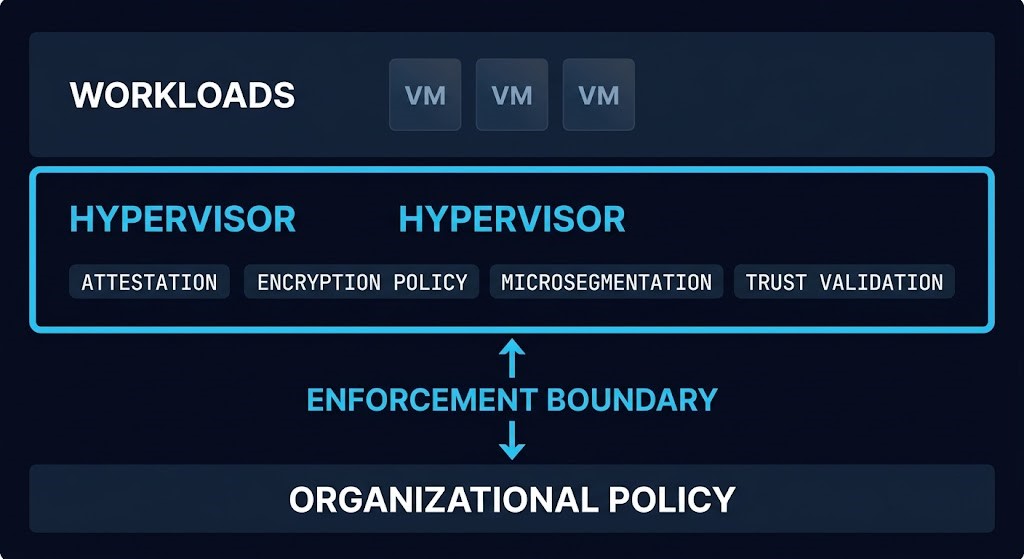
Within a single platform generation cycle, that same layer accumulated encryption policy enforcement, workload trust validation, microsegmentation, secure boot enforcement, host attestation, and workload isolation boundaries. Not as optional security add-ons evaluated by the security team. As core platform capabilities integrated into the operational baseline.
The perimeter-to-OS transition took decades. The hypervisor accumulated a comparable set of policy enforcement responsibilities in the time between one major vSphere release and the next. That compressed timeline is precisely what creates the ownership lag — the governance model that was adequate for a resource scheduler has not caught up to a platform that enforces organizational policy.
The Hypervisor Now Makes Binding Decisions
The distinction that matters is not between “strong hypervisor security” and “weak hypervisor security”, it is between a platform that observes policy and a platform that enforces it.
The hypervisor is no longer observing. It is enforcing. And enforcement means consequences.
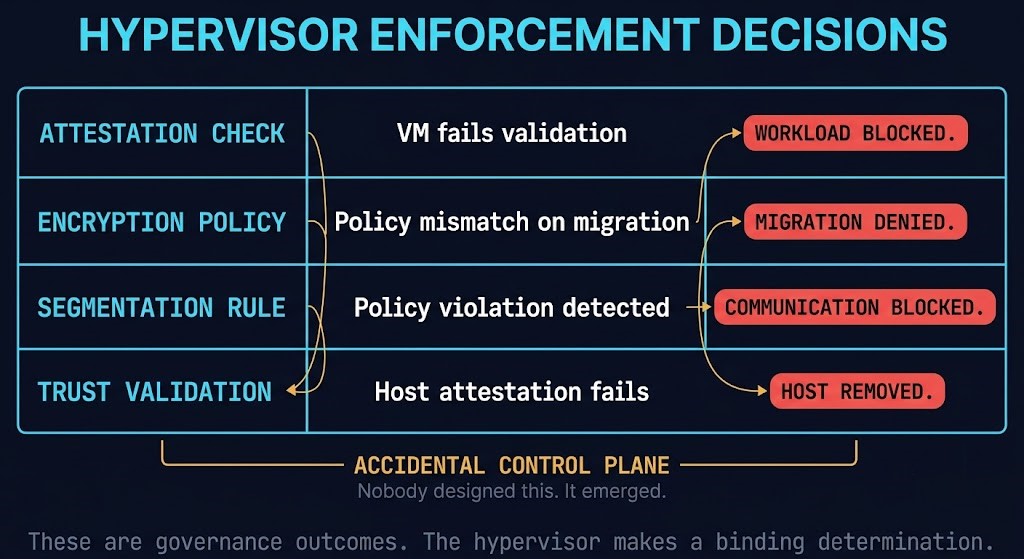
A VM fails attestation — the workload does not start. An encryption policy mismatch occurs — the workload cannot migrate to the target host. A segmentation policy violation is detected — communication is blocked at the platform layer before it reaches the network. A trust validation failure occurs — the host is removed from workload eligibility entirely.
Those are not scheduling decisions. Those are governance outcomes. The workload does not get a vote. The hypervisor makes a binding determination and the operational consequence is immediate.
This is what makes the hypervisor governance infrastructure: infrastructure that directly enforces organizational policy rather than merely executing workloads. The vSphere Lifecycle Governance post from earlier this week made the case that lifecycle decisions are governance decisions. The enforcement layer underneath those decisions has been shifting in the same direction — and the platform team that manages the hypervisor is now operationally responsible for governance outcomes whether or not anyone formally assigned that responsibility.
The same pattern runs through the broader authority layer problem — operational authority accumulates in infrastructure layers before the organization decides who owns it.
The Org Chart Never Updated
Most organizations have established review workflows for three categories of platform activity: infrastructure reviews that cover availability, capacity, and performance; security reviews that cover control posture, vulnerability state, and access; and compliance reviews that cover regulatory and audit obligations.
Very few have a workflow for reviewing hypervisor policy enforcement decisions as governance artifacts.
The enforcement decisions are being recorded. vSphere, AHV, and Proxmox all generate logs when attestation fails, when encryption policy blocks a migration, when segmentation rules drop traffic at the platform layer. Those logs exist. The governance process for reviewing them as policy enforcement records — not as infrastructure events — often does not.
Infrastructure teams review hypervisor logs for performance anomalies and availability incidents. Security teams review security tooling outputs. Nobody has a standing workflow that asks: which workloads did the hypervisor refuse to start this week, which policy decisions did it make, and are those decisions consistent with organizational intent?
That gap is a governance-review instance of a broader pattern: infrastructure, security, and compliance teams each maintain a locally coherent but mutually divergent picture of what the platform is doing, with no mechanism forcing reconciliation between them. Virtualization Sprawl: When Every Team Owns A Different Infrastructure Reality documents that divergence at the operational-assumption level — this is its governance-review analog, one layer up.
The enforcement decision is recorded. The governance process for reviewing that decision often isn’t. This ownership lag follows the same pattern documented at the CI/CD layer — The Console Is the Shadow Control Plane maps how operational authority accumulates in infrastructure layers before the org chart assigns ownership. The hypervisor is the current instance of that recurring transfer. The governance framing for lifecycle decisions that precedes enforcement is in vSphere Lifecycle Management Is a Governance Problem.
The same gap runs through IaC control planes: when a GitOps pipeline enforces a policy whose original justification has expired, the enforcement log records a clean reconciliation cycle while the governance failure accumulates silently — the pattern Framework #133 — Policy Intent Drift documents at the IaC layer.
This is the operational proof that the ownership model never evolved. The technology accumulated governance responsibilities. The org chart kept the old assignment. The infrastructure team owns the hypervisor the same way it always did — as a compute platform — without a corresponding expansion of the governance review process that the platform’s new enforcement role requires.
Secure Boot shows where that ownership gap sits for a single control. The platform offers it, but the trust anchors it enforces are virtual-firmware state. In the documentation reviewed, the platform initializes that state when the VM is created, vSphere templates carry it forward, and updates run on different paths on each platform. On vSphere the customer executes the Platform Key update from the hypervisor side while the guest operating system updates the KEK and DB. On Proxmox VE the administrator enrolls the certificates. On Azure the guest initiates the update and the platform applies it. Secure Boot Trust: Who Owns the Virtual Firmware State maps that split.
Closing — Governance Infrastructure, Not Just Infrastructure
Nobody bought a hypervisor to run governance. The procurement conversation was about resource efficiency, workload density, and operational manageability.
But governance kept showing up at the hypervisor layer anyway — because that is where workloads live, where policy can be enforced closest to the execution boundary, and where the major platform vendors have been competing on exactly these capabilities for the better part of a platform generation.
Most organizations think they operate a virtualization platform. Increasingly, they are operating a policy enforcement platform that happens to run virtual machines.
That’s the mechanism, not just the metaphor: when a hypervisor-level enforcement decision — an attestation failure, an encryption policy mismatch — blocks a workload outright, the blast radius isn’t contained to the workload that failed the check. It inherits downward through everything provisioned against that host, which is exactly the shape cloud governance failure domains takes at the platform level generally.
The hypervisor didn’t stop being infrastructure. It quietly became governance infrastructure — and most organizations are still operating it like it didn’t. The gap between where hypervisor security sits today and how most organizations govern it is where enforcement failures will surface.
Architect’s Verdict
Most organizations still classify the hypervisor as a compute platform. Increasingly, it behaves like a policy platform.
The ownership model that was adequate for a resource scheduler is not adequate for a system that makes binding decisions about which workloads start, which workloads communicate, and which hosts are trusted. Those decisions have governance consequences that infrastructure reviews were never designed to surface.
The hypervisor didn’t stop being infrastructure. It quietly became governance infrastructure — and the operating model, the review workflows, and the org chart assignment need to reflect that before the enforcement gap becomes an audit finding.
Additional Resources
View 2 more resources
Editorial Integrity & Security Protocol
This technical deep-dive adheres to the Rack2Cloud Deterministic Integrity Standard. All benchmarks and security audits are derived from zero-trust validation protocols within our isolated lab environments. No vendor influence.

R.M.
Senior Solutions Architect with 25+ years of experience in HCI, cloud strategy, and data resilience. As the lead behind Rack2Cloud, I focus on lab-verified guidance for complex enterprise transitions. View Credentials →
Get the Playbooks Vendors Won’t Publish
Choose the architecture problems you care about. Get field-tested playbooks and frameworks delivered to your inbox.
- > AI Infrastructure & Inference Economics
- > Cloud Strategy & Hidden Cost Models
- > Virtualization & Deterministic Migration
- > Kubernetes, IaC & Modern Infrastructure
- > Data Protection & Recovery Engineering
Zero spam. Includes The Dispatch weekly drop.
Need Architectural Guidance?
Independent review before major infrastructure decisions.
- > Validate assumptions
- > Identify hidden dependencies
- > Quantify migration risk
- > Challenge vendor narratives
Triage · Advisory · Fractional · Direct Hire