

Your AI Infrastructure Is Probably Solving the Wrong Problem
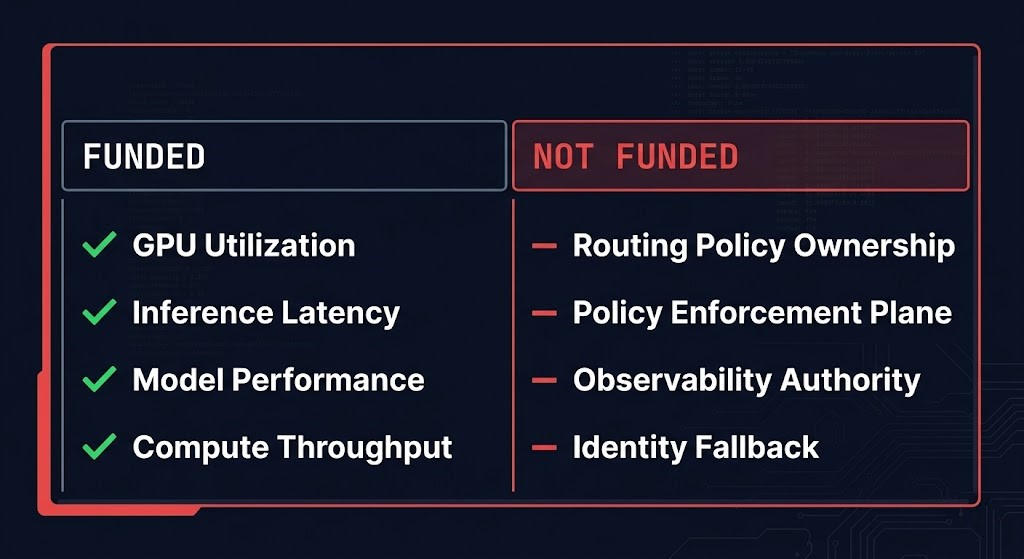
Most AI infrastructure programs are producing exactly the results they were funded to produce: higher GPU utilization, lower inference latency, and better model performance. The problem is that none of those metrics measure whether the organization actually controls its AI infrastructure.
AI infrastructure governance rarely appears in the infrastructure scope because it has no equivalent dashboard, no procurement line item, and no vendor selling it. The result is a program that is succeeding by every metric it tracks while the actual authority failures accumulate at the layers it is not tracking.
Every Authority Layer failure follows the same pattern: operational authority moves to a new layer before the organization decides who owns it. AI infrastructure is the current layer.
THE AUTHORITY LAYER
The Investment Is Going to the Wrong Layer
What AI infrastructure programs actually fund is not a mystery. Compute procurement, GPU sizing exercises, model selection evaluations, and inference latency benchmarks are where the engineering time, the architecture reviews, and the budget conversations go. All of that work is real. None of it is wrong. But the classification of what counts as infrastructure — and therefore what counts as an infrastructure problem — is where the gap originates.
This pattern is not unique to AI. VMware environments optimized consolidation ratios for years while operational concentration risk accumulated in tribal knowledge and vendor license dependency. Platform teams optimized cloud consumption rates while cost governance authority quietly migrated to finance departments that were never part of the original operating model. Every infrastructure era produces a metric that is easy to improve and a governance surface that is easy to defer. AI infrastructure is repeating the pattern at the authority layer.
The governance layer — who owns routing policy, who controls behavioral enforcement, who holds audit authority over inference telemetry — was never entered into the infrastructure scope because it does not look like infrastructure. It looks like application configuration. It looks like vendor integration. It looks like someone else’s problem. By the time the organization realizes it is an infrastructure problem, the vendor defaults have been running as operational defaults for long enough that changing them requires renegotiating contracts, not reconfiguring systems.
The Four Planes Nobody Budgets For
There are four runtime governance planes in every AI infrastructure stack. Each one carries operational authority over how AI systems actually behave. None of them appear on the typical AI infrastructure roadmap.
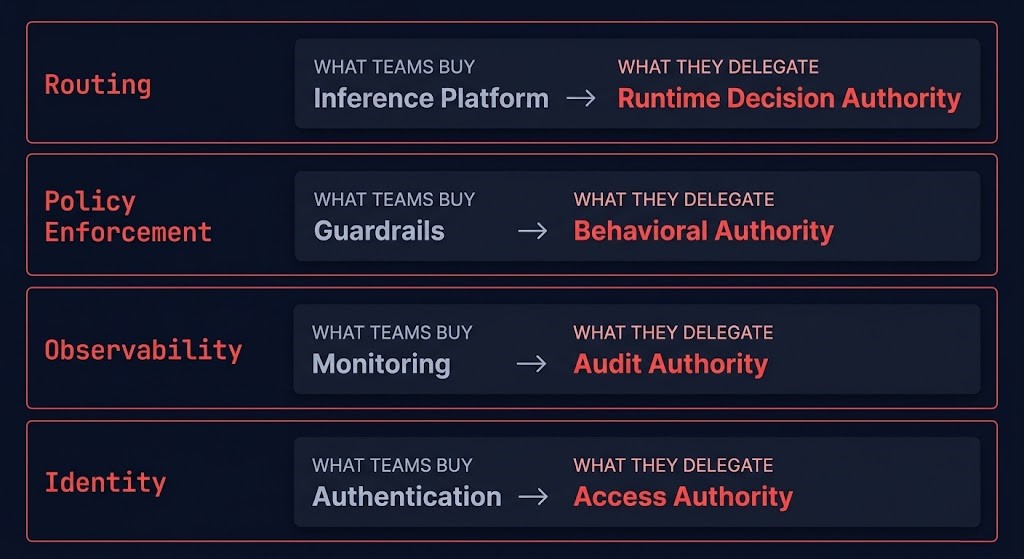
| Plane | What Teams Buy | What They Unknowingly Delegate |
|---|---|---|
| Routing | Inference platform | Runtime decision authority |
| Policy enforcement | Guardrails | Behavioral authority |
| Observability | Monitoring | Audit authority |
| Identity | Authentication | Access authority |
The routing plane determines which model handles which request, which fallback executes under load, and how traffic is distributed across inference endpoints. The organization buys an inference platform. What it unknowingly delegates is runtime decision authority — the logic that determines which model is making decisions on behalf of the organization at any given moment. When ownership of the routing plane is unclear, model behavior can change without triggering an infrastructure review.
The policy enforcement plane is where guardrails, content filters, safety evaluations, and rate logic execute. The organization buys guardrails. What it unknowingly delegates is behavioral authority — the operational definition of what the AI system is and is not permitted to do. When the vendor updates their safety taxonomy, the organization inherits behavioral changes from a system it does not operate.
The observability plane controls what inference requests and responses are logged, where those logs are stored, how long they are retained, and who can query them. The organization buys monitoring. What it unknowingly delegates is audit authority — the evidentiary record of what the AI system did and why. When the telemetry pipeline routes to a vendor SaaS, audit evidence becomes dependent on a vendor retention policy.
The identity and authorization plane governs who can invoke a model, under what conditions, and with what privilege scope. The organization buys authentication. What it unknowingly delegates is access authority — the operational gatekeeping of who the AI system considers authorized. When token validation routes through a third-party identity provider with no local fallback, authorization authority becomes contingent on an external dependency.
The full architectural specification for these four planes covers what local ownership requires at each layer — this section is about why none of the four appear in the infrastructure budget in the first place.
Why AI Infrastructure Governance Never Makes the Business Case
The four planes above are not being ignored because infrastructure teams are careless. They are being ignored because the organizational mechanisms that fund infrastructure investment are systematically incapable of surfacing them as a priority.
Compute has a dashboard. GPU utilization, throughput, latency, and inference efficiency are visible, reportable, and demonstrably improving. Every sprint review has a chart. Governance has no equivalent signal. There is no dashboard for inference routing ownership, no utilization metric for policy enforcement authority, no latency graph for audit trail integrity. What cannot be measured cannot be funded — and what cannot be funded does not make it into the roadmap.
Vendor demos sell performance. Every AI platform procurement evaluation is built around inference speed, model quality, integration simplicity, and time to deployment. No vendor wins an enterprise deal because their observability ownership model is architecturally sound. The selection criteria are defined by the buyers, and the buyers are evaluating the layers they understand. The governance layer is not absent from the demo — it simply was not part of the evaluation criteria when the RFP was written.
Governance failures are deferred. A compute failure is immediate: a GPU falls over, a request queue saturates, latency spikes, the on-call engineer gets paged. A governance failure accumulates. The routing policy changes in a vendor update. The guardrail taxonomy shifts. The telemetry pipeline begins routing to a new endpoint. None of these produce an alert. None of them show up in the monitoring dashboard. The failure surfaces months later — in a compliance audit, in a regulatory review, in a vendor deprecation notice that reveals a dependency nobody knew the organization held. The EU AI Act is precisely this kind of exposure event on a fixed calendar — Article 12 doesn’t ask whether governance was funded, it asks whether the evidence artifacts exist, and by August 2026 the organizations that treated governance as a compliance afterthought have exactly zero grace period to retrofit them. The Runtime Authority Vacuum is what this accumulation pattern produces at scale: AI infrastructure with no defined operational ownership model for the governance layer.
GOVERNANCE DEBT VISIBILITY
Governance debt accumulates in layers that rarely fail. Authority failures are invisible until an audit, an outage, a regulatory review, or a vendor change exposes them — and by then the contracts are signed, the integrations are embedded, and the ownership model has already been assumed.
Governance Investment Inversion — Framework #107
The condition where organizations invest in the layers that execute AI workloads while underinvesting in the layers that govern them.
Governance Investment Inversion is not a budgeting problem. It is a visibility problem. Organizations fund what produces metrics and defer what produces accountability.
01 — OPTIMIZATION
The team improves compute metrics. GPU utilization rises. Inference latency drops. Model performance benchmarks improve. The program is succeeding by every measure it tracks.
02 — DELEGATION
Governance functions default to vendor ownership. Routing policy is managed by the inference platform. Behavioral enforcement is managed by the guardrail service. Observability routes to the SaaS pipeline. Each integration decision appears low-risk in isolation.
03 — EXPOSURE
The authority failure surfaces outside operational metrics. A vendor deprecates an endpoint. An audit requires evidence from a telemetry pipeline the organization does not control. A behavioral change occurs without a deployment event. The failure is not a compute failure. It is an authority failure — at the layer nobody was governing.
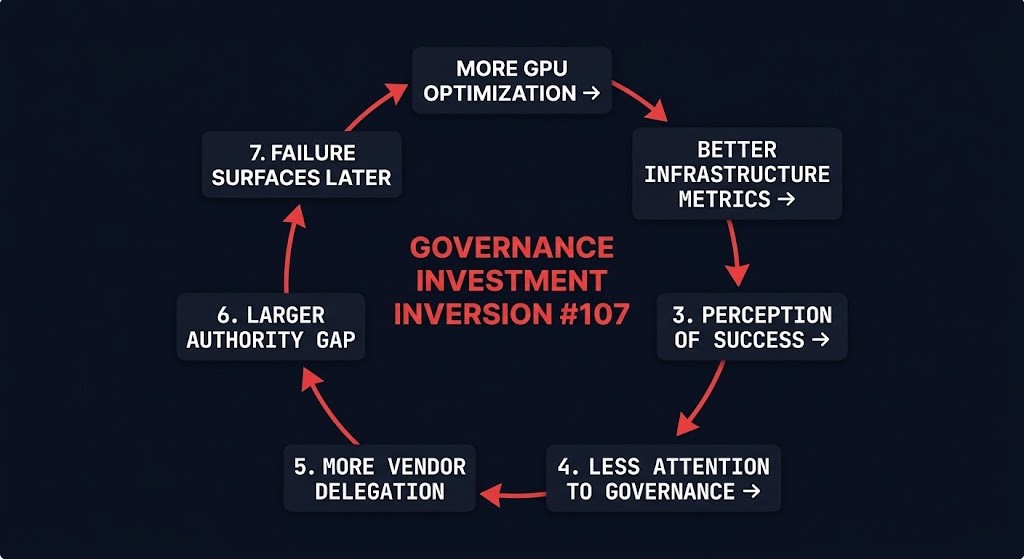
The compounding dynamic is what makes this a structural problem rather than a correctable oversight. The more successful the optimization program becomes, the less visible the governance gap becomes. A system with excellent GPU utilization, fast inference latency, and robust model performance appears healthy by every metric the organization is tracking. Nothing in the operational dashboard indicates that routing policy is externally mutable, that guardrail behavior changed last Tuesday without a deployment ticket, or that the audit trail for the last 90 days of inference requests lives in a vendor SaaS under their retention policy.
The Platform Team Became a Finance Team made the same inversion at the cost layer — cloud consumption optimized, cost governance authority migrated to a team that was never the infrastructure owner. AI infrastructure is making that inversion at the authority layer, one vendor integration at a time.
DIAGNOSTIC QUESTION
“Who in your AI infrastructure program owns the inference routing policy — not which vendor manages it, but which team is accountable if the vendor changes its behavior tonight?”
What Solving the Right Problem Actually Requires
The specification of what a sovereign AI control plane looks like — the four-plane architecture, the dependency mapping methodology, the routing topology options — is covered in depth in Sovereign AI Requires a Sovereign Control Plane. This section is about something earlier: the classification shift that has to happen before any of that architecture work can be funded.
Governance surface area has to enter the infrastructure scope before the first vendor integration is signed. Routing policy ownership, policy enforcement plane architecture, observability pipeline authority, and identity fallback design are infrastructure decisions. Not application configuration. Not operational afterthoughts. Not vendor defaults that can be revisited after the system is running. Infrastructure decisions — with the same ownership model, the same change review process, and the same blast radius analysis that applies to every other infrastructure decision the organization makes.
The model for what this looks like operationally is already established. The private cloud operating model built the governance architecture before the infrastructure was deployed, because governance retrofitted after deployment is not governance — it is negotiation. AI infrastructure requires the same approach: decide who owns the four planes before the runtime contract is signed, not after the first vendor deprecation notice arrives.
There is a prerequisite that sits before governance plane ownership can be assigned: knowing what agents are running. An organization that hasn’t inventoried its agents cannot assign routing plane ownership, cannot define policy enforcement scope, and cannot build a meaningful observability model — because the execution surface is unknown. The classification failure that creates this prior gap is documented in The AI Agent Inventory Gap Nobody Is Measuring.
The shadow control plane formed the same way — console access accumulated authority because the governed path was too slow. LLM authorization boundaries fail the same way — nobody asked who was authorized before the model was in production. GhostApproval is the same failure specifically at the policy enforcement plane this post names above — the approval step existed, fired, and was answered, and the behavioral authority it was supposed to govern was never what the dialog actually described. The pattern is consistent enough that it names itself.
Every Authority Layer failure follows the same pattern: operational authority moves to a new layer before the organization decides who owns it. Closing this gap at the AI layer requires making ownership decisions before the runtime is deployed — not after the authority failure surfaces in an audit finding.
The structured architectural sequence for that ownership model — execution authority assignment, policy enforcement plane design, Runtime Authority Vacuum diagnosis, and control plane governance at the runtime layer — is Governance & Runtime Control (A6) in the AI Infrastructure Architecture Path.
That ownership decision also has an infrastructure prerequisite. Autonomous operations require a specific infrastructure foundation — observable state, defined recovery paths, governed execution surfaces — before runtime authority can be meaningfully assigned. An organization that cannot satisfy those maturity conditions has no stable layer to assign ownership to. The specific infrastructure maturity model — what observable state, governed execution, and defined recovery paths actually require at the infrastructure layer — is the subject of Autonomous Operations Require Infrastructure Most Enterprises Don’t Have.
SERIES: THE AUTHORITY LAYER
Next → COMING SOON
The SaaS Control Plane ProblemArchitect’s Verdict
Most organizations do not have an AI infrastructure problem. They have an AI authority problem. GPU utilization can be measured. Governance ownership usually cannot. That asymmetry is why investment flows toward compute and away from control.
By the time the authority failure becomes visible, the contracts are signed, the integrations are embedded, and the ownership model has already been assumed by the vendor. The routing policy was always theirs to change. The behavioral enforcement was always operating against their taxonomy. The telemetry was always being retained under their policy. The organization did not cede these planes in a single decision. It ceded them one integration at a time, each one justified by a performance metric the governance layer could not compete with.
The question is not whether your AI infrastructure is performing. The question is whether anyone owns the decisions it is making.
Every Authority Layer failure follows the same pattern: operational authority moves to a new layer before the organization decides who owns it. The Authority Layer series exists because that pattern keeps repeating — in CI/CD pipelines, in shadow consoles, in platform cost governance, in private cloud operating models, and now in AI inference runtimes. The layer changes. The failure mode does not.
Additional Resources
View 5 more resources
Editorial Integrity & Security Protocol
This technical deep-dive adheres to the Rack2Cloud Deterministic Integrity Standard. All benchmarks and security audits are derived from zero-trust validation protocols within our isolated lab environments. No vendor influence.

R.M.
Senior Solutions Architect with 25+ years of experience in HCI, cloud strategy, and data resilience. As the lead behind Rack2Cloud, I focus on lab-verified guidance for complex enterprise transitions. View Credentials →
Get the Playbooks Vendors Won’t Publish
Choose the architecture problems you care about. Get field-tested playbooks and frameworks delivered to your inbox.
- > AI Infrastructure & Inference Economics
- > Cloud Strategy & Hidden Cost Models
- > Virtualization & Deterministic Migration
- > Kubernetes, IaC & Modern Infrastructure
- > Data Protection & Recovery Engineering
Zero spam. Includes The Dispatch weekly drop.
Need Architectural Guidance?
Independent review before major infrastructure decisions.
- > Validate assumptions
- > Identify hidden dependencies
- > Quantify migration risk
- > Challenge vendor narratives
Triage · Advisory · Fractional · Direct Hire