

Your Identity Controls Passed. Your Authorization Chain Failed.

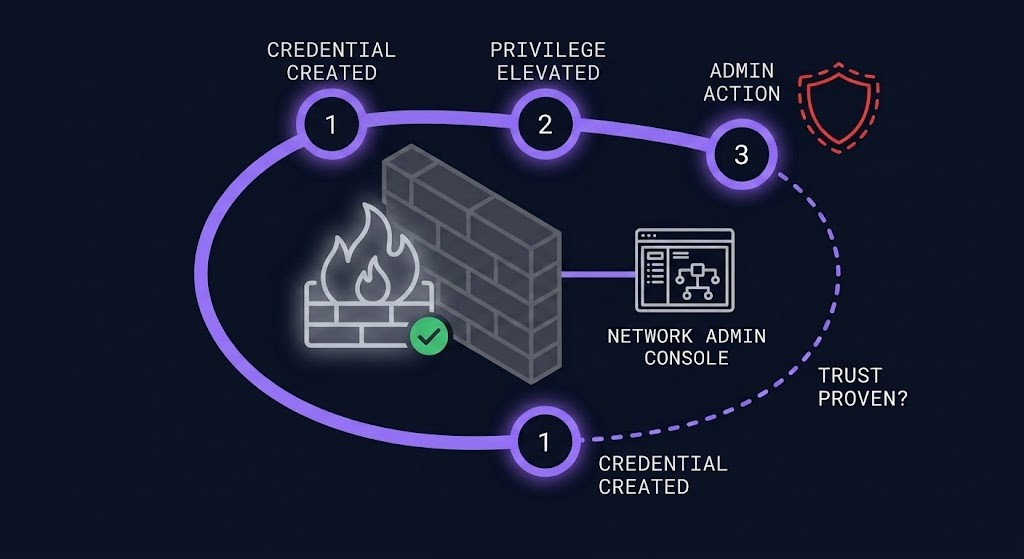
A credential chain functioned exactly as it was designed to. No firewall failed. No exploit executed. No malware bypassed a control. A red team walked past physical and social barriers using nothing more exotic than a plausible pretext, and came out the other side holding network admin credentials — issued correctly, authorized correctly, working exactly as the architecture intended them to.
That’s the part that should bother you. Not that a red team got in. That the system that let them in wasn’t broken. It did what every step in the chain was configured to let it do, and every one of those steps would have passed its own individual review.
The Breach That Wasn’t a Hack
Most incident writeups start with a vulnerability. This one doesn’t have one. The engagement in question used a pretext plausible enough that legitimate staff cooperated with it — no phishing link, no zero-day, no misconfigured S3 bucket. The perimeter held. The network segmentation held. Every control that shows up on a network security review passed.
What didn’t hold was a much narrower thing: the organization’s ability to reconstruct, after the fact, why each step in that credential chain should have been trusted. The credential was issued to someone with standing to request it. The elevation was approved by someone with authority to approve it. Every individual link was defensible in isolation. What nobody could produce was a single account of the whole chain — issuance through elevation through the final administrative action — that proved the sequence was legitimate, not just each transition in it.
Organizations confident in their network posture are frequently the highest-risk, for a specific reason: confidence in the perimeter is exactly what causes an organization to stop asking whether it can prove its own authorization chain, not just operate it.
Authentication Is Not Authorization Evidence
Framework #160 — Identity Boundary Inversion — established that identity now determines the effective control boundary — not this post’s argument to make again. This post examines the operational consequence: whether organizations can prove the authorization chain behind that identity. Many still validate individual authentication events instead of the complete chain of authorization decisions that produced an action.
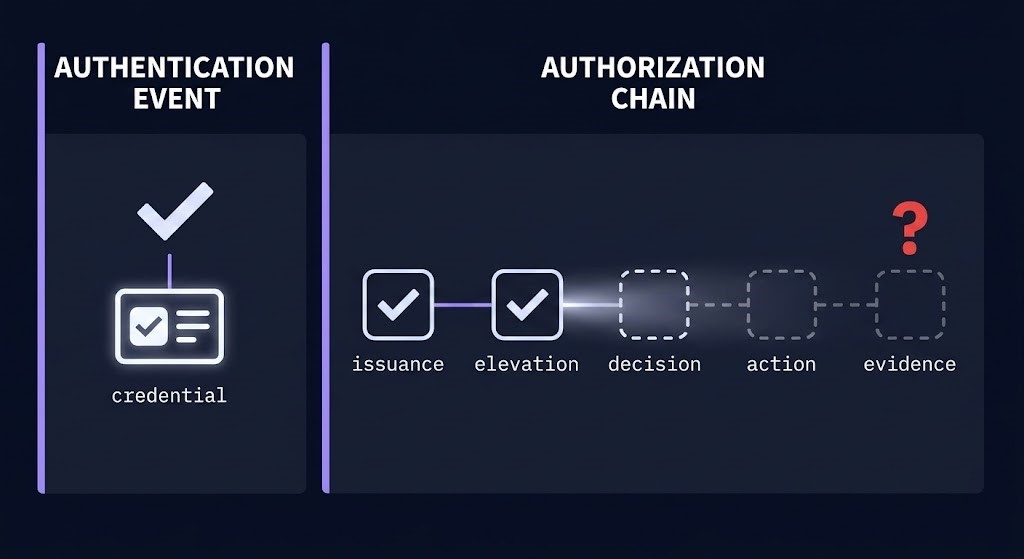
That distinction is the whole post. Authentication answers “is this credential valid right now.” It says nothing about whether the sequence of decisions that got this credential to this level of privilege was ever itself legitimate. An organization can have clean MFA logs, a passing access review, and a fully authenticated session, and still have no answer to the only question that actually matters after an incident: why was this specific chain of trust ever extended this far?
Most security programs have built extensive controls for the first question and almost nothing for the second. That gap — not a network gap, not an authentication gap — is where a correctly-issued, correctly-elevated credential walks straight through a system that never failed a single check.
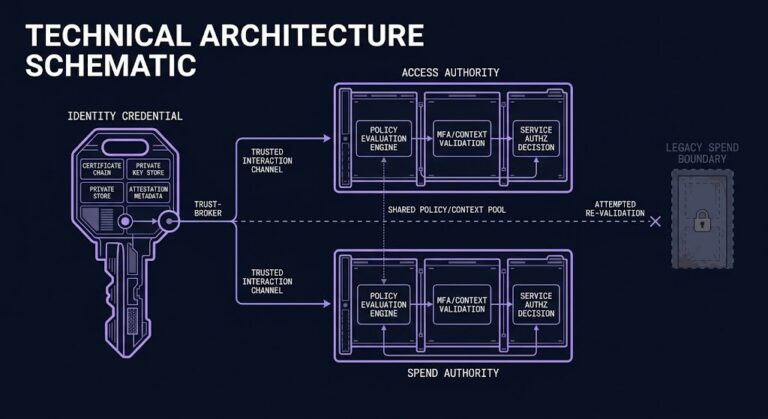
A parallel gap shows up one layer further out, in spend rather than access: Your Identity Provider Was Never Your Spend Boundary makes the same argument about financial authorization — an identity that passes every access check still isn’t the same as an identity whose spend has ever been capped independently. Same missing second question, aimed at money instead of access.
The pretext itself deserves a second look, because it’s the same mechanism this post’s red team used, aimed at a different target. The Help Desk Is Becoming The New Initial Access Broker documents an attacker manufacturing legitimacy inside a Teams chat instead of at a physical door — no exploit, no phishing link, just an employee who had no reason to doubt a message that looked like it came from IT support. That post’s failure isn’t this one: it’s a governance-recognition gap, not a proof gap — the help desk itself was never designed as, or governed like, a trust authority, even though it exercises one. This post asks whether a credential chain can be proven legitimate after the fact. That post asks whether the function that grants credentials in the first place has ever been recognized as capable of granting trust at all.
Every Credential Chain Passes Through Three Stages
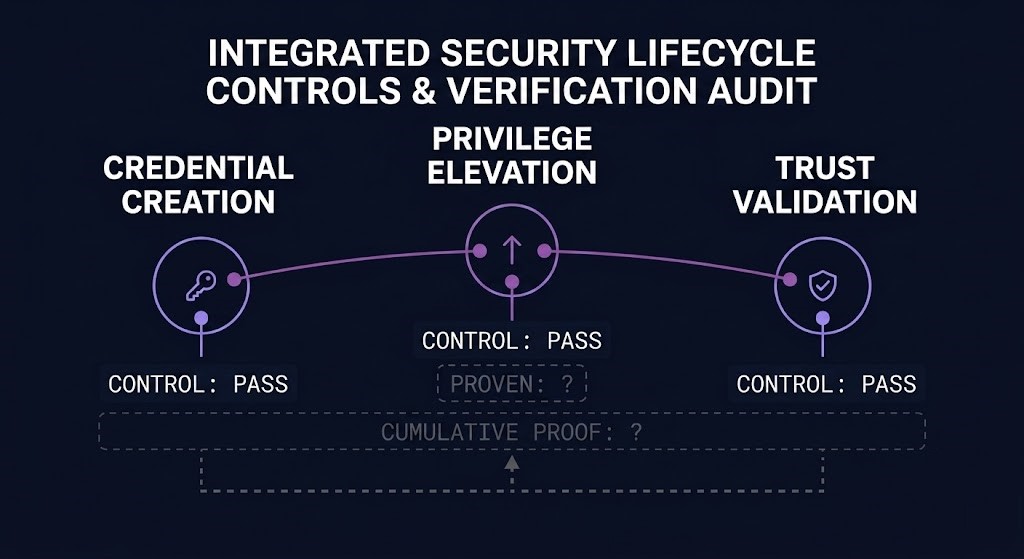
Every credential chain passes through three stages: creation, elevation, and validation. Each stage gets asked the wrong question by default — a control question instead of an architectural one — and that’s exactly where the chain goes unprovable.
The same structural split shows up one pillar over, aimed at governance documents instead of identities. Infrastructure Standards Without Enforcement Become Documentation Debt separates a standard into three comparable layers — definition, enforcement, and evidence — and makes the identical point: the layer everyone builds is the one that produces a deliverable, and the layer nobody builds is the one that would actually prove the first two are still true. A credential chain and a standard fail the same way, for the same reason: control questions get answered by default, architectural questions don’t get asked until something forces them.
Credential Creation — Was Trust Established Correctly?
The control question is whether the account was provisioned, whether MFA was enabled, whether onboarding succeeded. Those all pass in a functioning IT process and tell you nothing about the thing that actually matters: can the organization prove the identity, entitlement, and approval chain that created this authority in the first place — not that a process ran, but that the specific grant it produced was justified? A credential whose origin can be operationally confirmed but not architecturally justified is exactly the kind a pretext exploits, because nothing about it looks wrong from the outside.
Privilege Elevation — Was Authority Granted Intentionally?
The control question is whether the account had admin rights, whether it was technically capable of executing the action. Capability isn’t the failure mode — legitimacy is. The architectural question is whether the organization can distinguish an intentional, authorized elevation from an attacker who simply inherited an already-valid path to privilege. That distinction rarely gets tested directly, because most environments treat “the account could do it” and “the account was meant to be able to do it” as the same fact once an elevation has already happened.
Trust Validation — Can Trust Still Be Proven Afterward?
The control question is whether logging existed, whether the action got recorded. Evidence collection isn’t evidence integrity. The architectural question is whether the organization can reconstruct, after the fact, why the action was trusted at every transition — not that a log entry exists, but that the entry proves the chain that produced it. Your Migration Succeeded. The Identity Chain Didn’t. shows exactly this failure from a different trigger: a migration where compute, storage, and network all validated cleanly while the identity chain underneath — machine identity, service identity, delegation trust, certificate bindings, authorization state — went completely unverified. The migration team proved the workload moved. Nobody proved the chain survived. Restore Testing Is Becoming an Adversarial Discipline makes the same case from the recovery side: staging credential revocation mid-restore is a direct test of whether a revocation claim can actually be proven against a live system, not just asserted in a runbook. Infrastructure Needs Auditability, Not Just Idempotency generalizes the same point across infrastructure change broadly — idempotency proves a system reached a state; it doesn’t prove the change that got it there was authorized. Validation is the stage that catches a chain that was correct at every individual step and unprovable as a whole, and it’s the stage that gets built last, if it gets built at all.
The same unprovable chain shows up outside red-team engagements, in a live campaign: UNK_MassTraction’s university mail server campaign harvested session credentials through a patched-but-unapplied Roundcube flaw, then used that access to install a webshell — every credential in that chain was technically valid at the moment it was used, and nobody was reconstructing why a session cookie from a compromised webmail login should have been trusted to reach an administrative shell.
The same gap appears outside human identity. A human chain runs person → credential → privilege → action. An AI authorization chain adds a different failure surface: authentication can pass, role permissions can pass, and the system can still fail to evaluate whether this specific request, retrieval, or output was appropriate in context. The Model Answered. Nobody Asked Who Authorized That. extends the same architectural question into AI systems: not whether access was technically granted, but whether the conditions that justified that access were actually proven.
The chain extends one layer further still, into infrastructure trust itself. Confidential Computing Attestation Proves The Software. Not The Person Operating It. names the same unprovable-chain pattern at the hardware layer: a TEE attestation report proves the software running in an enclave matches a known-good measurement, but nothing in that proof establishes who controls the infrastructure underneath it or whether that operator can be trusted. This post’s credential chain asks whether authority was legitimately granted. Attestation asks whether code is legitimately running. Neither answers who’s actually on the other side of the boundary.
There’s a fourth variant, and it inverts the question this post asks rather than extending it. Your Cloud Isn’t Compromised. Your Vendor Is. Now What? examines credentials your organization never issued at all — a third party’s standing access into your environment, where the provenance was never in doubt and the failure is that nobody revisits the grant once the relationship that justified it changes. This post asks whether a chain was ever legitimately provable. That post asks whether authority that was legitimately granted stays worth trusting after its issuer is compromised. Different failure, same missing second question.
There’s a fifth variant, and it asks a question downstream of all four so far. The Authorization Was Legitimate. Nobody Watched What Happened Next. doesn’t ask whether the chain was ever provable, whether volume was bounded, or whether a third party’s authority survived its own compromise — it asks whether anything was watching what an already-legitimate session did, moment to moment, for as long as it lasted. A credential can pass every stage this post describes, stay within every volume bound Identity Directory Egress would want checked, and originate from an authority Third-Party Cloud Access would call clean — and still be the vehicle for an incident, because none of those checks are continuous. They fire once, or they fire at the boundary. Session-control-gap is the argument that authorization was never supposed to be a single event to begin with.
Where This Leaves Cloud Strategy
This isn’t a call to abandon network controls, and it isn’t a critique of any specific Zero Trust implementation. It’s a control-plane argument: cloud strategy that treats authorization proof as an audit-time afterthought — rather than an architectural property designed in from the start — is defending a credential chain it can operate but not reconstruct. Framework #160 — Identity Boundary Inversion established the architectural shift from network topology to identity. This post examines the operational consequence that follows: whether an organization can prove the chain remained trustworthy after authority was granted, not just that identity is now the thing being trusted. Cloud Strategy’s Strategic Resilience stage treats identity survivability as a first-class cluster for exactly this reason: authority that can’t be reconstructed under scrutiny isn’t resilient, no matter how clean the access logs look.
The credential chain in this incident is itself a case of what cloud governance failure domains names at the platform level: identity, elevation, and validation decisions that no longer function as advisory checkpoints but execute directly — granting privilege, in this case, without anyone in the loop re-verifying the sequence that produced it. The chain didn’t fail technically. It failed the same way a governance decision fails when nobody scoped its blast radius before it started executing on its own.
There’s a related question this post doesn’t ask, worth naming so the two don’t get conflated: this post is about whether a chain’s origin can be proven — creation, elevation, validation — regardless of volume. Identity Directories Have Become An Unmonitored Intelligence Source asks a volume question instead: once a session is valid, legitimately or otherwise, what can it observe at scale before anyone notices? A credential can pass every stage this post describes — legitimately created, legitimately elevated, fully logged — and still walk out with an entire tenant directory in one call, because nothing in a clean chain-of-custody constrains how much a valid session is allowed to read at once.
Architect’s Verdict
Firewalls still matter. Segmentation still matters. Network controls still matter. None of them answer the question this incident actually raises. The credential chain does — and answering for it means being able to prove it, not just operate it.
Modern attackers rarely need to break through anything. They inherit a valid identity path and operate inside a chain organizations cannot fully prove or reconstruct. The next security discipline isn’t only controlling access. It’s proving why access was ever trusted.
Additional Resources
Editorial Integrity & Security Protocol
This technical deep-dive adheres to the Rack2Cloud Deterministic Integrity Standard. All benchmarks and security audits are derived from zero-trust validation protocols within our isolated lab environments. No vendor influence.

R.M.
Senior Solutions Architect with 25+ years of experience in HCI, cloud strategy, and data resilience. As the lead behind Rack2Cloud, I focus on lab-verified guidance for complex enterprise transitions. View Credentials →
Get the Playbooks Vendors Won’t Publish
Field-tested blueprints for migration, HCI, sovereign infrastructure, and AI architecture. Real failure-mode analysis. No marketing filler. Delivered weekly.
Select your infrastructure paths. Receive field-tested blueprints direct to your inbox.
- > Virtualization & Migration Physics
- > Cloud Strategy & Egress Math
- > Data Protection & RTO Reality
- > AI Infrastructure & GPU Fabric
Zero spam. Includes The Dispatch weekly drop.
Architecture Audit Services
Fixed-scope audits for Zero-Trust Azure, VMware migration readiness, and recovery posture — no discovery call required to start.
>_ View Audit Services>_Related Posts
Your Vendor Review Process Never Saw The Real Supplier
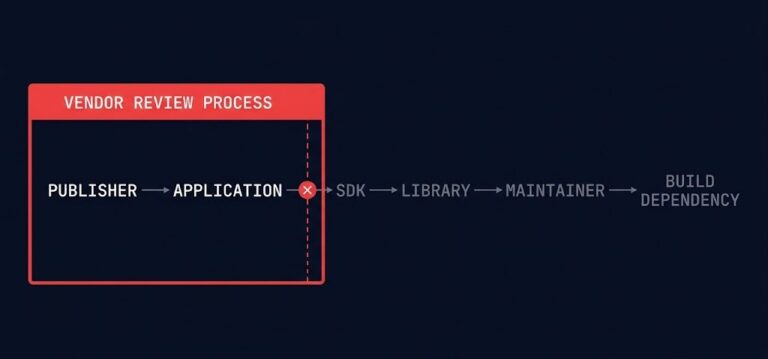
Every vendor review process assumes it’s evaluating a supplier — but a scan finding foreign-origin code embedded in more than one in eight mobile apps used by US military personnel makes the actual assumption visible: organizations review the company they bought from, not the code that arrived inside what they bought. >_ Architect’s Brief 60-second…
Your Kubernetes Cluster Isn’t Out of CPU — The Scheduler Is Stuck
Compute Tier 1 Authority Cascades to ➔ >_ Architect’s Brief 60-second read before you commit to the full post · Full post: 9 min Generating brief… [Storage] [Network] 🚨 Failure Signature Detected Grafana shows cluster CPU utilization is under 50%, but pods are stuck in Pending. Events show: 0/10 nodes are available: 10 Insufficient cpu….
Your Identity System Is Your Biggest Single Point of Failure
Part 2 of the Rack2Cloud’s Cloud Fragility Series >_ Cloud Fragility Series 01 Multi-Cloud Cascading Failure Risks 02 Your Identity System Is Your Biggest Single Point of Failure [CURRENT] 03 Vendor Lock-In Happens Through Networking — Not APIs 04 Your Cloud Bill Quietly Increased in 2026 — Here’s Where the Money Is Actually Going >_…
Your Identity Provider Was Never Your Spend Boundary
Every enterprise cloud governance program assumes a spend boundary sits somewhere between identity and money — a checkpoint that catches compromised access before it becomes compromised spend. It doesn’t exist. Not as a distinct control. Not as a separate policy layer. Not anywhere in the architecture most organizations have actually built. >_ Architect’s Brief 60-second…
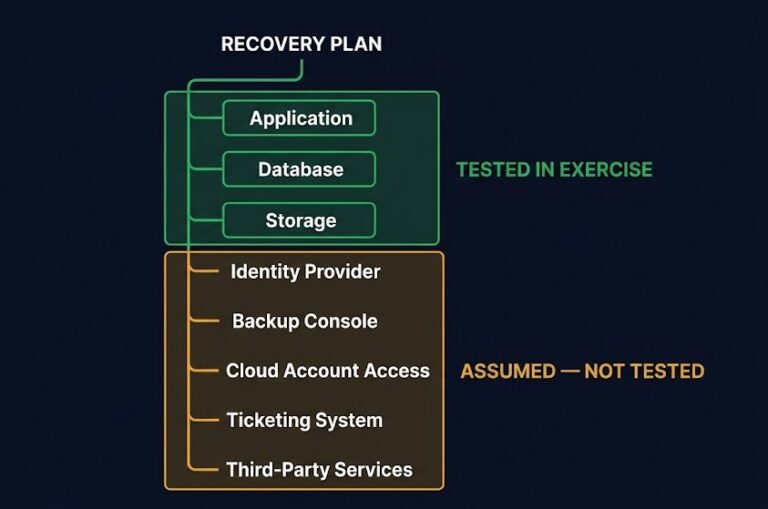
Your DR Test Passed. The Assumptions Didn’t.
DR plan failure rarely happens where you tested. It happens at the assumptions the exercise never reached — the dependencies that weren’t in scope, the runbook written for last year’s architecture, the authority chain nobody tested at 2am.
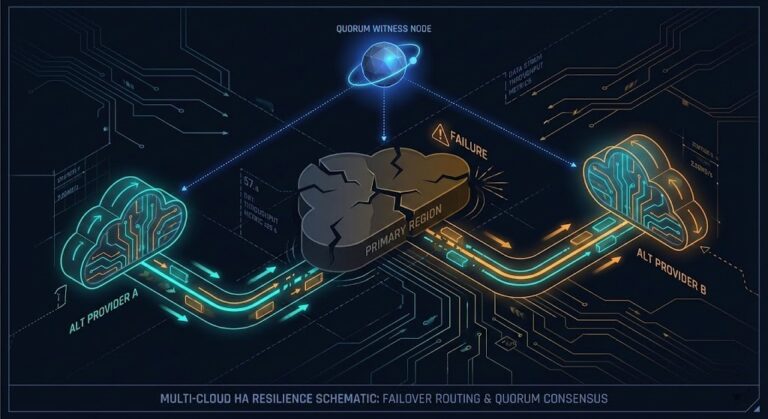
Your Cloud Provider Is Not Your HA Strategy
A Tactical Playbook for Architecting, Testing, and Automating Real Multi-Cloud & Multi-Region Resilience We’ve previously explored why cloud SLAs fail as guarantees in our deep dive, Cloud SLA Failure & Resilience Strategy. This article focuses on how to survive those failures in practice — architecturally, operationally, and financially. >_ Architect’s Brief 60-second read before you…