

Cloud Governance Failure Domains: When Governance Becomes Infrastructure
Cloud governance failure domains emerge when governance becomes operational infrastructure instead of administrative oversight. Twenty years ago governance approved infrastructure. Today governance is infrastructure — and most organizations don’t notice the transition until a policy decision takes down production before anyone flags it as an incident.
Architecture Used To Create Failure Domains
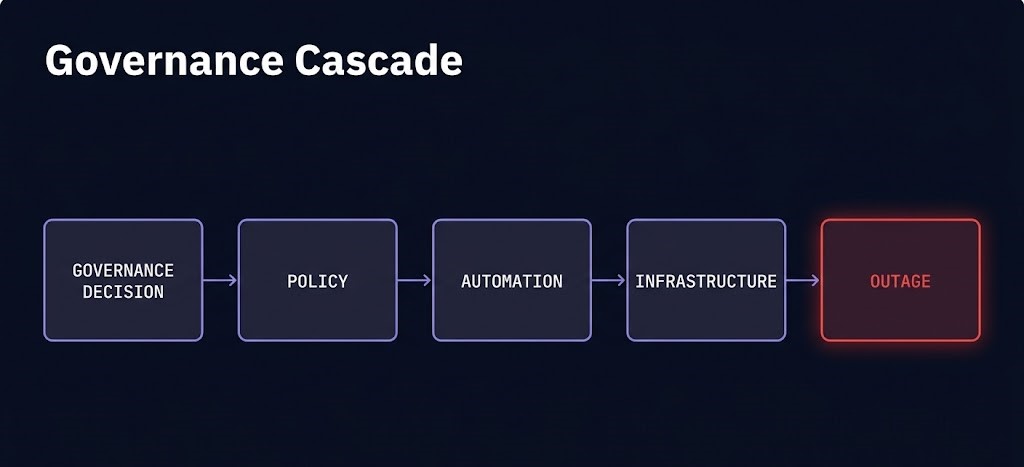
For twenty years, failure domains were an infrastructure conversation. You designed around them — region, availability zone, cluster, network segment, storage tier — because you knew the blast radius of each one before it ever failed. That discipline is the foundation of cloud architecture strategy: drawing failure boundaries deliberately, before anything fails, not after.
Governance sat outside that picture. It approved the design. It didn’t participate in runtime behavior. A landing zone review or a compliance sign-off happened before deployment, not during an incident.
That separation no longer holds — and that collapse is exactly where cloud governance failure domains come from.
Governance Now Creates Infrastructure
If you’ve read Cloud Governance Is Replacing Cloud Architecture, you already know governance became the primary decision layer. This is what happens next: that inversion changes what “governance” means operationally, and it’s the same inversion Governance Legitimacy Boundary (#154) evaluates from the authority-legitimacy side — this post picks it up from the operational-failure side. Azure Management Groups vs. Subscriptions: Where Should Policy Live? already mapped where governance sits in the hierarchy; this post is about what happens once that hierarchy fails. Identity providers, policy engines, tag enforcement, budget gates, compliance automation, and admission controllers don’t advise the platform anymore — they sit directly in the execution path. A Service Control Policy doesn’t recommend against a deployment; it stops it. An Azure Policy assignment doesn’t flag noncompliant resources for review; it denies their creation outright. A budget threshold doesn’t generate a report; it halts provisioning mid-rollout.
Every one of those mechanisms is governance. And every one of them now behaves exactly like infrastructure: it has a runtime, a failure mode, and a blast radius. Consumption-priced AI is a sharp instance of this: Why C-Suite Leaders Struggle With AI Consumption Pricing covers a governance mechanism — the approval process for infrastructure spend — whose blast radius no longer matches the runtime behavior actually generating the cost. This is precisely how cloud governance failure domains form — not through malicious intent, but through mechanisms that quietly graduated from advisory to operational without anyone updating the operating model around them. The organizations still treating governance as a pre-deployment checkpoint are the ones getting surprised — not because their infrastructure failed, but because their governance did, and nothing in their operational model was built to recognize that as the same category of event.
Infrastructure Now Obeys Governance
The dependency chain has inverted. It used to run architecture → infrastructure → operations → governance, with governance sitting downstream, reviewing what already existed. The modern cloud estate runs the opposite direction: governance → identity → policy → automation → infrastructure. Everything above that line decides. Everything below it obeys — and every environment running that inverted chain without realizing it is a candidate for cloud governance failure domains, whether or not one has surfaced yet.
This is the condition worth naming precisely: organizations increasingly express infrastructure through governance, not alongside it. An IAM boundary, an organizational unit, a tag policy, an OPA or Kyverno admission rule — these aren’t controls wrapped around the infrastructure anymore. They’re load-bearing. Remove one and workloads don’t get flagged; they stop scheduling, lose access, or get quarantined outright. It’s the same shift Identity Boundary Inversion (#160) names for identity specifically — identity, not network topology, as the boundary that actually determines whether an action is authorized. Governance is the same inversion generalized: authority that used to sit outside the platform now sits inside it, the same way Control Plane Capture (#115) describes operational authority accumulating in a single vendor control plane until alternatives become impractical.
The asymmetry this inversion produces cuts in a specific direction: it’s almost entirely a write-side story. Provisioning, policy, budget, and compliance mechanisms all execute directly now — which is exactly why they get governed with this level of rigor. The read side hasn’t caught up. Identity Directories Have Become An Unmonitored Intelligence Source names the mirror case: a full tenant directory export uses the same API, the same permission model, and none of the volume-aware controls the write layer has had for years, because nobody classified bulk observation as an operation that needed one.
How To Tell Governance Has Become Infrastructure
The diagnostic isn’t “is governance good?” It’s narrower and more useful than that:
Can governance change infrastructure behavior directly, without a human in the loop?
DIAGNOSTIC CHECKLIST
- Does a policy engine prevent a deployment from completing?
- Does identity determine where a workload is allowed to run?
- Does budget approval stop provisioning before it starts?
- Does compliance automation quarantine a resource on its own?
- Does a governance workflow gate production readiness without manual review?
If the answer to any of these is yes, governance in your environment is no longer oversight. It’s operational infrastructure — and it needs to be architected with the same discipline you’d apply to a control plane, because that’s what it now is.
Governance Failures Scale Differently
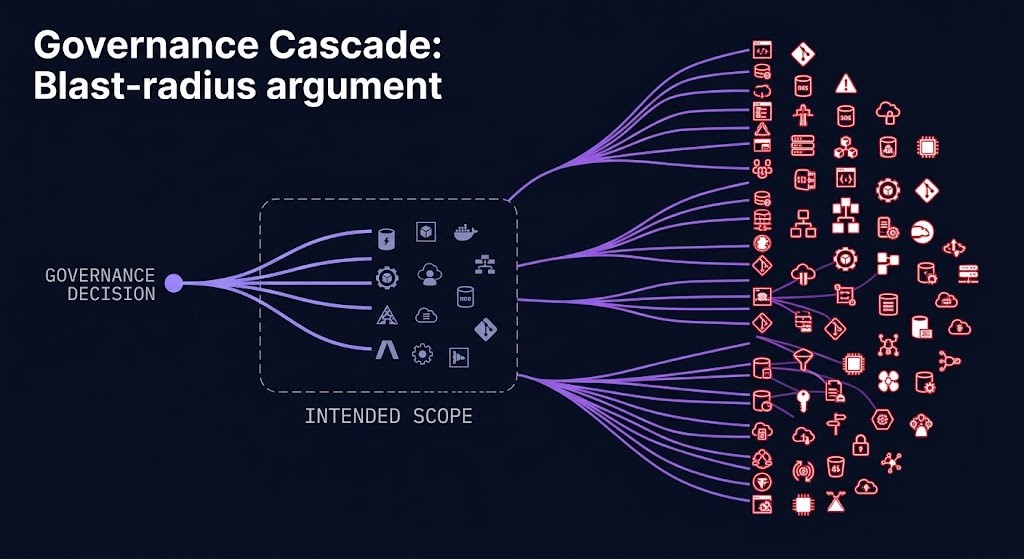
This is the part most architects miss, and it’s the mechanism behind how cloud governance failure domains actually behave once they form — the instinct is to assume a governance failure is just a smaller, softer version of an infrastructure failure. It isn’t. Infrastructure failures spread sideways — a node fails, load shifts to its neighbors, a region fails, traffic reroutes to another. Governance failures spread downward, through every resource that inherited the decision.
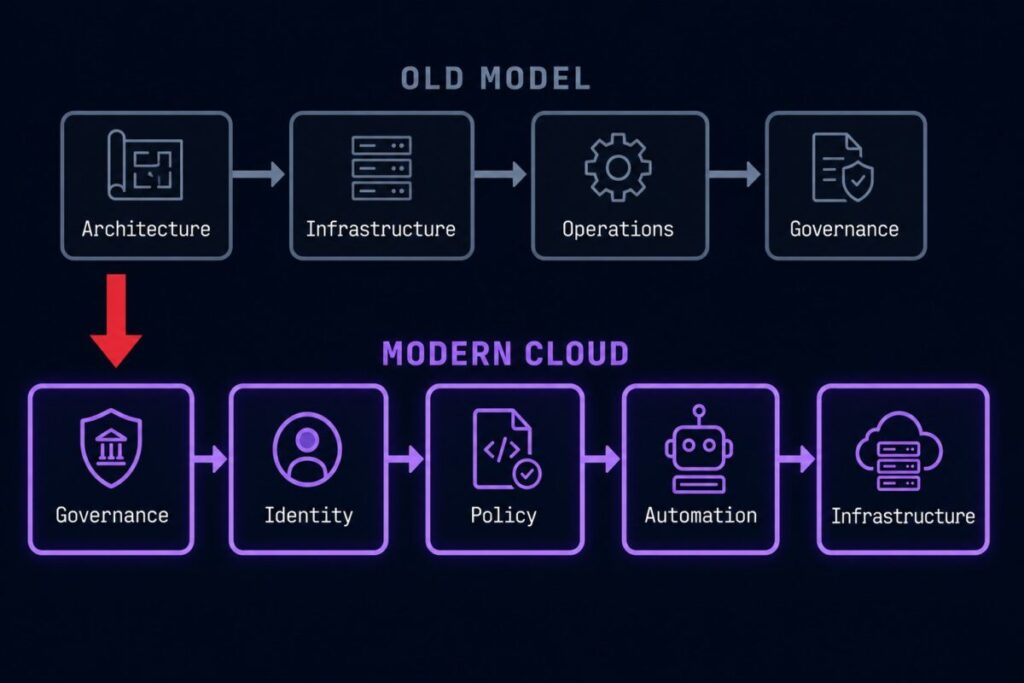
GOVERNANCE CASCADE — THE PROGRESSION
Governance Decision → Policy → Automation → Infrastructure → Outage
That’s the shape of a Governance Cascade: a governance decision whose operational blast radius exceeds the infrastructure it was intended to control — the same blast-radius reasoning that governs how you’d scope any infrastructure change, applied to policy instead. A bad SCP, a broken Azure Policy assignment, an accidental OU move, an inherited IAM boundary, a wrong landing zone baseline, an organizational restructuring — none of these are infrastructure failures. The infrastructure is behaving exactly as designed. The governance decision is wrong, and everything downstream of it inherits that error simultaneously rather than one node at a time. This isn’t hypothetical: the taxonomy of ClickOps tagging failures at planetary scale is a documented instance of exactly this shape — a tagging policy, not a server, produced the outage.
| Traditional Infrastructure Failure | Governance Failure |
|---|---|
| Server dies | Policy denies deployment |
| Network outage | Identity hierarchy blocks access |
| Storage failure | SCP removes permissions |
| Hypervisor issue | Organization hierarchy breaks inheritance |
| VM unavailable | Automation cannot execute |
That table is the practical shape of cloud governance failure domains — the left column is what your team already knows how to detect; the right column is what it’s currently blind to.
The comparison matters because your incident response playbooks are almost certainly built for the left column. Very few are built for the right one — and the right column doesn’t announce itself with an alert. It announces itself as things quietly stopping.
The AI Test Environment Is Becoming A Production Control Plane makes the same point from a different angle: that environment wasn’t dangerous because it involved AI. It became dangerous because governance granted production authority to infrastructure that was never architected to hold it. Same failure shape, different domain. The physical-infrastructure version shows up at gigawatt scale: when an AI campus becomes a distributed network of facilities, the governance layer — different jurisdictions, different utility contracts, different incident-response authorities — has to resolve to one accountable decision-maker, the same arbitration problem this post names for competing policy mechanisms. Skip that design work and the coordination layer inherits the exact single-point-of-failure risk the distribution was supposed to eliminate.
Designing Governance Like Infrastructure
If governance now behaves like infrastructure, it has to be designed like infrastructure — not administered like a policy document. Preventing cloud governance failure domains from forming in the first place means treating governance change with the same rigor as an infrastructure change:
01 — BLAST RADIUS BEFORE APPROVAL
Every policy change gets scoped for blast radius the same way a network change would — before it merges, not after it fails.
02 — TESTED ROLLBACK
If a governance decision can stop production, someone owns reversing it, and that reversal has actually been tested — not assumed.
03 — GOVERNANCE-AWARE MONITORING
Observability that watches infrastructure but not the policy layer controlling it will miss the cause and only ever see the symptom.
04 — SEPARATION OF ARBITRATION
Someone owns the composite outcome when multiple governance mechanisms interact — identity, cost, and compliance policy don’t get to each be “correct” while nobody owns what happens when they collide. That’s the same arbitration gap Cloud Arbitration Layer (#166) names at the cross-provider level.
None of this argues against governance. It argues against governing infrastructure with a discipline infrastructure itself outgrew years ago. Organizations don’t fail because governance exists. They fail because governance was never held to the architectural standard everything downstream of it depends on — and that gap, left unaddressed, is where the next round of cloud governance failure domains gets built.
Architect’s Verdict
Governance didn’t replace architecture. Governance became part of the architecture itself. Every policy engine, approval workflow, identity rule, budget gate, compliance check, and automation pipeline now participates directly in how infrastructure behaves.
Once governance became operational, it inherited operational failure modes. Architects who design systems without designing governance are no longer designing the whole system — they’re designing the part of it they can still see.
The problem was never governance. The problem is governance nobody architected — and that’s exactly how cloud governance failure domains form: not from bad intent, but from good policy operating without the discipline infrastructure earned twenty years ago.
Additional Resources
View 7 more resources
Editorial Integrity & Security Protocol
This technical deep-dive adheres to the Rack2Cloud Deterministic Integrity Standard. All benchmarks and security audits are derived from zero-trust validation protocols within our isolated lab environments. No vendor influence.

R.M.
Senior Solutions Architect with 25+ years of experience in HCI, cloud strategy, and data resilience. As the lead behind Rack2Cloud, I focus on lab-verified guidance for complex enterprise transitions. View Credentials →
Get the Playbooks Vendors Won’t Publish
Field-tested blueprints for migration, HCI, sovereign infrastructure, and AI architecture. Real failure-mode analysis. No marketing filler. Delivered weekly.
Select your infrastructure paths. Receive field-tested blueprints direct to your inbox.
- > Virtualization & Migration Physics
- > Cloud Strategy & Egress Math
- > Data Protection & RTO Reality
- > AI Infrastructure & GPU Fabric
Zero spam. Includes The Dispatch weekly drop.
Architecture Audit Services
Fixed-scope audits for Zero-Trust Azure, VMware migration readiness, and recovery posture — no discovery call required to start.
>_ View Audit Services>_Related Posts
Your Kubernetes Cluster Isn’t Out of CPU — The Scheduler Is Stuck
Compute Tier 1 Authority Cascades to ➔ >_ Architect’s Brief 60-second read before you commit to the full post · Full post: 9 min Generating brief… [Storage] [Network] 🚨 Failure Signature Detected Grafana shows cluster CPU utilization is under 50%, but pods are stuck in Pending. Events show: 0/10 nodes are available: 10 Insufficient cpu….
Your Identity System Is Your Biggest Single Point of Failure
Part 2 of the Rack2Cloud’s Cloud Fragility Series >_ Cloud Fragility Series 01 Multi-Cloud Cascading Failure Risks 02 Your Identity System Is Your Biggest Single Point of Failure [CURRENT] 03 Vendor Lock-In Happens Through Networking — Not APIs 04 Your Cloud Bill Quietly Increased in 2026 — Here’s Where the Money Is Actually Going >_…
Your Identity Provider Was Never Your Spend Boundary
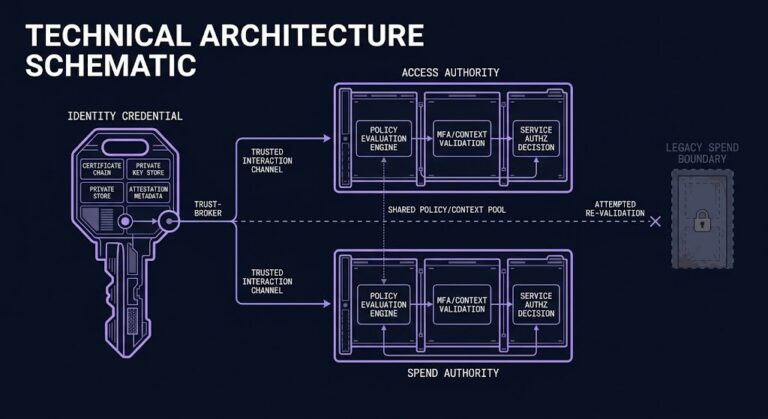
Every enterprise cloud governance program assumes a spend boundary sits somewhere between identity and money — a checkpoint that catches compromised access before it becomes compromised spend. It doesn’t exist. Not as a distinct control. Not as a separate policy layer. Not anywhere in the architecture most organizations have actually built. >_ Architect’s Brief 60-second…
Your Identity Controls Passed. Your Authorization Chain Failed.
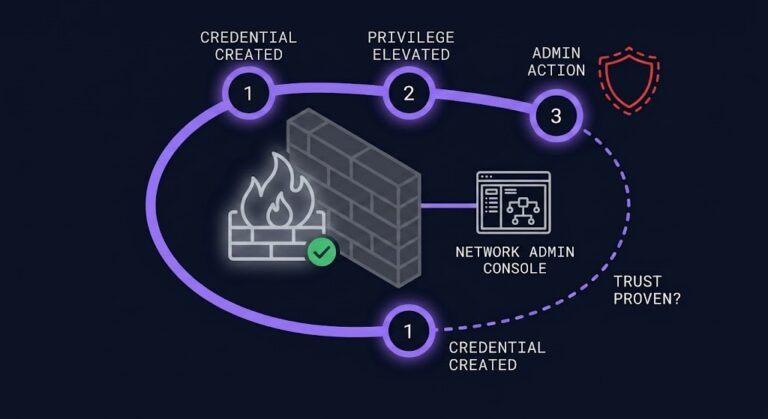
A credential chain functioned exactly as it was designed to. No firewall failed. No exploit executed. No malware bypassed a control. A red team walked past physical and social barriers using nothing more exotic than a plausible pretext, and came out the other side holding network admin credentials — issued correctly, authorized correctly, working exactly…
Your DR Test Passed. The Assumptions Didn’t.
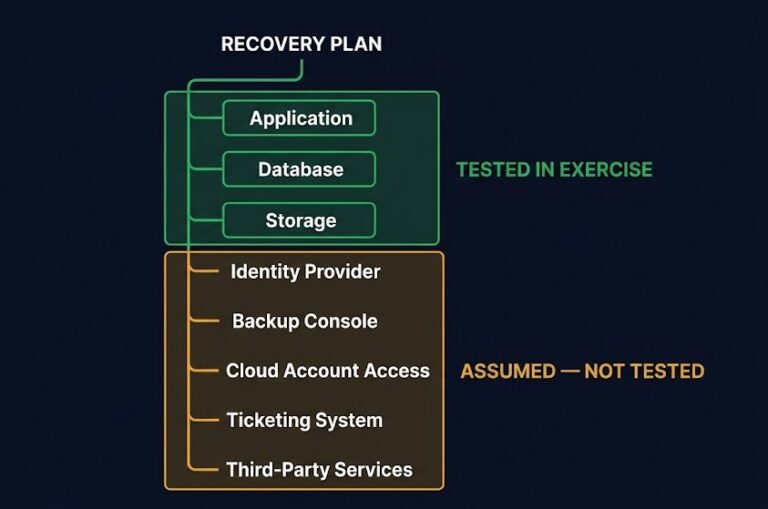
DR plan failure rarely happens where you tested. It happens at the assumptions the exercise never reached — the dependencies that weren’t in scope, the runbook written for last year’s architecture, the authority chain nobody tested at 2am.
Your Cloud Provider Is Not Your HA Strategy
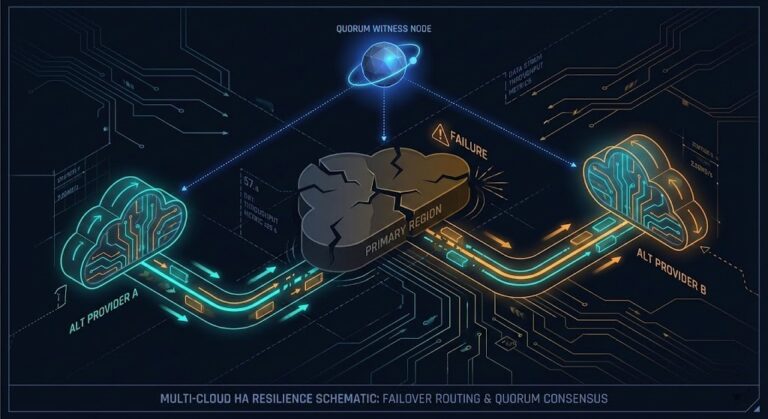
A Tactical Playbook for Architecting, Testing, and Automating Real Multi-Cloud & Multi-Region Resilience We’ve previously explored why cloud SLAs fail as guarantees in our deep dive, Cloud SLA Failure & Resilience Strategy. This article focuses on how to survive those failures in practice — architecturally, operationally, and financially. >_ Architect’s Brief 60-second read before you…