

Identity Directories Have Become An Unmonitored Intelligence Source
Identity directory egress is the blind spot sitting inside almost every enterprise security program: the moment a valid session reads more than it should, and nothing notices, because reading was never the thing anyone built alarms for.
This week, a threat actor operating under the alias “TheHatman” began selling internal employee directories pulled from at least nine Fortune 500-level organizations — McDonald’s, Vodafone, Tata Consultancy Services, HCL Technologies, InterContinental Hotels Group, Kyndryl, Gap, Hexaware, and Wyndham Hotels — reportedly extracted from their Azure and Entra tenants. Researcher reporting attributes the access to compromised credentials, though the precise acquisition method has not been publicly confirmed across every affected organization. That detail matters for incident response. It is close to irrelevant to the architectural finding, because the thesis below survives regardless of whether the session originated from an infostealer, a phishing kit, a hijacked token, or a compromised delegated application. What matters architecturally is what happened after a valid session existed — not how it came to exist.
Identity Directory Egress Is Rarely Treated As An Infrastructure Risk
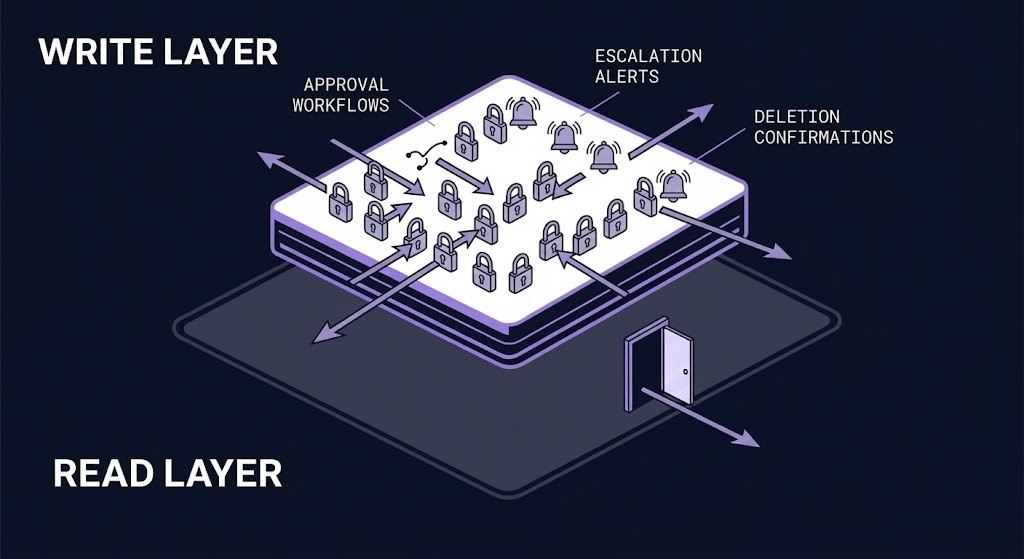
Security programs are built around a largely unstated hierarchy: writes are dangerous, reads are safe. Provisioning gets an approval workflow. Privilege escalation gets alerting. Deletion gets a confirmation step and an audit trail. Every one of those controls exists because something can be undone, broken, or stolen through a write — and because, for most of the history of enterprise IT, that assumption held. A compromised account browsing a handful of records was a privacy problem, not a cloud strategy control-plane problem.
The write side of this asymmetry has already had its reckoning. Cloud Governance Failure Domains: When Governance Becomes Infrastructure documents how identity, policy, and budget mechanisms stopped advising infrastructure and started executing directly against it — a policy engine that denies a deployment outright, an identity boundary that determines where a workload is allowed to run, a compliance rule that quarantines a resource with no human in the loop. That post’s diagnostic question is whether governance can change infrastructure behavior directly. Identity directory egress is the mirror case on the other side of the same control plane: not whether identity can act without review, but whether identity can be observed, at scale, without review — and almost nowhere has that question been asked with the same rigor the write side already received.
Identity directory egress is what happens when that assumption stops holding at scale. A full tenant directory export doesn’t look like an attack, because it isn’t architecturally distinguishable from one. The session is valid. The query is one the platform is explicitly designed to answer. The response is exactly what a legitimate administrator would receive running the same export for onboarding, an org-chart refresh, or a compliance audit. Researcher analysis of this week’s campaign is explicit on this point: the extraction itself occurred through legitimate directory-access mechanisms, not a platform vulnerability. Nothing about the request trips a wire, because nothing was ever wired to notice it.
This is the actual failure mode identity directory egress names: not a vulnerability, not a misconfiguration in the traditional sense, but a heavily governed write layer sitting on top of an almost entirely ungoverned read layer — in a system where the read layer can now return the entire organizational map in a single call, and where “the account was authenticated” is treated as a sufficient answer to a question it was never built to answer.
What a Directory Export Actually Contains
Mainstream coverage of this class of incident tends to frame it as an employee data leak — names, emails, job titles, phone numbers. That framing is accurate and also the least interesting thing about what actually left the building.
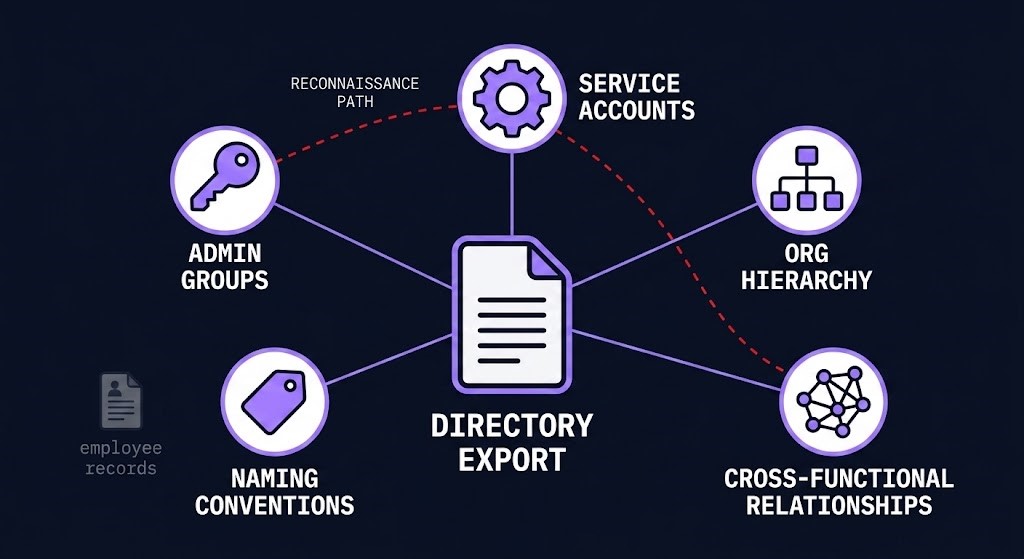
A full tenant directory export doesn’t just expose who works somewhere. It exposes:
WHAT A DIRECTORY EXPORT ACTUALLY CONTAINS
- Administrative and privileged group membership — who holds elevated access, and to what systems specifically
- Service account naming conventions and structure — the non-human identities that hold their own standing authority, often with weaker rotation and monitoring discipline than human accounts
- Organizational hierarchy and reporting lines — who approves what, and who to impersonate convincingly to get something approved
- Internal domain and tenant naming patterns — the vocabulary an attacker needs to make a phishing email or a pretext call sound native to the organization, not generic
- Cross-functional relationships — which teams touch which systems, visible through group membership and distribution-list structure, without ever querying a single application directly
None of that is employee PII in the conventional sense. It’s a labeled map of the organization’s control plane — who can act, what they can act on, and how the pieces connect to each other. Microsoft’s own framing of Entra positions identity as the control plane used to manage and secure access across an environment. Taken on those terms, large-scale directory enumeration isn’t a privacy incident. It’s control-plane reconnaissance, collected in one request, without the requester ever touching a single system the directory doesn’t already govern.
This is the same shift Identity Is Becoming the New Infrastructure Boundary — Framework #160, Identity Boundary Inversion — already named: identity, not network topology, is now the perimeter that actually determines whether an action is authorized. That framework closed the Evidence Gap series on the observation that most organizations still audit the old perimeter and not the one that replaced it. Identity directory egress is a direct extension of the same inversion, applied specifically to observation rather than action: if identity is the control plane of modern infrastructure, then the ability to enumerate that control plane in bulk is not a side effect of a privacy leak — it’s reconnaissance against the actual perimeter, gathered through a channel most Zero Trust programs were never built to watch, because they were built to govern what identity can do, not what a valid session can see.
A newer instance of the same inversion showed up one layer further out than this post covers. Microsoft’s own account of whether Entra ID had been exploited changed within a day, and no tenant held an independent channel to check either version — the read layer isn’t just under-instrumented internally, as this post argues; it’s entirely opaque once the platform generating it is fully vendor-operated and the vendor’s own narrative is the only account available.
The Pattern This Isn’t New To
Rack2Cloud has made a version of this argument twice before, in two different domains, and both are worth naming directly rather than pretending this is the first time the shape has appeared.
Your Monitoring Didn’t Miss the Incident. It Was Never Designed to See It. makes the case that threshold-based monitoring is built for systems that fail loudly — and that modern systems increasingly fail by drifting: latency doesn’t spike, it drifts; error rates don’t explode, they scatter. That’s a performance and cost argument, not a security one, but the underlying claim is identical to this post’s: the absence of an alert is not the absence of a problem. It’s evidence the monitoring model was never asked the right question.
Egress Audit Framework: How to Find Unbounded Movement Paths — anchored to Framework #127, Movement Authority Boundary — names a specific category, unknown egress, as the traffic class standard monitoring cannot detect, precisely because nobody classified it as a path worth watching in the first place. That’s a network and data-transfer cost argument. Same shape again: an entire category of movement exists outside the model of what “suspicious” looks like, not because it’s hidden, but because nobody drew the boundary around it.
Identity directory egress is another instance of the same pattern, now applied to identity: monitoring optimized around an expected failure class, producing a structural blind spot the moment reality moves outside the class the model was built to catch. Three domains, one architectural lesson — the question isn’t whether your monitoring is good. It’s whether anyone ever defined the shape of the thing it’s supposed to be watching for.
| Domain | Monitoring Assumption | Blind Spot |
|---|---|---|
| Observability | Systems fail loudly | Slow drift |
| Egress (network) | Data leaves through known, classified paths | Unbounded movement paths |
| Identity | Writes are dangerous, reads are safe | Reads at scale |
| Recovery/Remediation | Rotation and rebuild validate identity and host state | Permission-grant layer beneath identity’s own lifecycle |
| Domain Governance | Enforcement scoped to the domain named in a report | Account-level actor structure behind it |
A pattern that recurs across multiple unrelated domains stops being a coincidence and starts being a property of how monitoring gets designed in the first place: teams instrument the failure mode they can already imagine, and the instrumentation stops exactly where the imagination did.
A fourth domain belongs on this list, surfaced from the recovery side rather than the monitoring side: The Server Was Fixed. Persistent Access Wasn’t. documents recovery that correctly validated host state and credential state after an Exchange compromise, while a mailbox-permission grant survived both actions untouched — not because remediation failed, but because nobody had scoped that layer as something remediation needed to check. Same asymmetry as the write/read split above, one register over: the categories operations teams know to remediate versus the categories persistence actually lives in.
Another domain belongs on this list, and it isn’t enterprise IT at all. The Domain Was the Containment Unit. ICANN Is Reconsidering That. documents the identical shape in DNS abuse enforcement: registrars are built to catch and mitigate the domain named in an abuse report, and nothing in that model was ever built to ask what else the same account controls. The blind spot isn’t a detection failure — coordinated abuse campaigns are visible, well-documented, easy to describe — it’s a scope failure, the same way this post’s read layer isn’t invisible, just never classified as a category worth a rate limit. Different industry, different regulator, same root cause: the monitoring or enforcement model was sized to the failure class someone could already picture.
Why “Just Add MFA” Doesn’t Close This
The instinct after a credential-theft-adjacent story is to reach for identity hardening — stronger MFA, conditional access policies, shorter session lifetimes. Those controls matter, and none of them address identity directory egress specifically, because the premise of this failure mode is that the session is already valid at the moment the export happens. Hardening how a session gets created doesn’t constrain what an already-valid session is permitted to read in one action.
It’s worth being precise about what this post is not arguing, and where it differs from the closest thing Rack2Cloud has already published on identity failure. Your Identity Controls Passed. Your Authorization Chain Failed. asks whether a specific credential’s entire chain — creation, elevation, validation — can be reconstructed and proven legitimate after the fact. That’s an origin-of-authority question: should this credential have ever reached this level of privilege, and can the organization prove the chain that got it there? Identity directory egress asks a different question entirely: once a session is valid, regardless of how legitimately it was issued, what can it observe at scale before anyone notices? A credential can pass every stage of that post’s three-stage model — legitimately created, legitimately elevated, fully logged — and still walk out with the entire tenant directory in one call, because nothing in the chain-of-custody model constrains observation volume. The two failure modes are not competing explanations for the same incident. They’re adjacent gaps in the same identity plane, and an organization can close one completely while leaving the other wide open.
A third, more recent post extends the same identity plane one lifecycle stage further out. The Authorization Was Legitimate. Nobody Watched What Happened Next. asks neither the provenance question nor the volume question — it asks whether a session’s behavior, once authorization is granted, is ever treated as a signal worth watching in its own right. In the Qantas case that post examines, the bulk extraction ran through a connected app inheriting a legitimate agent’s authority, not through the native directory-read path this post covers, but the shared failure is identical in shape: identity governance stops at the moment of grant, and almost nothing downstream is built to notice that grant being exercised at a scale or in a manner nothing about the grant itself would predict.
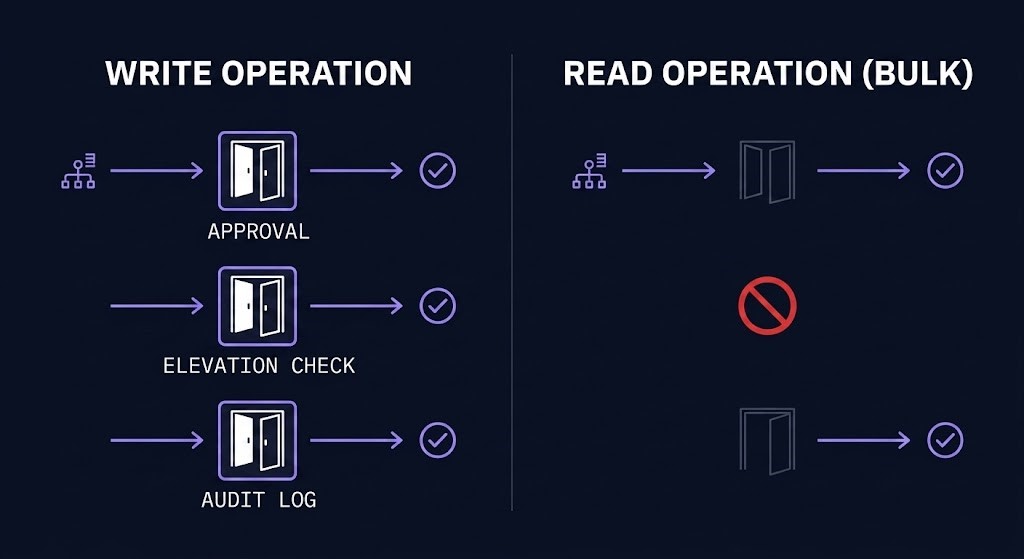
The architectural question identity directory egress actually raises — the question this entire post exists to ask — is a volume and rate question, not an authentication question: does anything in the environment distinguish an administrator pulling twelve records for onboarding from a session pulling the entire tenant directory in one call? For most organizations, today, the honest answer is no. Both operations use the same API, the same permission model, and the same absence of any rate boundary on read volume.
Closing the identity directory egress gap means treating bulk-read operations against identity directories the way write operations have been treated for years: volume-aware, rate-limited, and scored against a baseline of what normal administrative access actually looks like — not just whether the access was authenticated. A single account exporting a full directory in one session is not, by itself, evidence of a credential problem. It’s evidence of a missing control on an operation nobody classified as one that needed a control in the first place.
That’s a specific instance of the Automation Validation Tax (Framework #172), applied to identity infrastructure rather than automated decision-making: the platform’s read capability scaled to answer any query a valid session could construct, and the verification layer meant to distinguish a routine query from an anomalous one never scaled alongside it. Authentication succeeding was mistaken for the whole check having run — the same substitution the tax names everywhere else it shows up, just wearing a directory API instead of an approval dialog.
What Instrumenting the Read Layer Actually Requires
Naming the gap is the easy part. Closing it means answering three questions most identity platforms were never configured to answer, because nobody asked them at deployment time.
What does a normal export look like, by volume and by actor? Most organizations can answer “who has access to run a directory export” but very few can answer “what does a routine one actually return, in record count, on an average week.” Without that baseline, there’s no way to distinguish a bulk enumeration from an unusually large but legitimate HR pull — the alerting model needs a shape to compare against, and most environments have never built one.
Is read volume rate-limited independently of read permission? Permission answers whether an action is allowed at all. It says nothing about whether ten thousand records returned in one call should trigger a different response than ten. Most identity platforms today conflate the two: if the account is permitted to read the directory, it’s permitted to read all of it, at any volume, in a single request, with no distinction between the two cases.
Does the platform log query scope, not just query success? A successful authentication event and a successful full-tenant export produce the same class of log entry in most environments — a valid session performed an authorized action. Closing this gap requires logging what was actually returned, not just that a request succeeded, and treating a disproportionate response volume as a signal worth its own alert path rather than a detail buried in a request log nobody reviews unless an incident has already been declared.
None of this requires replacing an identity platform. It requires treating the read layer with the same architectural seriousness the write layer has had for years — because the incident that actually happens is rarely the one the monitoring model was built to catch. It’s the one nobody thought to define as a category at all.
Architect’s Verdict
Identity directory egress is not a story about stolen credentials, and treating it as one is how the actual lesson gets lost inside a category everyone already knows how to nod along to. The credential-acquisition detail is genuinely secondary — infostealer, phishing, session hijack, delegated application abuse, it doesn’t change the finding. What changes the finding is that once any valid session exists, bulk enumeration of an identity directory operates below the visibility threshold most security programs built, because those programs were built to catch dangerous writes, not to notice that a read at sufficient scale is its own category of danger.
The real problem most organizations have isn’t that their identity platform can be read in bulk. Every directory service can be. The problem is that nobody decided in advance whether that should be possible without triggering a single alert — and by the time nine Fortune 500 tenants show up for sale on a forum in the same week, the absence of that decision has already been made for them, by default, the way most architectural gaps get decided.
Visibility and control are not the same property. An identity platform can be tightly governed for change and left almost entirely ungoverned for observation — and the second condition doesn’t announce itself, because nothing about it was ever designed to. If a recurring version of this sentence keeps writing itself into future posts — redundant environments that depend on the same upstream identity plane are not operationally independent, and platforms governed for change but not for observation are not actually governed — that’s the signal a named framework is hiding underneath this concept. It isn’t there yet. This post is the first full statement of the argument, not the last.
Additional Resources
View 6 more resources
Editorial Integrity & Security Protocol
This technical deep-dive adheres to the Rack2Cloud Deterministic Integrity Standard. All benchmarks and security audits are derived from zero-trust validation protocols within our isolated lab environments. No vendor influence.

R.M.
Senior Solutions Architect with 25+ years of experience in HCI, cloud strategy, and data resilience. As the lead behind Rack2Cloud, I focus on lab-verified guidance for complex enterprise transitions. View Credentials →
Get the Playbooks Vendors Won’t Publish
Choose the architecture problems you care about. Get field-tested playbooks and frameworks delivered to your inbox.
- > AI Infrastructure & Inference Economics
- > Cloud Strategy & Hidden Cost Models
- > Virtualization & Deterministic Migration
- > Kubernetes, IaC & Modern Infrastructure
- > Data Protection & Recovery Engineering
Zero spam. Includes The Dispatch weekly drop.
Need Architectural Guidance?
Independent review before major infrastructure decisions.
- > Validate assumptions
- > Identify hidden dependencies
- > Quantify migration risk
- > Challenge vendor narratives
Triage · Advisory · Fractional · Direct Hire