

$7,200 Zombie Load Balancers: The Taxonomy of Failure & Why ClickOps Breaks Planetary Scale
A cloud governance tagging strategy is not documentation — it is routing. The moment a resource lacks identity, it falls outside every automation, security boundary, and financial control you rely on. I’ve spent too many Sunday nights staring at an $80k Azure bill, trying to figure out which “Dev Test” environment grew a pair of legs and started running P3v3 instances. If you can’t attribute a resource to a CostCenter, you aren’t managing a cloud — you’re sponsoring a black hole.
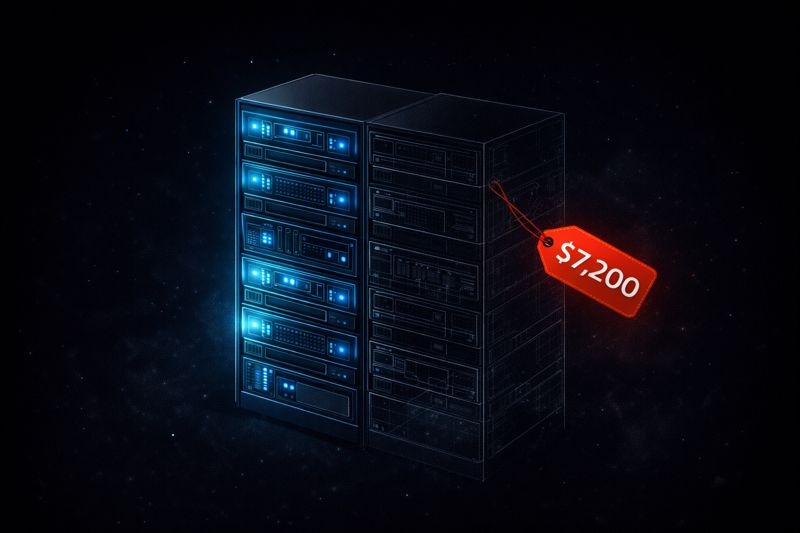
A single untagged Load Balancer, forgotten for 36 months, wasted $7,200. Multiply that by 400 POCs, and you have a financial problem that no amount of cost optimization tooling can fix after the fact.
If you walk into a warehouse and throw a box in the middle of the aisle without a barcode, that box effectively ceases to exist to the logistics system. It takes up space, it creates a tripping hazard, but it cannot be shipped, tracked, or audited. The cloud is no different. This post is the governance architecture layer that sits on top of the tactical fixes in Azure Policy Enforce CostCenter Tag and the Azure Untagged Resources Script.
The Physics of “Dark Matter” Infrastructure
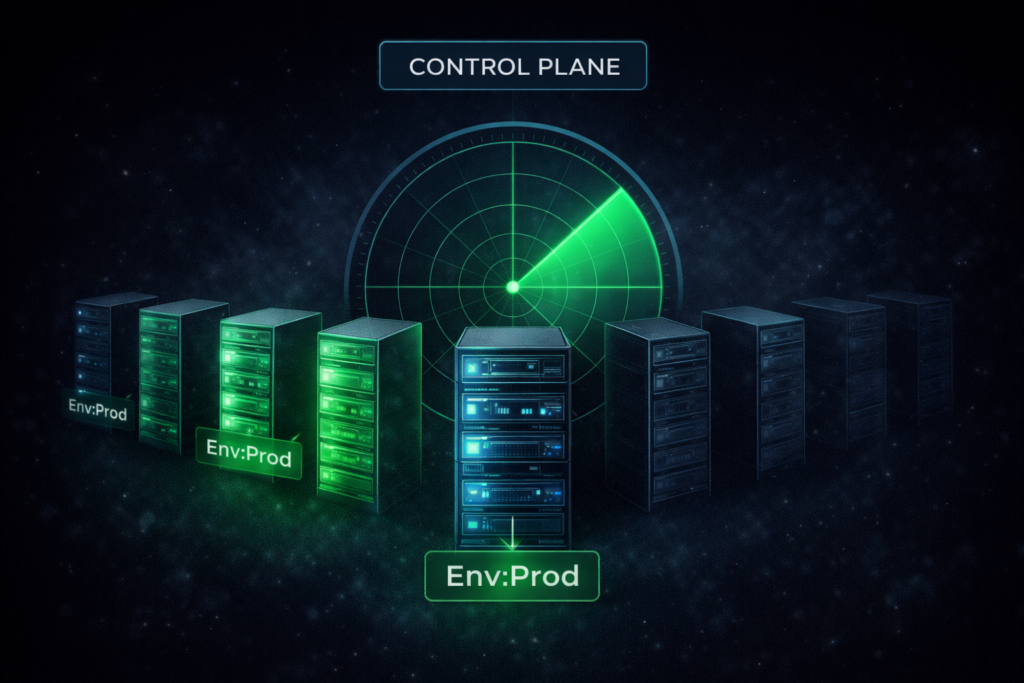
Every modern control plane — Security, Cost, and Operations — depends on Metadata Scopes. You don’t tell the backup software to “Back up Server A.” You tell it to “Back up everything tagged Sensitivity:Confidential.”
If a resource lacks a tag, it falls outside the scope. It becomes Operational Dark Matter.
In large environments, we routinely see 5–15% of resources fall into this category within a year.
- Unsecured: Vulnerability scanners skip it because it doesn’t match the
Env:Prodscope. - Unbillable: FinOps tools cannot allocate the cost because it lacks a
CostCenter. - Unowned: When it breaks at 3 AM, PagerDuty doesn’t know which
Ownerto wake up.
// THE CONTROL PLANE EQUATION
Control_Plane = Resource + Identity + Context
Click_Ops     = Resource + NULL_Identity + NULL_Context

>> RESULT: Control_Plane = NULL
A cloud governance tagging strategy solves all three failure modes simultaneously — not by adding documentation overhead, but by making identity a deployment prerequisite rather than an afterthought.
The Horror Story: The $7,200 Zombie Load Balancer
We recently audited a client environment to find the source of “Unallocated Spend.” We found a single AWS Application Load Balancer (ALB) that had been running for 36 months.
The Timeline of Waste
- Year 1 (The Click): A developer spins up an ALB via the Console (ClickOps) for a quick “Friday Afternoon POC.” They skip the tags because “it’s just a test.”
- Year 2 (The Departure): The developer leaves the company. The resource has no
Ownertag, so offboarding scripts miss it entirely. - Year 3 (The Invisibility): The ALB sits idle. It processes zero traffic, but bills for hourly availability.
The Math
$200/month (ALB Base + Idle LCU) × 36 Months = $7,200.
Why didn’t anyone catch it? Because it didn’t belong to a budget code. It wasn’t in Terraform state. It wasn’t in the security scope. It was invisible until we audited the raw bill.
Multiply this by every POC, intern project, and late-night hotfix in your history, and you don’t have “cloud sprawl” — you have a digital landfill. The Cloud Cost Is Now an Architectural Constraint post frames the FinOps logic: unattributed spend isn’t a reporting problem, it’s an architecture failure.
The Cloud Governance Tagging Strategy: The Golden Schema
Stop debating which of 50 possible tags you need. You only need five. These five tags answer the fundamental questions of existence for any compute resource and form the core of any serious cloud governance tagging strategy.
| Tag Key | Example Value | Operational Function |
|---|---|---|
CostCenter | CC-102, Eng-Core | Financial Routing. Determines who pays the bill. Missing = unallocatable spend. |
Environment | Prod, Dev, Stage | Security Scope. Determines firewall strictness, IAM access levels, and blast radius. |
Geo | EU-West, US-East | Data Residency. Determines compliance boundaries (GDPR) and latency expectations. |
Owner | [email protected] | Escalation Routing. Who gets paged when this breaks at 3 AM? |
Sensitivity | Public, Confidential | Compliance Scope. Determines backup frequency, encryption requirements, and DLP auditing. |
The Rule: If a resource does not have these five tags, it does not get deployed.
The Enforcement Layer: Governance as Code
The only reliable way to eliminate ClickOps sprawl is to make untagged deployments technically impossible. You must enforce this with code, not convention.
Option A: Azure Policy (Deny Effect)
This enforces the schema at the control plane, not the UI — which is why it works even against privileged users. If a user tries to create a Resource Group or Resource without the CostCenter tag, the API rejects the request. The full deployment guide for this policy is in Azure Policy Enforce CostCenter Tag.
The Enforcement Layer: Governance as Code
The only reliable way to eliminate ClickOps sprawl is to make untagged deployments technically impossible. You must enforce this with code, not convention.
Option A: Azure Policy (Deny Effect)
This enforces the schema at the control plane, not the UI — which is why it works even against privileged users. If a user tries to create a Resource Group or Resource without the CostCenter tag, the API rejects the request. The full deployment guide for this policy is in Azure Policy Enforce CostCenter Tag.
JSON
{
  "mode": "Indexed",
  "policyRule": {
    "if": {
      "allOf": [
        {
          "field": "tags['CostCenter']",
          "exists": "false"
        }
      ]
    },
    "then": {
      "effect": "deny"
    }
  }
}
Option B: AWS Service Control Policy (SCP)
This must be applied at the AWS Organization Root to be effective against account-level administrators. It blocks RunInstances or CreateVolume if tags are missing.
JSON
{
  "Version": "2012-10-17",
  "Statement": [
    {
      "Sid": "DenyUntaggedResources",
      "Effect": "Deny",
      "Action": "ec2:RunInstances",
      "Resource": "arn:aws:ec2:*:*:instance/*",
      "Condition": {
        "Null": {
          "aws:RequestTag/CostCenter": "true"
        }
      }
    }
  ]
}
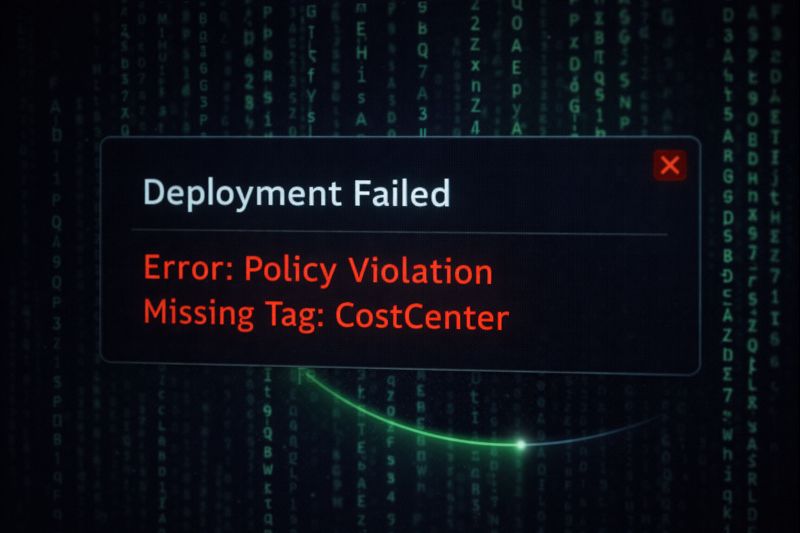
The Developer Experience: When a developer tries to ClickOps a VM and skips the tags, they hit Deployment Failed. Policy Violation. This forces them to abandon the manual portal and use Infrastructure as Code (Terraform/Bicep), where tags are applied automatically via modules. The Terraform side of this failure mode is covered in Terraform Azure Tagging Error: Policy Deny & Unsupported Resources Fixed.
The Hierarchy: Where Policies Live in a Cloud Governance Tagging Strategy
Where do you apply these policies? Not at the Subscription level (too much manual work). You apply them at the Management Group Root.
The Deployment Matrix: Pick Your Weapon
Apply these policies at the Management Group Root, not the Subscription level. Subscription-level assignment means manual work for every new subscription — which is exactly the ClickOps anti-pattern you’re trying to eliminate. The full governance hierarchy argument is in Azure Management Groups vs. Subscriptions: Where Policy Lives.
The Deployment Matrix: Pick Your Weapon
Not every organization can start with “Deny everywhere.” The right approach depends on organizational maturity and blast radius tolerance.
| Approach | Scope | Effect | Friction | Shadow IT Kill Rate |
|---|---|---|---|---|
| The Iron Fist | Root MG | Deny | High | 100% |
| Training Wheels | Root MG | Audit → Deny | Medium | 90% |
| Geo Sandbox | EU/US MGs | Deny | Low | 70% |
Recommendation: Start with Training Wheels. Set the policy to Audit for 2 weeks, run the Azure Untagged Resources Script against the compliance output to see what breaks, then flip to Deny.
Architect’s Verdict
There is an old saying in operations: “No Ticket, No Laundry.” It means if you don’t follow the process, you don’t get the service.
A cloud governance tagging strategy is the same principle at infrastructure scale: No Identity, No Compute.
It seems harsh to block deployments over metadata, but the alternative is a chaotic sprawl of Dark Matter infrastructure that bleeds budget, hides security risks, and makes 3 AM incidents impossible to route. Audit your “Unallocated” or “Unknown” cost bucket today. If it represents more than 5% of your bill, you don’t have a cloud strategy — you have a digital landfill.
The sequence: audit with the PowerShell script → apply the Golden Schema → enforce at Management Group root in Audit mode → flip to Deny. Everything else is postponing the problem.
Additional Resources
Editorial Integrity & Security Protocol
This technical deep-dive adheres to the Rack2Cloud Deterministic Integrity Standard. All benchmarks and security audits are derived from zero-trust validation protocols within our isolated lab environments. No vendor influence.

R.M.
Senior Solutions Architect with 25+ years of experience in HCI, cloud strategy, and data resilience. As the lead behind Rack2Cloud, I focus on lab-verified guidance for complex enterprise transitions. View Credentials →
Get the Playbooks Vendors Won’t Publish
Field-tested blueprints for migration, HCI, sovereign infrastructure, and AI architecture. Real failure-mode analysis. No marketing filler. Delivered weekly.
Select your infrastructure paths. Receive field-tested blueprints direct to your inbox.
- > Virtualization & Migration Physics
- > Cloud Strategy & Egress Math
- > Data Protection & RTO Reality
- > AI Infrastructure & GPU Fabric
Zero spam. Includes The Dispatch weekly drop.
Architecture Audit Services
Fixed-scope audits for Zero-Trust Azure, VMware migration readiness, and recovery posture — no discovery call required to start.
>_ View Audit Services>_Related Posts
Your Monitoring Didn’t Miss the Incident. It Was Never Designed to See It.
I’ve watched observability vs monitoring play out as a live incident more times than I can count. >_ Architect’s Brief 60-second read before you commit to the full post · Full post: 10 min Generating brief… The dashboard was green. The on-call engineer was not paged. The monitoring system did exactly what it was designed…
Your Kubernetes Cluster Isn’t Out of CPU — The Scheduler Is Stuck
Compute Tier 1 Authority Cascades to ➔ >_ Architect’s Brief 60-second read before you commit to the full post · Full post: 9 min Generating brief… [Storage] [Network] 🚨 Failure Signature Detected Grafana shows cluster CPU utilization is under 50%, but pods are stuck in Pending. Events show: 0/10 nodes are available: 10 Insufficient cpu….
Your Identity System Is Your Biggest Single Point of Failure
Part 2 of the Rack2Cloud’s Cloud Fragility Series >_ Cloud Fragility Series 01 Multi-Cloud Cascading Failure Risks 02 Your Identity System Is Your Biggest Single Point of Failure [CURRENT] 03 Vendor Lock-In Happens Through Networking — Not APIs 04 Your Cloud Bill Quietly Increased in 2026 — Here’s Where the Money Is Actually Going >_…
Your Identity Provider Was Never Your Spend Boundary
Every enterprise cloud governance program assumes a spend boundary sits somewhere between identity and money — a checkpoint that catches compromised access before it becomes compromised spend. It doesn’t exist. Not as a distinct control. Not as a separate policy layer. Not anywhere in the architecture most organizations have actually built. >_ Architect’s Brief 60-second…
Your Identity Controls Passed. Your Authorization Chain Failed.
A credential chain functioned exactly as it was designed to. No firewall failed. No exploit executed. No malware bypassed a control. A red team walked past physical and social barriers using nothing more exotic than a plausible pretext, and came out the other side holding network admin credentials — issued correctly, authorized correctly, working exactly…
Your DR Test Passed. The Assumptions Didn’t.
DR plan failure rarely happens where you tested. It happens at the assumptions the exercise never reached — the dependencies that weren’t in scope, the runbook written for last year’s architecture, the authority chain nobody tested at 2am.