

Confidential Computing Attestation Proves The Software. Not The Person Operating It.
Confidential computing attestation proves that a specific, verifiable piece of software is running exactly as intended on a given piece of hardware — and increasingly, architects are treating that proof as something it was never designed to deliver.
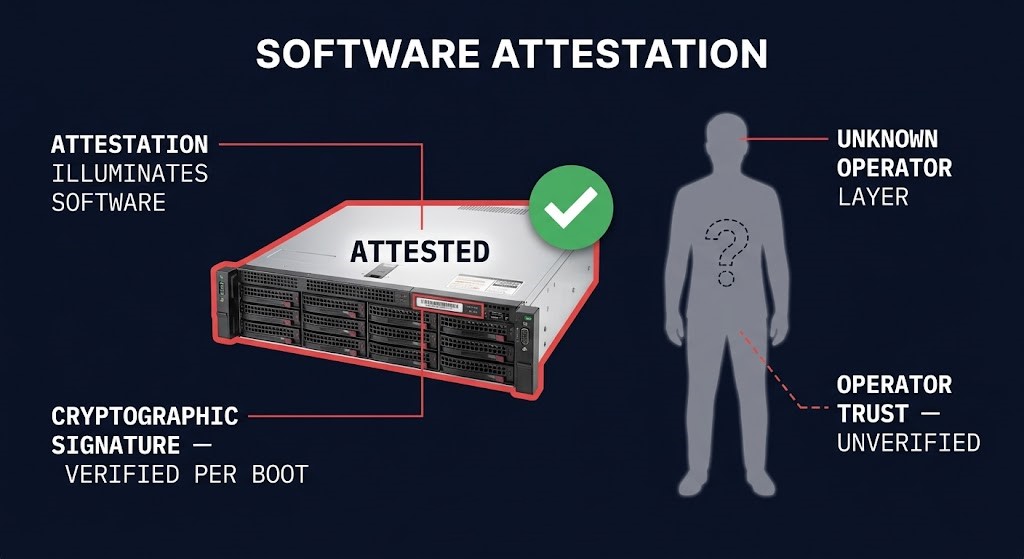
The Promise Of Confidential Computing Attestation
Confidential computing attestation made a real engineering leap possible. A trusted execution environment — whether it’s a confidential VM, a confidential GPU enclave, or a hardware-rooted TEE — can now produce a signed, cryptographic report confirming that the code loaded into it matches a known-good measurement. No hypervisor tampering. No silent binary substitution. No unverified boot chain.
For multi-tenant inference specifically, this solved a problem that used to be unsolvable in AI infrastructure architecture: a customer running a model on someone else’s GPU capacity can now get mathematical proof that the inference stack wasn’t modified before their weights and prompts touched it. That’s not a marginal improvement. Before attestation, “trust the cloud provider” was the entire security model for anything sensitive running on shared infrastructure. Attestation replaced faith with evidence.
That’s the part everyone gets right. It’s also where most of the analysis stops.
The Question It Never Answers
Attestation proves exactly one thing: that this is the software I expected. It does not answer who owns the environment that software is running in, who operates the infrastructure underneath it, or whose interests that operator actually represents.
Those are different questions, and architects are increasingly collapsing them into one — the same collapse that shows up when identity controls pass while the authorization chain fails, or when an identity provider answers a different question than the one being asked. A confidential GPU enclave can produce a perfect attestation report — correct measurement, valid signature, unbroken chain of trust back to the hardware root — while the entity controlling the physical infrastructure, the neocloud reseller, or the sovereign-adjacent capacity provider remains completely outside the architect’s actual trust assumptions. The workload is verified. The counterparty is not.
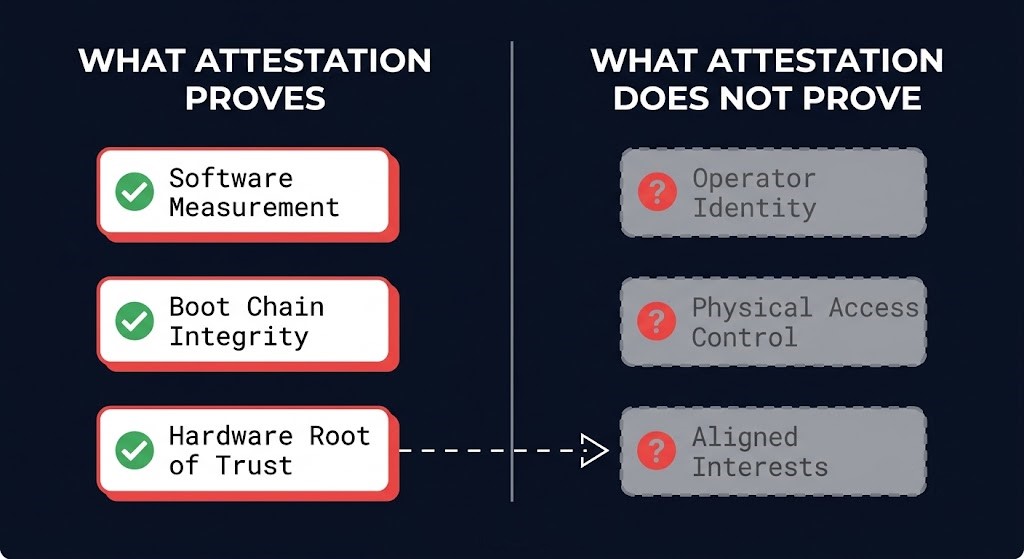
Verified software running under an unverified operator is not a hypothetical edge case. It’s the same failure shape found in agentic systems that inherit trust without a challenge, and it’s the default condition of most multi-tenant AI infrastructure being built right now. GhostApproval is the same split at the human-approval layer instead of the hardware-trust layer: the dialog can be a perfect, correctly-rendered confirmation of something, while the thing it’s actually confirming and the thing actually happening underneath it are two different facts.
The same split shows up one layer higher, at the platform rather than the hardware layer. Every AI Platform Is Becoming An Authority Platform examines vendor control planes — AgentMinder, Entra Agent ID, Agentforce’s governance stack — that now issue an agent a verifiable enterprise identity and enforce policy against it. That solves the agent-identity half of the problem cleanly. It says nothing about who operates the authority platform itself, or whether that operator’s interests are the ones an architect actually needs verified. Verifying the agent’s identity is not the same fact as verifying the platform vendor governing that identity — the same collapse this post describes one layer down, at the hardware root of trust instead of the control plane.
Why This Assumption Used To Be Safe
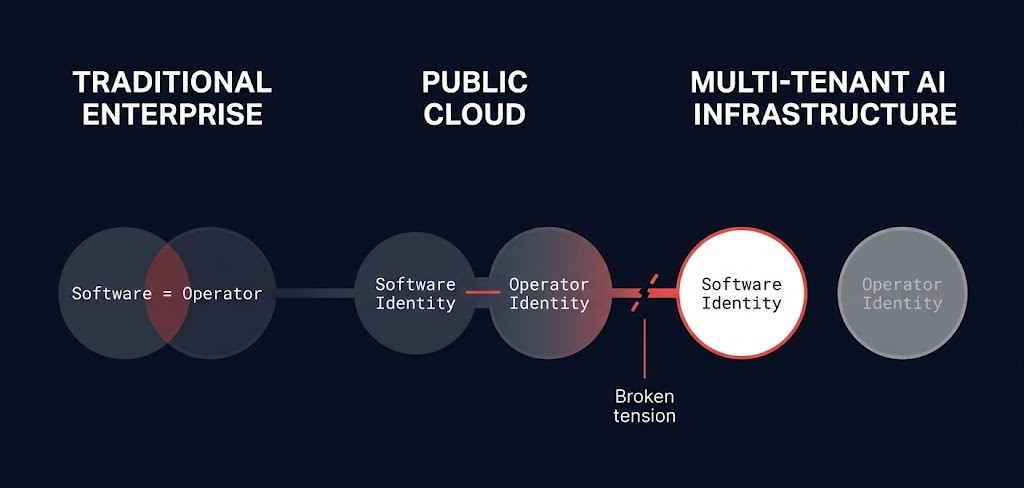
Nobody built this blind spot on purpose. For most of enterprise infrastructure’s history, software identity and operator identity were the same fact, discovered once. If you owned the hardware, you controlled the software running on it, and you were the operator by definition. Verifying the software was functionally equivalent to verifying the counterparty, because there wasn’t a separate counterparty to verify.
Public cloud loosened that coupling but didn’t break it entirely — architects extended trust to a small set of hyperscalers whose identity and reputation were never actually in question, even when the underlying hardware wasn’t theirs to inspect. The operator was still knowable, even if it wasn’t the architect’s own organization.
The AI Architecture Learning Path’s treatment of runtime governance covers this territory in more depth, but the short version: multi-tenant AI infrastructure is what actually broke the assumption. Confidential GPU capacity increasingly runs through neoclouds, capacity resellers, and sovereign-adjacent providers several layers removed from any brand an architect would recognize. Confidential computing attestation did not create this gap. It exposed the moment software identity and operator identity stopped belonging to the same organization — and gave architects a verification tool precise enough to prove the software half of that split while leaving the operator half completely unaddressed.
What Attestation Proves — And The Question It Leaves Unanswered
Confidential computing attestation proves, cryptographically, that specific code is running unmodified. No existing attestation mechanism proves who controls the environment that code is running in — not the hardware, not the physical access, not the ability to intervene if something goes wrong or someone decides to look.
| Attestation Confirms | Attestation Does Not Confirm |
|---|---|
| The measured software matches a known-good image | Who owns or operates the underlying infrastructure |
| The boot chain was not tampered with | Whether that operator’s interests align with yours |
| The hardware root of trust is valid | Whether the operator can be compelled, subpoenaed, or acquired |
| The code hasn’t been silently substituted | Who has physical or administrative access to intervene |
For any architect deploying sensitive inference on capacity they don’t own, the honest diagnostic question is simple: attestation confirmed the software. What confirmed the operator?
If there’s no answer, the trust chain has a gap that no attestation report will ever close — because it was never built to close it.
Architect’s Verdict
trust question: can the software be trusted? AI infrastructure increasingly depends on a second question: can the operator be trusted?
Those two questions used to have the same answer, because for most of infrastructure’s history there was only ever one party to evaluate. Multi-tenant AI broke that. The tooling caught up on one side of the split and hasn’t caught up on the other.
Architects who treat a clean attestation report as proof of a trustworthy counterparty have verified the software and made an assumption about everything else.
Additional Resources
Editorial Integrity & Security Protocol
This technical deep-dive adheres to the Rack2Cloud Deterministic Integrity Standard. All benchmarks and security audits are derived from zero-trust validation protocols within our isolated lab environments. No vendor influence.

R.M.
Senior Solutions Architect with 25+ years of experience in HCI, cloud strategy, and data resilience. As the lead behind Rack2Cloud, I focus on lab-verified guidance for complex enterprise transitions. View Credentials →
Get the Playbooks Vendors Won’t Publish
Field-tested blueprints for migration, HCI, sovereign infrastructure, and AI architecture. Real failure-mode analysis. No marketing filler. Delivered weekly.
Select your infrastructure paths. Receive field-tested blueprints direct to your inbox.
- > Virtualization & Migration Physics
- > Cloud Strategy & Egress Math
- > Data Protection & RTO Reality
- > AI Infrastructure & GPU Fabric
Zero spam. Includes The Dispatch weekly drop.
Architecture Audit Services
Fixed-scope audits for Zero-Trust Azure, VMware migration readiness, and recovery posture — no discovery call required to start.
>_ View Audit Services>_Related Posts
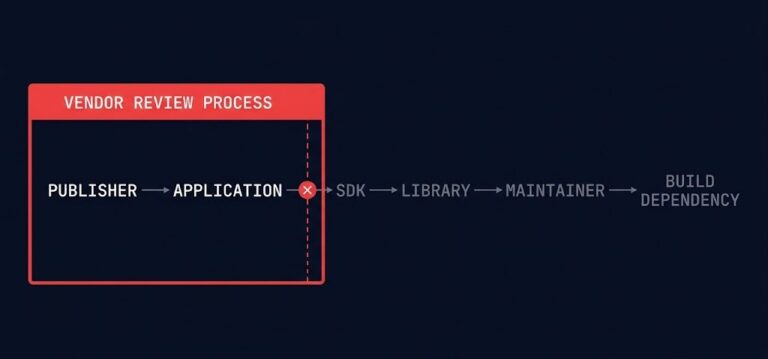
Your Vendor Review Process Never Saw The Real Supplier
Every vendor review process assumes it’s evaluating a supplier — but a scan finding foreign-origin code embedded in more than one in eight mobile apps used by US military personnel makes the actual assumption visible: organizations review the company they bought from, not the code that arrived inside what they bought. >_ Architect’s Brief 60-second…
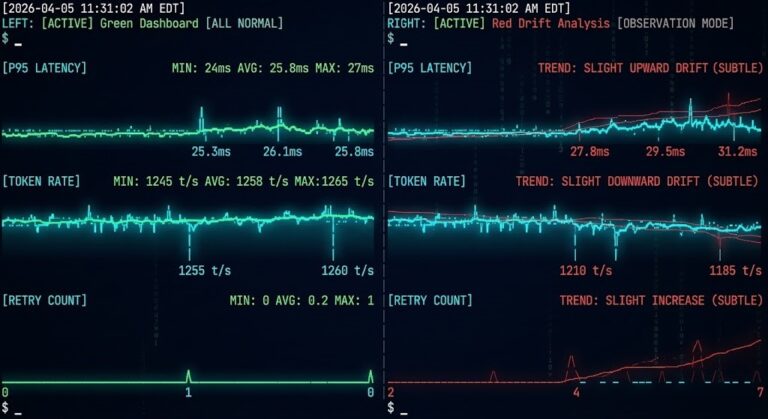
Your Monitoring Didn’t Miss the Incident. It Was Never Designed to See It.
I’ve watched observability vs monitoring play out as a live incident more times than I can count. >_ Architect’s Brief 60-second read before you commit to the full post · Full post: 10 min Generating brief… The dashboard was green. The on-call engineer was not paged. The monitoring system did exactly what it was designed…
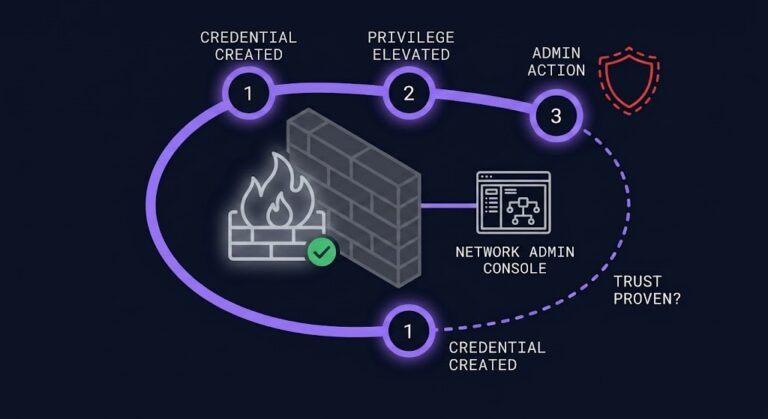
Your Identity Controls Passed. Your Authorization Chain Failed.
A credential chain functioned exactly as it was designed to. No firewall failed. No exploit executed. No malware bypassed a control. A red team walked past physical and social barriers using nothing more exotic than a plausible pretext, and came out the other side holding network admin credentials — issued correctly, authorized correctly, working exactly…
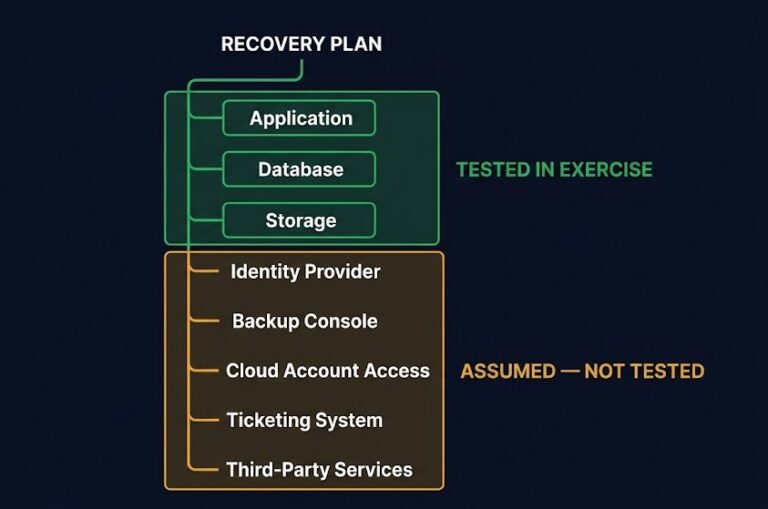
Your DR Test Passed. The Assumptions Didn’t.
DR plan failure rarely happens where you tested. It happens at the assumptions the exercise never reached — the dependencies that weren’t in scope, the runbook written for last year’s architecture, the authority chain nobody tested at 2am.
Your AI Vendor Became Critical Infrastructure Before The Contract Did
On June 11, 2026, Microsoft 365 Copilot went down for seven hours. The cause was a misconfigured authentication deployment that cascaded through Microsoft Graph, taking Copilot Chat and the Office portal with it. It was the second major Copilot disruption in eleven days. Microsoft 365 posted 99.526% uptime in Q1 2026 — the lowest quarterly…
Your AI Test Environment Is Becoming A Production Control Plane
Your AI test environment did not need to touch a single line of model code to become part of your production authority chain — it only needed a credential, a network path, or a dataset copy that nobody scheduled for removal. That is the actual lesson sitting underneath this week’s disclosures from two frontier labs:…