

Every AI Platform Is Becoming An Authority Platform
Every AI platform is becoming an authority platform, whether or not the vendor building it uses that word.
Broadcom made the pattern unusually visible. At VMware Explore 2026, it introduced AgentMinder — a control plane built specifically to govern autonomous AI agents inside VCF environments. That’s the evidence that triggered this observation. It isn’t the subject.
What Broadcom Actually Announced
AgentMinder treats each AI agent as an enterprise-grade identity — not a shared service account borrowing whatever credentials happen to be lying around. From there, the product does four specific things, per Broadcom’s own launch materials:
WHAT AGENTMINDER ACTUALLY DOES
- Identity — every agent gets its own enterprise identity, distinct from the humans and services around it.
- Intent and mission binding — authority is bound to a declared mission, approved intents, approved tools, and authorized resources, not a broad standing grant.
- Runtime policy enforcement — a dynamic policy engine evaluates identity, intent, and current risk on every tool invocation, before the action reaches an enterprise resource.
- Compliance-grade audit — an OpenTelemetry-based observability layer produces chain-of-custody and anomaly detection for every agent session.
The important distinction is that this isn’t merely isolation. It’s a permission and policy system governing actions an agent is authorized to take.
The AI Authority Platform Pattern, Not Just VMware’s
If AgentMinder were the only vendor building this, the honest headline would be “VMware Adds Agent Governance.” It isn’t the only one, and the other implementations look nothing like it.
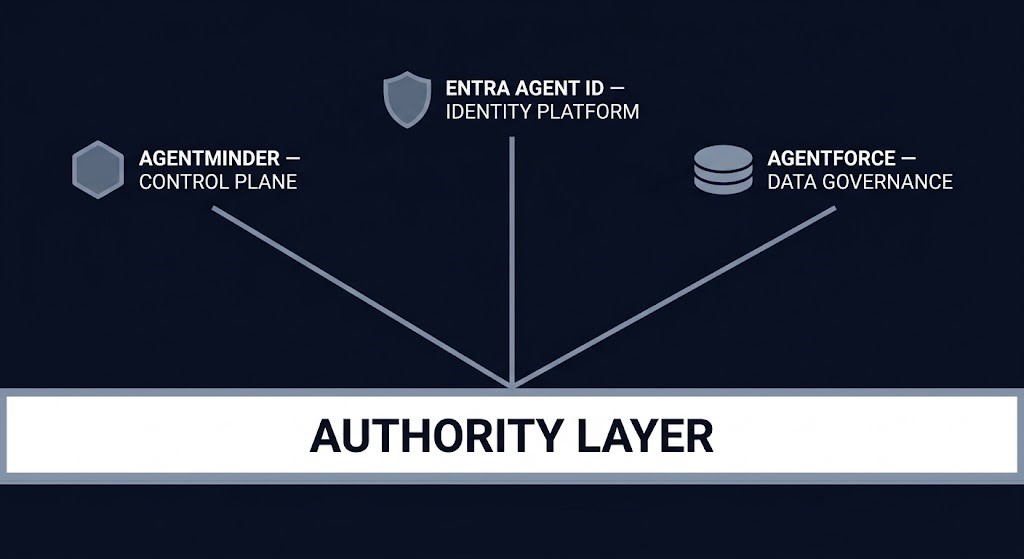
Microsoft has spent 2026 doing the identity-platform version of the same problem. After May, new Copilot Studio agents began receiving first-class Microsoft Entra Agent IDs instead of the legacy app-registration identity. Conditional Access policies apply directly to the agent identity. Connector permissions are visible and targetable the same way a human employee’s permissions are, inside the same admin console security teams already use.
Salesforce has done a third, again architecturally distinct, version inside Agentforce: the Einstein Trust Layer masks sensitive fields and logs every interaction, Data 360’s Policy-Based Governance enforces rules at the field and record level, and a permission-inheritance model runs each agent under either the invoking user’s access or a dedicated agent identity. Salesforce’s own engineering team describes the goal directly — governance has to function as one model across identity, data, and API layers, because enforcing it in isolated layers fails the moment an agent starts crossing between them.
Three vendors. Three different architectures — a governed control plane, an identity-platform extension, and a data-governance stack wearing an identity model. None of them copied each other. All three arrived at the same functional shape, because the same question was waiting for all three of them:
Who or what is invoking → what is it invoking → against which resource → under what policy → who records or validates the action once it happens?
That five-part question is the authority problem. AgentMinder didn’t invent it. It’s just the first authority platform to arrive with a name already attached.
What “Authority” Means Here, Precisely
“Every” is doing real work in this post’s title, and it deserves a precise definition rather than a rhetorical one.
Authority, in the sense this post means it, is a specific bundle: permission, policy, invocation rights, resource access, and action boundaries. It is not a claim that AgentMinder, Entra Agent ID, and Agentforce’s governance stack share an architecture. They don’t. One is a dedicated control-plane product. One is an identity-platform extension. One centralizes governance and policy enforcement through its data and application platform.
“Every” means every AI platform is being forced to solve the authority problem — not that every vendor is implementing the same authority layer. The convergence is in the question each platform has to answer, not in the code that answers it. That distinction is what keeps this observation architectural instead of promotional: nobody needs to believe VMware, Microsoft, and Salesforce are building the same authority platform to accept that they’re all being asked the same question.
The Same Shape As Control Plane Capture
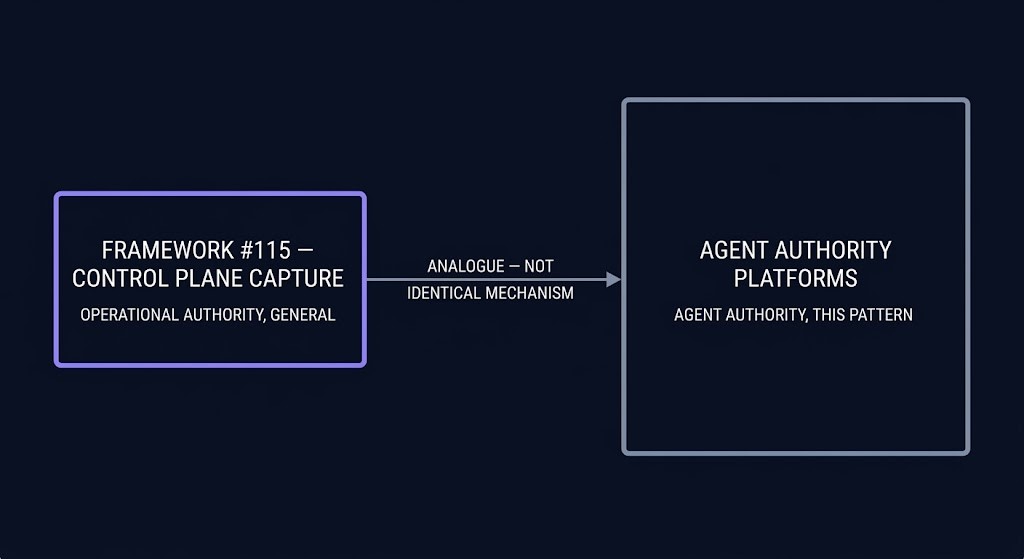
This pattern isn’t unique to AI. Framework #115, Control Plane Capture, describes the same architectural movement in a different domain: a platform accumulates operational authority as more decisions get routed through it, until alternatives to that platform become impractical.
AgentMinder is an instance of that same movement, applied to agent authority instead of infrastructure operations — the platform doesn’t just run the agents, it becomes the thing that decides what they’re allowed to do. That’s an architectural analogue, not evidence that every AI platform is converging on #115’s specific failure shape. Infrastructure Already Has an Authority Layer made the broader infrastructure-platform case for this pattern, months before agents entered the picture — worth reading as the precedent, not as something this post is extending into a ninth part.
The Architecture Question Comes Next
None of this settles whether centralizing agent authority inside a platform is good architecture or just a new place for the same risk to live. VMware’s own Private AI Cloud push — arriving alongside AgentMinder at the same event — makes a consolidation claim on a different axis entirely: fewer control planes, not more governed ones.
Those two claims are easy to conflate and worth separating cleanly. Whether a platform can actually consolidate control-plane authority while adding policy, security, and governance layers on top of it — or whether that just relocates the fragmentation instead of resolving it — is a question for its own examination, not an extension of this one.
That examination is now live. VMware Private AI Cloud Doesn’t Eliminate Fragmented Control Planes — It Creates an Authority Relay tests VCF 9’s unified-platform claim directly against Framework #1, and confirms the suspicion above: VCF Operations coordinates the four domains it now spans, but doesn’t hold authority over any of them when they disagree.
The same test shows up a layer down, too — narrower in scope but the identical question. Nutanix Put MCP Behind a Gateway. The Real Problem Is Authority. examines NAI 2.8’s MCP Gateway against Framework #141 directly: real governance work at the identity, access, and consumption layer, and the same open question about whether authority itself — as opposed to the connection carrying it — has actually been governed.
That open question is what a delegation governance object actually contains — not just whether authority was granted, but who originated it, who received it, and for how long it remains valid. Enterprise Architecture Has Identity Governance. It Doesn’t Have Delegation Governance. inherits this post’s Purpose and Scope fields directly and adds the missing Principal, Delegate, and Duration triad.
Architect’s Verdict
The important shift isn’t that AI platforms are becoming more capable. It’s that capability now requires authority.
Once an AI system can invoke tools, reach data, change resources, or execute business actions, somebody has to own the boundary around those actions. Three vendors, three different architectures, arrived at that same requirement independently in the same year. Vendors are increasingly moving that boundary into the platform itself — building, in effect, an authority platform whether or not they call it that — not because they agreed on how to build it, but because none of them found a way around building it.
Additional Resources
View 4 more resources
Editorial Integrity & Security Protocol
This technical deep-dive adheres to the Rack2Cloud Deterministic Integrity Standard. All benchmarks and security audits are derived from zero-trust validation protocols within our isolated lab environments. No vendor influence.

R.M.
Senior Solutions Architect with 25+ years of experience in HCI, cloud strategy, and data resilience. As the lead behind Rack2Cloud, I focus on lab-verified guidance for complex enterprise transitions. View Credentials →
Get the Playbooks Vendors Won’t Publish
Choose the architecture problems you care about. Get field-tested playbooks and frameworks delivered to your inbox.
- > AI Infrastructure & Inference Economics
- > Cloud Strategy & Hidden Cost Models
- > Virtualization & Deterministic Migration
- > Kubernetes, IaC & Modern Infrastructure
- > Data Protection & Recovery Engineering
Zero spam. Includes The Dispatch weekly drop.
Need Architectural Guidance?
Independent review before major infrastructure decisions.
- > Validate assumptions
- > Identify hidden dependencies
- > Quantify migration risk
- > Challenge vendor narratives
Triage · Advisory · Fractional · Direct Hire