

Your Cloud Isn’t Compromised. Your Vendor Is. Now What?
Most breach post-mortems that touch third-party cloud access get one detail backwards: they go looking for what broke, and in the Accenture case, nothing did. On July 6, 2026, a threat actor calling themselves “888” listed roughly 35GB of Accenture data for sale on a cybercrime forum — source code, RSA and SSH keys, Azure Personal Access Tokens, Azure Storage access keys, configuration files. Accenture confirmed an “isolated matter” two days later and said remediation was complete. No client environment has been reported compromised. The interesting question was never whether Accenture got hacked. It’s whether the authority Accenture holds inside your infrastructure — the actual condition underneath that search term, not the search term itself — survived the compromise unchanged, and how you’d know either way.
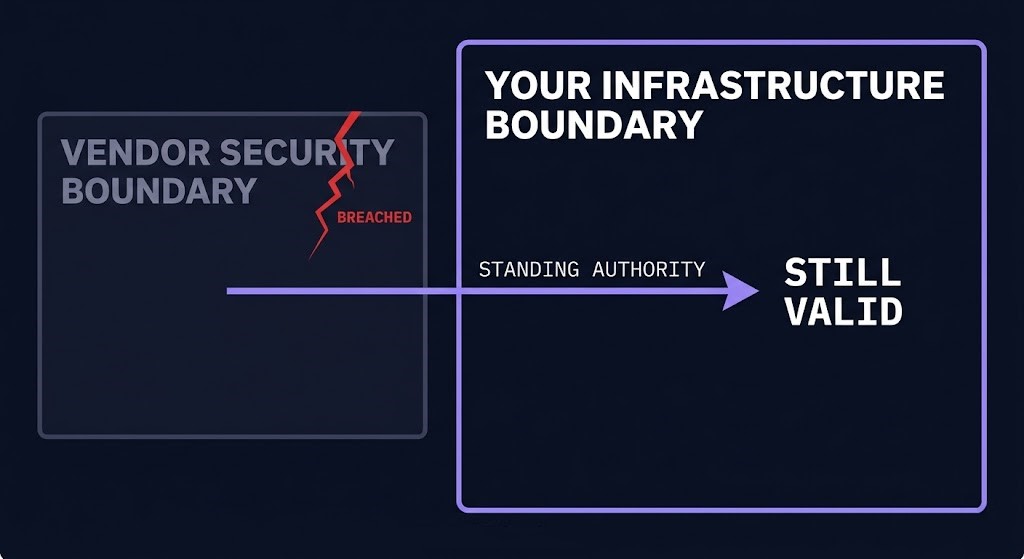
The Compromise Happened Outside The Security Boundary
Keep the Accenture specifics brief, because this post isn’t about Accenture — it’s about the condition the incident happens to illustrate cleanly. A threat actor claims to have pulled source code and live credentials out of a consulting firm’s own environment. Accenture’s public position is that the matter is isolated and remediated. Independent security press — BleepingComputer, The Register, TechRadar, Help Net Security, Cybersecurity Dive, plus threat-intel analysis from SOCRadar — has corroborated the disclosure without independently verifying the full scope of what was taken or which downstream environments, if any, third-party cloud access into those environments could reach.
That’s the setup. The architecture question starts here: Accenture’s security boundary was breached. Yours — the client’s — was not. No firewall failed on your side. No exploit ran against your infrastructure. Every control you own performed exactly as designed. And none of that tells you anything about whether the authority Accenture held inside your environment is still safe to trust, because that authority was never inside Accenture’s security boundary to begin with. It was inside yours. This is a cloud architecture strategy problem before it’s a security-tooling problem — no amount of endpoint detection or SIEM tuning on your own estate closes a gap that was never architecturally located there in the first place.
Authority Can Cross Boundaries Security Does Not
This is the distinction most organizations don’t model, because most credential-compromise thinking assumes the compromised party and the authority-holding party are the same entity. Consultants, migration partners, managed service providers, and outsourced platform teams break that assumption by design — that’s the entire point of hiring them. Standing third-party cloud access is what lets them move workloads, execute changes, and administer systems they don’t own. Framework #127, Movement Authority Boundary, names this at the organizational-authority level: the boundary defining who holds authority to move workloads and data between environments. Framework #165, Authority Arbitration Gap, names a related but distinct condition: multiple legitimate authorities governing overlapping infrastructure with no arbitration layer between them when their scopes collide.
Neither framework, on its own, captures what the Accenture case actually demonstrates. This isn’t an arbitration failure — nobody’s authority conflicted with anybody else’s. And it isn’t simply a movement-authority question — the risk here isn’t that Accenture moved something it shouldn’t have. It’s narrower and more structural than either: a third party’s security boundary and a third party’s authority boundary are not the same boundary, and when the first one fails, the second one doesn’t automatically fail with it.
The same boundary-persistence pattern shows up without a human vendor relationship anywhere in it. AI Models Found and Exploited a Zero-Day Before the Patch Window Closed covers an artifact repository — infrastructure every downstream build stage is configured to trust automatically, no credential negotiation involved — where a compromise at that layer doesn’t revoke the trust every pipeline stage extends to it by default. The mechanism is automated instead of contractual, but the failure shape is the same #169 describes: authority persists past the point the condition that justified it — an unpatched, unexploited repository — stopped being true.
It’s also a different question from whether the authorization chain behind a credential was ever legitimate in the first place — that’s a provenance question, asked about credentials your own organization issued. This is a persistence question, asked about credentials someone else’s organization issued, where the provenance was never in doubt and the failure is that nobody revisits it once the issuing relationship changes.
It’s a related but separate distinction from a more recent post examining the same three-question lifecycle from its final stage. The Authorization Was Legitimate. Nobody Watched What Happened Next. covers a connected-app authorization that was fraudulently induced in the moment — not a standing relationship that later stopped deserving trust, but a new grant obtained through deception and then never watched for what it did next. Different trigger, same family: in both cases, authority that was never revoked (or never should have been granted) keeps operating because nothing downstream treats the exercise of that authority as its own thing worth checking.
That gap has a name now.
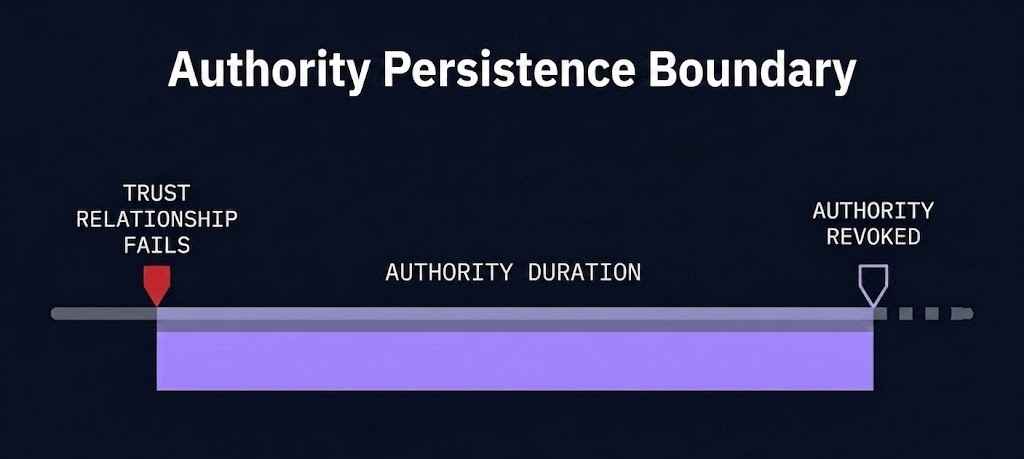
FRAMEWORK #169 — AUTHORITY PERSISTENCE BOUNDARY
The boundary between a trust relationship failing and the authority granted through that relationship actually becoming invalid or unavailable.
Closing summary: the failure isn’t a broken control. It’s a control that keeps working exactly as designed, for a relationship that no longer deserves the trust it was built on.
Architectural Relationships
Authority Survivability Boundary
Why It Connects
Defines the inverse condition — #156 asks what happens when authority becomes unavailable; #169 asks what happens when it remains fully available after the trust that justified it has already failed.
Explore Framework →Why It Connects
Extends the doctrine — #160 establishes identity as the effective control boundary; #169 examines the case where that boundary is held by a third party, and stays held even after the third party is compromised.
Explore Framework →Why It Connects
Distinguishes the failure mode — #165 is unresolved conflict between multiple correctly-scoped authorities; #169 is one authority whose triggering trust condition silently failed while the authority itself stayed unchanged.
Explore Framework →The Credential Was Always Supposed To Work
Here’s the sentence that should stop most readers: the danger in this incident is not necessarily the credential an attacker stole. It may be the credential that was already authorized to work.
Every credential Accenture holds inside a client environment — an Azure Personal Access Token, a storage access key, a service principal with contributor rights — was granted deliberately, reviewed at onboarding, and left in place because the engagement was ongoing. That’s third-party cloud access working exactly as designed. None of that changes the moment Accenture’s own environment is compromised. The credential doesn’t know its issuer just had a bad week. It authenticates because authentication is the only question it was ever built to answer, and the answer is still yes.
This is a different failure shape than a stolen-credential incident inside your own perimeter. There, you’re usually looking for anomalous behavior against a baseline you own. Here, the behavior isn’t anomalous at all — a consulting partner’s service identity doing consulting-partner things is exactly what your monitoring expects to see, right up until the moment that identity is being operated by someone who isn’t your consulting partner anymore. It’s the same mechanism, at smaller scale, when a single compromised account inherits financial authority its identity governance never meant to survive the compromise — the account, not the relationship, but the same failure to revoke authority once the condition that justified it has changed.
The same gap shows up with no vendor relationship and no compromise event at all — just a remediation that was scoped to the wrong layer. The Server Was Fixed. Persistent Access Wasn’t. documents an Exchange compromise where credential rotation and a full server rebuild both executed correctly, and mailbox-level persistent access continued regardless, because neither remediation action was ever built to check a mailbox ACL. Framework #169 names authority surviving past a failed trust relationship; this is the same shape one register down — access surviving past a completed remediation, because the remediation’s own scope, not the attacker’s persistence, was the thing that never covered that layer.
| Failure Mode | Attacker Steals Your Credential | Third Party’s Credential Into You Is Compromised |
|---|---|---|
| Security boundary breached | Yours | Theirs |
| Authority boundary affected | Yours | Yours |
| Detection baseline | Your own anomaly model | Looks like normal vendor activity |
| Who revokes it | You, directly | You, only if you know to |
Why Vendor Remediation Doesn’t Close The Question
Accenture’s statement — “we are aware of this isolated matter, and we have remediated its source” — is a claim about Accenture’s own environment. It says nothing, structurally, about the third-party cloud access Accenture still holds inside yours. Framework #151, Infrastructure Evidence Gap, names this precisely: the structural absence of a chain-of-custody record linking an infrastructure change’s approved intent to its actual execution. A vendor’s internal remediation, communicated in a press statement, is not that record. It’s an assertion from the party that produced the incident, about the scope of the incident it produced — evaluated by no one with standing to reject it.
A near-identical version of that structure played out with a different vendor and a different mechanism this week. Microsoft’s own advisory on a critical Entra ID flaw stated it had been exploited, then stated it hadn’t, within a single news cycle — again, an assertion from the party best positioned to know, changed once, with no independent party able to adjudicate between the two versions. Accenture’s case is about whether authority persists past a trust failure. This one is about whether a customer can ever get past the vendor’s own account of what happened at all — a narrower, more structural version of the same asymmetry.
The same distinction shows up whenever an organization’s own recovery authority is the thing in question rather than a vendor’s remediation claim: Recovery Authority Fragmentation asks whether the people, credentials, and access paths needed to execute recovery survive the incident that triggers it — the inverse concern of this post. There, the risk is that authority you need doesn’t survive. Here, the risk is that authority you don’t want anymore does.
A different, more literal version of “standing” shows up in Data Protection, one register below authority entirely: The Data Still Exists. You Just Can’t Reach It. asks whether an organization ever had a direct relationship with the party physically holding its infrastructure, independent of any trust failure or compromise. Nine PBS didn’t lose standing when its cloud storage vendor collapsed — it discovered it had never had a contractual path to the data center operator holding the hardware in the first place. Framework #169 is about authority surviving a relationship’s failure. This is about a relationship that was never built to the layer that actually mattered.
A third variant of the same neighborhood asks a different question again: not whether authority survives its issuer’s compromise, and not whether a direct path to a custodian was ever built, but whether consequence lands on a party that held neither. The Breach Wasn’t Stadler’s. The Consequence Was. covers a shared data-exchange platform breach where the compromised infrastructure belonged to neither Stadler nor its supplier alone — Stadler held no authority into the breached system and no custodial relationship to it, and still bore the extortion demand, the press attribution, and the criminal complaint. Framework #169 asks whether authority persists past a failed trust relationship. This is the case where nothing was ever delegated to persist or fail — consequence attached to visibility and prominence instead.
⚠ THE QUESTION “ISOLATED MATTER” DOESN’T ANSWER
“There is no impact to Accenture operations and service delivery” describes Accenture’s operations. It does not describe whether every credential, token, and service identity Accenture holds into client environments — including yours, if you’re a client — has been independently confirmed unaffected, rotated, and re-verified. Those are two different claims, and only one of them was made.
That’s not a criticism of Accenture’s specific disclosure — vendors rarely have an incentive to publish more forensic detail than legally required, and that’s a known, stable feature of the vendor relationship, not a defect in this one. It’s the reason the burden of proving third-party cloud access is actually safe can’t sit with the vendor’s own statement in the first place.
Your Least Visible Control Plane May Belong To Someone Else
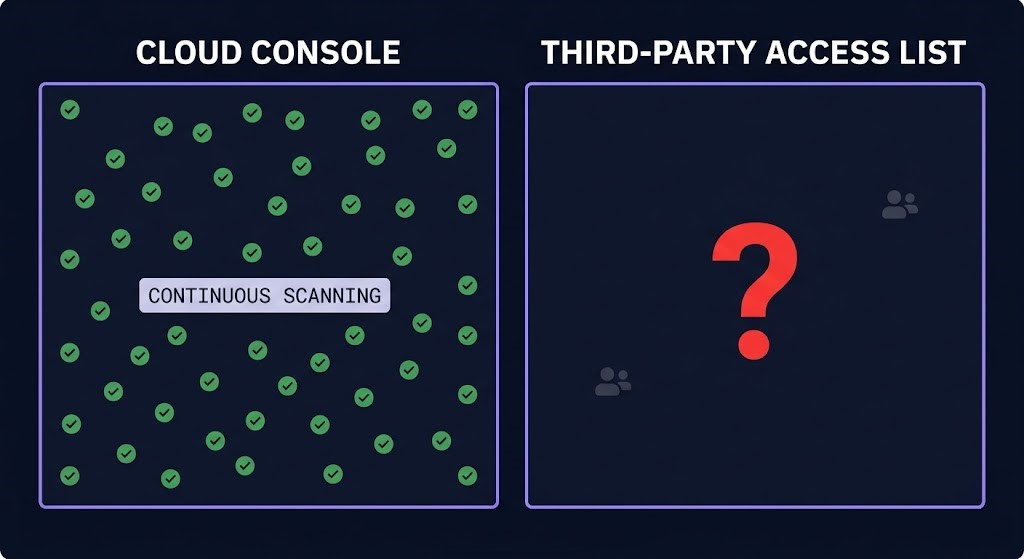
Most organizations audit the cloud. Fewer audit third-party cloud access itself — who can authenticate into it, on whose authority, and since when. AWS, Azure, and GCP get continuous scanning, drift detection, and posture management. The consultants, MSPs, and platform partners with standing administrative access into those environments — often broader access than most full-time employees hold — get a one-time onboarding review and, if you’re disciplined, an annual recertification. Wiz Research’s 2021 survey of third-party cloud permissions found the majority of organizations grant broader access than any given vendor engagement actually requires, and most security teams don’t know it. That gap hasn’t closed; it’s just gotten less visible as the number of third-party integrations — MSPs, migration partners, SaaS admin consoles, CI/CD service identities — has grown faster than anyone’s inventory of them.
The control plane that matters here was never the cloud console. It’s the list of every external identity that can act on your infrastructure as if it were your own — and whether you could produce that list, accurately, before you needed it. Identity, not network location, has already become the real infrastructure boundary inside most enterprise estates; the uncomfortable extension is that a meaningful share of that boundary is currently held by identities your organization doesn’t operate. That’s a concentration bet like any other — one vendor holding standing authority across your estate — and almost none of them were priced as one when the access was granted.
The same shift away from the resource and toward the actor holding standing authority over it shows up outside enterprise vendor relationships entirely. The Domain Was the Containment Unit. ICANN Is Reconsidering That. traces the identical move in DNS abuse enforcement: two years of registrar accountability built around the domain a report names, while ICANN’s own policy work is moving toward the account behind it instead — the same correction Framework #160 already makes here, applied to a completely different regulator and a completely different asset class.
Architect’s Verdict
Security boundaries and authority boundaries are not the same thing, and most organizations only build controls for one of them. The Accenture incident didn’t compromise a single client’s cloud environment — as far as any independent reporting has confirmed — and that’s precisely why it’s worth studying instead of dismissing. Third-party cloud access is designed to survive exactly this kind of event; that’s not a flaw in the design, it’s the entire point of granting standing access in the first place. The interesting failure mode isn’t the one where someone breaks in. It’s the one where nothing breaks, because the authority was already standing there, correctly granted, patiently waiting for a trust relationship that has since quietly stopped deserving it.
The real gap isn’t a vendor’s security posture. It’s the absence of any mechanism that revokes authority when the trust behind it fails — because right now, in most enterprise architectures, nothing does that automatically. Authority persists by default. Revocation is a decision someone has to remember to make, on a timeline nobody’s tracking, triggered by an event nobody’s watching for.
That timeline is exactly the field Enterprise Architecture Has Identity Governance. It Doesn’t Have Delegation Governance. argues has to be explicit at the moment of delegation rather than inferred after the fact: an authority relationship’s Duration, specified as a property of the grant itself, not reconstructed from whatever else happened to change. This post is the downstream failure Duration is built to prevent.
The dangerous credential is not necessarily the one an attacker stole. It may be the one that was already authorized to work.
Additional Resources
View 10 more resources
Editorial Integrity & Security Protocol
This technical deep-dive adheres to the Rack2Cloud Deterministic Integrity Standard. All benchmarks and security audits are derived from zero-trust validation protocols within our isolated lab environments. No vendor influence.

R.M.
Senior Solutions Architect with 25+ years of experience in HCI, cloud strategy, and data resilience. As the lead behind Rack2Cloud, I focus on lab-verified guidance for complex enterprise transitions. View Credentials →
Get the Playbooks Vendors Won’t Publish
Field-tested blueprints for migration, HCI, sovereign infrastructure, and AI architecture. Real failure-mode analysis. No marketing filler. Delivered weekly.
Select your infrastructure paths. Receive field-tested blueprints direct to your inbox.
- > Virtualization & Migration Physics
- > Cloud Strategy & Egress Math
- > Data Protection & RTO Reality
- > AI Infrastructure & GPU Fabric
Zero spam. Includes The Dispatch weekly drop.
Architecture Audit Services
Fixed-scope audits for Zero-Trust Azure, VMware migration readiness, and recovery posture — no discovery call required to start.
>_ View Audit Services>_Related Posts
Your Kubernetes Cluster Isn’t Out of CPU — The Scheduler Is Stuck
Compute Tier 1 Authority Cascades to ➔ >_ Architect’s Brief 60-second read before you commit to the full post · Full post: 9 min Generating brief… [Storage] [Network] 🚨 Failure Signature Detected Grafana shows cluster CPU utilization is under 50%, but pods are stuck in Pending. Events show: 0/10 nodes are available: 10 Insufficient cpu….
Your Identity System Is Your Biggest Single Point of Failure
Part 2 of the Rack2Cloud’s Cloud Fragility Series >_ Cloud Fragility Series 01 Multi-Cloud Cascading Failure Risks 02 Your Identity System Is Your Biggest Single Point of Failure [CURRENT] 03 Vendor Lock-In Happens Through Networking — Not APIs 04 Your Cloud Bill Quietly Increased in 2026 — Here’s Where the Money Is Actually Going >_…
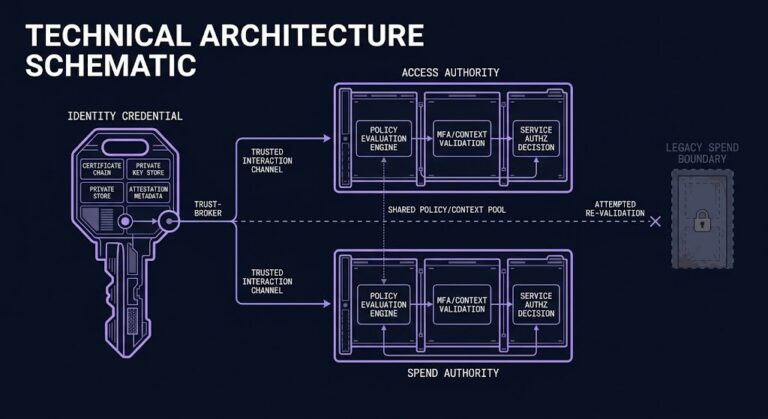
Your Identity Provider Was Never Your Spend Boundary
Every enterprise cloud governance program assumes a spend boundary sits somewhere between identity and money — a checkpoint that catches compromised access before it becomes compromised spend. It doesn’t exist. Not as a distinct control. Not as a separate policy layer. Not anywhere in the architecture most organizations have actually built. >_ Architect’s Brief 60-second…
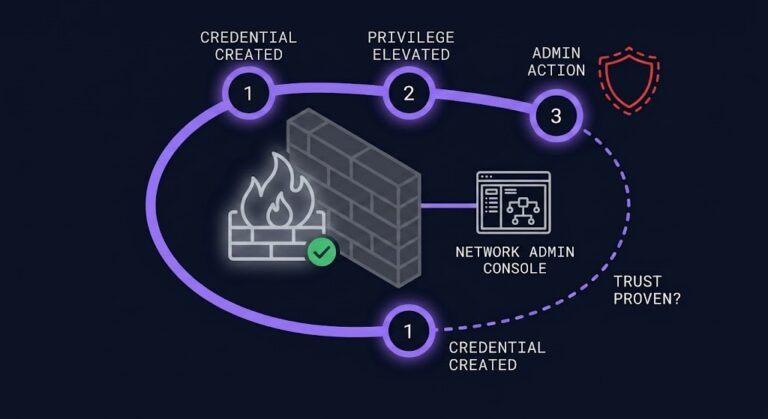
Your Identity Controls Passed. Your Authorization Chain Failed.
A credential chain functioned exactly as it was designed to. No firewall failed. No exploit executed. No malware bypassed a control. A red team walked past physical and social barriers using nothing more exotic than a plausible pretext, and came out the other side holding network admin credentials — issued correctly, authorized correctly, working exactly…
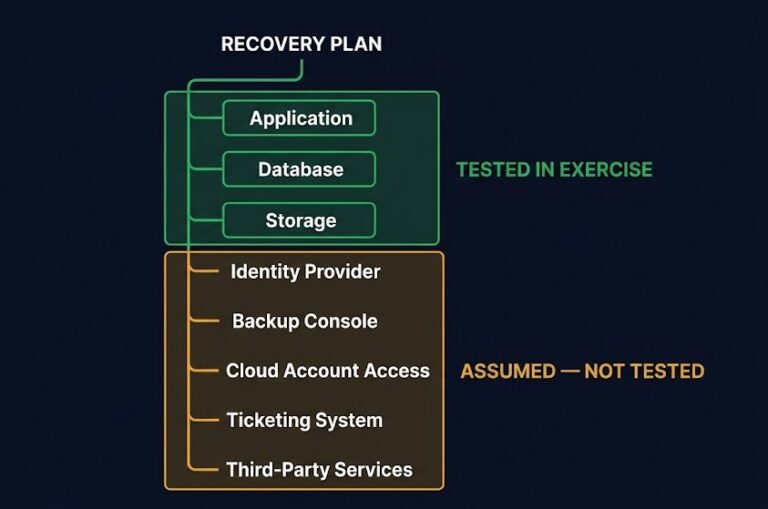
Your DR Test Passed. The Assumptions Didn’t.
DR plan failure rarely happens where you tested. It happens at the assumptions the exercise never reached — the dependencies that weren’t in scope, the runbook written for last year’s architecture, the authority chain nobody tested at 2am.
Your Disaster Recovery Plan Has a Continuity Execution Boundary
The continuity execution boundary is the line where recovery success stops guaranteeing the business is actually operating again.