

The Breach Wasn’t Stadler’s. The Consequence Was.
Consequence exposure — bearing an incident’s operational and reputational fallout independent of whether your own systems or data were involved — doesn’t require a breach of your own perimeter to land. If your systems weren’t breached and the data wasn’t yours, it’s easy to assume the incident isn’t your problem. Stadler Rail’s July 2026 extortion attempt breaks that assumption cleanly, and it’s worth being precise about how.
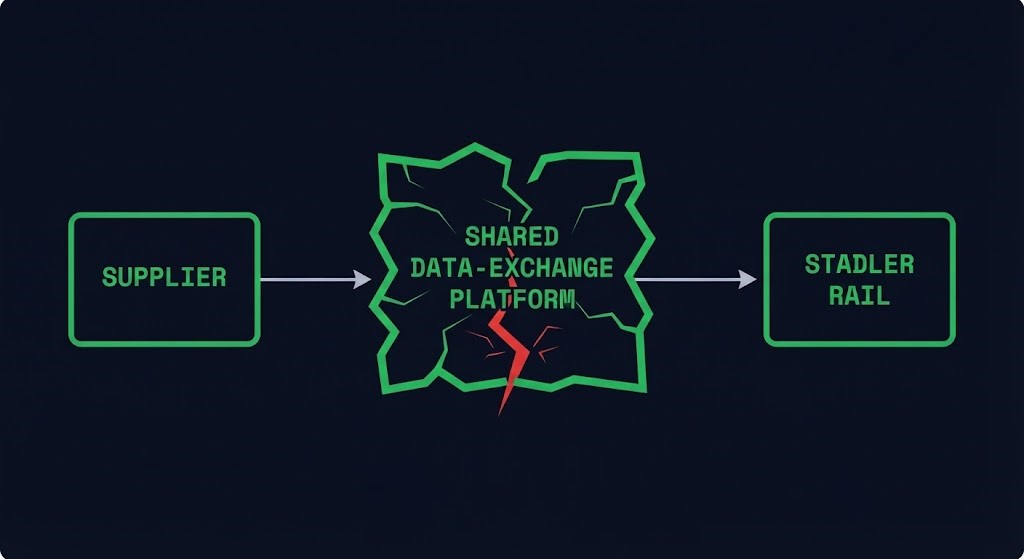
In mid-July 2026, the Everest ransomware group obtained stolen login credentials for a data-exchange platform Stadler Rail — the Swiss train manufacturer — used to collaborate with one of its suppliers. Everest exfiltrated technical data from that platform and demanded $12.3 million (CHF 10 million) not to publish it. Stadler refused outright, filed a criminal complaint with the Thurgau cantonal police, and confirmed its own IT systems, production lines, and rail vehicles were never touched. At the time of that disclosure, Stadler had not appeared on Everest’s leak site and the data had not been published.
Everest subsequently claimed to have published the stolen material — reportedly an archive of more than 271,000 files. That later publication is attributed to Everest’s own leak operation; the file count and contents are the group’s claim, not independently verified evidence, and the detail matters here only for one reason: it confirms the extortion consequence Stadler faced wasn’t hypothetical. Refusal didn’t make the threat disappear.
Read the facts in sequence and something doesn’t line up the way an ordinary ransomware story would. Attackers never entered Stadler’s network. The data taken belonged to the supplier, not to Stadler — technical information sitting on a platform outside Stadler’s own environment. The supplier’s technical data was the data exposed in the incident. And yet Stadler is the party named in every headline, the party that received the ransom demand, the party that refused it, the party that filed the police report, and — once the leak followed — the party whose name carried the story forward. The organization whose systems were compromised and the organization bearing the consequence are not the same organization.
What Actually Failed
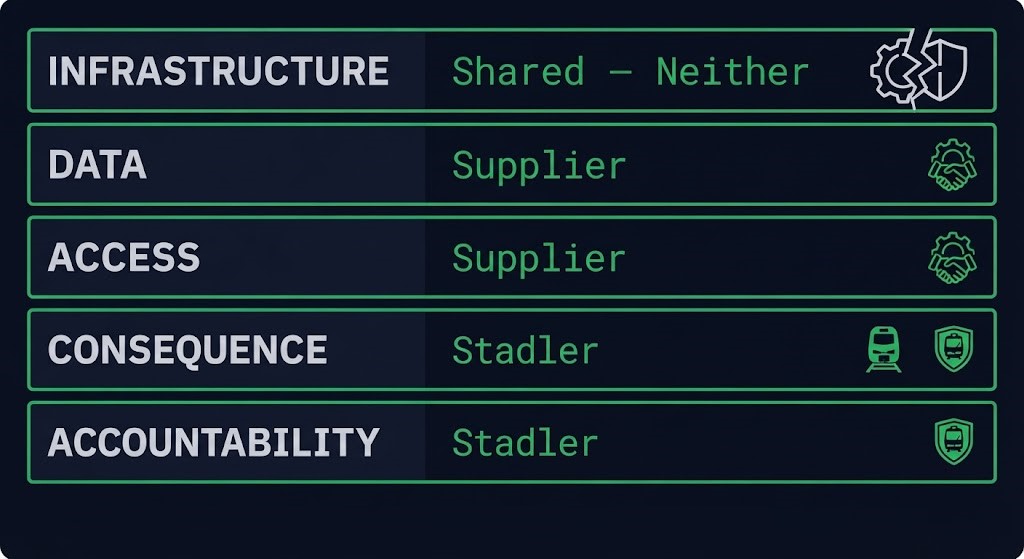
Lay this out as a data protection architecture problem, not a narrative, and the failure becomes precise:
01 — INFRASTRUCTURE
The compromise occurred on a shared data-exchange platform used by Stadler and one of its suppliers. That placed the compromise at a shared boundary outside Stadler’s own IT environment rather than inside Stadler’s perimeter.
02 — DATA
The exposed information belonged to the supplier, not to Stadler. Stadler’s own technical data, customer data, and operational data were never part of what Everest claimed to hold.
03 — ACCESS
The attackers reached the platform via stolen credentials tied to the supplier’s side of the relationship — not through any hole in Stadler’s own perimeter.
04 — CONSEQUENCE
Stadler received the extortion demand. Stadler is the party the press named. Stadler is the party whose reputation carried the exposure, independent of whose systems or data were actually involved.
05 — ACCOUNTABILITY
Stadler filed the criminal complaint and made the public “we will not pay” statement — carrying the operational and reputational response, whether or not it carried any of the preceding four.
Five questions. Five potentially different answers. Most incident response models assume they collapse to one.
Why “Supplier Ransomware” Undersells This
It would be easy to file this next to the site’s existing supply-chain and vendor-dependency coverage and move on. That would miss what makes it distinct.
This isn’t a story about a supplier’s compromised environment becoming a pivot point into Stadler’s own network — that’s the more common supply-chain shape, and it didn’t happen here. Stadler’s perimeter was never crossed. It also isn’t a story about delegated authority surviving a vendor’s breach unnoticed — that’s a different, already-covered mechanism on this site, Framework #169, Authority Persistence Boundary, differentiated in full below. Nor is it an unreviewed-dependency problem — a vendor review process never seeing the actual supplier behind a relationship — or an authority-ownership problem — Framework #157, Cross-Cloud Ownership Boundary, the question of who governs a decision spanning two environments. Both are close neighbors, both differentiated in full below. What happened to Stadler is narrower and, for architecture purposes, more useful: an organization can become the visible consequence-bearer of an incident in which none of its own systems were touched and none of its own data was exposed, purely because the infrastructure where the breach occurred was shared rather than singly owned.
That’s not a security failure in the conventional sense. The incident did not result from a compromise of Stadler’s own perimeter. The relevant architectural question therefore moves upstream: what controls existed around the shared boundary, and which organization was expected to own them? Most data protection and vendor-risk programs never draw that boundary in the first place — not because the question is unanswerable, but because it’s never asked until an incident forces it.
Where This Generalizes
Nothing about the five-boundary problem is specific to rail manufacturing or to one platform vendor. The same structure sits underneath any arrangement where infrastructure is genuinely shared rather than clearly owned by one party with the other as a guest:
WHERE THIS GENERALIZES
- Joint data-exchange and collaboration platforms — the Stadler pattern exactly: two organizations building or contracting a shared workspace where neither party’s standard vendor-risk process was ever designed to evaluate “infrastructure we co-own.”
- Consortium and multi-party infrastructure — shared research environments, joint ventures, industry data pools — where a breach anywhere in the consortium can attach consequence to whichever member is largest, most visible, or easiest to name in a headline, independent of who actually built or ran the compromised piece.
- Multi-tenant SaaS with co-branded or white-labeled access — where an end customer interacting with what looks like a single vendor’s platform is actually crossing an infrastructure boundary the customer never sees and the vendor’s own contract never fully assigned.
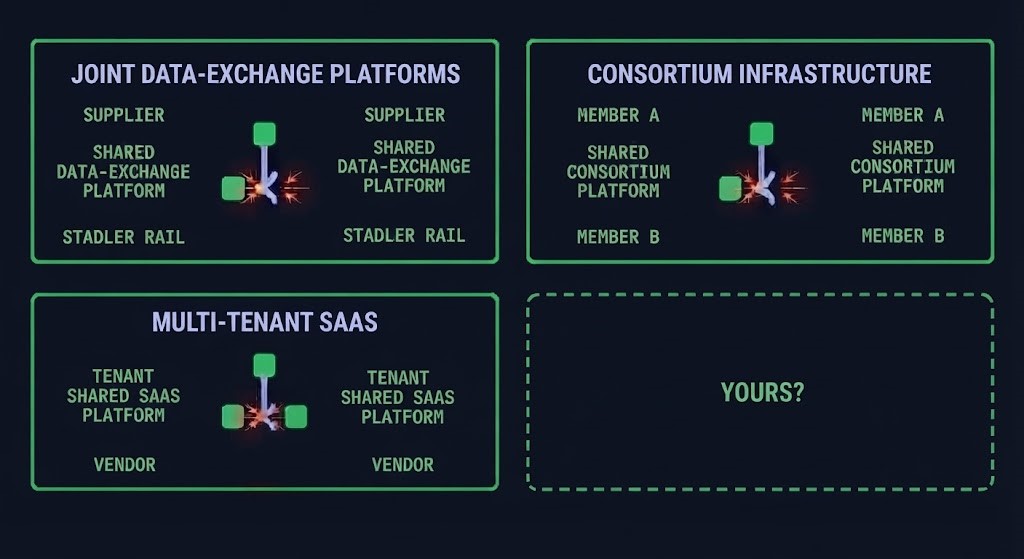
The diagnostic question is the same across all of them: if this infrastructure were breached tomorrow, which of the five boundaries — infrastructure, data, access, consequence, accountability — would land on us, and did we ever check?
Modeling Consequence Exposure: An Architecture Check
Data protection and vendor-risk programs are well built to ask about the asset: is it backed up, is it encrypted, is the vendor’s security posture adequate. They’re not built to ask about the boundary Stadler’s case actually exposed:
ARCHITECTURE CHECK
- Name every piece of shared infrastructure. Not just vendor systems — anything genuinely co-owned or co-operated with a partner, supplier, or consortium member.
- Map the five boundaries separately, for each one. Infrastructure, data, access, consequence, and accountability don’t default to the same answer. Assuming they do is the gap this case exposes.
- Ask who gets named, not just who gets breached. Public attention can follow organizational visibility and prominence rather than the technical location of the compromise. If your organization is the larger, more recognizable name in a shared arrangement, model that you may carry consequence exposure regardless of where the actual compromise occurs.
- Don’t let “our systems weren’t touched” end the review. It’s a legitimate finding. It isn’t the same finding as “we have no exposure here.”
Once the five boundaries are named, the next question is who formalizes authority over them — the same territory Governance & Recovery Assurance (Data Protection — Maturity Stage 6) already covers for recovery claims generally, applied here to consequence rather than recoverability.
None of this is a legal determination about liability, and it shouldn’t be treated as one — Stadler’s case establishes operational and reputational consequence landing on an unbreached party, not a court’s ruling on who was at fault. The architecture question is upstream of the legal one: did anyone model where consequence lands before an incident forced the question?
Differentiation
Five existing pieces on this site sit close to this territory. Worth being precise about why none of them own this mechanism:
| Framework | What It Asks | What This Post Asks |
|---|---|---|
| Framework #169 — Authority Persistence Boundary | Does delegated authority survive unchanged after a vendor’s own security boundary fails? | Can consequence land on a party that was never delegated any authority into the breached system at all? |
| The Data Still Exists. You Just Can’t Reach It. | Does an access path exist across a multi-party custodial chain? | Does consequence attribution track infrastructure ownership at all — independent of whether access ever worked? |
| Governance & Recovery Assurance (Stage 6) | How does an organization continuously prove recoverability and formalize authority over recovery claims? | Prior to any recovery question: where does consequence for a shared-infrastructure incident land in the first place? |
| Vendor Review Process | Was the actual supplier behind a relationship ever classified as something requiring review? | Once every party is correctly classified, does consequence still land on whichever one is largest or most visible — independent of review coverage? |
| Framework #157 — Cross-Cloud Ownership Boundary | Who holds authority to decide, execute, govern, or recover across an ownership seam — before anything fails? | Who bears consequence after something already has, on infrastructure where no one named the seam in advance? |
Framework #169 assumes something was delegated into the breached environment and asks whether it survives. This post’s case had nothing delegated into Stadler’s environment — Stadler’s environment was never reached. The custodial-chain post asks whether an owner can reach data through a chain of intermediaries; this post’s failure isn’t about reaching data at all, it’s about who bears consequence when the infrastructure itself has no single owner. The vendor-review-process post asks whether a supplier was ever correctly named as one to review; this post’s five-boundary problem exists even when every party has been correctly named — Stadler and its supplier both knew exactly who the other was. Framework #157 asks who holds authority across a cross-cloud ownership seam before anything fails; this post asks who bears consequence after something already has, on a seam neither party built an authority model for in the first place. Neighbors, not overlaps.
Architect’s Verdict
Stadler Rail didn’t fail to secure its network. Its network was never the target. What the case exposes is a gap in how data protection and vendor-risk programs draw their boundaries: they assume infrastructure, data, access, consequence, and accountability collapse to the same party, because for most of enterprise architecture’s history, they did. Shared infrastructure breaks that collapse without breaking anything else.
The organization that gets named isn’t necessarily the organization that failed. Until consequence exposure is modeled as its own architectural property — separately from the technical and data boundaries architecture teams already know how to draw — that gap will keep finding whichever party is largest and most visible in the shared arrangement, and calling it the victim.
Additional Resources
Editorial Integrity & Security Protocol
This technical deep-dive adheres to the Rack2Cloud Deterministic Integrity Standard. All benchmarks and security audits are derived from zero-trust validation protocols within our isolated lab environments. No vendor influence.

R.M.
Senior Solutions Architect with 25+ years of experience in HCI, cloud strategy, and data resilience. As the lead behind Rack2Cloud, I focus on lab-verified guidance for complex enterprise transitions. View Credentials →
Get the Playbooks Vendors Won’t Publish
Choose the architecture problems you care about. Get field-tested playbooks and frameworks delivered to your inbox.
- > AI Infrastructure & Inference Economics
- > Cloud Strategy & Hidden Cost Models
- > Virtualization & Deterministic Migration
- > Kubernetes, IaC & Modern Infrastructure
- > Data Protection & Recovery Engineering
Zero spam. Includes The Dispatch weekly drop.
Need Architectural Guidance?
Independent review before major infrastructure decisions.
- > Validate assumptions
- > Identify hidden dependencies
- > Quantify migration risk
- > Challenge vendor narratives
Triage · Advisory · Fractional · Direct Hire