

The Data Still Exists. You Just Can’t Reach It.
Owning your data has never guaranteed you can retrieve your data — and most organizations don’t discover they’d conflated the two until the company holding it disappears.
That’s the situation Nine PBS is in right now. The St. Louis public television station has roughly 70 years of programming — about 50 terabytes of it — sitting in a Denver data center it cannot get into. Nobody has reported the archive destroyed. No ransomware, no fire, no failed disk array. The data, as far as anyone has confirmed, still exists. Nine PBS could not retrieve it through the relationships it already had, and a court ultimately had to establish a process for getting the data out.
What Actually Failed
The sequence is plain enough once you lay it out, and none of it requires a framework to understand.
Nine PBS contracted with a cloud storage vendor called Open Source Storage (OSS) starting in 2019, renewing annually without incident through 2025. In February 2026, the station tried to reach OSS about that year’s renewal and got no response. The existing contract expired March 6, 2026. Its own terms gave Nine PBS 30 days after expiration to retrieve its data. OSS cut off access before that window closed.
It turned out OSS had gone defunct — its website was gone, and Colorado’s Secretary of State listed the company as delinquent. But the archive wasn’t simply out of reach — it was one contractual layer removed. OSS was itself a customer of Iron Mountain Data Centers, which operates the Denver facility housing OSS’s hardware. When Nine PBS came looking for its data, Iron Mountain didn’t dispute that the archive was inside its building. It maintained something narrower: that it had no logical access to the data at all. The servers, and the data on them, belonged to its own customer — OSS — not to Iron Mountain. A judge later confirmed the same distinction from the bench, describing Iron Mountain as the data’s “custodian” while noting explicitly that Iron Mountain was never the vendor Nine PBS actually contracted with. That obligation stayed with OSS.
Nine PBS owned 70 years of its own history. But its contract stopped with OSS, while the hardware containing the archive remained inside infrastructure operated by Iron Mountain.
The Three-Layer Problem
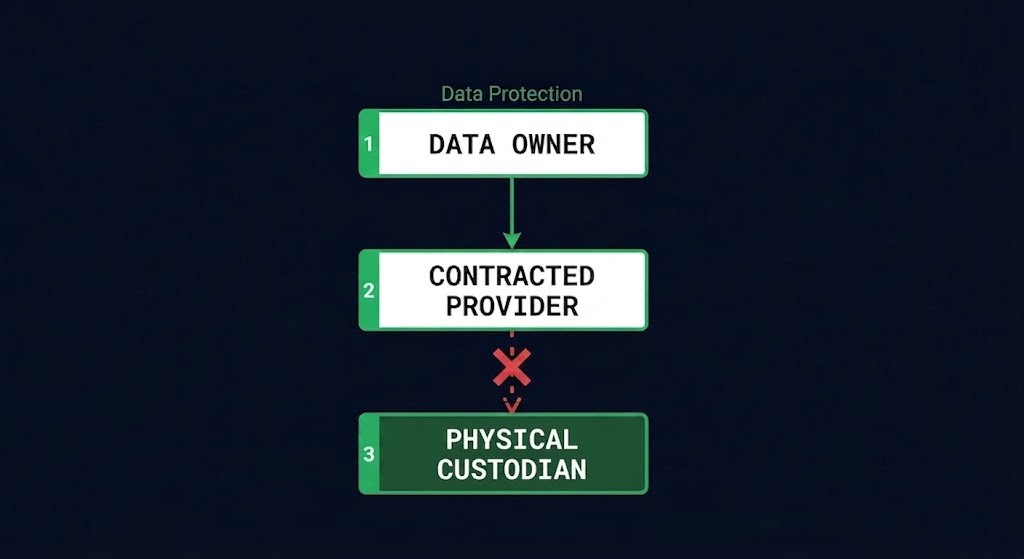
Strip the specifics away and the structure looks like this:
THE THREE-LAYER PROBLEM
01
Data Owner
Nine PBS — holds title to the data, no direct contract with the facility operator where the hardware remained
02
Contracted Provider
Open Source Storage — the only party the owner actually has standing with, now defunct
03
Physical Custodian
Iron Mountain — operates the facility where OSS’s hardware remained; no direct contract with Nine PBS
The retrieval path breaks between the contractual provider and the infrastructure custodian — not because either party destroyed the data, but because the owner had no direct relationship with the party operating the facility where its data remained.
Nine PBS’s contract stopped at layer 2. When layer 2 disappeared, layer 1 discovered it had no path to layer 3 — not a broken path, an absent one. Nobody removed a connection that used to exist. It was never built.
Owning The Data Isn’t The Same As Being Able To Retrieve Your Data
Most data protection programs are built to answer questions about the asset itself: where is it, how long is it retained, is it durable against hardware failure, does the backup restore cleanly. Nine PBS could probably have answered all of those questions correctly for years. None of them is the question that actually failed.
The question nobody asked was simpler and much less technical: if the company we contracted with disappeared tomorrow, who could actually hand us our data?
That’s not a backup question. A backup that restores cleanly assumes you can reach the system it restores from. It’s not quite a vendor-risk question either, in the usual sense — Nine PBS didn’t get breached, defrauded, or ransomed. Nobody did anything to the data. The failure sits one layer beneath all of that: the organization had never established a direct contractual path to the party that actually held the infrastructure containing its asset. Durability was never in question. The organization had never established who could actually provide the data when the contracted provider disappeared.
Why The Court Became Part of the Recovery Path
The reason this matters architecturally, not just legally, is what happened next.
A default judgment obtained earlier this year established that Nine PBS owns the data and that OSS breached its agreement by cutting off access early. That judgment did nothing to move Iron Mountain. OSS wasn’t around to contest anything, and a default judgment against a defunct company doesn’t obligate a party that was never named in it. Nine PBS had to file a second, separate suit — this time against Iron Mountain directly, in Denver.
⚠ NOT A RECOVERY STORY YET
A Denver court has since ordered Iron Mountain to cooperate and established a process for Nine PBS to retrieve its data — the station must identify a third party (it has said it is already in contact with a former OSS employee willing to help) to actually extract the archive, without exposing or corrupting other OSS customers’ data still sitting on the same infrastructure. Both parties must report progress to the court by September 14. None of that is the same claim as “the archive was recovered.” The judge himself noted that complications — encryption among them — could still require another hearing. A court-ordered process is not proof the process worked.
That sequence is the actual evidence for this post’s argument, and it’s worth being precise about why. Once OSS disappeared, there was no operational, technical, or contractual mechanism available to Nine PBS to reach its own archive on its own. The court had to establish a retrieval process that the existing contractual and operational relationships had never provided. That’s not a story about a lawsuit. It’s a story about what’s left once a lawsuit is the only lever available.
Where This Generalizes
Nothing about this is specific to public broadcasting, or to Open Source Storage, or even to cloud storage narrowly defined. The same three-layer structure — owner, contracted intermediary, actual custodian — sits underneath a long list of routine enterprise relationships:
MANAGED SERVICE PROVIDERS
An MSP may hold the client relationship while the underlying cloud account, colocation contract, or hardware lease sits with a party the client has never directly contracted with.
BACKUP AND ARCHIVAL VENDORS
Nine PBS’s exact pattern: a storage vendor that resells or subcontracts the actual physical hosting to a data center operator the customer never sees on an invoice.
CLOUD RESELLERS
A cloud reseller may put another contractual layer between the end customer and the underlying provider, changing who the customer can actually contact when something goes wrong.
SAAS AGGREGATORS
A platform bundling several underlying SaaS tools under one login can leave the actual data owner a layer removed from whichever backend vendor holds it, with no direct relationship to that backend vendor at all.
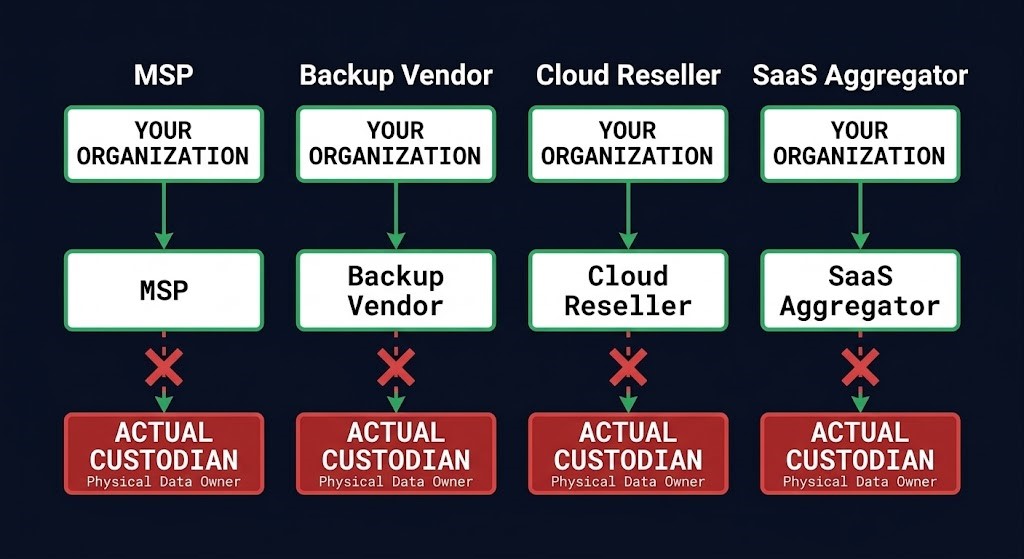
The diagnostic question doesn’t change across any of these: if the company you contracted with disappeared tomorrow, who could actually hand you your data? Most organizations have never asked it, because the question that gets asked instead — is our data protected — has a comfortable answer. This one usually doesn’t, until something forces it.
Differentiation
This isn’t a recovery-dependency problem, and it isn’t the same shape as authority surviving an incident. Three frameworks already on this site ask adjacent but distinct questions:
| Framework | What It Asks | What This Post Asks |
|---|---|---|
| #101 — Dependency Recovery Blindness | What hidden dependency prevents recovery from completing? | Who has standing to release an asset that was never hidden in the first place? |
| #122 — Recovery Dependency Collapse | Which recovery dependency became unavailable during recovery? | Does ownership grant a recoverable access path at all — independent of any incident? |
| #144 — Disaster Recovery Authority | Did the incident degrade the internal chain an organization needs to execute its own recovery? | Did the organization ever have a direct path to the party holding its data, incident or not? |
| #169 — Authority Persistence Boundary | Can authority remain valid after the trust relationship that justified it has failed? | What happens when the trusted intermediary disappears entirely, revealing a path that was never built to the actual custodian? |
Both #122 and #144 live in the Disaster Recovery & Failover Architecture stage of the Data Protection Learning Path, if either warrants a deeper read.
None of these are wrong to invoke here — they’re neighbors, not overlaps. This post’s failure predates any incident, requires no compromised trust, and would exist even if OSS had shut down quietly instead of disputing anything. Ownership was never in doubt. The path to exercise it was.
A closer cousin runs the same clock-mismatch shape in the opposite direction: a vendor’s audit rights outliving a customer’s declared exit, the subject of Vendor Relationships End. Audit Rights Often Don’t. There, the customer thinks the relationship is over and the contract disagrees. Here, the owner’s rights never extended far enough to reach the custodian in the first place. Same underlying pattern — an operational milestone and the parallel legal reality run on clocks nobody owns jointly — running in opposite directions.
A different cousin again runs the standing question forward into consequence rather than backward into retrieval. The Breach Wasn’t Stadler’s. The Consequence Was. asks whether consequence attribution tracks infrastructure ownership at all, independent of whether an access path ever worked — Stadler bore the ransom demand and the reputational fallout for a breach on a platform it shared with a supplier, never a party it held either custodial or contractual standing with. This post’s failure is retrieval: an owner who had rights but no path to the custodian. That post’s failure is attribution: a party with no rights and no path at all, still made to answer for the breach.
Architecture Check
Data protection architecture planning routinely tests durability, retention, and restore integrity. It almost never tests the one thing this case actually broke:
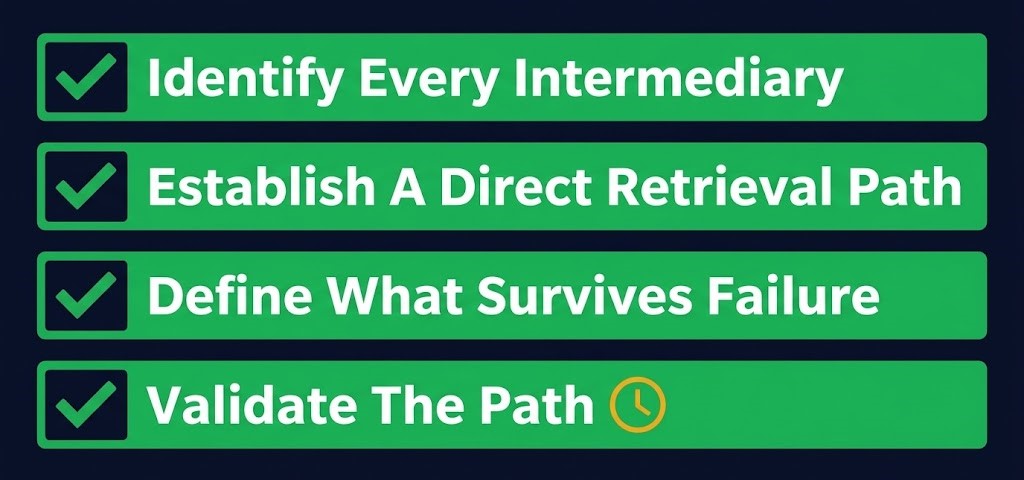
BEFORE THE INCIDENT, NOT AFTER
Identify every intermediary. Name every party between the data’s owner and its physical or logical custodian — not just the vendor on the invoice.
Establish a direct retrieval path where one doesn’t exist. A contractual escalation path, a documented custodian contact, or an enforceable mechanism for accessing the underlying infrastructure is worth establishing before it becomes the only thing that could save the relationship with your own data.
Define what survives intermediary failure. If the contracted party disappeared today, name — specifically — what path would remain. If the honest answer is “none,” that’s the finding.
Validate the path, not just the asset. A durability test proves the data survives. It proves nothing about whether you could reach it if the party standing between you and it stopped existing.
None of this requires new tooling or a new assessment category. It requires treating the retrieval path as an architectural property — one that can be validated in advance, the same way durability already is — rather than something an organization discovers it never had, at the exact moment it needs it most.
Architect’s Verdict
Nine PBS didn’t fail to protect its data. The archive, as far as anyone has confirmed, is intact. What failed was a relationship the organization never knew it needed: a direct, enforceable path to the party actually holding what it owned. Ownership was never the question in doubt. Reach was.
The real miss here isn’t unique to cloud storage, and it isn’t a story about one vendor going out of business. It’s that data protection planning has a well-developed vocabulary for what happens to the asset — durability, retention, restore integrity — and almost no vocabulary for what happens to the path connecting the owner to it when the party in the middle stops existing. That gap doesn’t announce itself. It sits there, unnoticed, for as long as the intermediary keeps functioning.
The archive’s ending is still unwritten. A court has built Nine PBS a path that didn’t exist before; whether that path actually delivers 70 years of programming back intact is a separate question this post can’t answer yet, and doesn’t need to. The architecture lesson was already true the day the contract expired — before anyone knew how the story would end.
Additional Resources
View 2 more resources
Editorial Integrity & Security Protocol
This technical deep-dive adheres to the Rack2Cloud Deterministic Integrity Standard. All benchmarks and security audits are derived from zero-trust validation protocols within our isolated lab environments. No vendor influence.

R.M.
Senior Solutions Architect with 25+ years of experience in HCI, cloud strategy, and data resilience. As the lead behind Rack2Cloud, I focus on lab-verified guidance for complex enterprise transitions. View Credentials →
Get the Playbooks Vendors Won’t Publish
Choose the architecture problems you care about. Get field-tested playbooks and frameworks delivered to your inbox.
- > AI Infrastructure & Inference Economics
- > Cloud Strategy & Hidden Cost Models
- > Virtualization & Deterministic Migration
- > Kubernetes, IaC & Modern Infrastructure
- > Data Protection & Recovery Engineering
Zero spam. Includes The Dispatch weekly drop.
Need Architectural Guidance?
Independent review before major infrastructure decisions.
- > Validate assumptions
- > Identify hidden dependencies
- > Quantify migration risk
- > Challenge vendor narratives
Triage · Advisory · Fractional · Direct Hire