

Our AI Infrastructure Was Built For Assistants. It’s Being Asked To Run Operations.
Mission-critical AI infrastructure changes the question architects have to answer about inference. For the first two years of the AI boom, that question barely came up — inference infrastructure served copilots, chat interfaces, and internal assistants, where a failed or slow request meant a refresh button, not a consequence.
In 2026, the Department of War — the Pentagon’s official secondary title since a September 2025 executive order, though Congress has not yet fully codified the name change into statute — launched Agent Network, an AI-agent system built to compress battle management, decision support, and targeting timelines, and signed classified-network deployment agreements covering its IL6/IL7 systems with eight commercial AI and cloud providers. Put those developments beside the Department’s own standing DDIL assumption — that battlefield connectivity will be denied, degraded, intermittent, or limited, not guaranteed — and a more interesting architecture question appears: what happens when infrastructure optimized for centralized, always-connected inference is asked to support a capability whose failure carries consequences well beyond application availability?
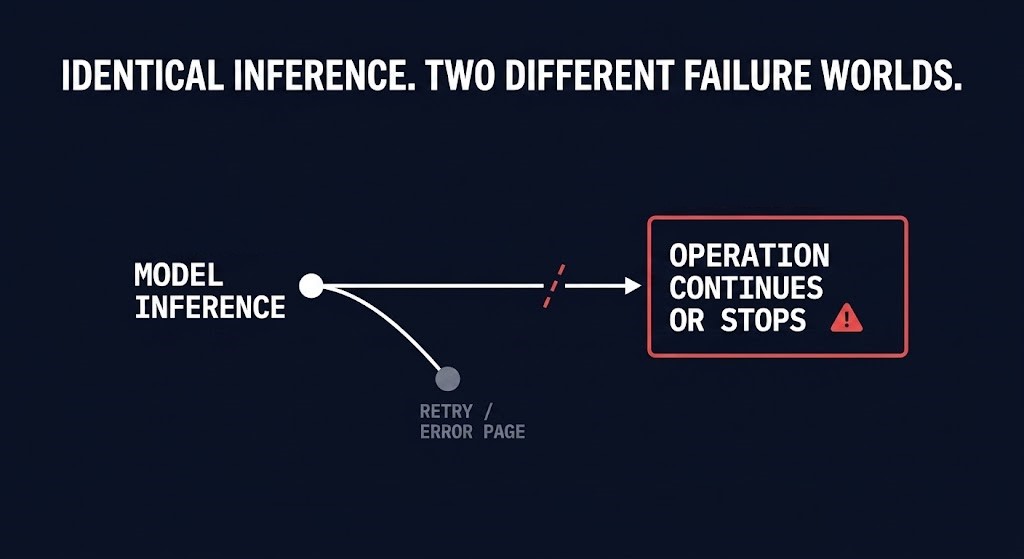
That’s the trigger. The architecture problem underneath it is what this post is actually about.
The Optimization Criteria Nobody Questioned
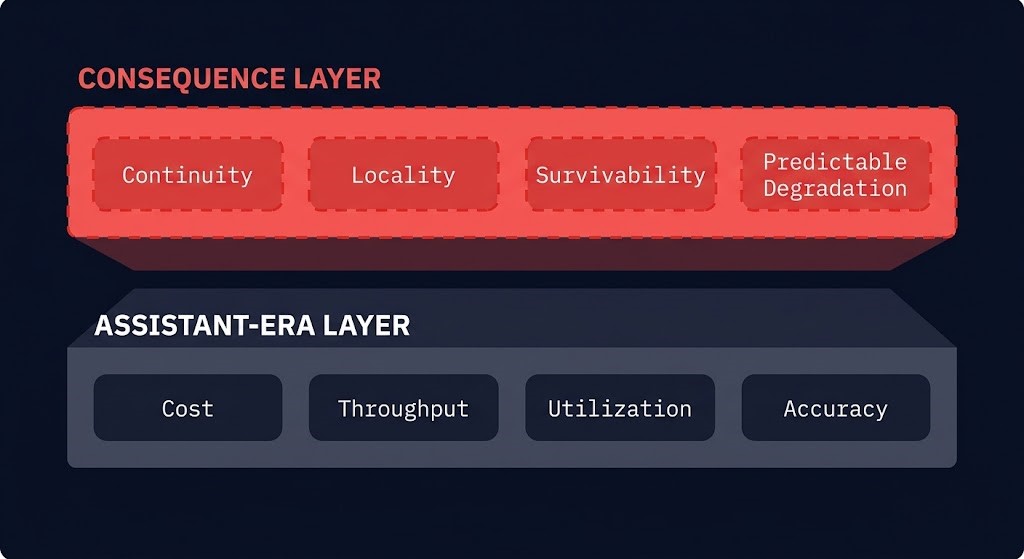
Much of the first wave of enterprise AI infrastructure architecture was evaluated against a familiar set of priorities: cost per token, throughput, GPU utilization, and model accuracy. Procurement conversations, capacity plans, and architecture reviews ran through that same short list often enough to make it the default. It wasn’t a bad list. It was the correct list for what inference was actually doing — serving copilots, chat interfaces, internal assistants, and productivity tooling, where the cost of a failed or slow request was measured in user frustration, not operational consequence.
THE ASSISTANT-ERA OPTIMIZATION SET
- Cost per token — the unit economics of every inference call
- Throughput — requests served per second at acceptable latency
- GPU utilization — how much of the provisioned accelerator capacity actually does work
- Model accuracy — output quality against a benchmark or eval set
None of these four measures asks what happens operationally if the inference call simply doesn’t return. That question didn’t need asking, because for the workloads this list was built for, the honest answer was: the user waits, retries, or the request times out into a visible error. That’s the assumption this list was quietly built on top of — and it’s the assumption that’s now failing to hold across an increasing share of AI deployment. The failure isn’t visible in the list itself. It only shows up once mission-critical AI infrastructure enters the picture and the four measures above stop being sufficient on their own.
What Actually Changed: The Case For Mission-Critical AI Infrastructure
Here’s the distinction that matters, and it’s easy to get wrong in exactly the direction the Pentagon story invites: the workload didn’t change. A model classifying a sensor feed, routing a request, or generating a recommendation is doing recognizably the same kind of inference work whether it’s running behind a chat interface or inside a forward-deployed system. What changed is the operational consequence attached to that inference failing — and it’s the operational consequence, not the workload label, that should determine which infrastructure properties become non-negotiable.
This is the architectural law worth stating plainly: operational consequence changes the optimization hierarchy. It doesn’t dictate the architecture outright — workload characteristics still matter. A trading system, a factory control system, and a battlefield decision-support system don’t require identical infrastructure just because all three have expensive failures; latency profile, data gravity, model characteristics, regulatory constraints, and physical environment all still shape the specific design. What consequence does is decide which properties are non-negotiable versus merely desirable. A recommendation engine and a battlefield decision-support system can run structurally similar inference pipelines — same model class, same serving stack, same fundamental math — and still need entirely different infrastructure guarantees, because the two fail into different worlds. One fails into a refresh button. The other fails into a gap in a decision that has to get made anyway, with or without the model.
That reframing matters because it’s easy to mistake this argument for a restatement of “AI infrastructure needs to handle disconnected environments” — a case this site has already made in full. It doesn’t. Connectivity is one way consequence becomes visible. It isn’t the underlying variable.
A fully connected, fully cloud-resident inference service can still be mission-critical AI infrastructure if what’s riding on it is expensive enough when it fails — a trading system, a clinical decision-support tool, an industrial safety interlock. None of those examples have a disconnected-network problem. All of them have a failure-consequence problem. The Department of War’s DDIL doctrine happens to make connectivity the visible symptom in that specific domain, because contested electromagnetic environments are a standard feature of that domain — but the underlying law is broader than the trigger event that makes it visible.
The same architectural test can be applied outside defense as a thought experiment, without claiming this site has evidence of a broad 2026 deployment trend: an industrial quality-control system whose inference determines whether a production line stops would sit in the same category as a battlefield sensor-fusion model, for the same reason — not because either one is disconnected, but because both would fail into a world where nothing else picks up the decision in time. A hospital triage-support model or a logistics routing system for physical freight would face the same test. The common thread isn’t the domain. It’s whether the organization has moved a given inference workload from a place where failure is absorbed by a human clicking retry, to a place where failure would be absorbed by nothing — the decision still has to happen, on schedule, with or without the model’s help.
That consequence class isn’t hypothetical outside AI. When ransomware affected production-related systems at Coca-Cola’s Fairlife operations, U.S. production was suspended — no model involved, just the coordination layer an operation depends on to decide what to run next. A ransomware production shutdown is the failure consequence this section describes, arriving through conventional systems first. Once an inference workload takes a seat in that coordination layer, it inherits the operation’s availability requirements whether anyone designed for them or not.
This is where an AI infrastructure program can be exposed without knowing it. An organization can correctly optimize every metric on the assistant-era list — driving cost per token down, throughput up, utilization up, accuracy up — while the infrastructure underneath has never been tested against the question that now matters for at least some share of its workloads: what happens in the seconds after this inference call fails to return? For assistant-era workloads, that question was rhetorical. For workloads carrying real operational consequence, it isn’t, and the infrastructure was never built to answer it because nobody asked it at design time. That gap is the entire argument for treating mission-critical AI infrastructure as its own design discipline rather than a hardened version of the assistant-era stack.
The Priorities That Move Above The Old List
Once operational consequence enters the picture, the four assistant-era measures don’t disappear — cost, throughput, utilization, and accuracy remain real constraints. But they stop being sufficient, and the second layer that actually defines mission-critical AI infrastructure has to sit above them, derived directly from what actually happens when inference fails rather than from what’s easy to instrument on a dashboard.
| Failure consequence | Architectural priority |
|---|---|
| Inference interruption affects mission or operational execution | Continuity |
| Remote dependency cannot be tolerated | Locality |
| Infrastructure failure can terminate a capability outright | Survivability |
| Partial failure produces unpredictable behavior | Predictable degradation |
Each of these is a direct answer to a specific version of “what happens when this fails” — not a generic best-practices checklist borrowed from resilience engineering in general. Continuity answers the mission-execution version: the capability remains available through the failure, not necessarily by continuing to produce automated decisions — sometimes the correct behavior under continuity is to stop and hand off to a defined safe fallback, not to keep deciding regardless. Locality answers the unacceptable-remote-dependency version. Survivability answers the capability-termination version — failure has to degrade into a defined state, not collapse into nothing. Predictable degradation answers the version where the danger isn’t total failure, but unpredictable partial failure — a system that’s technically still running but whose behavior has become inconsistent enough that nobody downstream can trust it to plan against. That name is deliberate: it’s a different claim from deterministic networking (symmetric fabric topology, bounded jitter at the packet layer, already covered elsewhere on this site), which is a physics-layer guarantee about the network fabric, not an operational property of how a system behaves when it’s degrading.
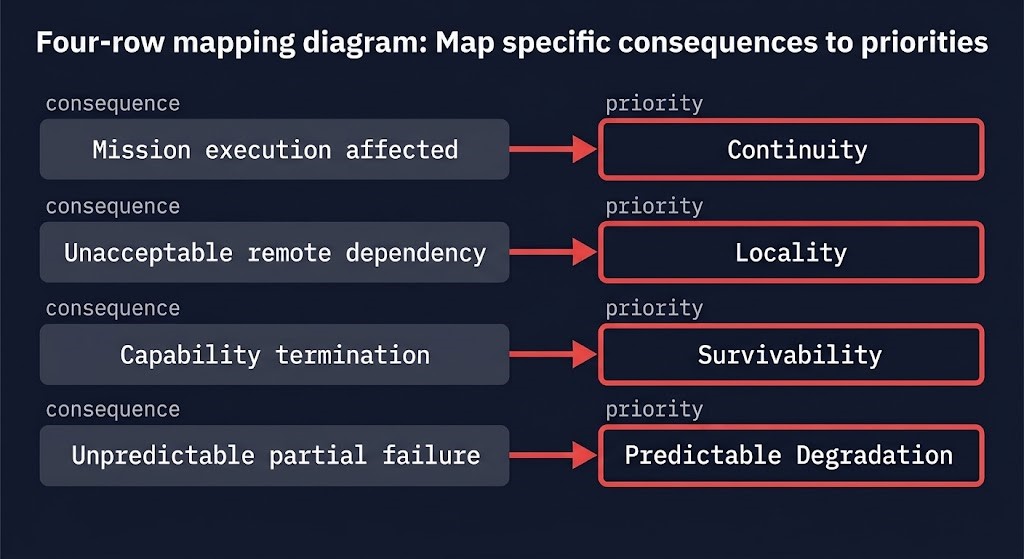
The practical shift this creates for an architect is sequencing. Assistant-era design starts with the optimization list and treats failure handling as an add-on once the happy path works. Mission-critical design has to start with the consequence question — what happens when this fails, specifically, in this deployment context — and derive the infrastructure priorities from that answer before the cost/throughput/utilization conversation happens. Get the sequencing backwards, and an organization ends up with an inference layer that’s excellent by every metric it tracks and unable to answer the one question that was actually going to matter. That backwards sequencing isn’t unique to consequence planning — the same classification-before-optimization mistake shows up in placement decisions architects make around cost and locality, where committing to a placement before the workload is classified produces the same kind of infrastructure that looks correct on paper and fails the question that actually mattered.
Distinguishing This From Adjacent Arguments
This argument sits close enough to other pieces of AI Infrastructure content on this site that the differences are worth stating explicitly rather than leaving readers to assume overlap that isn’t there. It’s also worth being explicit about what this post doesn’t cover: once a failure sequence actually begins, what happens next — the degradation states, the recovery path, the blast-radius containment — is the subject of the System Survivability Architecture stage and its resident frameworks (#124/#125). This post stops at determining which properties are non-negotiable for mission-critical AI infrastructure before that sequence starts; it doesn’t re-litigate what the site has already built there.
Versus Autonomous Operations Readiness (Framework #118): that framework defines the infrastructure maturity threshold — observable state, defined recovery paths, governed execution surfaces — that has to exist before an organization can safely delegate runtime authority to an autonomous system. It’s a governance-gate question: are you mature enough to hand over the decision. This post’s argument is upstream and orthogonal to that gate — it’s about what technical properties the infrastructure needs regardless of whether authority has been formally delegated yet, because the consequence of failure doesn’t wait for a governance maturity model to catch up. An organization can fail this post’s test badly while still being nowhere near ready for the #118 conversation, and vice versa.
Versus the site’s Disconnected Brain argument: that piece establishes that cloud-dependent AI is an architectural liability in disconnected environments, and it already uses the defense/edge example this post’s trigger event resembles. The mechanism there is connectivity-specific — the cloud round-trip is the single point of failure. This post’s mechanism doesn’t require disconnection at all; a fully connected, always-reachable inference service can still fail this post’s test if the consequence of a slow or wrong answer is severe enough.
DIAGNOSTIC QUESTION
“If this inference call failed to return right now, what actually happens next — and does anything downstream notice in time to matter?”
The same reasoning appears elsewhere in the site’s architecture corpus. The Vertical Integration AI Moat analysis asks whether the cost of workload variability is high enough to justify deeper integration over portability. Different decision, same underlying pattern: the consequence of getting the tradeoff wrong changes which property deserves optimization. That’s worth registering as a sibling mechanism, not as external proof this post needs to lean on. Both arguments trace back to the same claim: real consequence changes what gets optimized, whether the decision in front of the architect is about mission-critical AI infrastructure or about a vendor relationship. The same law scales up to the facility itself: when a single AI campus becomes large enough to carry critical-infrastructure consequences, the properties this post derives from inference-level failure — continuity, survivability, predictable degradation — apply again, one layer up, to the physical site the inference runs on.
Architect’s Verdict
Mission-critical AI infrastructure isn’t a defense story, and it isn’t an edge-deployment story. It’s a consequence story. The four metrics that dominated much of the first wave of enterprise AI infrastructure — cost, throughput, utilization, accuracy — are still real, still worth optimizing, and still incomplete the moment an inference failure stops being absorbed by a human hitting retry.
The mistake is assuming this shift announces itself. It doesn’t. Mission-critical AI infrastructure doesn’t announce itself by looking broken — it announces itself by looking perfectly fine right up until the moment it wasn’t. An AI infrastructure program can be succeeding by every measure on its dashboard — cost falling, throughput rising, utilization climbing, accuracy improving — while the underlying architecture has never once been tested against what actually happens in the seconds after a failed inference call, because nobody asked that question at design time. The Pentagon’s Agent Network made the consequence visible in one domain. Nothing about the architectural question is specific to that domain.
The workload didn’t change. The cost of it failing did. Everything about how you architect mission-critical AI infrastructure follows from that one distinction.
Additional Resources
View 2 more resources
Editorial Integrity & Security Protocol
This technical deep-dive adheres to the Rack2Cloud Deterministic Integrity Standard. All benchmarks and security audits are derived from zero-trust validation protocols within our isolated lab environments. No vendor influence.

R.M.
Senior Solutions Architect with 25+ years of experience in HCI, cloud strategy, and data resilience. As the lead behind Rack2Cloud, I focus on lab-verified guidance for complex enterprise transitions. View Credentials →
Get the Playbooks Vendors Won’t Publish
Choose the architecture problems you care about. Get field-tested playbooks and frameworks delivered to your inbox.
- > AI Infrastructure & Inference Economics
- > Cloud Strategy & Hidden Cost Models
- > Virtualization & Deterministic Migration
- > Kubernetes, IaC & Modern Infrastructure
- > Data Protection & Recovery Engineering
Zero spam. Includes The Dispatch weekly drop.
Need Architectural Guidance?
Independent review before major infrastructure decisions.
- > Validate assumptions
- > Identify hidden dependencies
- > Quantify migration risk
- > Challenge vendor narratives
Triage · Advisory · Fractional · Direct Hire