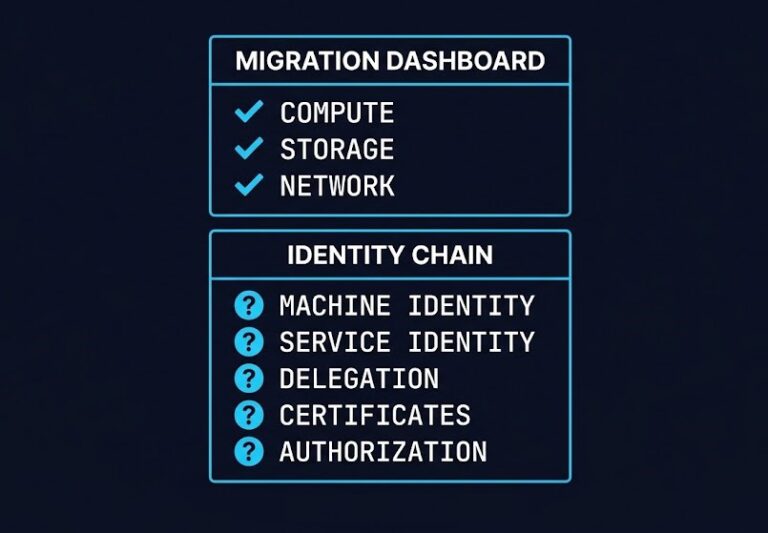


Your Backup Completed. Your Recovery Architecture Didn’t.
The recovery design boundary is the line between organizations that know their backups completed and organizations that know their systems will actually come back online — and a green dashboard this morning doesn’t tell you which side of it you’re standing on.
The Backup Completion Fallacy
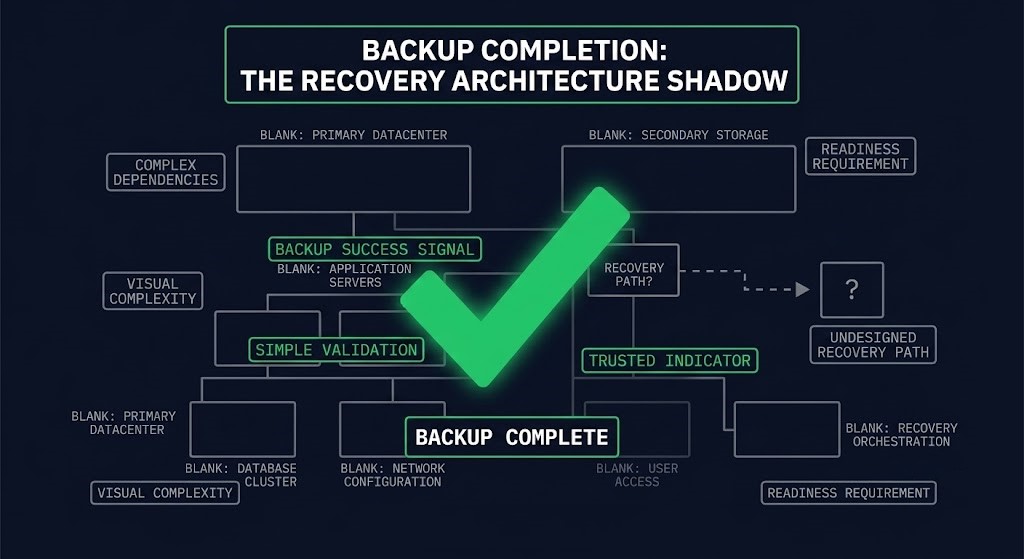
Every backup platform on the market is extremely good at answering one question: did the job run. Green checkmarks, completed jobs, RPO windows met on paper — the dashboard says everything is fine, and for what it actually measures, it is. A completed backup job proves that data was captured. It does not prove that a recovery architecture exists. Kubernetes readiness probes make a related but sharper claim — the signal there isn’t just incomplete, the thing it confirms (process accepted traffic) is a genuinely different fact from the thing that matters (transaction completed). Here the gap is that the design was never built. There, the design exists and the signal still can’t see past it.
Those are different claims, and most DR planning quietly treats them as the same one. Recovery topology — what systems recover where — dependency sequencing, target capacity, and restoration authority all have to be designed before failure occurs, because recovery cannot discover its own architecture during an outage. An organization can pass every backup-completion metric it owns and still have no answer to what actually happens when someone has to bring a system back.
That gap has a name in this site’s own framework registry, even though nothing has been written about it directly until now: organizations often confuse evidence of backup existence with evidence of recovery readiness, and the Recovery Design Boundary is the line where that confusion gets tested against reality.
NIST SP 800-34 makes the same distinction at the federal-systems level: contingency planning is a design discipline that precedes testing, not a byproduct of it — sequencing, dependencies, and recovery strategy selection happen before a test ever validates them.
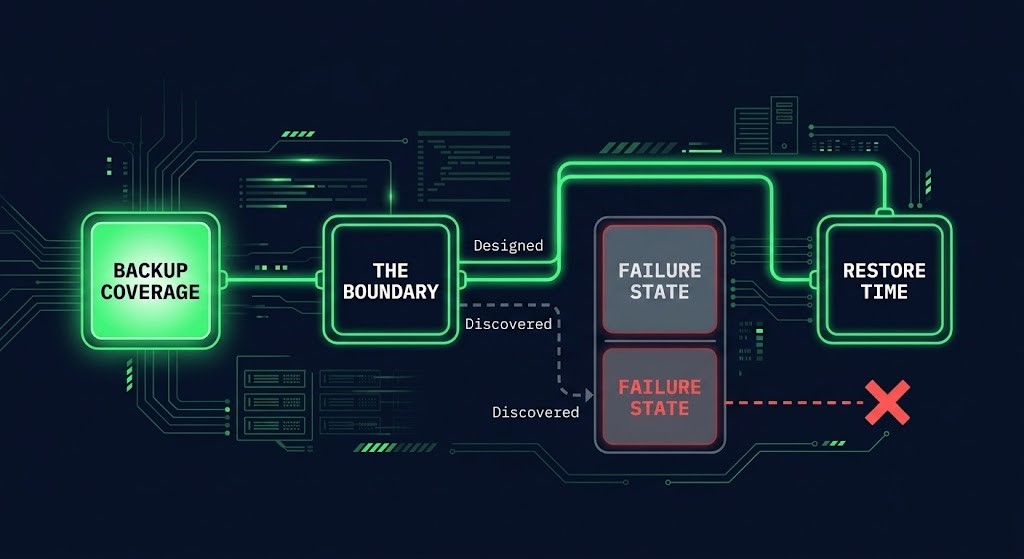
FRAMEWORK #146 — RECOVERY DESIGN BOUNDARY
The line between systems whose recovery characteristics have been intentionally designed and systems whose recovery behavior is only discovered during restoration. Backup exists on both sides. Recoverability only exists on the designed side.
Recovery-Blind Architecture: backup coverage exists, but recovery behavior, restore sequencing, authority ownership, and blast-radius boundaries were never explicitly designed — they’re discovered at restore time instead.
Architectural Relationships
Why It Connects
Pairs with the Recovery Design Boundary on blast-radius design — both are D1-adjacent design questions, one about whether topology was designed, one about what collapses when it wasn’t.
Explore Framework →Recovery Authority Fragmentation
Why It Connects
Pairs with the Recovery Design Boundary on authority-ownership design — both are D1-adjacent design questions, one about whether an owner was assigned, one about what happens when that owner is unreachable.
Explore Framework →Where the Recovery Design Boundary Diverges From “Did The Test Pass”
Two frameworks already live on this site ask closely related questions about recovery — and this post isn’t a third entry competing with either of them. It’s the question underneath both.
| Question | Framework |
|---|---|
| Was there a recoverable architecture to validate at all? | Recovery Design Boundary (#146) |
| Did the recovery test validate the documented procedure? | Recovery Validity Boundary (#111) |
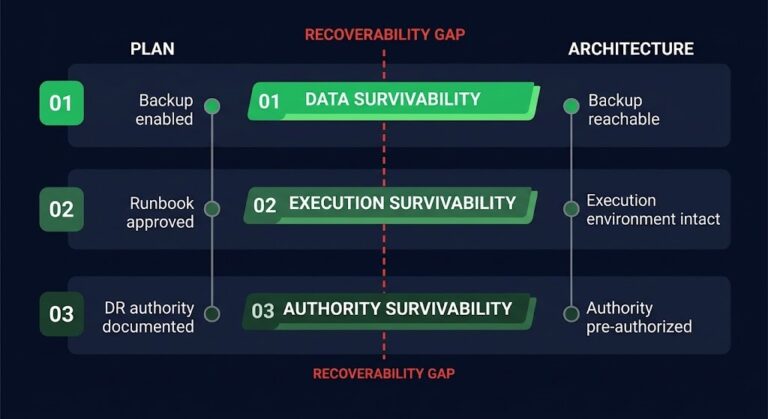
| Can recovery survive compromise, corruption, or operational failure? | Recoverability Gap (#148) |
#111 and #148 both assume a recovery design already exists — one asks whether a specific test proves the plan, the other asks whether a validated plan survives adversarial conditions. The Recovery Design Boundary is upstream of both: you can’t validate a test procedure or stress-test survivability against a recovery architecture that was never designed, only discovered.
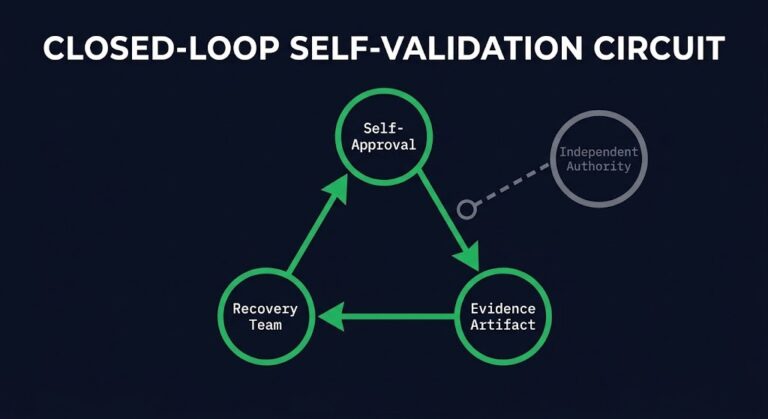
There’s a fourth question downstream of all three, sitting above design, validity, and survivability alike: even a recovery architecture that was deliberately designed (this framework), validity-tested (#111), and proven survivable under attack (#148) still only establishes that recovery works. The <a href=”/recovery-evidence-boundary/”>Recovery Evidence Boundary (#167)</a> asks whether anyone structurally independent of the team that designed, tested, and hardened it has standing to validate that claim — a different axis entirely from whether the architecture itself holds up.
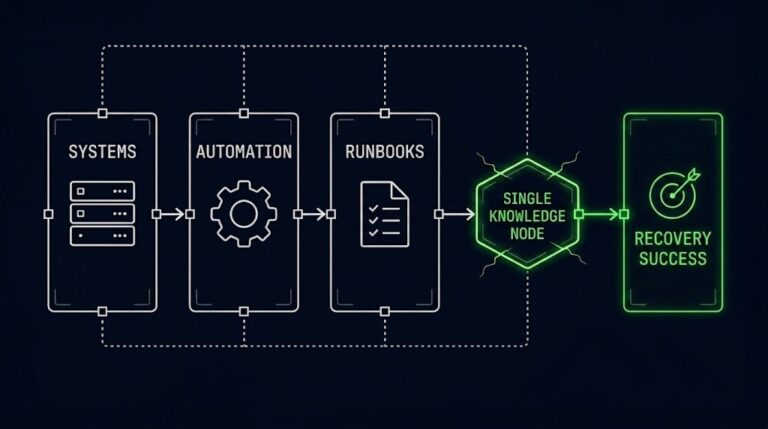
There’s a fifth question that cuts across all four instead of sitting above them: does executing any of this depend on one or two specific people being reachable? Recovery bus factor is a personnel-concentration problem, not a design, validity, evidence, or survivability one — an architecture can be deliberately designed, validity-tested, proven survivable, and independently validated, and still fail the night the two engineers who actually understand its sequencing exceptions are both unreachable.
Restore Testing Is Becoming An Adversarial Discipline covers the methodology side of this same territory — how tests are run, under what conditions. That post is about proving a design holds under hostile conditions. This one is about whether a design exists to test in the first place.
Recovery Is an Architecture Problem, Not a Backup Problem
This is the distinction that gets lost inside the Data Protection pillar specifically, because backup and recovery share a vendor, a dashboard, and a budget line. Backup is a mechanism — software that copies data on a schedule and reports whether the copy succeeded. Recovery is an operating architecture — a set of decisions about topology, sequencing, capacity, and authority that determines whether that copied data becomes a running system again.
Most enterprises have a mature backup practice and an accidental recovery architecture — one that was never designed as a whole, only assembled piecemeal as individual systems were onboarded to the backup platform. The data protection architecture discipline exists precisely because these are different maturity problems: a mechanism can be excellent and an architecture can still not exist.
This post is the anchor entry point for Recovery Architecture Foundations (D1), the foundation stage of the Data Protection & Resiliency Learning Path — the stage built around the same question this framework asks: can this system actually be recovered, or has recovery only ever been assumed?
Four Places Backup Completion Doesn’t Reach
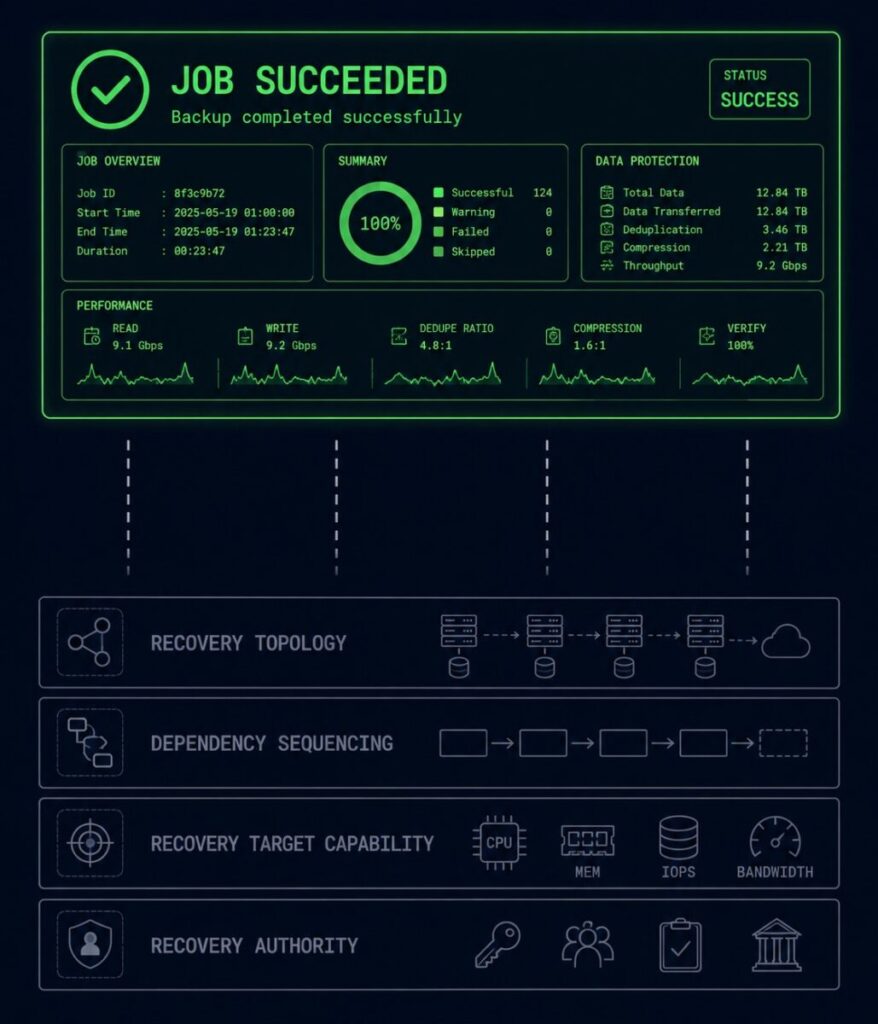
A backup job’s success or failure has no visibility into any of the following. All four have to be decided before an outage, not during one.
01 — RECOVERY TOPOLOGY
What systems recover where. A backup job confirms data left production. It says nothing about which recovery site, region, or platform receives it, or whether that destination was ever actually provisioned to accept it. AWS’s own disaster recovery guidance names this directly as a strategy choice — backup-and-restore, pilot light, warm standby, or multi-site — each with a different designed answer to where systems recover, not a default one.
02 — DEPENDENCY SEQUENCING
Multi-tier applications recover in a specific order or they don’t recover at all — a database restored after the application tier that depends on it is a failed recovery with a completed job log. See Recovery Dependency Collapse for the blast-radius side of this same design gap.
03 — RECOVERY TARGET CAPABILITY
Capacity, identity, networking, tooling, and licensing at the recovery target all have to match what production actually needs — not what was provisioned when the DR contract was signed two budget cycles ago.
04 — RECOVERY AUTHORITY
Who owns execution when normal operating boundaries are broken. A recovery plan with no assigned authority discovers, mid-incident, that the person who could approve the failover is the same person the outage just made unreachable. Recovery Authority Fragmentation names this failure directly.
Recovery topology gets tested for real when the primary location itself is the failure, not just its data. A wildfire forced a ten-day evacuation of a Spokane VA medical center in August 2026 — the recovery topology question there wasn’t which system recovers where in the abstract, it was whether the region’s other facilities had the capacity, staffing, and licensing to receive 27 inpatients and the specialty services attached to them. Recovery topology decided in advance is the difference between that being a designed failover and an emergency-room negotiation conducted in real time.
DIAGNOSTIC QUESTION
“If every backup job succeeded last night, could you state your restore sequence, your target capacity, and who has authority to execute recovery — without discovering any of the three live?”
The Recovery Architecture Checklist
The four gaps above compress into five design decisions. None of them require new tooling — they require someone to have decided the answer before an incident forces the question.
RECOVERY ARCHITECTURE CHECKLIST
- Recovery topology defined — which systems recover to which destination
- Dependencies mapped — restore order documented for every multi-tier application
- Target environment validated — capacity, identity, and licensing confirmed current
- Recovery authority assigned — named, not assumed, and reachable independent of the outage
- All four tested against simulated failure, not just documented in a runbook
Architect’s Verdict
A completed backup job proves that data was captured. It does not prove that a recovery architecture exists — and the distance between those two claims is exactly where organizations discover, mid-incident, that nobody ever decided how systems come back, only that they get copied.
The real problem isn’t backup coverage. Most enterprises have that. It’s that recovery topology, dependency sequencing, target capacity, and restoration authority get treated as implementation details to sort out during the restore, instead of architectural decisions made in advance. Recovery cannot discover its own architecture during an outage — and an organization that’s never tested whether it can is not more prepared than one that hasn’t backed up at all. It’s just better documented on the way to the same discovery.
Backup is a mechanism. Recovery is an architecture. Confusing the two is how a green dashboard becomes the last thing that worked.
Additional Resources
Editorial Integrity & Security Protocol
This technical deep-dive adheres to the Rack2Cloud Deterministic Integrity Standard. All benchmarks and security audits are derived from zero-trust validation protocols within our isolated lab environments. No vendor influence.

R.M.
Senior Solutions Architect with 25+ years of experience in HCI, cloud strategy, and data resilience. As the lead behind Rack2Cloud, I focus on lab-verified guidance for complex enterprise transitions. View Credentials →
Get the Playbooks Vendors Won’t Publish
Field-tested blueprints for migration, HCI, sovereign infrastructure, and AI architecture. Real failure-mode analysis. No marketing filler. Delivered weekly.
Select your infrastructure paths. Receive field-tested blueprints direct to your inbox.
- > Virtualization & Migration Physics
- > Cloud Strategy & Egress Math
- > Data Protection & RTO Reality
- > AI Infrastructure & GPU Fabric
Zero spam. Includes The Dispatch weekly drop.
Architecture Audit Services
Fixed-scope audits for Zero-Trust Azure, VMware migration readiness, and recovery posture — no discovery call required to start.
>_ View Audit Services>_Related Posts
Your VMware Exit Was Successful. The First Incident Will Tell You If That’s True.
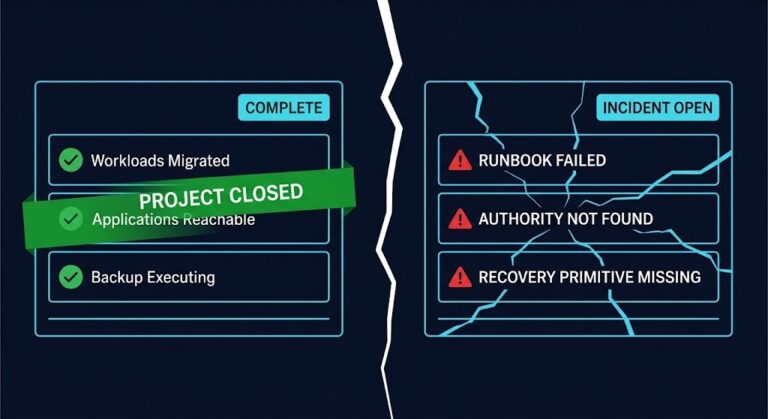
VMware exit survivability is the question your migration project never formally scheduled — and the first production incident on the new platform will answer it whether you are ready or not. The cutover completed. The workloads are running. The project closed green. None of that tells you whether the operating model, runbooks, authority structures, and…
Your Recovery Program Has a Recovery Evidence Boundary
Recovery evidence boundary is the point where a recovery program stops being an engineering question and starts being a governance one — and most organizations cross it without ever finding out, because everything on the way there still looks like success. The backups completed. The DR test passed. The tabletop went well. Somebody wrote a…
Your Recovery Architecture Has A Bus Factor Problem
Recovery bus factor is the gap between a recovery plan that has been tested, documented, and signed off — and a recovery plan that can actually be executed when the one or two people who know how to run it aren’t in the room. The recovery program had passed everything that mattered on paper: RTO…
Your Ransomware Recovery Plan Has a Recoverability Gap
The recoverability gap is the structural distance between what your recovery plan assumes and what your infrastructure can actually deliver under failure conditions. Most organizations don’t discover it during planning. They discover it on day three of an incident. >_ Architect’s Brief 60-second read before you commit to the full post · Full post: 12…
Your Ransomware Plan Is Fiction: 5 Recovery Metrics Nutanix, Cohesity, Rubrik & Pure Can’t Hide
Ransomware recovery metrics are the only thing standing between your recovery plan and a PowerPoint. Every vendor demo shows a single VM booting in 60 seconds. Every real ransomware recovery looks like this: the backups are intact, the ransomware is neutralized, the executives are on the bridge — and nothing is coming back online. >_…
Your Migration Succeeded. The Identity Chain Didn’t.
Identity chain continuity is the thing every migration runbook assumes and almost none of them prove. A migration dashboard can go fully green — compute online, storage attached, network reachable — while the identity chain underneath it is already broken, and nothing in that dashboard will tell you. >_ Architect’s Brief 60-second read before you…