

A State-Sponsored Campaign Is Exploiting Unpatched University Mail Servers

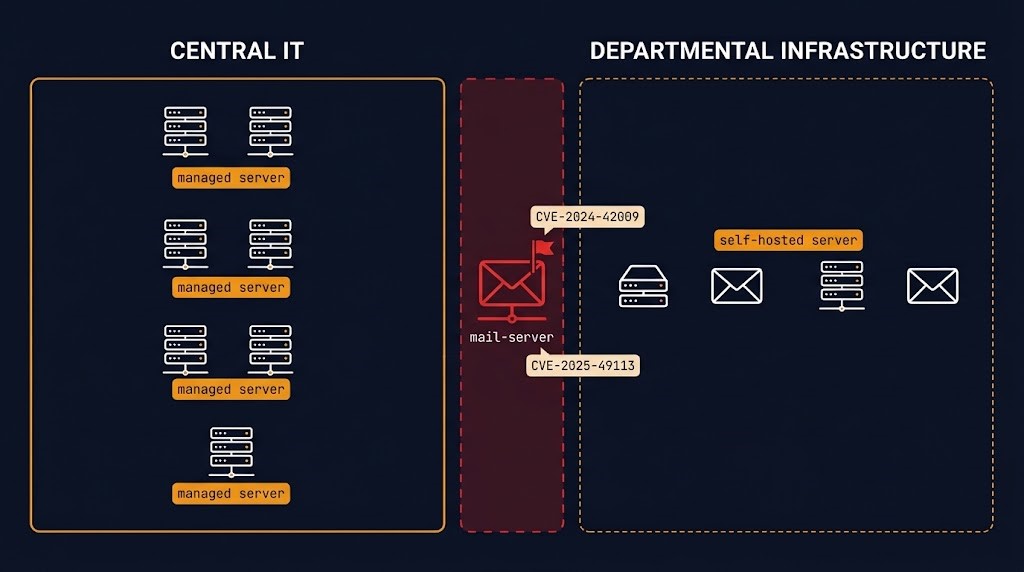
University mail servers just gave a suspected China-aligned state-sponsored group the better part of a year of open access to physics and engineering research at U.S. and Canadian universities — not because the vulnerabilities were secret, but because nobody at the departmental level clearly owned patching them. The campaign, tracked by Proofpoint as UNK_MassTraction and first observed in May 2026, chained two Roundcube webmail flaws that had been publicly disclosed and fixed months before the first phishing email went out. This isn’t a zero-day story. It’s a governance story wearing an espionage costume.
This Wasn’t a Zero-Day. That’s What Makes It Worse
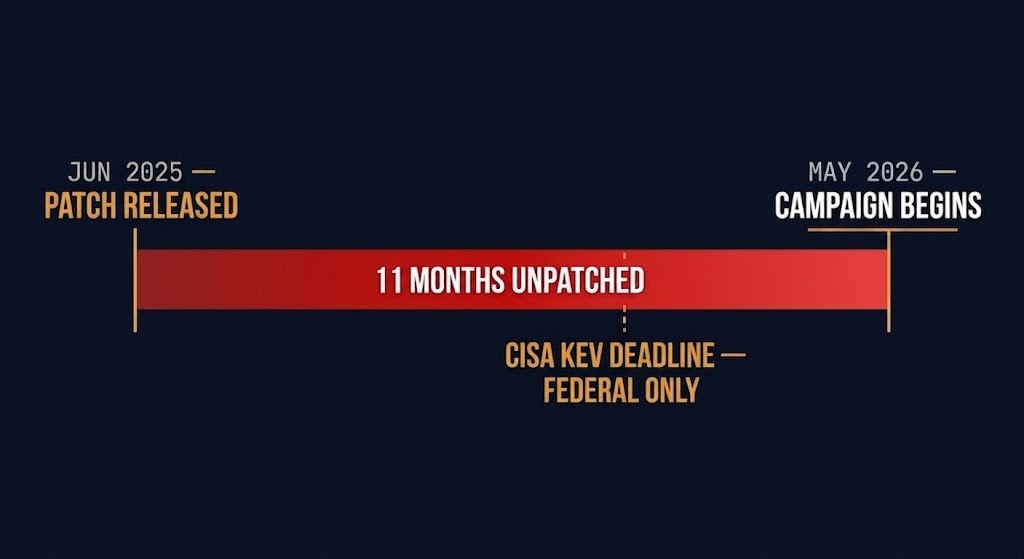
Zero-day exploitation gets the headlines because it exposes a gap nobody could have closed in advance — the vulnerability didn’t exist in anyone’s threat model until an attacker used it. This campaign is the opposite case, and architecturally it’s the more instructive one. CVE-2024-42009, a cross-site-scripting flaw in Roundcube (CVSS 9.3), was disclosed and patched in 2024. CVE-2025-49113, a post-authentication remote-code-execution flaw (CVSS 9.9), was patched on June 1, 2025 — and within 48 hours, researchers watched a working exploit get reverse-engineered and sold on underground forums. Within a week, scanners found roughly 85,000 Roundcube instances still exposed to it. CISA added it to the Known Exploited Vulnerabilities catalog on February 20, 2026, giving federal civilian agencies a hard remediation deadline of March 13, 2026.
UNK_MassTraction didn’t start targeting universities until May 2026 — eleven months after the fix for the RCE flaw shipped, and well over a year after the fix for the XSS flaw. Every one of these university mail servers was running software with a known, published, vendor-supplied fix already sitting on the shelf. Rack2Cloud’s Security Entropy Accumulation framework names this specific pattern patch latency debt — the exposure window between “a fix exists” and “the fix is applied” that accumulates silently in infrastructure nobody is actively watching (see Security Drift Is the New Configuration Drift). From here forward, treat the vulnerability count as evidence. It isn’t the story.
Reading this next to yesterday’s Field Note sharpens the point. AI Models Found and Exploited a Zero-Day Before the Patch Window Closed covered AI systems finding and exploiting a flaw inside an active patch window — a discovery problem, resolved by how fast defenders could react to something genuinely new. This one is an ownership problem: the vulnerability wasn’t new, the fix wasn’t secret, and the patch window had already closed months before anyone exploited it.
| Friday’s FN | Saturday’s FN | |
|---|---|---|
| Failure type | Discovery problem | Ownership problem |
| Vulnerability | New | Existing |
| Core question | Can defenders find the risk fast enough? | Was anyone responsible for acting on it? |
| Patch window | Just opened | Ignored for months |
The Attack Chain Inside University Mail Servers: Two Old CVEs, One Persistent Foothold
The mechanics behind these university mail servers’ compromise are straightforward once the governance gap is in place. A generic phishing email lands in a target’s inbox and triggers CVE-2024-42009’s cross-site-scripting flaw the moment the message renders in a vulnerable Roundcube session — no attachment, no link click required beyond the message being opened. The injected JavaScript, tracked as IceCube, harvests session credentials, 2FA cookies, and cached form data, then posts them back to attacker infrastructure. That mechanism belongs to a broader pattern Rack2Cloud has covered before: Your Identity Controls Passed. Your Authorization Chain Failed. is the same failure shape — controls that work exactly as designed right up until the credential behind them is already gone.
From there, UNK_MassTraction pivots to CVE-2025-49113, using the harvested access to trigger the post-authentication RCE and drop a webshell — SquareShell or VShell, depending on the target — directly onto the mail server. Where that fails, a fallback shell script delivers a SNOWLIGHT ELF loader instead. Persistence comes from what Proofpoint calls deferred triggers: the implant waits, monitors ordinary user activity on the compromised server, and re-exploits the same two vulnerabilities on a delay — so a single successful phishing email can produce access that outlives the initial compromise by months.
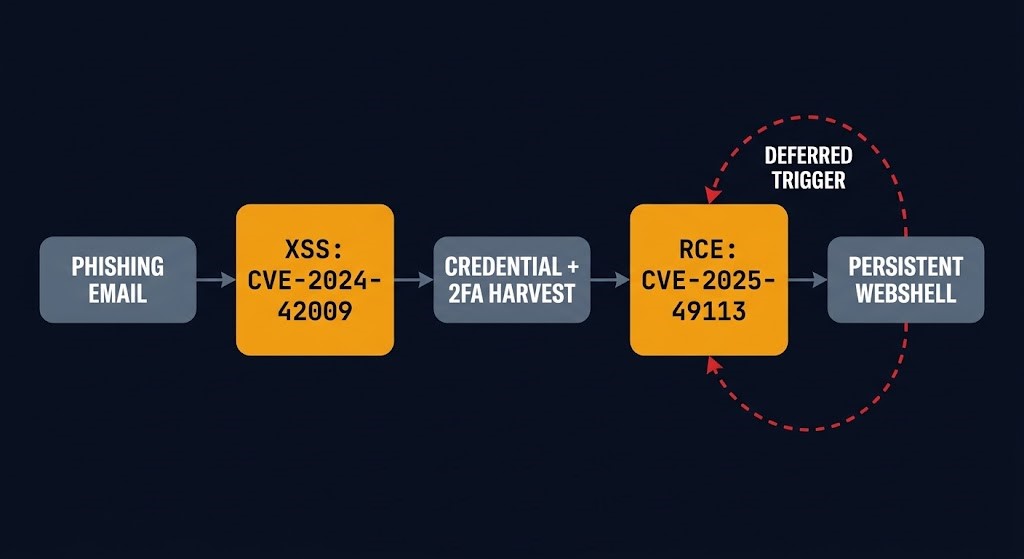
None of this required a novel technique. It required patience, a target list, and two vulnerabilities that were public knowledge before the campaign ever started.
Why Attackers Picked Physics and Engineering Departments
Proofpoint counted fewer than ten confirmed victims, with an estimated few dozen more likely compromised — this was never indiscriminate. The targeting concentrated on administrators and professors in physics and engineering departments, specifically those tied to national-security-linked research or work in astrophysics and particle physics. That specificity matters more than the university setting itself.
Research universities are unusual environments architecturally: individual departments frequently run their own infrastructure — mail, file shares, compute clusters — for real operational reasons. A physics department managing a specialized instrument or a multi-institution collaboration often needs infrastructure decisions made faster than a centralized IT request queue can move. That’s legitimate distributed ownership, not negligence. But distributed ownership only holds up if patch responsibility travels with it, and for a lot of departmental webmail, it never did. UNK_MassTraction didn’t need to find a hole in university security broadly. It needed to find the one department whose university mail servers sat where infrastructure ownership and patch ownership had quietly come apart — high-value research departments running their own systems outside centralized governance were exactly where to look.
The Patch Was Available. The Owner Wasn’t
Roundcube wasn’t abandoned software. The project shipped a fix for the RCE flaw on June 1, 2025, and CISA added it to the KEV catalog eight months later, attaching a hard remediation deadline for the federal agencies bound by it. The advisories weren’t buried — they moved through the same disclosure channels vendors, researchers, and government agencies rely on precisely so defenders don’t have to discover flaws on their own. It’s the identical pattern vSphere Lifecycle Management Is a Governance Problem — Not a Patching Problem already made about a completely different technology stack: the patching mechanics are rarely what’s missing.
None of that machinery reaches university mail servers the way it reaches a federal agency’s systems. KEV deadlines bind FCEB agencies, not higher education — there’s no equivalent forcing function that puts a departmentally-run mail server on a remediation clock. The patch existed. The advisory existed. The proof of active exploitation existed. What didn’t exist was a clear, enforceable answer to the question of who was specifically responsible for applying the fix before May 2026.
That’s a different failure than “nobody knew.” Everybody in a position to publish a fix, a scanner signature, or a compliance deadline did their part individually. The gap sat exactly where those systems stop being enforceable — inside infrastructure that’s real, legitimate, and owned by someone who was never plugged into the patch-governance loop in the first place.
Patch Visibility Debt (Framework #170) is the inverted case worth naming directly: same underlying “confirmation lagged reality” shape, but running against SharePoint’s centrally-owned, actively-monitored infrastructure rather than a departmental mail server nobody claimed. There, ownership was never in question — the CVE cluster’s own KEV classification was the thing lagging behind attacker activity by weeks. Ownership gaps and confirmation-signal gaps are different failures that produce the identical symptom: exploitation predating the moment anyone’s process said to act.
Self-Hosted Software Is Infrastructure Nobody Owns Until It’s Breached
These university mail servers are the specific instance here. The pattern is bigger than webmail. Every infrastructure inventory has a category of software that’s self-hosted, functionally critical, and structurally hard to assign a single owner to: the internal Git server someone spun up three years ago, the legacy Jenkins box a departed engineer configured and nobody has touched since, monitoring appliances that alert on everything except their own patch level, backup consoles with admin access to the one thing you can’t afford to lose, forgotten management VMs still holding valid credentials, department-managed Kubernetes clusters that never made it onto the platform team’s radar. None of it is unauthorized. All of it is real infrastructure doing real work. And all of it sits in exactly the gap this campaign exploited — patchable, but outside whatever process actually enforces patching.
This is what Modern Infrastructure & IaC governance is supposed to close, and it’s the specific failure mode Governance & Drift exists to name: infrastructure sitting between central IT and departmental ownership accumulates governance debt faster than it accumulates technical debt. The CVEs age normally. The advisories publish on schedule. The gap that matters was never in the software — it’s in whether anything connects “a patch exists” to “someone applied it” for infrastructure that was never fully claimed by either side. That’s the same enforcement gap Infrastructure Standards Without Enforcement Become Documentation Debt already named in a different context — standards and advisories that exist on paper but were never wired to anyone’s actual accountability. University mail servers just make the gap easier to see, because they’re what got breached.
Architect’s Verdict
The lesson from this campaign isn’t that a state-sponsored group targeted university mail servers, and it isn’t that Roundcube had exploitable flaws — every widely deployed piece of self-hosted software eventually does. The lesson is that patched software remained exploitable for the better part of a year because no one was clearly responsible for closing the gap between fix availability and fix application.
Infrastructure rarely remains vulnerable because fixes do not exist. It remains vulnerable because responsibility is fragmented — split across central IT, departmental ownership, and vendor disclosure processes that each did their job individually while the seams between them went unmanaged. UNK_MassTraction didn’t need a novel exploit. It needed an organization complex enough to lose track of who owned one specific mail server, and patient enough to wait eleven months for the right one to show up.
Every organization running self-hosted infrastructure has its own version of that mail server right now — patchable, unowned, and one phishing email away from finding out which one first. Fixes are cheap. Ownership is the expensive part, and it’s the part nobody budgeted for.
Additional Resources
View 2 more resources
Editorial Integrity & Security Protocol
This technical deep-dive adheres to the Rack2Cloud Deterministic Integrity Standard. All benchmarks and security audits are derived from zero-trust validation protocols within our isolated lab environments. No vendor influence.

R.M.
Senior Solutions Architect with 25+ years of experience in HCI, cloud strategy, and data resilience. As the lead behind Rack2Cloud, I focus on lab-verified guidance for complex enterprise transitions. View Credentials →
Get the Playbooks Vendors Won’t Publish
Choose the architecture problems you care about. Get field-tested playbooks and frameworks delivered to your inbox.
- > AI Infrastructure & Inference Economics
- > Cloud Strategy & Hidden Cost Models
- > Virtualization & Deterministic Migration
- > Kubernetes, IaC & Modern Infrastructure
- > Data Protection & Recovery Engineering
Zero spam. Includes The Dispatch weekly drop.
Need Architectural Guidance?
Independent review before major infrastructure decisions.
- > Validate assumptions
- > Identify hidden dependencies
- > Quantify migration risk
- > Challenge vendor narratives
Triage · Advisory · Fractional · Direct Hire