

SharePoint Vulnerabilities And The Cost Of Patch Visibility Debt
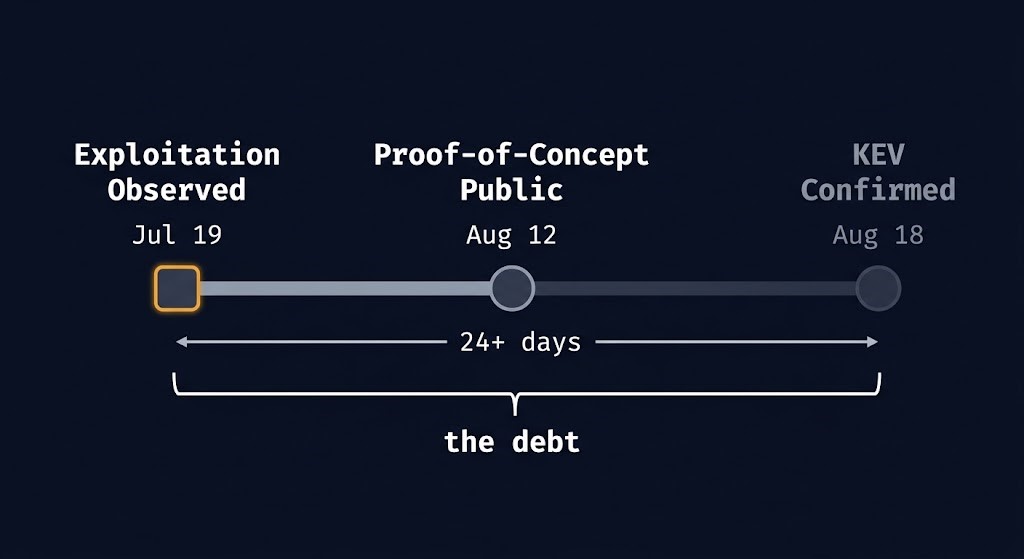
Patch visibility debt is what accumulates when remediation priority depends on confirmation signals that arrive later than attacker activity does — and the SharePoint Server vulnerability cluster CISA has been updating since April is the clearest demonstration of it this year. On July 19, something began exploiting an unauthenticated SharePoint authentication-bypass flaw. On August 12, a public proof-of-concept for that same flaw went live. On August 18, CISA added it to the Known Exploited Vulnerabilities catalog. Most patch governance programs are built to read that sequence in the opposite order — KEV listing, then proof-of-concept, then exploitation — because that’s the order confirmation signals usually arrive in. This time they didn’t, and the twenty-four days between the real event and the first public evidence of it is the debt.
The SharePoint Cluster, Verified
Six CVEs make up the current SharePoint Server cluster: 32201, 45659, 56164, 58644, 50522, and 55040. All six are now confirmed in CISA’s KEV catalog. That single sentence is doing more work than it looks like, because it wasn’t always true, and the way it became true is the point.
When the cluster was first disclosed across April and July’s Patch Tuesday cycles, it split cleanly into two groups: three vulnerabilities (32201, 45659, 56164) with confirmed active exploitation, and three more (58644, 50522, 55040) that Microsoft and CISA flagged as critical but “not yet observed exploited.” That distinction read as a risk signal. It functioned as one for exactly as long as it took each of the second group to close the gap — 58644 within two days, 50522 within eight, and 55040 not until August 18, over a month after its patch shipped.
The 55040 timeline is the one that matters most, because independent sensor data places first exploitation attempts on July 19 — three weeks before the public proof-of-concept existed, and a full month before CISA’s own confirmation. An organization that read “not yet observed exploited” as a lower-priority classification on July 20 was already wrong. The vulnerability wasn’t unconfirmed risk. It was confirmed risk with a reporting lag.
That’s the pattern worth carrying forward: the original exploited/not-exploited split collapsed as the weeks passed, exploitation activity preceded the confirmation signals defenders were using to set priority, and the cluster’s final state — six for six, eventually — is the proof rather than the anomaly. It’s also the cleanest public illustration of patch visibility debt available this year, because the dates line up precisely enough to measure the gap instead of just arguing it exists.
WHAT “NOT YET OBSERVED EXPLOITED” ACTUALLY MEANT HERE
Not “this is lower risk.” Not “you have time.” It meant nobody had confirmed exploitation yet — which, for CVE-2026-55040, was already false by three weeks when the label was applied.
Patch Visibility Debt
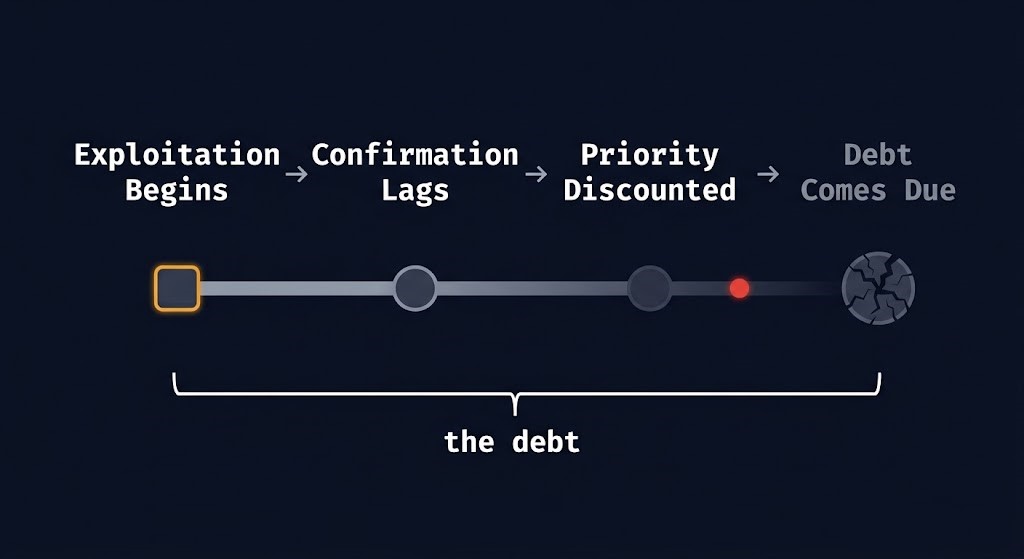
Patch visibility debt accumulates whenever remediation priority depends on confirmation signals that arrive later than attacker activity. KEV listings, public proof-of-concept code, vendor advisories, and threat-intel feed alerts are the examples — not the definition. Any of them can lag the actual event, and every patch governance program that treats “not yet confirmed” as a proxy for “not yet happening” is carrying debt it hasn’t measured.
The mechanism runs the same way every time:
FRAMEWORK #170 — PATCH VISIBILITY DEBT
Debt accumulates whenever remediation priority depends on confirmation signals that arrive later than attacker activity.
The debt isn’t the vulnerability. It’s the time spent believing exploitation hasn’t started yet — every day between node 01 and node 04 counted against a risk register that still says “unconfirmed.”
Architectural Relationships
Why It Connects
Extends the same “you think you’re fine but you’re not” family from a different angle — Security Entropy Accumulation asks why secure states decay silently even while configuration stays converged; Patch Visibility Debt asks why organizations stay behind attacker activity even while actively monitoring for it.
Explore Framework →Why It Connects
Distinguishes two forms of stale-reality governance — Policy Intent Drift is declared infrastructure intent diverging from enforced behavior because reconciliation ownership was never assigned; Patch Visibility Debt is remediation priority diverging from attacker reality because confirmation lags activity. Different mechanisms, same underlying pattern: governance decisions made against a stale representation of reality.
Explore Framework →Nothing about this mechanism requires SharePoint. Strip the product name out entirely and the framework still holds: Exchange, Citrix, Fortinet, VMware, identity providers, and AI control planes have all produced the same pattern — a vulnerability that was live before anyone could prove it. SharePoint is this year’s clearest instance, not a special case.
The EOL Collision
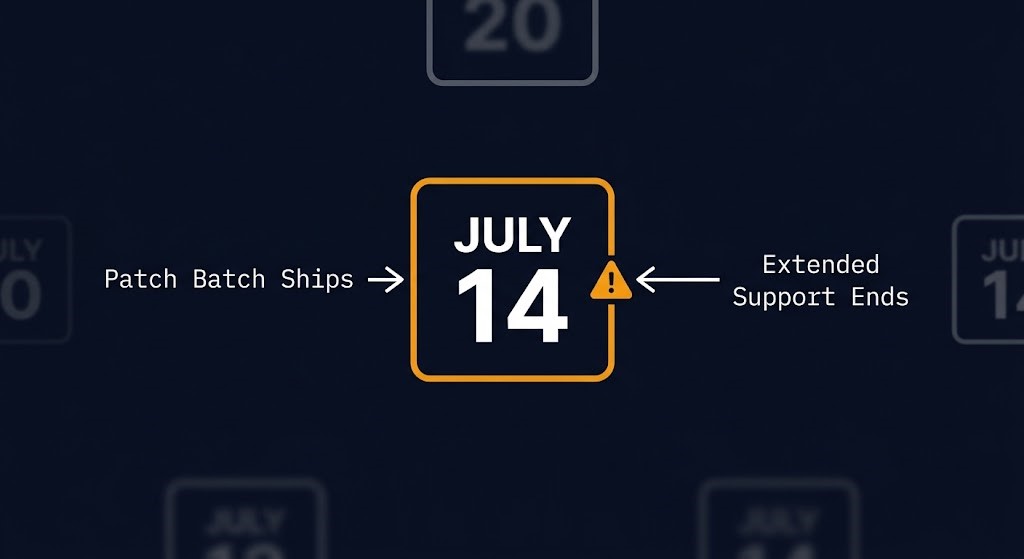
There’s a second layer to this cluster that has nothing to do with confirmation lag, and it makes the first layer worse. SharePoint Server 2016 and 2019 reached end of extended support on July 14, 2026 — the same day Microsoft shipped the patch batch covering 56164, 58644, 50522, and the RCE-chain component of 55040.
For any organization still running one of those two product lines, July 14 was simultaneously the day they received one of the last updates that platform will ever get, and the day the clock started on the confirmation gap described above. Patch visibility debt and platform lifecycle debt landed on the same calendar date, on the same servers, for at least part of this cluster. That’s not a coincidence architects get to file away as bad luck — it’s what happens when patch governance and lifecycle governance run on separate tracks that only synchronize by accident.
An organization deciding how urgently to respond to CVE-2026-55040 on July 20 was making that call on a platform that had just stopped receiving vendor support, using a vulnerability classification that was already three weeks out of date. Neither fact alone forces action. Together, they remove the excuse for waiting.
Windows 10 ESU is the inverse version of the same collision: instead of a patch and an end-of-support date landing on the same calendar day by accident, Microsoft is selling continued patching on a published schedule specifically so the two dates don’t have to coincide — for a price that escalates the longer an organization treats the purchase as the plan instead of the bridge. Patch visibility debt is confirmation lagging reality. ESU’s version is patch status lagging the actual question, which was never “is this patched” but “is this still governed.”
What This Means For Patch Governance
The instinct here is to end on generic advice — patch faster, maintain an asset inventory, mature the vulnerability management program. All true, all said by every vendor blog covering this same cluster, and none of it specific to what this cluster actually demonstrated.
The specific lesson is this: exposure should determine urgency before confirmation determines certainty. A KEV listing, a public PoC, and a vendor’s “not yet observed exploited” note are all downstream of someone else confirming something. Exposure — whether the system is internet-reachable, what it’s authenticated against, what it can reach from there — is something an organization already knows about its own environment, independent of anyone else’s confirmation timeline.
WHAT EXPOSURE-FIRST PRIORITIZATION ACTUALLY CHANGES
- Internet-reachable instances get treated as exploited-until-proven-otherwise, regardless of current KEV status.
- Patch-to-confirmation lag is tracked as its own metric per vendor, not discarded once the patch is applied.
- “Vendor has not confirmed exploitation” and “exploitation has not occurred” are recorded as two different facts in every risk register — never collapsed into one field.
This is where patch visibility debt stops being a framework for understanding what happened to SharePoint and starts being a governance decision an organization can make before the next cluster shows up under a different product name. Every patch governance program already has an exposure map. Very few of them have made it the primary input for urgency, which is the only change patch visibility debt actually requires.
Architect’s Verdict
Patch visibility debt is not a SharePoint problem. SharePoint is just the cluster where the evidence happened to line up cleanly enough to see it: an exploitation date, a proof-of-concept date, and a KEV date, twenty-four days and thirty days apart, in that order.
What most patch governance programs miss is that they’ve built urgency ranking on top of someone else’s confirmation pipeline — CISA’s, the vendor’s, a threat-intel feed’s — and treated the absence of a signal as the absence of a problem. That’s a category error every one of those sources will eventually correct, but only after the debt has already been carried for however long the correction takes.
The fix isn’t more monitoring. Exposure should determine urgency before confirmation determines certainty — rank the priority decision on what’s already reachable, and let confirmation catch up to a call that was already correct.
Additional Resources
View 3 more resources
Editorial Integrity & Security Protocol
This technical deep-dive adheres to the Rack2Cloud Deterministic Integrity Standard. All benchmarks and security audits are derived from zero-trust validation protocols within our isolated lab environments. No vendor influence.

R.M.
Senior Solutions Architect with 25+ years of experience in HCI, cloud strategy, and data resilience. As the lead behind Rack2Cloud, I focus on lab-verified guidance for complex enterprise transitions. View Credentials →
Get the Playbooks Vendors Won’t Publish
Choose the architecture problems you care about. Get field-tested playbooks and frameworks delivered to your inbox.
- > AI Infrastructure & Inference Economics
- > Cloud Strategy & Hidden Cost Models
- > Virtualization & Deterministic Migration
- > Kubernetes, IaC & Modern Infrastructure
- > Data Protection & Recovery Engineering
Zero spam. Includes The Dispatch weekly drop.
Need Architectural Guidance?
Independent review before major infrastructure decisions.
- > Validate assumptions
- > Identify hidden dependencies
- > Quantify migration risk
- > Challenge vendor narratives
Triage · Advisory · Fractional · Direct Hire