

Security Drift Is the New Configuration Drift
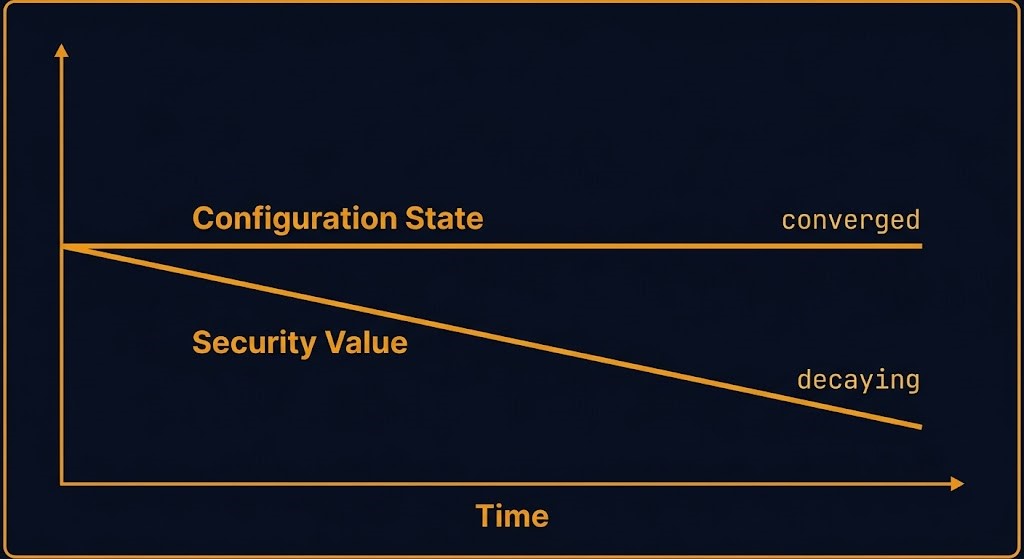
Security drift is what happens when infrastructure stays exactly as compliant as the day it was deployed and gets less secure anyway. Configuration drift — the gap between declared state and actual state — has a decade of tooling built around catching it: Terraform plans, GitOps reconciliation loops, drift detection dashboards. Security drift doesn’t show up in any of that. Declared state and actual state can match perfectly, every single time a pipeline runs, while the real security posture of that infrastructure quietly gets worse.
That’s not a hypothetical edge case. It’s the default outcome of running idempotent infrastructure for longer than a few months without treating security posture as its own reconciliation target.
Configuration Drift Was Solved. Security Drift Wasn’t.
Modern infrastructure and IaC architecture spent the better part of a decade solving one problem: making sure infrastructure matches what was declared. Terraform plans, Kubernetes reconciliation controllers, GitOps pipelines — all of it exists to close the gap between intent and reality. Configuration drift is a solved problem in the sense that matters: the tooling to detect it is mature, widely deployed, and generally trusted.
That’s exactly why security drift is invisible to it.
TWO DIFFERENT FAILURES
- Configuration drift measures whether infrastructure matches intent — declared state versus actual state.
- Security drift measures whether that intent is still secure — actual state versus a security baseline that decays independently of it.
Those are not two names for the same problem. A drift detector answers one question: does the live environment match what’s declared in code? It says nothing about whether what’s declared in code is still a good idea. An IAM policy can be exactly what the last approved commit specified and still represent a materially worse security posture than it did the day it was written — because the world around that static declaration changed, and nothing in the reconciliation loop was built to notice.
IaC drift detection is designed to catch unauthorized changes to declared state. It is not designed to catch authorized state that has quietly become dangerous. Those require different instrumentation, and most infrastructure teams have only built the first kind.
Why Idempotent Infrastructure Still Gets Less Secure
Idempotency is the property that running the same operation twice produces the same result. It’s foundational to everything modern IaC does well, and it says nothing about security. Here’s what that looks like in practice.
THE TERRAFORM EXAMPLE
Day one: the plan applies cleanly. The security group matches code. The IAM role matches code. The secret reference matches code. Everything is converged.
Eighteen months later: the IAM role has accumulated permissions added for one-off incidents and never revoked. The secret hasn’t rotated. The security group still carries a legacy exception opened during a migration that finished a year ago. Terraform plans and applies without a single change — because none of this touched the declared state. The environment is fully converged and materially less secure than it was on day one.
Terraform reports success both times. Nothing in that report is false. The plan really did converge. The gap is that “converged with declared state” and “secure” were never the same claim, and most governance conversations treat them as if they were.
This is the mechanism behind Control Plane Boundaries (MI2) in a way the stage doesn’t fully name on its own: MI2’s anchor framework, #133 Policy Intent Drift, is about who owns reconciliation when declared and enforced state diverge. Security drift is the adjacent case — declared and enforced state agree, ownership is unambiguous, and the infrastructure still gets less secure, because nobody assigned reconciliation authority over the security value of that agreed-upon state.
Framework #162 — Security Entropy Accumulation
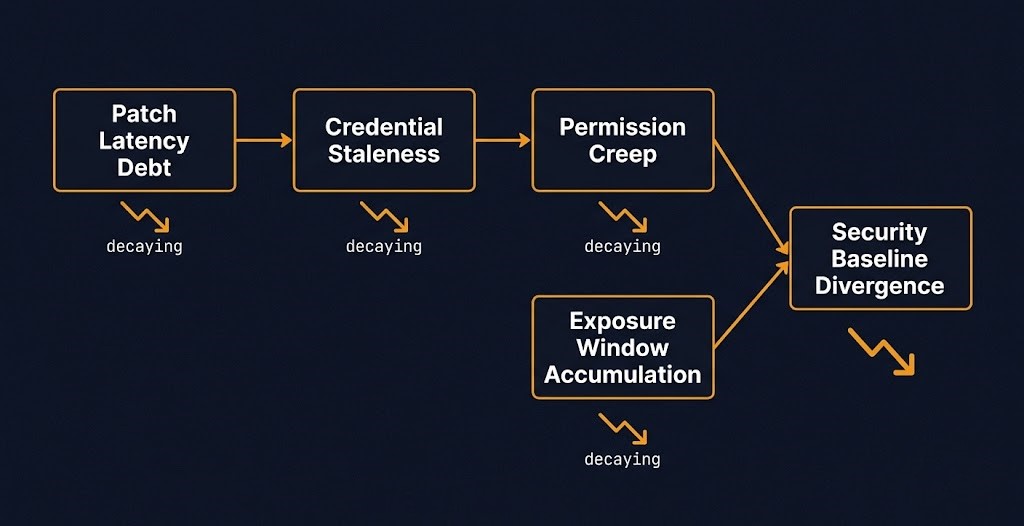
FRAMEWORK #162 — SECURITY ENTROPY ACCUMULATION
Security posture degradation that accumulates while infrastructure remains fully converged with declared configuration state. Declared and actual state continue to match — but the security value of that state decays over time.
Failure state: Security Baseline Divergence — infrastructure passes every configuration-reconciliation check while its real security posture falls further from what the design intended, because reconciliation tooling was never scoped to detect anything except state-vs-declared variance.
These four domains are parallel, not sequential — none depends on the others firing first, which is why the grid above uses uniform node weighting rather than the narrowing-opacity pattern used for cascading failure sequences. Framework #162 extends #4 Drift Origin Model — drift has traceable origins; security entropy accumulation is the category of degradation that produces no origin event to trace — and stands as the mirror image of #133 Policy Intent Drift: #133 is declared-vs-enforced divergence, #162 is the case where declared and enforced agree and risk still rises.
Framework #162 is one of two culminating frameworks in the Governance & Drift learning path stage’s Cluster 02, alongside #159 Emergency Reconciliation Gap. Together they show a fully governed system failing in two different registers: loudly, when an authorized exception never returns (#159), and quietly, when nothing ever drifted at all (#162). See the full Governance & Drift stage for both.
Architectural Relationships
Why It Connects
Governs the connection — without a traceable-origin drift taxonomy, Security Entropy Accumulation has no baseline to define itself against. It names the category of degradation that produces no origin event to trace.
Explore Framework →Why It Connects
Defines the connection — mirror-image failure modes: #133 is declared-vs-enforced divergence; #162 is the case where declared and enforced agree and security value still worsens.
Explore Framework →Why It Connects
Constrains the connection — shared pattern: a system reports healthy according to its own instrumentation while reality disagrees.
Explore Framework →There’s a related but distinct question sitting one layer above both: not whether security posture decayed while reconciliation stayed clean, but whether the security standard itself was ever verified as current in the first place. Infrastructure Standards Without Enforcement Become Documentation Debt treats evidence as the third layer most organizations never build — this post is effectively that argument run against one specific domain, security posture, where the missing evidence layer is exactly what would have caught Patch Latency Debt, Credential Staleness, Permission Creep, and Exposure Window Accumulation before they compounded.
The Four Domains Where Security Entropy Accumulates
| Domain | What Changed? | Why Drift Tools Miss It |
|---|---|---|
| Patch Latency Debt | Nothing in the declared config — the available patch changed | Reconciliation checks the resource against its own declaration, not against the current patch catalog |
| Credential Staleness | Nothing in the declared config — the credential’s age changed | A secret reference that resolves correctly is, by definition, converged — rotation status isn’t a config-state property |
| Permission Creep | Nothing in the declared config — a grant was added and never removed | Every access review adds. Almost none subtract. “Compliant with declared policy” and “least privilege” quietly diverge, and nothing about that divergence looks like drift |
| Exposure Window Accumulation | Nothing in the declared config — the reason for the exception expired | An authorized exception with no closure deadline behaves identically to a permanent one, and reconciliation has no concept of “this was supposed to be temporary” |
Patch Latency Debt gets a harder edge when the patch doesn’t exist yet. Everything above assumes a fix is available and simply isn’t applied — the reconciliation gap this post describes. AI Models Found and Exploited a Zero-Day Before the Patch Window Closed covers the adjacent case: a vulnerability an AI system found and used before any vendor patch existed to be latent about. Different failure, same underlying discipline — Patch Latency Debt asks whether you’re reconciling against the current patch catalog; the zero-day case asks what authority a vulnerable system holds during the interval where no patch catalog entry exists yet to reconcile against.
Patch Latency Debt shows up as a live case study, not just a diagram row: the eleven-month gap between Roundcube’s RCE patch and UNK_MassTraction’s exploitation of university mail servers is exactly the “fix available, simply isn’t applied” interval this domain names — reconciliation stayed green the entire time, because nothing about a mail server’s own convergence check was ever scoped to notice an unapplied vendor patch.
Patch Latency Debt has a sibling case on the confirmation side of the same domain: Patch Visibility Debt (#170), where the CVE cluster behind SharePoint’s August 2026 exploitation wave sat classified as “not yet observed exploited” for weeks after attacker activity had already started — the fix wasn’t the missing piece, the confirmation signal was.
Permission Creep deserves the most attention of the four, because it’s the domain every architect has already lived through personally. A grant added under incident pressure — broaden an IAM role at 2am to unblock a fix — is, by design, meant to be temporary. It almost never is, because nothing in the standard IaC loop flags “this matches declared state” and “this shouldn’t still be declared” as different facts. Infrastructure auditability covers the adjacent problem: proving when a permission change was authorized and under what policy. Security drift is what accumulates in the gap even when that proof exists — the change was legitimately authorized, correctly declared, and still wrong to still have in place a year later.
Emergency change paths are the other reliable source of Exposure Window Accumulation. An emergency exception that never gets a reconciliation owner or a closure deadline doesn’t drift out of declared state — it becomes the declared state, indistinguishable from an intentional design choice to anyone who wasn’t there when it was opened.
The parallel worth naming directly: autonomous systems don’t fail by breaking — they drift until the accumulated gap between design assumption and operating reality becomes large enough to surface as a failure. Security entropy is the same pattern at the infrastructure layer. The system stays operationally healthy — every health check passes, every reconciliation loop reports converged — right up until the accumulated gap is what an attacker finds first.
Designing Against Security Entropy
The fix isn’t better drift detection. Drift detection already does its job correctly — it just was never scoped to do this job. What’s missing is a second reconciliation loop, running against a different baseline than the one Terraform checks.
| Entropy Domain | Countermeasure |
|---|---|
| Patch Latency Debt | Security baseline reconciliation — a loop that checks infrastructure against the current patch catalog, not just against its own declared state |
| Credential Staleness | Automated rotation enforcement — rotation age becomes a checked property, not an assumed one |
| Permission Creep | Authorization recertification — grants expire by default unless explicitly renewed, inverting the additive-only failure mode |
| Exposure Window Accumulation | Expiry-driven exception controls — every emergency exception carries a closure deadline enforced by the system, not documented as an expectation |
Each countermeasure is a reconciliation loop in its own right — the same architectural pattern that made configuration drift tractable, pointed at a different baseline. Security baselines have to be treated as a first-class reconciliation target with their own drift detection, not as a property that’s assumed to follow automatically from configuration compliance. It doesn’t, and eighteen months of accumulated entropy is what happens when a team assumes it does.
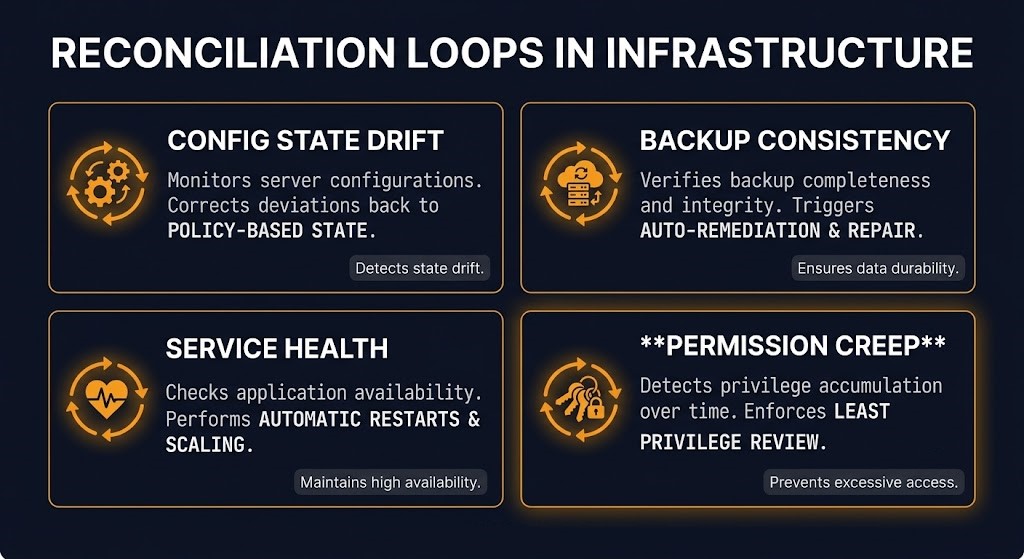
Every domain in Framework #162 needs a place to live before it can decay, and a platform’s tool count sets how many of those places exist: tool sprawl’s cost model names the category — every adopted tool is a new place credentials live, a new system a compliance review has to catch. Security drift is what happens to any one of those places once it’s been adopted and nobody’s rechecking it against a current baseline. Tool sprawl explains why the governance surface exists. This post explains what accumulates on it while nobody’s watching.
Architect’s Verdict
Idempotency guarantees that infrastructure reproduces. It does not guarantee that infrastructure stays secure. Those two claims have been treated as though satisfying the first automatically satisfies the second, and for the first decade of mature IaC tooling, most teams never had reason to notice the gap — reconciliation was new enough, and drift itself was the visible failure mode. It isn’t anymore. Configuration drift is a solved problem. Security drift is what was left standing once it was solved.
The real failure isn’t a missing patch or a stale credential in isolation — every environment has those. It’s treating “the drift dashboard is green” as evidence of security posture rather than evidence of configuration convergence, which is a narrower and different claim. A system can be perfectly declared, perfectly reconciled, and meaningfully less secure than it was a year ago, and nothing in a standard IaC pipeline will say so.
Security baselines need their own reconciliation loop, running against their own drift definition, checked on their own schedule. Configuration drift got a decade of tooling investment because someone finally treated it as an architectural requirement instead of an operational inconvenience. Security drift is waiting for the same treatment.
Additional Resources
View 7 more resources
Editorial Integrity & Security Protocol
This technical deep-dive adheres to the Rack2Cloud Deterministic Integrity Standard. All benchmarks and security audits are derived from zero-trust validation protocols within our isolated lab environments. No vendor influence.

R.M.
Senior Solutions Architect with 25+ years of experience in HCI, cloud strategy, and data resilience. As the lead behind Rack2Cloud, I focus on lab-verified guidance for complex enterprise transitions. View Credentials →
Get the Playbooks Vendors Won’t Publish
Choose the architecture problems you care about. Get field-tested playbooks and frameworks delivered to your inbox.
- > AI Infrastructure & Inference Economics
- > Cloud Strategy & Hidden Cost Models
- > Virtualization & Deterministic Migration
- > Kubernetes, IaC & Modern Infrastructure
- > Data Protection & Recovery Engineering
Zero spam. Includes The Dispatch weekly drop.
Need Architectural Guidance?
Independent review before major infrastructure decisions.
- > Validate assumptions
- > Identify hidden dependencies
- > Quantify migration risk
- > Challenge vendor narratives
Triage · Advisory · Fractional · Direct Hire