

Why “Portable” Systems Still Fail During the First Real Exit Test
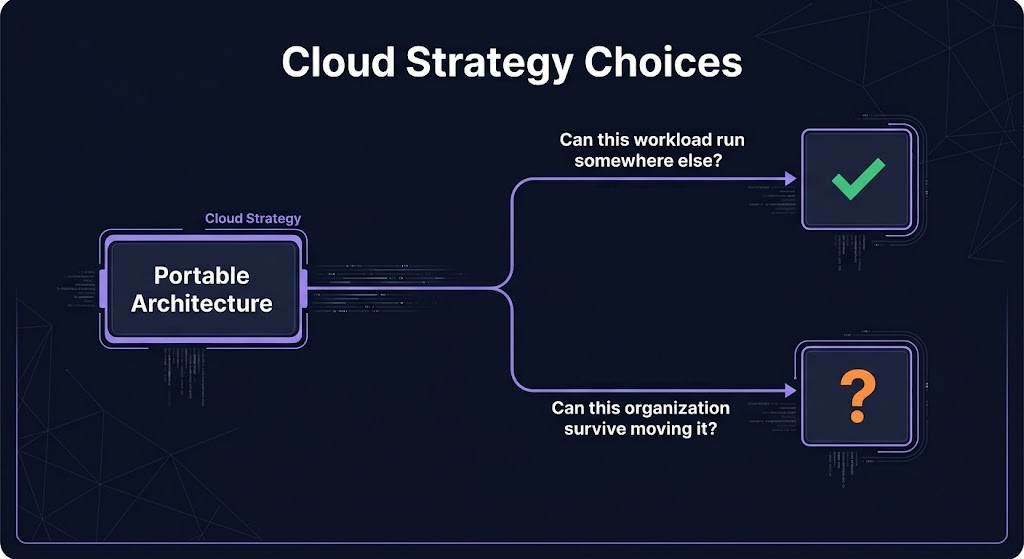
Cloud exit validation is not the same claim as portability, and enterprises keep discovering the difference at the worst possible time — mid-exit, mid-incident, with the old platform already half-decommissioned and the new one not yet proven.
The pitch behind every “portable” architecture — a cloud-agnostic control plane, a Terraform module set that runs identically on three providers, a Kubernetes abstraction layer that hides the underlying vendor — is that portability solves exit risk. If the workload can run anywhere, the thinking goes, you’ve already de-risked the exit. You built the escape hatch into the architecture. The hard part is done.
It isn’t. Portability answers a design question. Exit validation answers an operational one, and the two are not the same question wearing different clothes. That split is one instance of a broader shift the industry is only now naming directly — architectural optionality has quietly replaced optimization as the thing infrastructure architecture rewards — and cloud exit validation is where that distinction stops being theoretical and starts getting tested.
The Portability Promise
Take the “portable control plane” pattern directly: a Crossplane-based abstraction layer designed to run identically across AWS, Azure, and GCP, so that switching providers becomes a configuration change rather than a rebuild. That’s a real architectural achievement, and it answers a real question — can this workload run somewhere else?
But it isn’t the question that determines whether an exit succeeds. The question that actually matters is can this organization survive moving it? — and that question involves people, authority, process, and institutional memory that no abstraction layer touches, no matter how clean the underlying design.
These are not the same question. Conflating them is the architectural mistake this post exists to name. It’s a specific case of a broader failure: declaring a process closed on the signal that’s easiest to produce — a passing design review — rather than the outcome it was standing in for.
Why Cloud Exit Validation Cannot Be Simulated
Portability testing happens in design review. Exit validation happens during an actual exit. That’s not a timing footnote — it’s the whole argument. A portability test simulates the technical conditions of an exit. Cloud exit validation only occurs when an exit actually happens, under real authority constraints, real operational pressure, and real institutional gaps that a simulation has no way to surface.
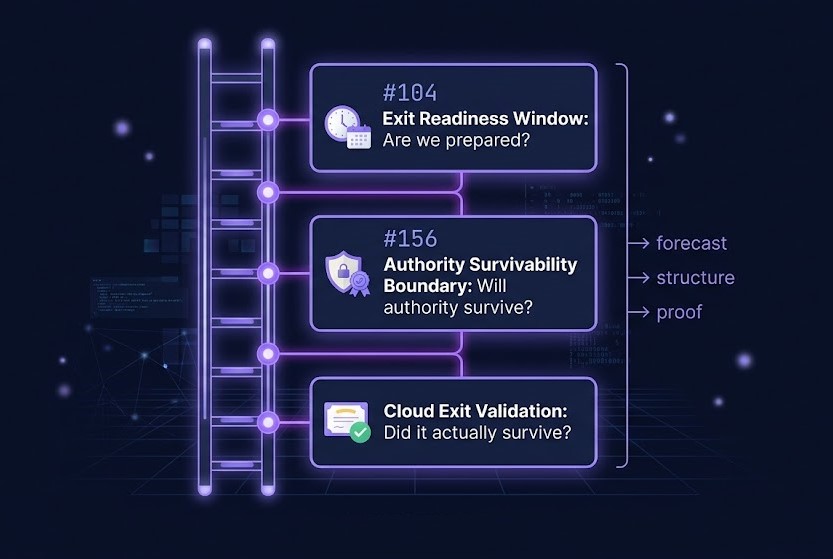
This post sits in a specific place in the Cloud Architecture Strategy domain’s Strategic Resilience stage — not duplicating what’s already been said, but answering the one question the existing doctrine hasn’t yet:
| Framework | Question Being Answered |
|---|---|
| #104 Exit Readiness Window | Are we prepared to begin an exit? |
| #156 Authority Survivability Boundary | Will authority survive the disruption? |
| Cloud Exit Validation | Did the organization actually survive the exit? |
Exit readiness is a forecast. Authority survivability is a resilience claim about structure. Cloud exit validation is the only one of the three that’s an observation rather than a prediction — and it’s the only one that can’t be produced ahead of time, no matter how well-designed the architecture is.
The Governance Gap Behind Portability
Here’s the sentence that matters most in this post: portability transfers workloads. It does not transfer authority.
A portable control plane can move a workload’s compute, storage, and networking definitions across providers without friction. It cannot move who is authorized to approve a production change on the new platform. It cannot move the exception-handling process that’s grown up around three years of tribal knowledge with the old provider’s support escalation path. It cannot move the identity system’s assumptions about which team owns which resource — the same governance gap that shows up any time infrastructure capability outruns the operating model built around it.
Every failed exit story eventually stops being a technical story. It becomes a story about who owned the policy, who owned the identity mapping, who owned the runbook, and who owned the exception process — an ownership problem, not a technology problem — and discovering, mid-exit, that “portable” never meant any of that traveled with the workload.
What the Virtualization Pillar Already Learned
This isn’t a new failure pattern. It’s a familiar one wearing a different layer of the stack.
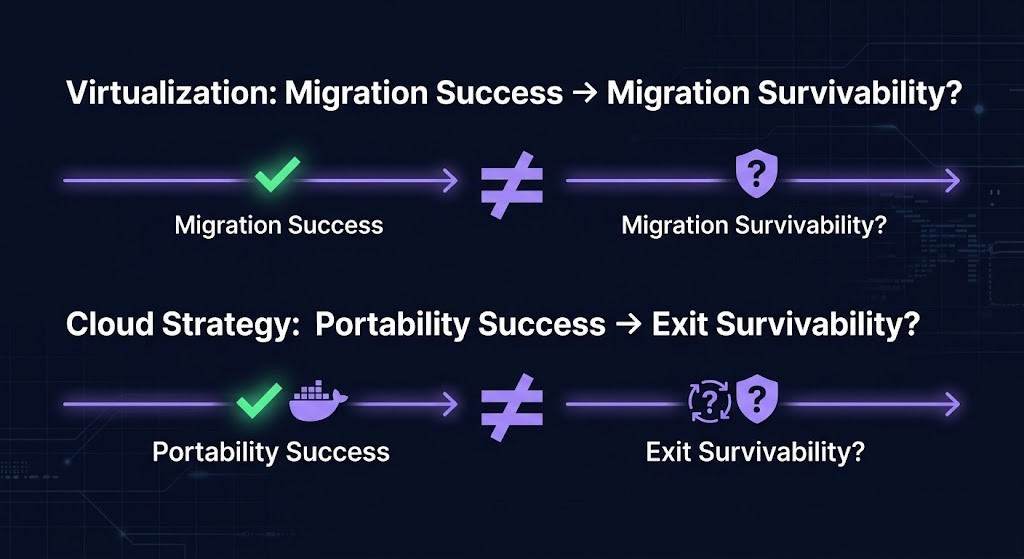
| Virtualization | Cloud Strategy |
|---|---|
| Migration success | Portability success |
| Migration survivability | Exit survivability |
Migration success does not prove migration survivability. Portability success does not prove exit survivability. The Virtualization pillar already lived this lesson at the hypervisor layer — a migration project can close green and still fail its first real incident, because the recovery runbook still references constructs that no longer exist on the new platform. Cloud strategy is now relearning the identical lesson one layer up, at the control-plane level instead of the hypervisor level.
What Exit Validation Measures That Portability Never Could
A portability review checks whether the architecture can move. Cloud exit validation checks six things that only surface once it actually does:
- Identity Continuity — do identity and access assumptions survive the platform change, or does the new environment require rebuilding trust relationships the old one never documented?
- Authority Continuity — does the team that could approve a production change on the old platform still have that authority on the new one?
- Operational Runbooks — do incident response procedures reference primitives that exist in the new environment, or do they assume tooling that no longer applies?
- Network & Connectivity Assumptions — do application connectivity paths survive the move, or were they quietly dependent on the old provider’s specific networking layer rather than the APIs everyone assumed?
- Egress & Data Movement Mechanics — does the exit itself execute at the cost and speed the architecture assumed, or does data gravity make the “portable” design theoretical?
- Evidence Continuity — can the organization still prove configuration ownership and policy state after the move, or did the audit trail stay behind with the platform it was built for?
None of these show up in a portability diagram. All of them show up in the first real incident after the exit.
Portability validates architecture. Exit validation validates operations.
A seventh thing surfaces after all six of the above have been checked, and it’s the one exit validation is least equipped to catch because it isn’t operational at all: whether the organization’s own legal obligations to the old vendor actually ended when the platform did. Vendor Relationships End. Audit Rights Often Don’t. covers the case where identity, authority, runbooks, connectivity, egress, and evidence all validated clean — and the exit still wasn’t closed, because a licensing agreement’s audit-rights and record-retention clauses were written to survive termination on a clock the infrastructure side never owned. Exit validation proves the organization survived the move. It doesn’t prove the vendor agrees the relationship is over.
An eighth thing sits beside it, also outside the six operational checks, and also not something a drill can surface: whether the exit program’s cost model kept counting what it declared gone. Dependency Residue (#77) names that gap — every one of the six checks above can pass clean, the portability claim can hold under a real exit, and the program can still be paying for an identity tenant, a data path, or an operational service it scoped out of the migration and never budgeted again. Exit validation proves the organization survived the move. It doesn’t prove the cost model survived contact with what the move actually excluded.
Architect’s Verdict
Portability proves a workload can move. Cloud exit validation proves the organization can survive the move.
Most enterprises building “portable” architectures are solving the first problem and quietly assuming it answers the second. It doesn’t. The Exit Readiness Window tells you whether you’re prepared to start. The Authority Survivability Boundary tells you whether your governance structure holds. Only the exit itself tells you whether it actually worked.
An architecture that has never been forced to prove this hasn’t demonstrated survivability. It’s demonstrated intent.
Additional Resources
View 5 more resources
Editorial Integrity & Security Protocol
This technical deep-dive adheres to the Rack2Cloud Deterministic Integrity Standard. All benchmarks and security audits are derived from zero-trust validation protocols within our isolated lab environments. No vendor influence.

R.M.
Senior Solutions Architect with 25+ years of experience in HCI, cloud strategy, and data resilience. As the lead behind Rack2Cloud, I focus on lab-verified guidance for complex enterprise transitions. View Credentials →
Get the Playbooks Vendors Won’t Publish
Choose the architecture problems you care about. Get field-tested playbooks and frameworks delivered to your inbox.
- > AI Infrastructure & Inference Economics
- > Cloud Strategy & Hidden Cost Models
- > Virtualization & Deterministic Migration
- > Kubernetes, IaC & Modern Infrastructure
- > Data Protection & Recovery Engineering
Zero spam. Includes The Dispatch weekly drop.
Need Architectural Guidance?
Independent review before major infrastructure decisions.
- > Validate assumptions
- > Identify hidden dependencies
- > Quantify migration risk
- > Challenge vendor narratives
Triage · Advisory · Fractional · Direct Hire