

Most Cloud Exit Strategies Start Too Late
Every cloud exit strategy starts with the same problem: the exit window doesn’t close when you decide to leave. It closes years before — quietly, incrementally, one managed service at a time.
Most cloud exit strategies fail not because the migration plan is wrong, but because by the time the plan is written, the architecture has already voted. Cloud exit becomes non-computable long before it becomes operationally impossible. The data is still there. The workloads are still running. But the structural conditions that made a cloud exit strategy executable — portable data tiers, independent control planes, owned identity, abstracted observability — have been replaced, one convenience decision at a time, with deep dependencies that resist not just movement but modeling.
This is not a story about vendor lock-in as a concept. It is a story about how managed-service-first default design accumulates into architectural paralysis — and why a cloud exit strategy that starts at the point of exit is already a decade too late.
The Real Antagonist: Managed-Service-First Default Design
The conventional framing of this problem puts the blame on vendors. That framing is not wrong — providers are structurally incentivized to deepen integration. But it lets architects off the hook for decisions they made willingly, usually under time pressure, usually with full knowledge of the tradeoffs.
The real antagonist in most cloud exit failures is not a vendor. It is a design philosophy: managed-service-first default design, where the default answer to any architectural question is the provider’s managed offering because it is faster to provision, easier to operate, and already paid for. This philosophy is not malicious. It is rational under the conditions of initial cloud adoption, when the primary pressure is velocity and the primary constraint is team bandwidth.
The problem is that architecture shaped by onboarding velocity is not the same architecture you need when exit survivability becomes the constraint. The services chosen for speed become the anchors that resist movement. The integrations chosen for convenience become the dependency chains that resist mapping. The operational model chosen to minimize day-one complexity becomes the model that cannot survive provider removal.
By the time leadership issues the exit mandate, the team is not executing a migration. They are performing forensic archaeology on an architecture that was never designed to be understood from the outside.
What Cloud Exit Readiness Actually Requires
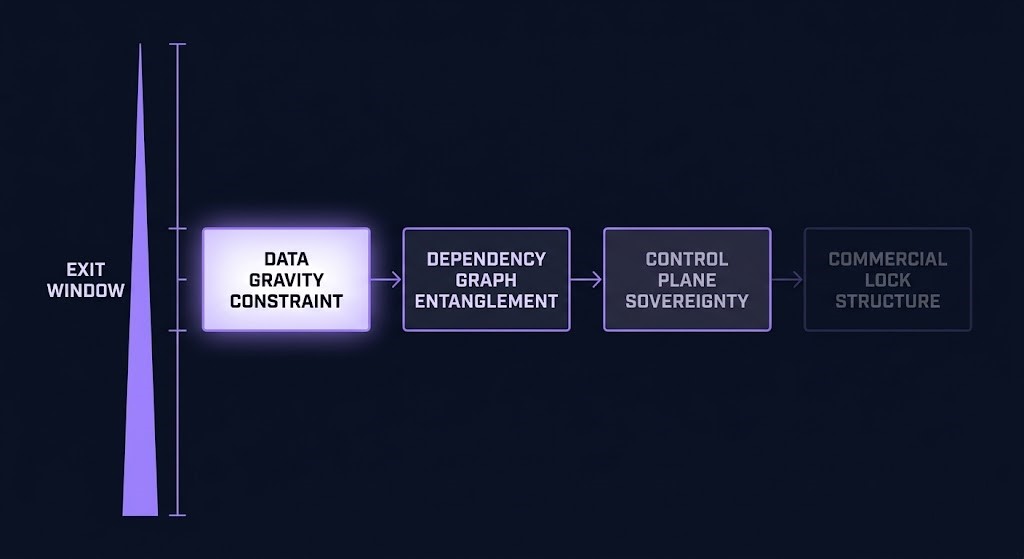
A viable cloud exit strategy depends on exit readiness — the absence of irreversible coupling across four constraint domains. Note the framing: absence. Not the presence of portability tools, not a migration plan in the drawer, not a multi-cloud strategy document. The structural absence of coupling that cannot be reversed without redesigning adjacent systems. Each of the four domains below is also a concentration point, and pricing that concentration is what makes “we’re not exit-ready” a number instead of a feeling.
The four domains are not a checklist. They are architectural pressure points — areas where coupling accumulates quietly and compounds over time. A cloud exit strategy that does not address all four is not a strategy. It is a wish. The movement forces that determine which of the four constraint domains is already closed — egress economics, data gravity, identity lock-in, operational capability, and regulatory constraint — are mapped and classified at Movement Architecture, the Operational stage of the Cloud Strategy Architecture Learning Path.
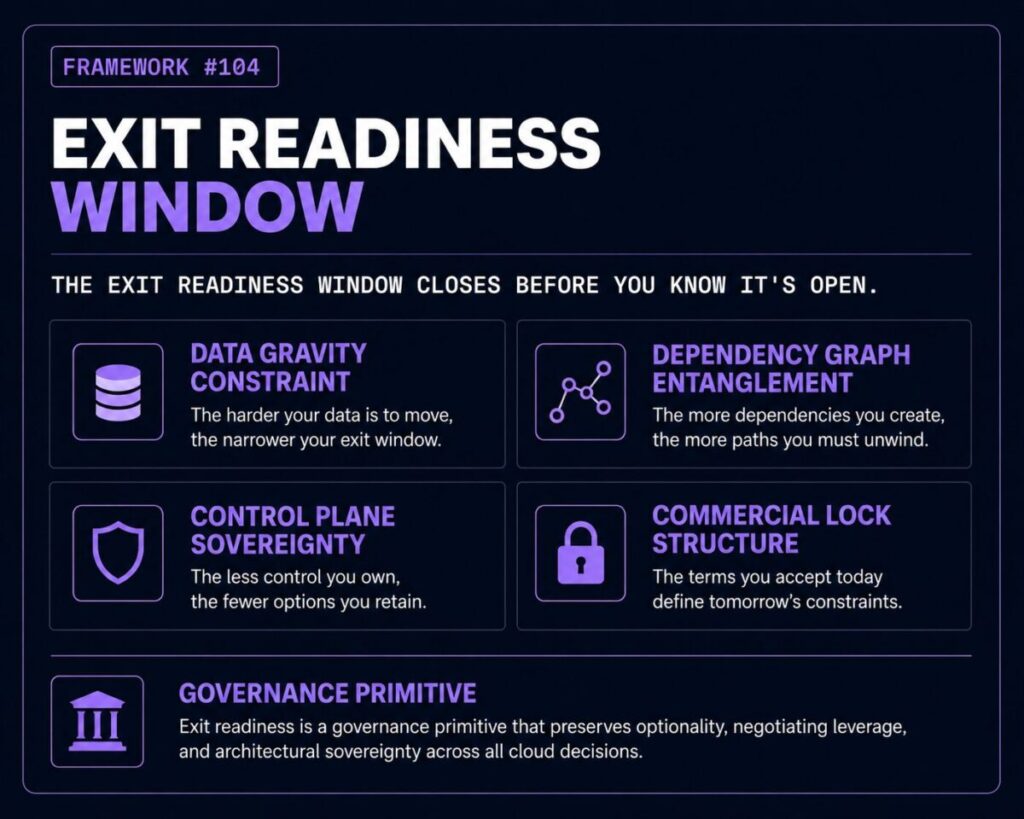
FRAMEWORK #104 — EXIT READINESS WINDOW
The Exit Readiness Window Closes Before You Know It’s Open — exit readiness is the absence of irreversible coupling across four constraint domains.
When any domain reaches the irreversibility threshold, exit becomes non-computable — not just expensive, but no longer modelable with confidence.
Data Gravity Constraint is the most visible but most underestimated. The question is not whether your data can be exported — every provider supports some form of data export. The question is whether your application logic is coupled to the provider’s storage semantics. If your data tier relies on provider-native query patterns, managed replication behavior, or service-specific transaction models, the data can move but the application cannot follow without redesign. You are not moving data. You are rewriting the data layer. That distinction rarely appears in cloud exit strategy cost models. It is why exit cost as a first-class architectural constraint should be modeled before the architecture is built, not after the exit decision is made.
Dependency Graph Entanglement is the domain that most teams genuinely cannot map at exit time, not because the data is unavailable, but because no one ever built the graph. Provider-native eventing, messaging, and integration services accumulate dependency edges that are invisible in the application layer. They exist in configuration, in IAM policy, in trigger chains that were never documented because they worked. An exit attempt surfaces the graph for the first time — through failure.
Control Plane Sovereignty is where the operational outsourcing disguised as acceleration shows its real cost. Managed Kubernetes, managed logging, managed service mesh — every managed control plane is a tradeoff: reduced operational burden now, reduced operational independence later. The teams that built expertise in provider-native tooling discover at exit time that the expertise doesn’t travel. The control plane knowledge is not portable. The institutional operational memory is locked to the provider’s abstractions.
Commercial Lock Structure is underrepresented in technical exit discussions, but it is often the constraint that determines the timeline. Data egress pricing at scale, minimum commitment thresholds in enterprise agreements, and data residency clauses that require provider cooperation to satisfy are commercial terms that become architectural constraints. By the time you need to move, these terms are already set. Understanding them as architecture — not just procurement — is the work that has to happen before the contract is signed. The cost structure these commercial terms create — and how they compound with egress, idle, and reservation lock economics — is the subject of Economic Architecture (Framework #131: Economic Gravity Boundary), the Operational stage that follows Movement Architecture in the Cloud Strategy path.
How the Window Closes: Four Stages of Progressive Entrapment
The exit readiness window does not close in a single architectural decision. It closes in stages, each individually defensible, collectively irreversible.
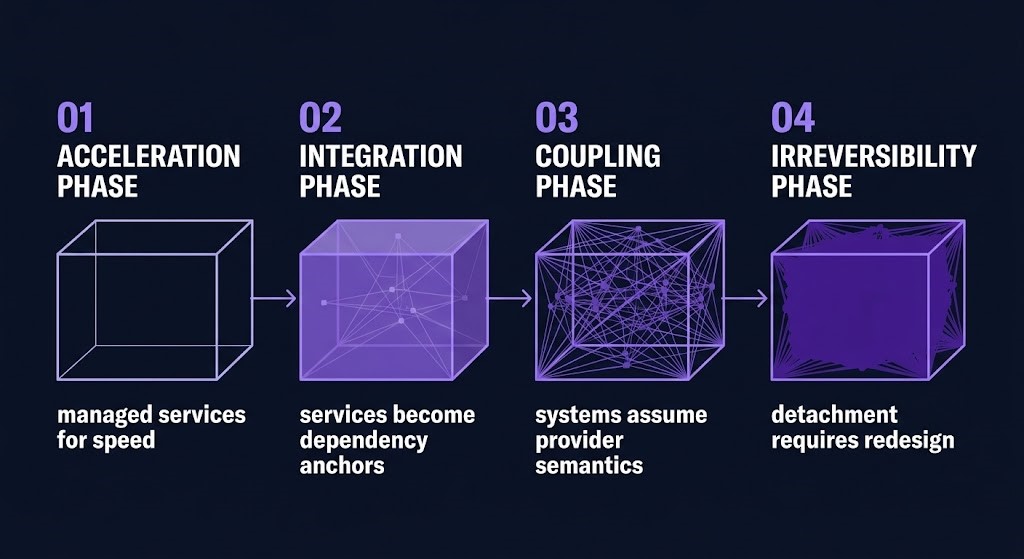
Stage 01 — Acceleration Phase
Managed services are introduced for speed. The first cloud deployment prioritizes time-to-production over architectural independence. Managed databases because the DBA team is stretched. Managed Kubernetes because cluster operations require expertise the team doesn’t have yet. Managed monitoring because standing up a full observability stack would delay the launch by six weeks. These decisions are correct given the constraints. The team believes — and is usually right — that they can address the architectural debt later. The cloud exit strategy conversation, if it happens at all, is deferred to a future sprint that never arrives.
What is actually happening: the data tier is anchoring to provider semantics, and the operational model is beginning to delegate authority to the provider’s control plane. The window is still open.
Stage 02 — Integration Phase
The services provisioned for speed become dependency anchors. Other services begin integrating with them — not by design, but by gravity. Internal applications start consuming the managed database’s replication events. The monitoring stack becomes the source of truth for alerting rules. The managed event bus becomes the backbone of inter-service communication. Each integration is a local optimization. No one is building lock-in deliberately.
What is actually happening: the dependency graph is growing, and the edges are becoming harder to enumerate. The blast radius of removing any single service is expanding beyond what any single team can see. The window is narrowing.
Stage 03 — Coupling Phase
Systems begin assuming provider semantics — not just using provider services, but encoding the provider’s behavioral contracts into application logic. IAM policies appear in application authorization flows. Business logic triggers on managed database events. Observability pipelines are structured around provider-native telemetry schemas. The provider’s proprietary messaging semantics are embedded in queue consumers that would require rewriting to function on a different eventing backbone.
What is actually happening: reversing individual decisions no longer means replacing components. It means rewriting the systems that depend on those components’ specific behavior. This is the onset of the irreversibility threshold.
Stage 04 — Irreversibility Phase
⚠ IRREVERSIBILITY THRESHOLD
The irreversibility threshold is the point at which reversing a design decision requires rewriting adjacent systems rather than replacing the original component. Once crossed, the exit cost model breaks: you can no longer price the exit because you can no longer enumerate what changes.
Detachment now requires redesign, not migration. The IAM integration is not just “misconfigured” — it is threaded through application auth flows that would need to be rebuilt against a new identity provider. The managed database is not just “the wrong service” — its behavioral contracts are embedded in dozens of consumer services whose developers have turned over twice. The observability pipeline is not just “the wrong tool” — its telemetry schema shapes the alerting logic, the SLO definitions, and the runbook triggers that the on-call team relies on.
This is where cloud exit strategy becomes non-computable. Not impossible to execute, but impossible to model with confidence. The exit cost estimate requires knowing what changes. What changes requires mapping the dependency graph. The dependency graph was never built. The cloud exit strategy planning process itself becomes the first attempt to understand an architecture that was never fully understood by anyone.
The Cloud Exit Strategy That Keeps the Window Open
Maintaining exit readiness is not neutral. It increases upfront engineering cost in exchange for preserved optionality. That tradeoff should be made explicitly — not as over-engineering, but as a first-class architectural constraint modeled alongside performance, cost, and reliability.
EXIT-READY ARCHITECTURE: WHAT YOU ARE REJECTING
- Provider-agnostic data tier — explicitly rejecting deep coupling to managed database behavioral semantics and proprietary replication contracts
- Owned identity architecture — explicitly rejecting IAM delegation to the provider identity plane as the root authority for application auth flows
- Portable control plane — explicitly rejecting managed Kubernetes and provider-native orchestration as the operational model for cluster authority
- Organization-owned observability — explicitly rejecting provider-native telemetry schemas as the structural backbone for alerting, SLOs, and runbook logic
- Egress-modeled contract architecture — explicitly rejecting enterprise agreements that treat data movement costs as procurement variables rather than architectural constraints
The “explicitly rejecting” framing matters. These are not preferences. They are architectural stances that carry operational cost. A team that builds a provider-agnostic data tier is accepting more upfront complexity in schema tooling and replication management. A team that owns its identity architecture is accepting more operational burden in identity lifecycle management. The tradeoffs are real and should be visible in the architecture decision records — not buried in the assumption that portability will be addressed “later.”
Multi-Cloud Failover Is Mostly Theater covers the related failure mode where multi-cloud presence is mistaken for multi-cloud exit readiness. The two properties are not the same. You can run workloads across two providers and still be unable to exit either one because the integration layer is coupled to both.
Repatriation Is Not Always the Signal It Appears to Be
The organizations executing cloud exits most successfully are not the ones who decided late and moved fast. They are the ones who maintained cloud exit strategy readiness as a continuous architectural discipline — and then, when the exit conditions were actually met, exercised optionality that was already preserved.
That framing matters because the alternative misreads the repatriation signal. The Repatriation Calculus is specific about what conditions actually justify a move back to on-premises infrastructure. Not all repatriation is signal. Some of it is latency-driven panic misread as strategy — performance incidents that surface under scale, cost spikes that surface under growth, operational failures that surface under incident pressure. These can all appear, briefly, to justify an exit. They don’t.
DIAGNOSTIC QUESTION
“Is the exit decision being driven by a structural economics argument with modeled alternatives — or by an incident that surfaced an architectural problem that exists regardless of provider?”
The organizations that get repatriation right — including the 93% signal examined in depth — are the ones that can answer that question with data rather than pressure. That capacity for structured analysis depends on having maintained the dependency map, the cost model, and the architectural independence that makes alternatives legible.
Private Cloud Is Back — Because Governance Never Left covers what actually changes architecturally when the on-premises operating model is the right answer. It is not a return to the previous model. It is a different operating model that requires its own architectural preparation. You cannot exit into an environment that wasn’t built to receive the workloads.
When the Window Is Still Open: What a Manageable Exit Looks Like
The contrast case is instructive. An organization that has maintained exit readiness across all four constraint domains does not execute a cloud exit as a crisis project. It executes it as a controlled migration against a known dependency map, with a cost model that was built before the decision was made, against a destination environment that was designed to receive the workloads.
The data tier moves because the schema abstraction layer was never coupled to provider semantics. The identity plane transitions because the application auth flows were always pointed at an identity provider the organization owns. The observability stack transfers because the telemetry schema was defined internally and the provider’s pipeline was always just a transport layer. The control plane sovereignty transfers because the operational model was never fully delegated to the provider’s managed services.
The infrastructure control plane consolidation analysis is directly relevant here: the organizations with the cleanest exit paths are consistently the ones that maintained an internal control plane authority even while running significant workloads on provider infrastructure. Sovereignty is not about where the workloads run. It is about who owns the system of record for how those workloads are governed. Even a well-mapped dependency graph and an owned control plane are not proof of exit readiness — they are necessary preconditions. Whether the architecture actually survives contact with a real exit is a separate, testable question, covered in Why “Portable” Systems Still Fail During the First Real Exit Test.
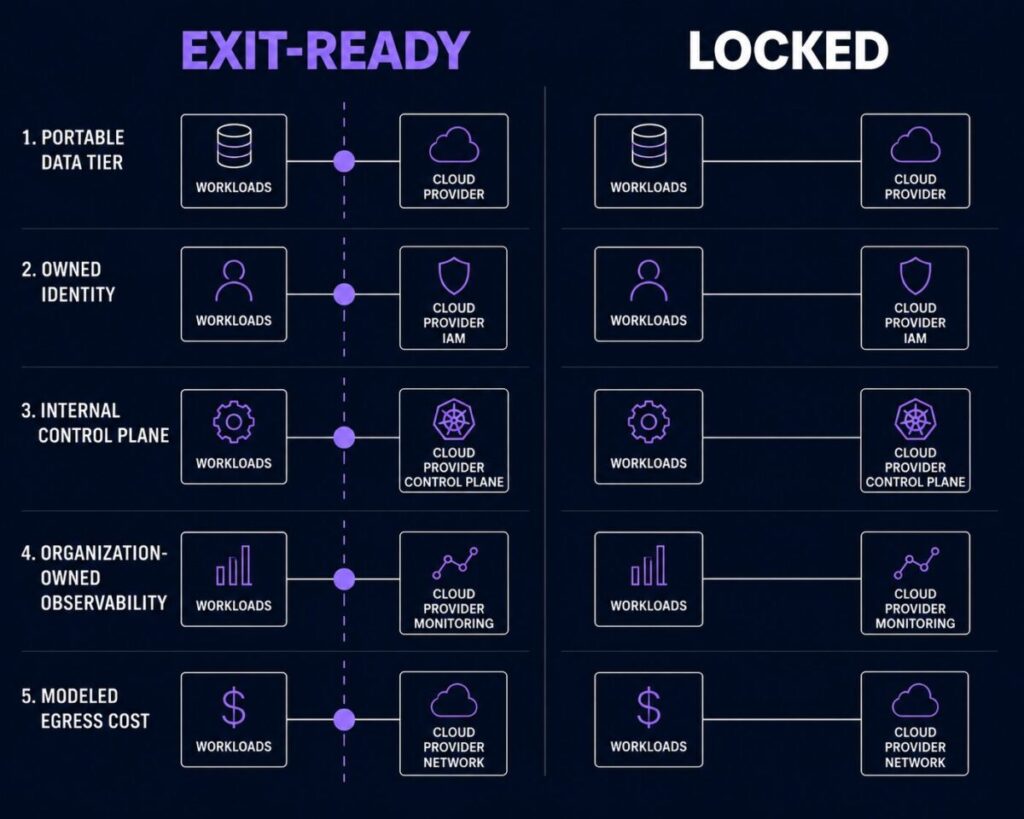
The contrast case — the organization that did not maintain exit readiness — is not executing a migration. It is performing forensic analysis of an architecture that was never fully mapped, producing cost estimates with confidence intervals wide enough to be meaningless, and negotiating with a provider that holds structural leverage because the alternative to staying is not credibly executable.
Architect’s Verdict
A cloud exit strategy built at the point of exit is already too late. That is the distinction most exit planning frameworks miss. Cloud exit becomes non-computable before it becomes impossible. The workloads are still running. The data is still accessible. But the structural conditions that would make an exit legible — a mappable dependency graph, a portable data tier, an owned control plane, a modeled egress cost — were never built. The exit cost estimate requires enumerating what changes. Enumerating what changes requires a dependency map that doesn’t exist. The planning process itself becomes the first discovery pass on an architecture nobody ever fully understood.
The real architecture failure is not choosing the wrong managed services. It is treating cloud exit strategy as a future project — something to address after the current priorities are cleared. Managed-service-first default design is not inherently wrong. But architecture shaped by onboarding velocity is not the same architecture you need when exit survivability becomes the constraint. The window closes at the speed of convenience, not at the speed of intention.
Exit readiness is not a cloud strategy concern. It is a governance primitive for infrastructure decision-making — one that belongs alongside cost governance, security governance, and operational governance as a standing architectural constraint. The organizations building AI infrastructure at scale are discovering this now, as observability governance systems begin surfacing the same dependency entanglement problems at the model and inference layer that cloud architects have been accumulating at the infrastructure layer for a decade. The pattern is the same. The window closes the same way.
Additional Resources
View 4 more resources
Editorial Integrity & Security Protocol
This technical deep-dive adheres to the Rack2Cloud Deterministic Integrity Standard. All benchmarks and security audits are derived from zero-trust validation protocols within our isolated lab environments. No vendor influence.

R.M.
Senior Solutions Architect with 25+ years of experience in HCI, cloud strategy, and data resilience. As the lead behind Rack2Cloud, I focus on lab-verified guidance for complex enterprise transitions. View Credentials →
Get the Playbooks Vendors Won’t Publish
Choose the architecture problems you care about. Get field-tested playbooks and frameworks delivered to your inbox.
- > AI Infrastructure & Inference Economics
- > Cloud Strategy & Hidden Cost Models
- > Virtualization & Deterministic Migration
- > Kubernetes, IaC & Modern Infrastructure
- > Data Protection & Recovery Engineering
Zero spam. Includes The Dispatch weekly drop.
Need Architectural Guidance?
Independent review before major infrastructure decisions.
- > Validate assumptions
- > Identify hidden dependencies
- > Quantify migration risk
- > Challenge vendor narratives
Triage · Advisory · Fractional · Direct Hire