

OpenTofu Readiness Bridge
Audit HCL. Identify Divergence. Migrate With Confidence.
In late 2023, Terraform’s shift to the Business Source License turned every planned migration into a licensing question first and an engineering question second. OpenTofu emerged as the open-source successor, and for most configurations it delivers on drop-in compatibility. The problem was never the common case — it’s the enterprise edge cases that don’t show up in a compatibility matrix until a migration hits them in production: ephemeral value blocks, provider-defined functions, cross-variable validation logic, removed block syntax that quietly diverged after the fork.
Compatibility matrices and vendor changelogs answer “what changed in general.” They don’t answer “does my HCL use any of it.” The OpenTofu Readiness Bridge skips the matrix and reads the configuration directly — paste your HCL and it scans for the four known divergence classes, then returns a scored verdict with the specific construct, the reason it diverges, and a corrected snippet. Not a checklist to cross-reference. An answer.
The Solution: The OpenTofu Readiness Bridge
The OpenTofu Readiness Bridge (OTRB) was engineered by Rack2Cloud to act as a pre-flight diagnostic layer. It provides a non-destructive audit of your current Terraform environment to determine its “Tofu-Readiness.”
By mapping provider versions, state file schemas, and HCL (HashiCorp Configuration Language) features against the OpenTofu registry, the tool eliminates the guesswork of vendor migration.
What the OpenTofu Readiness Bridge Surfaces
01 — Ephemeral Divergence
Terraform 1.10+ ephemeral value syntax requires OpenTofu 1.11+ memory-only state handling. This is the single breaking-divergence class the Bridge checks for — everything else is refactorable, this one gates your target version.
02 — Provider-Defined Function Drift
Custom provider functions (Terraform 1.8+ syntax) need manual validation against the OpenTofu registry mapping — the registry mirrors Terraform’s, but function-level parity isn’t guaranteed for every provider.
03 — Cross-Variable Validation Divergence
Multi-variable validation logic that references more than one variable in a single condition must move to a `postcondition` block under OpenTofu — the Bridge flags the pattern and supplies the corrected structure.
04 — Removed Block Divergence
OpenTofu 1.7+ doesn’t use the internal `lifecycle` block inside a `removed` block the way recent Terraform syntax does — a small syntax divergence that fails silently if you don’t know to look for it.
Migration Confidence & Verdict Classification
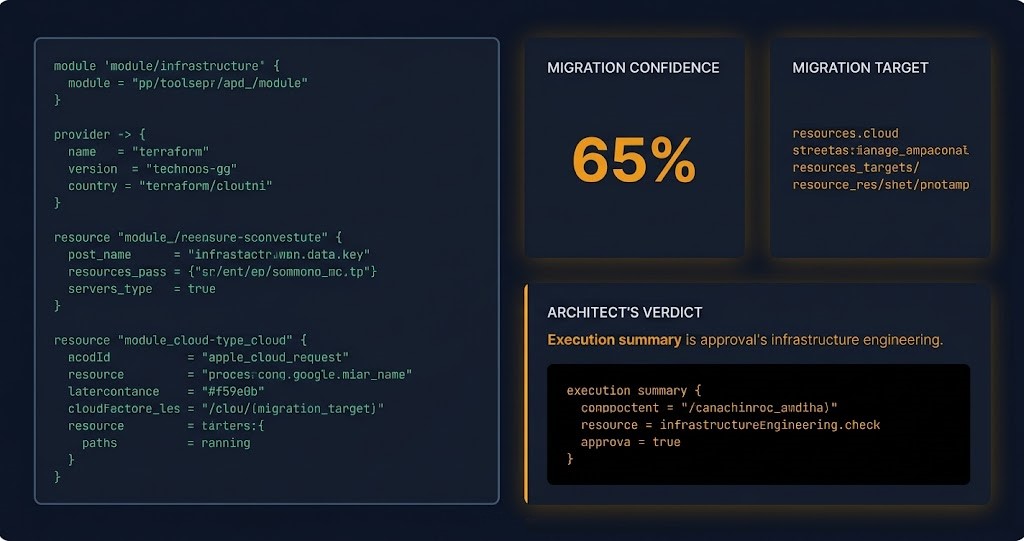
Output is a Migration Confidence score plus a classified verdict — not a pass/fail gate.
| Verdict | Confidence | Trigger |
|---|---|---|
| Compatibility Baseline Met | 100% | No divergent constructs detected. HCL uses standard MPL-compatible syntax — drop-in migration target. |
| Refactor Required | 70% | One or more of: provider-defined functions, cross-variable validation, or removed + lifecycle syntax detected. |
| Breaking Divergence | 35% | Ephemeral value blocks detected — requires OpenTofu 1.11+. Takes priority over Refactor Required findings. |
Deterministic, Not a Matrix Lookup
A compatibility matrix tells you what’s changed between Terraform and OpenTofu in general. It can’t tell you whether your HCL is affected without you cross-referencing every line yourself — and enterprise codebases run to thousands of resources across dozens of modules. The Bridge inverts that: instead of you reading the matrix and searching your code, it reads your code and tells you which matrix entries apply.
The scan is pattern-based and deterministic — the same HCL produces the same verdict every time, with no model inference and no probabilistic scoring. That’s a deliberate tradeoff: it means the four checks are narrow by design rather than an attempt at exhaustive coverage, but every finding it does surface is traceable to an exact construct in your configuration, not a general risk statement.
This tool is the audit layer for the OpenTofu Architecture Series. Run the Readiness Bridge first, then follow the execution path:
Key Features
scoring, same input always produces the same verdict.
- Corrected Code Snippets: Every finding ships with the specific construct, a plain-language explanation of why it diverges, and a ready-to-use corrected snippet — not just a citation to read further.
- Migration Confidence Score: A three-tier verdict (Compatibility Baseline Met / Refactor Required / Breaking Divergence) scoped to what the scan actually found, not a generic maturity score.
- Architect’s Verdict Summary: A single scored readout instead of a line-by-line diff — built for a pre-migration go/no-go conversation, not a linter’s output log.
- Client-Side Only: No data leaves the browser. No telemetry, no server-side logging, no account required.
THE BRIDGE SURFACES THE GAPS.
A REVIEW CLOSES THEM.
Auditing compatibility identifies where your HCL diverges from OpenTofu. Closing the gaps requires refactoring identified constructs, validating provider parity, and building a migration sequence that doesn’t break production.
|
>_ Architectural Guidance
Infrastructure Architecture ReviewA structured review against your readiness findings — resolving compatibility gaps, validating provider parity, and sequencing a migration that survives production.
|
>_ The Dispatch
Architecture Playbooks. Field-Tested Blueprints.Weekly breakdowns of IaC governance, control plane migration patterns, and the compatibility decisions that determine whether an OpenTofu migration survives Day 2.
Zero spam. Unsubscribe anytime. |
Frequently Asked Questions
Q: Does it work with Nutanix AHV providers?
A: Yes. It specifically checks for the Nutanix AOS/AHV provider versions commonly used in enterprise hybrid-cloud stacks.
Q: Is my state file data secure?
A: Absolutely. The OTRB logic is designed to analyze versioning and structural metadata. No actual infrastructure secrets or state content are uploaded or stored.
Q: Why use OpenTofu instead of staying with Terraform?
A: For many, it is about Vendor Sovereignty. OpenTofu is governed by the Linux Foundation, ensuring that your core Infrastructure-as-Code (IaC) tool remains an open-source public good, protected from unilateral licensing changes.
Additional Resources
🔒 Privacy Architecture: No cookies. No tracking pixels. No server-side database.
This logic runs entirely in your local browser session.