

Restore Evidence Is the Missing Artifact in Every DR Program
Restore evidence is the artifact layer most disaster recovery programs never build — the difference between reporting that a restore succeeded and being able to prove it. Backup restored. Applications started. Users logged in. Test passed.
Every one of those is a statement. None of them is an artifact.
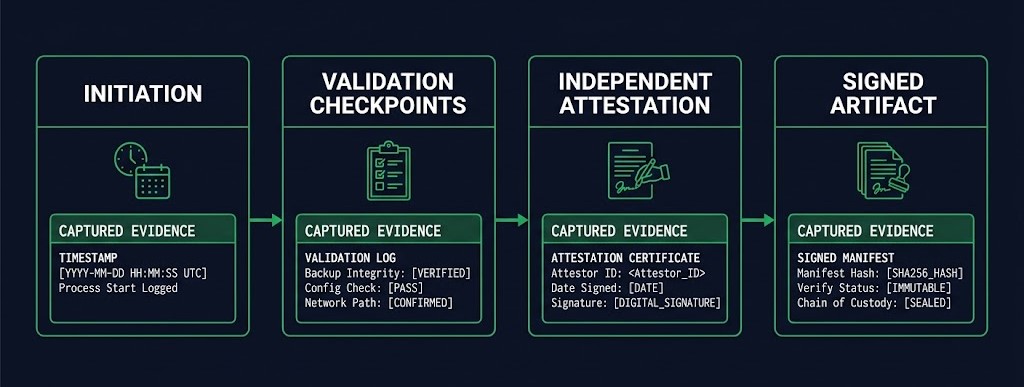
A Successful Restore Still Doesn’t Prove Anything
Ask the question directly: what artifact exists proving those four statements are true? Not a summary someone wrote after the fact. Not a status the orchestration tool displayed on a dashboard that no longer exists. An artifact — something that survives the test, that a third party could examine independently of the people who ran it.
Most organizations stop at outcome reporting. The DR test “passed,” the ticket closes, the runbook gets filed. Your DR Test Passed. The Assumptions Didn’t. already named this problem at the assumption layer — this post names it at the artifact layer. A passed test and a proven test are not the same claim. That’s a result, not evidence. This gap sits directly on top of Framework #153’s Restore Design Gap: even when every layer — data, platform, identity, dependency, validation — recovers cleanly, nothing generated during the restore proves it recovered cleanly. The Evidence Gap series established in Part 1 asked whether recovery can happen at all. This post asks a narrower, harder question: can recovery be proven?
What Restore Evidence Actually Is
Restore evidence is a set of artifacts generated during the restore, not summarized after it — timestamped, attributable, and independently verifiable without relying on the memory or good faith of whoever ran the test.
WHAT COUNTS AS RESTORE EVIDENCE
- A restore initiation record with exact timestamp and trigger source
- Source backup identifier and integrity confirmation
- Validation test execution log, not a pass/fail summary
- Dependency check results — DNS, certificates, secrets, auth, integrations
- Authorization record — who declared the restore, on what authority
- Independent validation sign-off — a second party, not the operator
- Hash or signature binding the artifact to the specific restore event
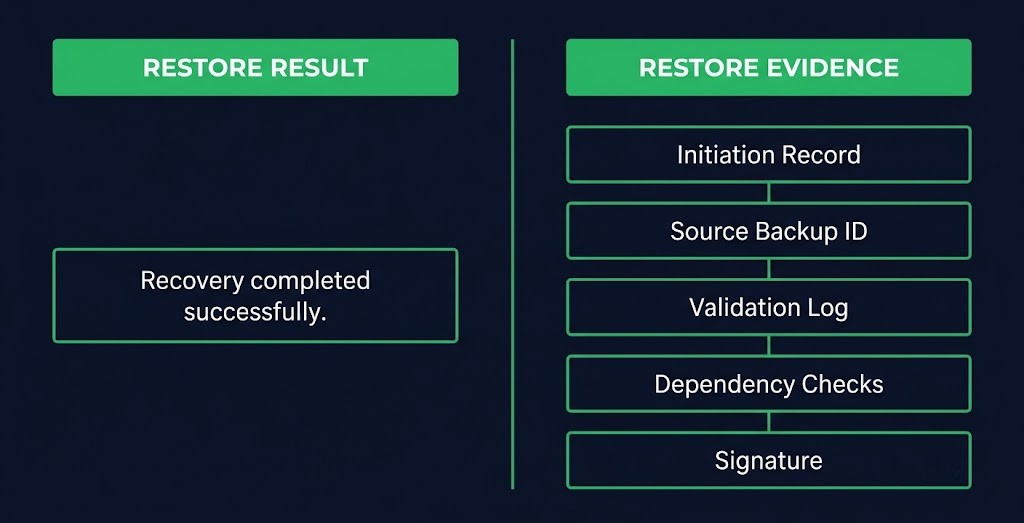
Restore Results Are Not Restore Evidence
This is the distinction most DR programs collapse without noticing.
| Restore Result | Restore Evidence |
|---|---|
| Recovery completed successfully | Restore initiated at 03:14:22 UTC, source backup bkp-2026-0630-441, triggered by scheduled test |
| Application came back online | Validation test VAL-DNS-03 executed, dependency checks passed, timestamped |
| Test passed | Authorized by [name/role], independently validated by [second name/role] |
| No issues reported | Hash/signature sha256:... binding artifact set to this specific restore event |
A result is a claim. Evidence is the thing that lets someone other than the person who made the claim confirm it’s true. A passed test closing the loop on itself, with no independent verification behind it, is the same premature-closure failure showing up at the recovery-testing layer. Most DR documentation is optimized to produce results. Almost none of it is architected to produce evidence — the same neglect The Restore Path Is the Most Neglected Part of Backup Design identified at the design layer shows up again here at the proof layer.
Platform status is a result in this sense too. On the restore-through-create path in affected containerd releases, the runtime reports the requested security configuration while the restored process holds the state saved in the checkpoint, so a restore record can be timestamped, attributed and signed off while the process runs with privileges the destination never approved. The checklist above has no line for that, because none of its artifacts read the restored workload’s effective state. Checkpoint restore through containerd’s create call covers the mechanism and what has to be read from the process to prove it.
The Three Places Evidence Should Exist and Doesn’t
01 — PRE-RESTORE STATE CAPTURE
Before the restore begins: what backup, what integrity state, what authorization triggered it. Most environments capture none of this — the restore just starts.
02 — MID-RESTORE VALIDATION CHECKPOINTS
During the restore: dependency checks, auth validation, functional tests, each timestamped and logged independently, not summarized into a single end-state pass/fail.
03 — POST-RESTORE ATTESTATION
After the restore: an independent party — not the operator who ran it — signs off on what was validated and how. Without this, the only account of what happened is the account of the person with the most incentive to say it went well.
DIAGNOSTIC QUESTION
“If your last disaster recovery test disappeared tomorrow, what artifact would remain that proves the restore actually occurred? Not screenshots. Not meeting notes. Not a signed checklist. An actual restore artifact.”
Why Restore Evidence Changes the Recovery Conversation
Restore evidence isn’t a compliance add-on — it changes who can ask what question and get a real answer.
Operations asks: did recovery succeed? Evidence answers this at the technical layer — logs, checkpoints, dependency validation.
Leadership asks: can we resume business operations? Evidence answers this at the authorization and validation layer — who signed off, on what basis.
External parties — auditors, insurers, regulators, acquirers during due diligence — ask a different question entirely: can we prove what happened? This is the question restore results cannot answer at all, regardless of how confident the summary sounds. Insurers underwriting cyber and BC coverage are increasingly asking for this directly, and regulatory disclosure regimes are starting to require it — but that’s a symptom of the gap, not the reason to close it.
That three-way split — Operations, Leadership, External parties — is the same translation gap boards run into when they ask about recovery readiness generally: the number a board is shown usually answers the engineer’s question, not the board’s. Evidence is what lets a board-level recovery claim survive contact with exactly the kind of question this section describes — not a status, but something a regulator or insurer can independently confirm.
The Missing Layer Above Recovery
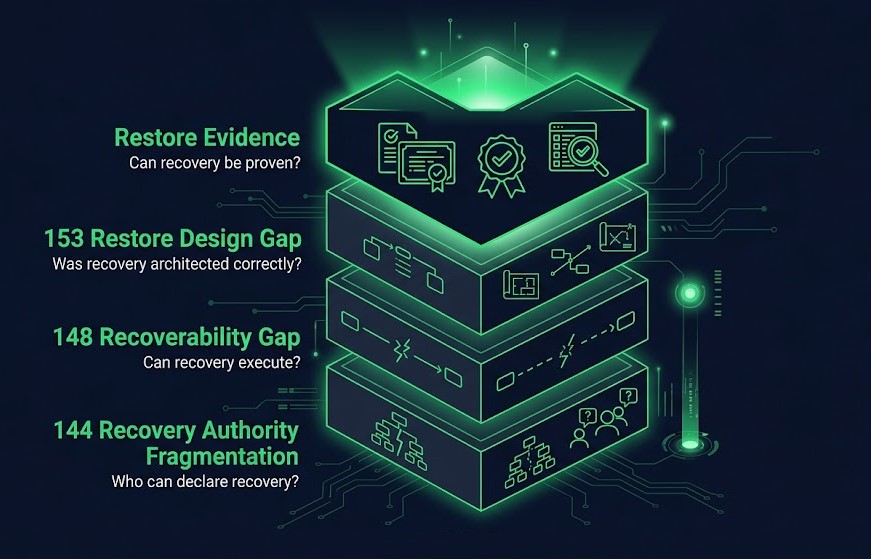
Three frameworks already describe pieces of the recovery problem. None of them describe proof.
| Framework | Question |
|---|---|
| #144 Recovery Authority Fragmentation | Who can declare recovery? |
| #148 Recoverability Gap | Can recovery execute under adversarial conditions? |
| #153 Restore Design Gap | Was recovery architected correctly across all five layers? |
| Restore Evidence | Can recovery be proven? |
An organization can pass all three existing checks — clear authority, survivable execution, correct architecture — and still have nothing to show anyone who asks for proof after the fact. Restore evidence is the layer that sits above all three, not a fourth parallel concern. This closes Data Protection Phase 1: authority, execution, design, and now proof.
AI workloads make that same evidence problem concrete in a way that’s easy to demonstrate and easy to miss. A restored retrieval service can produce every artifact in the checklist above — initiation record, integrity confirmation, dependency checks, sign-off — and still be serving degraded answers, because none of those artifacts checks whether the restored index and the restored embedding model still share a version lineage. Proof of recovery for a retrieval-backed workload requires a fixed set of known-answer queries run against the restored service before recovery is declared — the artifact that answers the question none of the standard restore-evidence categories are built to ask: does the recovered system still mean what it meant before.
Even that proof has a further boundary above it. Restore evidence establishes that verifiable artifacts exist — timestamped, attributable, independently checkable. It doesn’t establish that anyone structurally independent of the team that produced those artifacts has ever been positioned to reject the conclusion they draw. That’s the governance layer the Recovery Evidence Boundary (#167) names directly: an artifact chain can be flawless and still be self-validated, if no authority outside the chain’s own producers has standing to dispute it.
The same artifact-vs-claim distinction applies outside recovery entirely, anywhere an outside party gets to define what counts as proof instead of the team that produced it. Vendor Relationships End. Audit Rights Often Don’t. covers the exit-side version: a decommission ticket marked complete is a result, not evidence — what a vendor’s audit rights actually require is de-provisioning logs from their own management plane and infrastructure-as-code diffs showing the footprint went to zero, retained for as long as the contract’s own record-retention clause runs. “We migrated off the platform” and “we can prove it, on the vendor’s terms, eighteen months later” are exactly the restore-result-versus-restore-evidence gap this post names, one contractual layer over. Retention conflict architecture puts the same gap one layer earlier still: “we resolved the conflicting obligations correctly” is a result. An evidence trail showing who decided, on what authority, and when — before the deletion or preservation action executed — is the artifact that actually survives a regulator’s or auditor’s challenge to that claim.
The strongest version of that proof isn’t generated by a cooperative drill. Adversarial restore testing produces evidence under exactly the conditions an auditor or insurer should care about most — credential revocation, control-plane contention, repository denial — rather than evidence that the restore succeeded when nothing was working against it.
Architect’s Verdict
Most organizations measure recovery success as an event. The restore ran, the systems came back, the ticket closed — success, recorded and forgotten.
Mature recovery programs treat recovery success as an artifact. Not a status. Not a memory. Something that exists independently of the people who produced it, that survives longer than their recollection of the event.
The difference becomes visible the moment someone asks for proof instead of reassurance.
Additional Resources
View 9 more resources
Editorial Integrity & Security Protocol
This technical deep-dive adheres to the Rack2Cloud Deterministic Integrity Standard. All benchmarks and security audits are derived from zero-trust validation protocols within our isolated lab environments. No vendor influence.

R.M.
Senior Solutions Architect with 25+ years of experience in HCI, cloud strategy, and data resilience. As the lead behind Rack2Cloud, I focus on lab-verified guidance for complex enterprise transitions. View Credentials →
Get the Playbooks Vendors Won’t Publish
Choose the architecture problems you care about. Get field-tested playbooks and frameworks delivered to your inbox.
- > AI Infrastructure & Inference Economics
- > Cloud Strategy & Hidden Cost Models
- > Virtualization & Deterministic Migration
- > Kubernetes, IaC & Modern Infrastructure
- > Data Protection & Recovery Engineering
Zero spam. Includes The Dispatch weekly drop.
Need Architectural Guidance?
Independent review before major infrastructure decisions.
- > Validate assumptions
- > Identify hidden dependencies
- > Quantify migration risk
- > Challenge vendor narratives
Triage · Advisory · Fractional · Direct Hire