

Your AI Workload RPO Was Met. The Restore Still Returns Wrong Answers.
AI workload RPO is a time-indexed contract, and AI workloads are not coherent by time.
A retrieval service fails overnight and is restored to the 02:00 recovery point. The capture was clean: one consistency group, every component taken in the same instant. The document store, the vector index, and the serving configuration all come back inside their objective. The database opens. The index loads. The model serves. The health checks go green, and the application answers questions.
It answers them worse than it did yesterday. Nothing failed, so nothing alerts. The recovery report says the objective was met, and by the only definition the recovery tooling has, it was.
What RPO Actually Promises
RPO is the maximum acceptable data loss, measured backward in time from the failure. It’s one of the few recovery metrics that genuinely shapes infrastructure — replication topology, capture frequency, and storage tiering all fall out of it — which is why RTO, RPO, and RTA belong in the design, not the runbook appendix.
Every RPO carries an assumption nobody writes down: at the chosen timestamp, the system was in a coherent state worth recovering to. For a single database, application-consistent capture makes that true. For a multi-store application, consistency groups extend it across stores. In both cases the contract holds because correctness is organized along the same axis the contract measures. A transaction committed at 01:59 belongs to the 02:00 state, and one committed at 02:01 doesn’t. The state at 02:00 is a state the system was actually in.
That premise underpins most of data protection architecture, and for most workloads it’s sound. AI workloads break it quietly. Whether a retrieval pipeline returns the right answer depends on relationships between its components that aren’t organized by time at all. An AI workload RPO inherits that gap without anyone deciding it should.
Three Kinds of Consistency. Backup Systems Can Guarantee Two.
Recovery engineering has spent two decades making “consistent” mean something precise. It currently means two different things. AI workloads need a third.
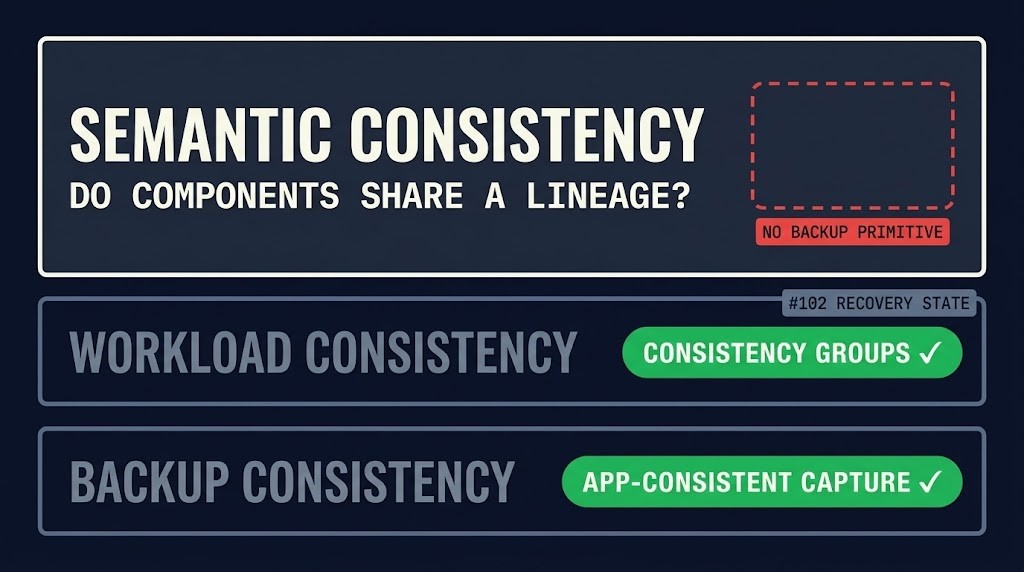
| Layer | Question it answers | What guarantees it |
|---|---|---|
| Backup consistency | Is each component internally coherent? | Application-consistent capture |
| Workload consistency | Do components share a point in time? | Consistency groups |
| Semantic consistency | Do components share a lineage? | No equivalent backup primitive |
The first layer is the old lesson that crash-consistent is not a database backup: bytes copied at an instant are not a state the application can start from. The second is the harder lesson that independently replicated components each report healthy while the recovered system is invalid. That’s the consistency boundary problem, and it’s why Recovery State (#102) treats the full set of state beyond data as the actual recovery target. Consistency groups close it by capturing everything that has to fail together in the same instant.
The primitives for both layers exist. Consistency groups solve temporal incoherence across the Recovery State. They do not solve lineage incoherence.
Semantic consistency asks whether the components belong to the same version lineage. Was the vector index built by the embedding model now encoding queries? Was the model trained against the feature definitions now being served? Does the index reflect the corpus the application believes it’s searching? None of those relationships is defined by a timestamp alone, which is why an AI workload RPO cannot express them by itself. Capturing more often doesn’t satisfy them, and capturing together doesn’t either.
That places lineage one layer beneath the replication and state-survivability cluster in Disaster Recovery & Failover Architecture, where #102 and the other consistency-boundary frameworks sit.
Lineage Skew: Why a Perfect Consistency Group Still Restores the Wrong System
Call the failure lineage skew: components that restore successfully and remain internally consistent, but whose version lineage is no longer coherent across the workload.
The underlying mismatch isn’t new here. The vector database and RAG architecture guide lists embedding model mismatch as a production failure mode and treats a model change as a planned migration that invalidates the index. The LLM Ops lifecycle post describes the symptom precisely: model hash matches, index checksum matches, dashboards clean, answers wrong. What neither covers is the recovery path. The mismatch that change management exists to prevent can be reintroduced by a restore, inside RPO.
Here is the sequence.
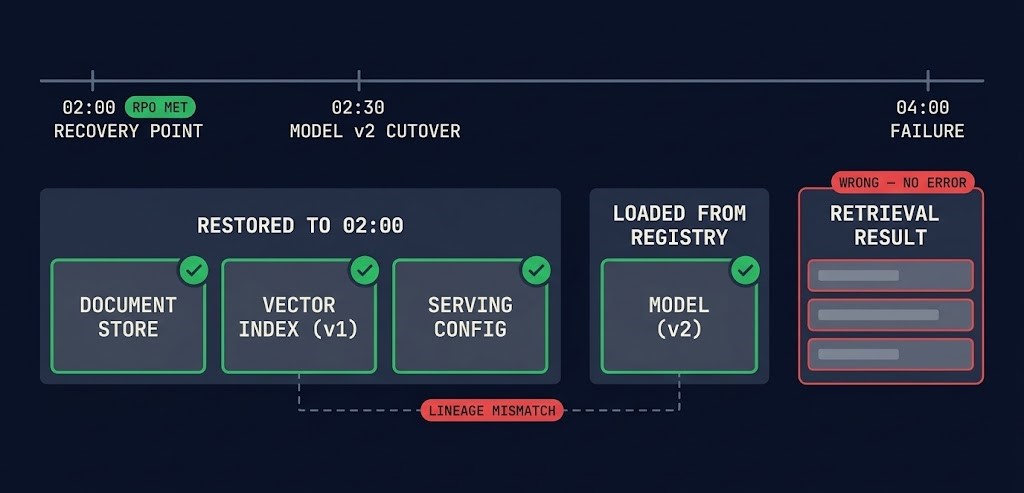
The index was built with embedding model v1. At 02:30, after a planned re-embedding run, the team cuts over to model v2 and the v2 index — exactly the governed migration the guide prescribes. At 04:00 the service fails, and the restore goes back to the 02:00 recovery point, comfortably inside a four-hour AI workload RPO.
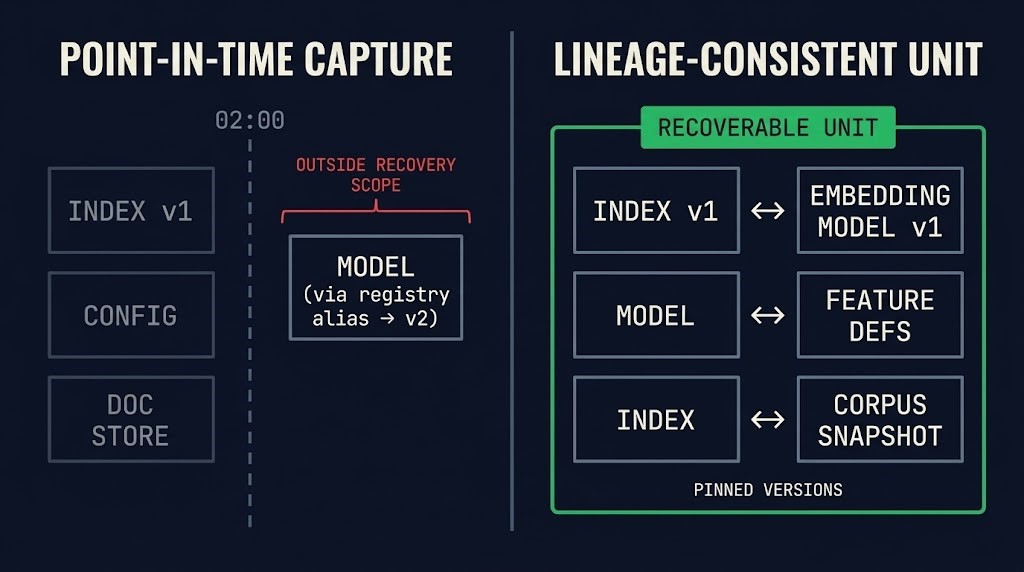
The consistency group did its job. At 02:00 it captured the document store, the index, and the serving configuration in one instant, and all three come back coherent with each other. But the serving configuration doesn’t contain the embedding model. It references one, by an alias the model registry resolves at startup. The registry is shared across services, so it sits outside this workload’s recovery scope, and nobody rolls it back. The restored service starts, resolves the alias, and loads v2. It is now encoding queries with v2 against an index built with v1.
Where an index’s vectors are bound to the lineage of the model that produced them, that pairing produces semantically invalid retrieval even when dimensions match and every component check passes. MongoDB’s migration guidance for its own embedding models says the same thing plainly: vectors from different models aren’t comparable, and identical dimensions don’t make relevance carry across models. Some platforms do offer compatible query models or managed migration paths, and those change the details. They don’t change the recovery question, which is whether the restore knows the binding exists.
The restore completes. The database opens. The index loads. The model serves. The application responds. Similarity search still returns its nearest neighbors, just not the right ones. There’s no error to catch, because nothing is broken in any sense a component can report.
The same shape appears wherever versions are bound. A model restored against feature definitions it wasn’t trained on is training/serving skew, reintroduced by recovery instead of deployment. The embedding case is simply the cleanest proof, because the dependency is absolute and invisible.
Redefining the Recoverable Unit for AI Workload RPO
The Restore Design Gap (Framework #153) already moved the recoverable unit once, from the dataset to the application, because a restored dataset isn’t a recovered service. For AI workloads that move isn’t enough. The application has to come back as a lineage-consistent set, or it can clear every layer #153 defines — data, platform, identity, dependency, even an owner signing off — and still answer wrong.
So an AI workload RPO can’t be set first. It has to be set against a recoverable unit that’s been defined first, and that definition is architectural work:
01 — RECOVERABLE UNIT
What constitutes the recoverable unit? The set of components that must come back as one version, named explicitly — including the ones that live outside the workload’s own storage, such as model registries, feature definitions, and embedding services referenced by alias.
02 — VERSION BINDING
Which components are version-bound? Index to embedding model. Model to feature definitions. Index to corpus snapshot. These pairs define the unit; timestamps don’t.
03 — CHECKPOINT VS. REGENERATE
Which state must be checkpointed, and which can be regenerated? An index can be rebuilt from the corpus and the model, at a cost measured in hours or days. Whether that rebuild fits inside RTO decides whether the index is protected state or derived state.
04 — AUTHORITY
Which component is authoritative? When a restored index and a live model disagree, one of them has to win. Decide which before the incident, not during it.
05 — SKEW TOLERANCE
What lineage skew is acceptable? For many embedding model and index pairings, lineage skew may be unacceptable. Other pairings tolerate drift — a corpus a few hours staler than its index may be fine. Set the tolerance per pair, not per workload.
06 — PROOF OF RECOVERY
How will recovery be proven at the application level? Component health can’t answer this. A test whose answer is known before the incident can — covered in the next section.
The inventory already exists. The reproducibility layer in the LLM Ops lifecycle post — model hash, retrieval snapshot ID, preprocessing version — was written down so someone could explain a strange answer months later. Recovery has to treat that same list as the unit it restores, pinned together, rather than as metadata it happens to carry. Point-in-time snapshots remain necessary. The lineage binding is what makes them sufficient.
What Changes in the Next Restore Test
Most restore tests written against an AI workload RPO check that the components came back: the index loads, the endpoint answers, latency looks normal. Those checks are necessary, and they can’t see lineage skew, because every component really did come back.
Component health proves the components came back. A known-answer retrieval test proves the recovered lineage still means what the workload expects it to mean. Keep a fixed set of queries with known correct results, run it against the restored service before recovery is declared, and treat a drop in retrieval quality as a failed restore, not a tuning ticket.
That test also carries weight in the determinism sense. The Deterministic Recovery Model (#158) requires success criteria fixed before the incident, and a known-answer set is exactly that kind of criterion. Without it, a lineage-skewed restore can be perfectly deterministic: the same wrong answers, every run. Determinism proves the outcome repeats. Only a semantic test proves it’s the right outcome.
Architect’s Verdict
AI workload RPO measures how much time you can afford to lose. It says nothing about whether what comes back belongs together, and for AI workloads that’s the part that decides whether the service is correct.
The failure isn’t in the backup product. Consistency groups do exactly what they promise. The failure is treating a timestamp as the definition of a recovery point for a system whose correctness is defined by version lineage — and leaving the components that carry that lineage, like a shared model registry, outside the recovery scope because they don’t look like data.
Define the recoverable unit before you set the objective. Recovery objectives should be measured against that recoverable unit, not merely against the timestamp of a successful restore. Name the version-bound pairs, decide which side is authoritative, and prove recovery with a query whose answer you already know.
A timestamp tells you when. It can’t tell you which.
Additional Resources
View 3 more resources
Editorial Integrity & Security Protocol
This technical deep-dive adheres to the Rack2Cloud Deterministic Integrity Standard. All benchmarks and security audits are derived from zero-trust validation protocols within our isolated lab environments. No vendor influence.

R.M.
Senior Solutions Architect with 25+ years of experience in HCI, cloud strategy, and data resilience. As the lead behind Rack2Cloud, I focus on lab-verified guidance for complex enterprise transitions. View Credentials →
Get the Playbooks Vendors Won’t Publish
Field-tested blueprints for migration, HCI, sovereign infrastructure, and AI architecture. Real failure-mode analysis. No marketing filler. Delivered weekly.
Select your infrastructure paths. Receive field-tested blueprints direct to your inbox.
- > Virtualization & Migration Physics
- > Cloud Strategy & Egress Math
- > Data Protection & RTO Reality
- > AI Infrastructure & GPU Fabric
Zero spam. Includes The Dispatch weekly drop.
Architecture Audit Services
Fixed-scope audits for Zero-Trust Azure, VMware migration readiness, and recovery posture — no discovery call required to start.
>_ View Audit Services>_Related Posts
Your VMware Exit Was Successful. The First Incident Will Tell You If That’s True.
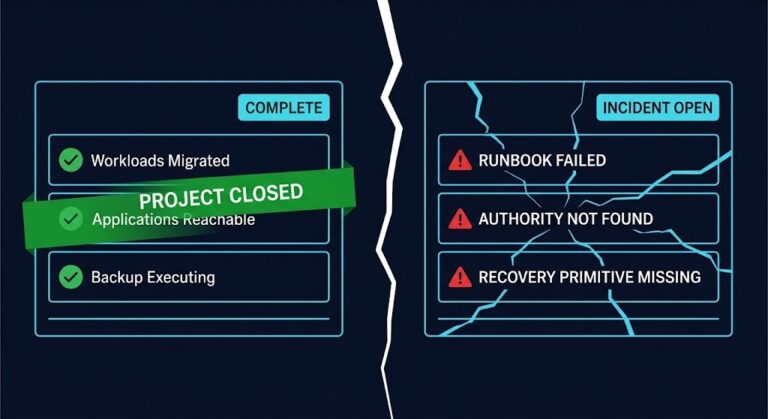
VMware exit survivability is the question your migration project never formally scheduled — and the first production incident on the new platform will answer it whether you are ready or not. The cutover completed. The workloads are running. The project closed green. None of that tells you whether the operating model, runbooks, authority structures, and…
Your Vendor Review Process Never Saw The Real Supplier
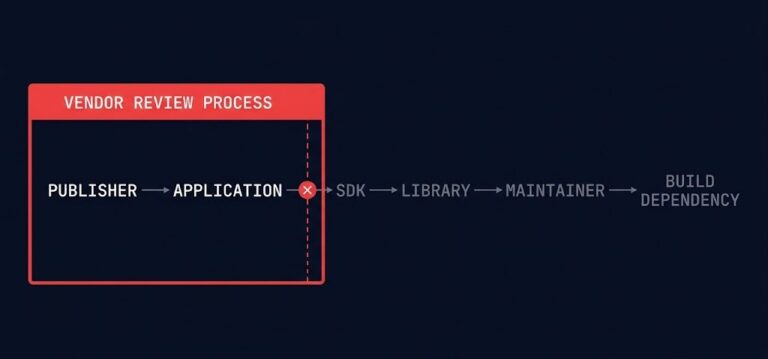
Every vendor review process assumes it’s evaluating a supplier — but a scan finding foreign-origin code embedded in more than one in eight mobile apps used by US military personnel makes the actual assumption visible: organizations review the company they bought from, not the code that arrived inside what they bought. >_ Architect’s Brief 60-second…
Your Recovery Program Has a Recovery Evidence Boundary
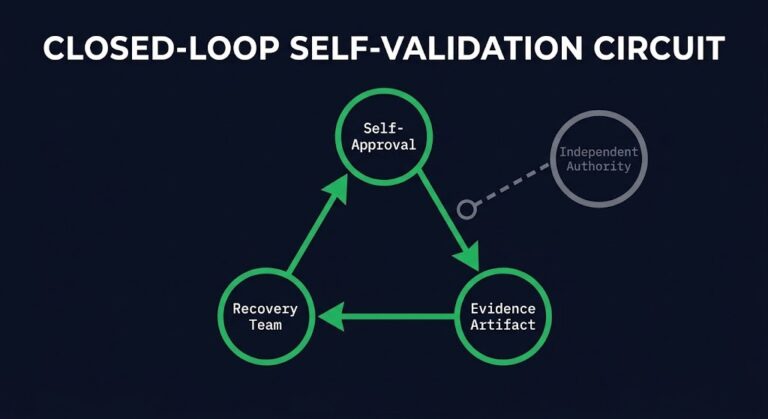
Recovery evidence boundary is the point where a recovery program stops being an engineering question and starts being a governance one — and most organizations cross it without ever finding out, because everything on the way there still looks like success. The backups completed. The DR test passed. The tabletop went well. Somebody wrote a…
Your Recovery Architecture Has A Bus Factor Problem
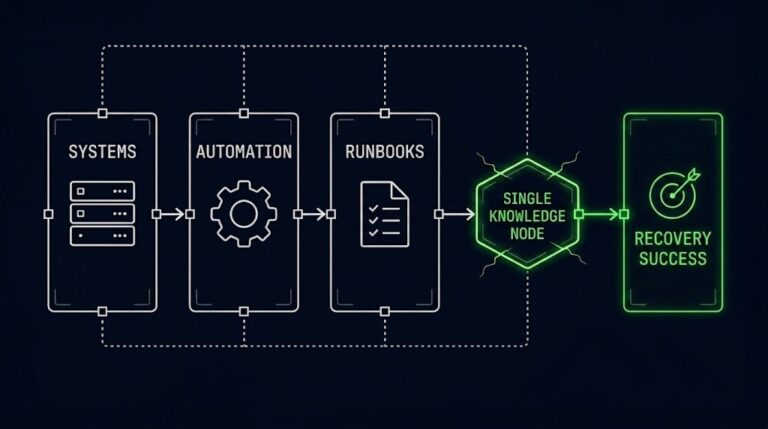
Recovery bus factor is the gap between a recovery plan that has been tested, documented, and signed off — and a recovery plan that can actually be executed when the one or two people who know how to run it aren’t in the room. The recovery program had passed everything that mattered on paper: RTO…
Your Ransomware Recovery Plan Has a Recoverability Gap
The recoverability gap is the structural distance between what your recovery plan assumes and what your infrastructure can actually deliver under failure conditions. Most organizations don’t discover it during planning. They discover it on day three of an incident. >_ Architect’s Brief 60-second read before you commit to the full post · Full post: 13…
Your Ransomware Plan Is Fiction: 5 Recovery Metrics Nutanix, Cohesity, Rubrik & Pure Can’t Hide
Ransomware recovery metrics are the only thing standing between your recovery plan and a PowerPoint. Every vendor demo shows a single VM booting in 60 seconds. Every real ransomware recovery looks like this: the backups are intact, the ransomware is neutralized, the executives are on the bridge — and nothing is coming back online. >_…