

Recovery Determinism Is Becoming the Real DR Problem
Recovery determinism is the property most disaster recovery programs never engineered for, and its absence is why the same plan produces a different outcome every time it runs. Two teams ran the same runbook against the same failure scenario six weeks apart. The first drill closed in just under four hours. The second — same application, same backup set, same documented steps — took eight hours and change, and closed only after someone found an identity dependency nobody had modeled. Nothing in the plan changed. The outcome did anyway.
That’s not a testing problem. It’s not a staffing problem. It’s a property the recovery architecture never had in the first place.
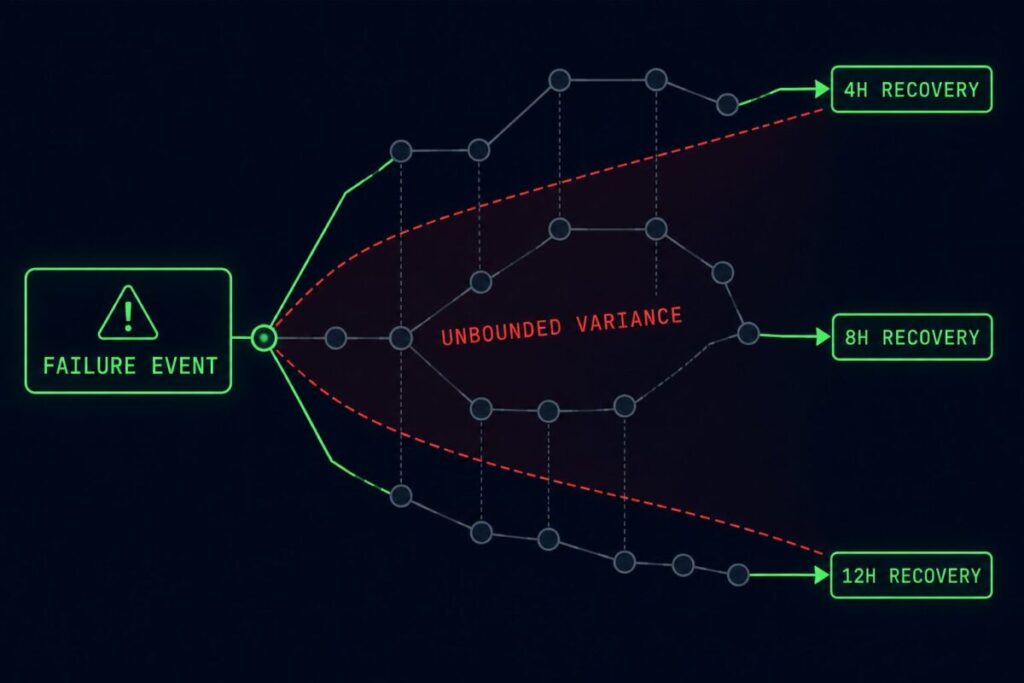
Your DR Program Optimized for Coverage. The Problem Is Variance.
Most data protection programs have spent the last several years closing the right gaps — backup coverage, immutability, restore testing, authority mapping. Each of those closed a real hole. None of them touch the thing that actually determines whether a recovery event goes well: whether the outcome is repeatable.
Your DR Test Passed. The Assumptions Didn’t. documented this from the assumption side — DR tests that pass because they validate the assumptions baked into the runbook, not the failure conditions that actually occur in production. Backup Success Rates Are a Dangerous Metric made the adjacent point about measurement: a 99.98% backup success rate tells you data was captured, not that recovery from it behaves the same way twice. Both posts describe symptoms of the same underlying absence. Neither names it directly.
Here’s the direct version: recovery that succeeds sometimes isn’t recovery architecture — it’s probability. An organization can pass a DR drill and still have no idea whether the next real incident resolves in four hours or twelve, because nothing in the architecture constrains that variance. It’s discovered live, incident by incident, rather than engineered in advance.
That gap has a name, and until now it hasn’t had a framework.
What Recovery Determinism Actually Means
Recovery determinism is not another way of saying RTO or RPO. RTO and RPO are targets — numbers a plan is written against. Determinism is a property of the system that executes the plan: whether hitting those targets is a predictable outcome or a lucky one.
RTO Reality: Why Your Backups Mean Nothing Without a Recovery Drill makes the mechanism visible without naming it: a recovery drill’s real value isn’t confirming the RTO was met once, it’s confirming the RTO gets met again under different conditions — different on-call engineer, different time of day, different partial-failure state. When that second drill produces a materially different result, the plan wasn’t wrong. The system just isn’t deterministic. RTA — recovery time actual — becomes a distribution instead of a number, and a wide distribution is the tell.
A recovery process is deterministic when the same failure condition produces the same recovery outcome within a bounded variance envelope. That last phrase matters. Determinism doesn’t mean a stopwatch reading of exactly four hours every time. Four hours, four hours ten minutes, and three hours fifty-five minutes is still deterministic — the variance sits inside an engineered tolerance. What isn’t deterministic is four hours one quarter and twelve the next, driven by which engineer answered the page and what they had to discover mid-incident. The engineering target isn’t zero variance. It’s bounded variance.
Framework #158 — The Deterministic Recovery Model
Four variables govern whether a recovery process holds this property, and all four have to hold simultaneously — a recovery that gets three of four right is still probabilistic, because the fourth is where the variance leaks back in.
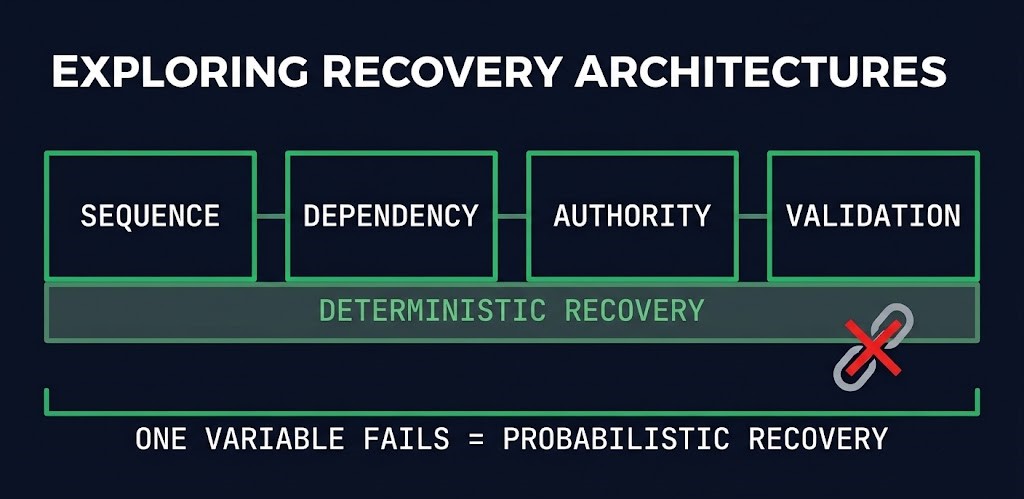
01 — SEQUENCE
Restore order is fixed and validated in advance — not reconstructed by whichever operator is on call. If the sequence is discovered live, the outcome depends on who’s discovering it.
02 — DEPENDENCY
Required dependencies are known and bounded before the incident, not discovered during it. Identity systems, certificate hierarchies, federation services, and delegated trust relationships are the modern flagship case — they’re dependency-state requirements, not independent recovery targets, and finding them mid-restore is where most variance originates.
03 — AUTHORITY
Decision rights are invariant under incident conditions — who can approve a failover, authorize a restore sequence, or declare recovery complete doesn’t shift depending on who happens to be reachable.
04 — VALIDATION
Success criteria are predefined and repeatable, not adjudicated after the fact. If “recovered” means something different depending on which operator is asked, the recovery time itself becomes negotiable — and negotiable recovery time is the opposite of deterministic.
When one or more of these is left to be resolved at incident time instead of engineered in advance, the failure state is Probabilistic Recovery — the recovery completes, but which outcome it produces depends on who’s running it and what they discover along the way. Outcome exists. Confidence in repeating it doesn’t.
GM’s eBoost degradation sequence is a Validation-variable question at hardware scale. GM ran the sequence, confirmed the outcome once in a dynamic test scenario, and documented it as the expected response. What NHTSA’s Engineering Analysis is now examining is whether that outcome repeats across the full range of real-world ABS events — or whether the tested result was closer to a favorable single run than a bounded, deterministic behavior. GM’s Brake-by-Wire Investigation Is a Verification Story covers the same one-test-vs-repeatable-outcome question this framework names for recovery architecture.
This is Framework #158 in the Data Protection maturity progression, and it sits at a specific point relative to what’s already documented. Recovery Architecture Foundations — Framework #146, Recovery Design Boundary — asks whether a recovery path is designed at all. Recovery Execution Boundary, Framework #147, asks whether the platform can actually execute that path under failure conditions. Framework #158 asks the question neither of the first two tests for: once the path is designed and executable, does it produce a repeatable outcome? The progression now runs one boundary further still: the Continuity Execution Boundary (#163) asks the question that stays open even after all three hold — whether the business is actually operating on the other side of a recovery that was designed, executable, and repeatable — the determinism-to-continuity handoff that anchors Cluster 4 of the Disaster Recovery & Failover Architecture stage.
| Framework | Question | Failure State |
|---|---|---|
| #146 — Recovery Design Boundary | Can recovery be designed? | Recovery-Blind Architecture |
| #147 — Recovery Execution Boundary | Can recovery be executed? | Authority Without Execution at the platform layer |
| #158 — Deterministic Recovery Model | Can recovery be repeated? | Probabilistic Recovery |
Backups Fail at Restore Time Because Restore Is Underdesigned documented the undesigned space between technical recovery and operational recovery — data restored, VM running, but nobody agreeing on whether the system actually works. That’s a real and adjacent problem, but it names an absence. The Validation variable above is what closes it: not just observing that validation was missing, but prescribing that validation criteria be fixed in advance and applied the same way every time.
Disaster Recovery Authority: The Missing Layer in Most Recovery Plans covers the Authority variable in isolation — who owns the decision to fail over, and what happens when that ownership isn’t clear at 3 a.m. It’s the personnel-and-credential layer of the same variable this framework treats as one of four, not the whole picture.
Why Recovery Determinism Is Becoming Harder to Hold
Recovery variance isn’t static — it’s growing, and it’s growing because the four variables above have more surface area than they did five years ago.
Your Ransomware Recovery Plan Has a Recoverability Gap covers the adversarial case directly: a ransomware event doesn’t just test whether backups exist, it tests whether identity, credentials, control-plane orchestration, and governance approval all survive the same event that triggered recovery. That’s Sequence, Dependency, and Authority variance compounding simultaneously under conditions specifically designed to break all three at once. A clean-failure DR test never exercises that combination — which is exactly why a passing drill and a survivable ransomware recovery are different claims.
Adversarial restore testing is the practice built specifically to close that distinction — staging credential revocation, control-plane contention, and repository denial deliberately, rather than leaving Sequence, Dependency, and Authority variance to compound for the first time during an actual ransomware event.
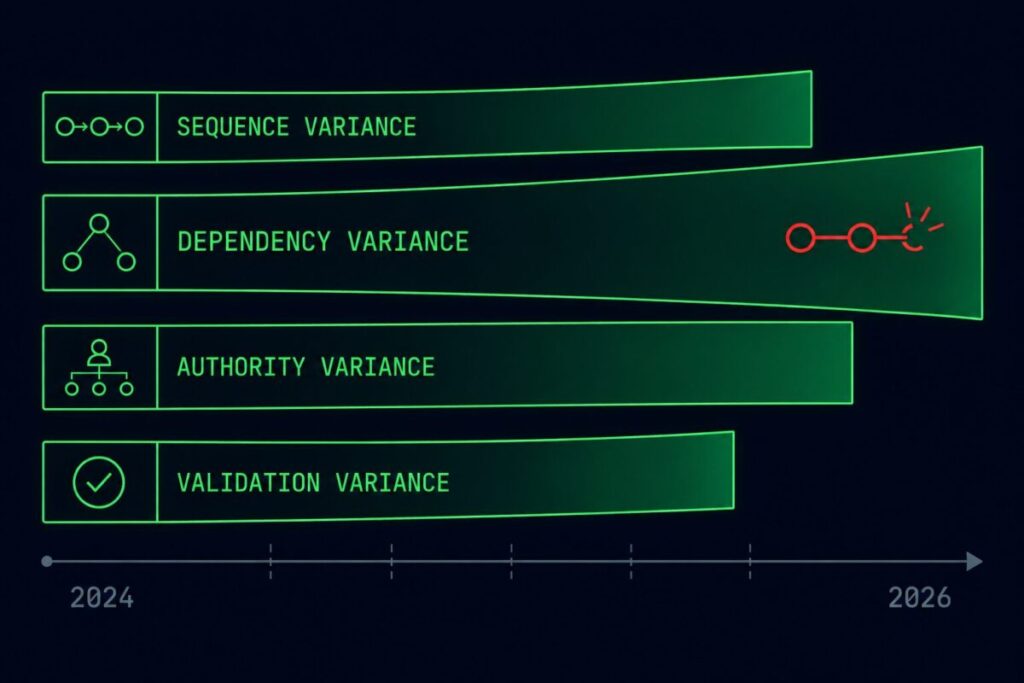
The four variance sources map directly back to the model:
- Sequence variance — restore order improvised rather than pre-validated, usually because the environment has grown past the point where one runbook still matches reality.
- Dependency variance — the identity-chain problem above, plus DNS, certificates, secrets, and third-party integrations discovered rather than modeled. Modern environments depend on more of these than they did even two years ago, and each one is a place variance can enter.
- Authority variance — decision rights that were clear on an org chart and unclear the moment the incident actually happens, especially across teams that didn’t design the recovery plan together.
- Validation variance — the newest and least discussed source. As recovery increasingly spans application, identity, and business-transaction layers, “recovered” stops being a single technical checkbox and becomes a negotiation between whoever’s in the room.
None of these four are shrinking. Recovery determinism is becoming the real DR problem precisely because the systems recovery depends on keep adding dependency surface faster than most programs are engineering variance out of it.
Engineering Determinism: From Observed Outcome to Designed Property
The fix isn’t a better runbook — most enterprise DR programs already have detailed runbooks. It’s treating each of the four variables as something to engineer against, not something to discover during the next incident.
Recovery Platform Architecture — the D2 stage — is where Sequence and Authority get tested against actual platform execution capability, not just documented intent. Cyber Vault Architecture — D3 — extends the same discipline to Dependency variance under adversarial conditions, where the dependency set has to be assumed compromised rather than merely unavailable.
Restore Evidence Is the Missing Artifact in Every DR Program is the companion piece on Validation specifically: a deterministic recovery claim is only as good as the evidence artifact behind it. Predefined success criteria are only useful if there’s a record showing they were actually applied the same way each time, not just documented and then interpreted differently in the moment.
AI workloads need a Validation criterion the general case doesn’t: a fixed, known-answer test, not just a defined one. A retrieval-backed service can satisfy Sequence, Dependency, and Authority perfectly and still be lineage-skewed — the restore is deterministic, repeatable, every run producing the identical wrong answer. Determinism proves the outcome repeats. Only a semantic test, run against the same queries every time, proves it’s the right outcome.
Determinism is also the property a board-level recovery readiness claim depends on most directly: a recovery number reported upward as governance is worthless if it describes one favorable drill rather than a repeatable outcome — the same distinction this framework draws between an observed result and an engineered property. Sequence, Dependency, Authority, and Validation are the technical substrate underneath what a board experiences as “would this hold up again, with a different team on call.”
Dependency variance is also the one variable that’s directly testable today, independent of a live incident:
Architect’s Verdict
Recovery determinism is the property most DR programs have never named, let alone engineered for. Backup coverage, immutability, and restore testing all matter — none of them tell you whether the same failure produces the same outcome twice.
The real problem isn’t that recovery is hard, or that dependencies exist, or that testing is insufficient. Those are already documented elsewhere. The problem is that recovery outcome variance is itself an architectural failure state — one that gets treated as bad luck, a staffing gap, or an unlucky on-call rotation, when it’s actually the predictable result of four variables nobody engineered to hold constant.
A recovery plan that works is not the same claim as a recovery plan that works the same way every time. Most enterprise DR programs can currently only make the first claim.
Additional Resources
View 6 more resources
Editorial Integrity & Security Protocol
This technical deep-dive adheres to the Rack2Cloud Deterministic Integrity Standard. All benchmarks and security audits are derived from zero-trust validation protocols within our isolated lab environments. No vendor influence.

R.M.
Senior Solutions Architect with 25+ years of experience in HCI, cloud strategy, and data resilience. As the lead behind Rack2Cloud, I focus on lab-verified guidance for complex enterprise transitions. View Credentials →
Get the Playbooks Vendors Won’t Publish
Choose the architecture problems you care about. Get field-tested playbooks and frameworks delivered to your inbox.
- > AI Infrastructure & Inference Economics
- > Cloud Strategy & Hidden Cost Models
- > Virtualization & Deterministic Migration
- > Kubernetes, IaC & Modern Infrastructure
- > Data Protection & Recovery Engineering
Zero spam. Includes The Dispatch weekly drop.
Need Architectural Guidance?
Independent review before major infrastructure decisions.
- > Validate assumptions
- > Identify hidden dependencies
- > Quantify migration risk
- > Challenge vendor narratives
Triage · Advisory · Fractional · Direct Hire