

Azure Landing Zones and AWS Control Tower Won’t Fix a Broken Operating Model
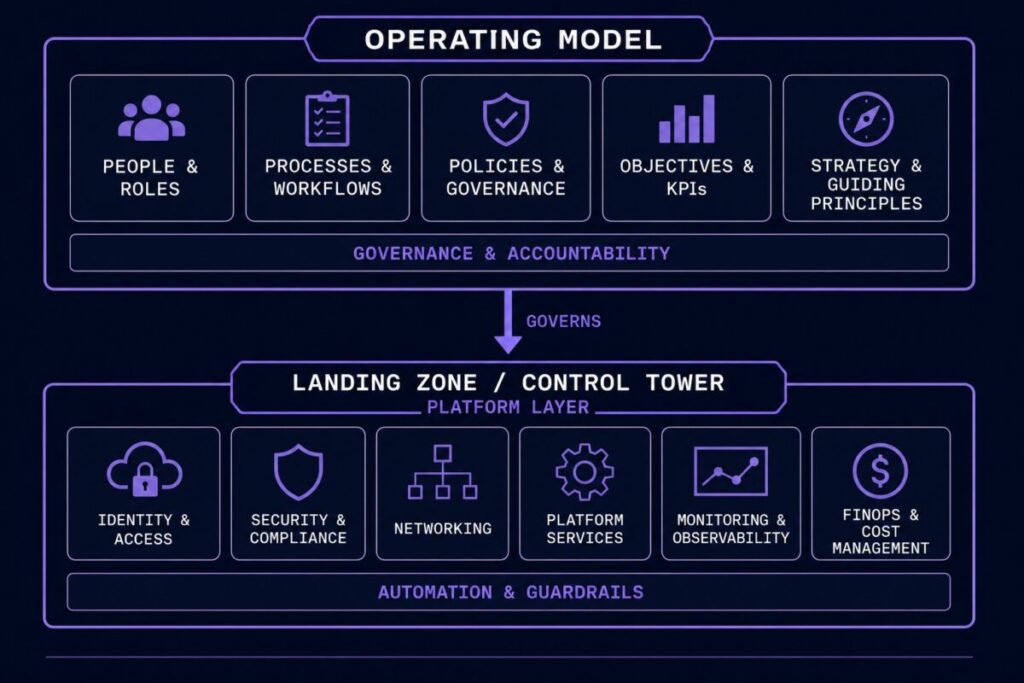
Operating model gaps are the reason two organizations can deploy the identical Azure Landing Zone or AWS Control Tower reference architecture and end up with completely different governance outcomes. Organizations frequently debate Azure Landing Zones versus AWS Control Tower as though the platform determines the outcome. In practice, most failed deployments aren’t platform failures. They’re operating-model failures that existed before the first landing zone was ever deployed — the platform choice just determines which flavor of guardrail eventually gets routed around.
That distinction sounds academic until you watch it fail in production. An organization deploys a textbook-correct Azure Landing Zone — management group hierarchy, policy assignments, subscription vending, the works — and eighteen months later governance has quietly collapsed into exception spreadsheets and Slack threads. The architecture didn’t degrade. The operating model underneath it was never resolved, and the platform has spent eighteen months faithfully encoding whatever ad hoc decisions filled that vacuum.
The Coherence Problem Everyone Misdiagnoses
The comparison exercise itself isn’t wrong — Azure Landing Zone and AWS Control Tower have genuinely different architectural philosophies, and picking the wrong one for your org’s cloud posture creates real friction. But that comparison answers a platform-structure question, not a governance-outcome question. Teams that treat “which platform” as the decision that determines governance quality are solving the wrong layer of the problem.
The tell is almost always the same: leadership asks for a landing zone “so we finally have governance,” as if governance is a deployable artifact rather than a standing decision-making capability the artifact merely encodes. Six months post-deployment, the guardrails are technically intact and the governance is theater — every meaningful decision still routes around the platform because the platform was never given anything real to enforce.
What the Operating Model Actually Governs
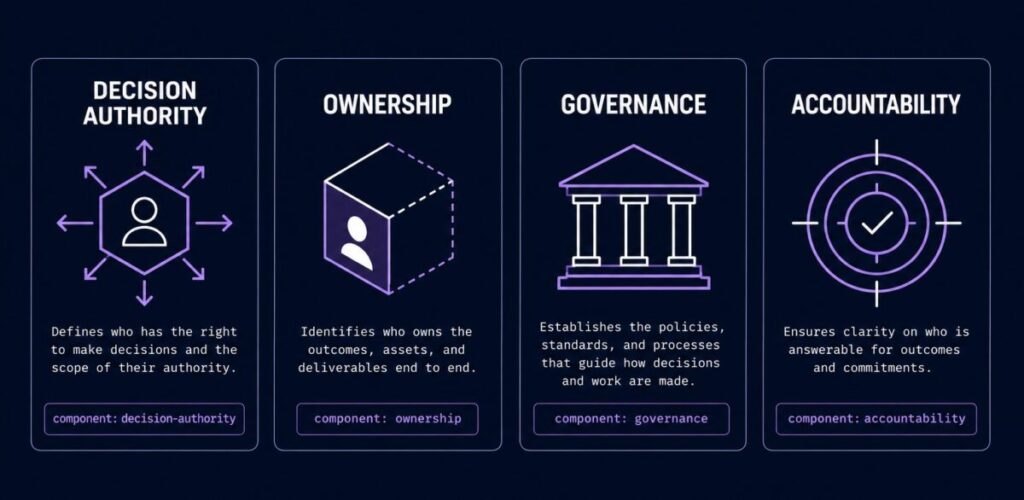
An operating model, in the sense that matters for landing zone and control tower deployments, resolves four things before a single management group gets created:
Decision Authority — who has standing to make a governance decision, and at what altitude. Not “who can technically change a policy” — who is authorized to.
Ownership — which team or role owns which layer of the environment, in a way that survives reorgs and doesn’t require a war-room to reconstruct during an incident. This is the same failure pattern internal developer platforms run into when ownership gets deferred to the tooling layer instead of resolved organizationally — the platform absorbs a question it was never designed to answer.
Governance — the standing process by which decisions get made, revisited, and enforced. Not a policy document. A functioning process with a named owner.
Accountability — what happens when governance is violated, drifts, or gets bypassed under pressure, and who is answerable for the outcome either way. The same accountability gap shows up as configuration drift once ownership isn’t resolved — drift isn’t usually a tooling failure, it’s an ownership failure that happens to surface as tooling symptoms.
Cross-cloud environments add a fifth dimension to this: when a decision spans multiple cloud environments, none of the four domains above function independently anymore — decision authority, execution, governance, and recovery all have to hold simultaneously across the boundary, not just within a single provider’s landing zone.
None of these four things live inside Azure Landing Zone or AWS Control Tower. Both platforms assume you’ve already answered them and give you a place to implement the answer. Microsoft’s own Cloud Adoption Framework governance documentation makes this same distinction — governance disciplines are organizational decisions the framework helps structure, not something the landing zone tooling supplies on its own.
Why Landing Zones and Control Tower Can’t Solve Ownership
Guardrails encode decisions. They cannot originate them. An Azure Policy assignment or an AWS Control Tower preventive guardrail is a compiled decision — someone, at some point, decided what “acceptable” looks like, and the guardrail enforces that decision mechanically going forward. If the “someone” was never clearly identified, or the decision was made informally and never actually had standing authority behind it, the guardrail is enforcing a decision that doesn’t have an owner.
This is where the failure mode gets deceptive: the guardrails still fire. Policy violations still get blocked. The dashboards look green. But the moment a genuine exception arises — a business unit needs a deviation, a workload doesn’t fit the standard pattern, an acquisition brings in infrastructure that predates the landing zone — there’s no resolved authority to adjudicate it. What happens instead is what always happens when authority is unresolved: the loudest stakeholder wins, the exception gets granted informally, and the landing zone’s policy layer now has a gap nobody tracked because the exception never went through a process that didn’t exist in the first place.
This is the mechanism cloud governance failure domains names directly: the guardrail isn’t advisory anymore, it’s execution-path infrastructure, and an unresolved exception doesn’t just sit in a queue waiting for review — it inherits downward through everything provisioned under that policy layer until someone notices. The guardrail behaved exactly as configured. The operating model behind it never did.
Multiply that by a few dozen exceptions over a couple of years and you get an architecture that is technically compliant and operationally incoherent — guardrails everywhere, coherent decision-making nowhere.
The Same Architecture Produces Different Outcomes Under Different Operating Models
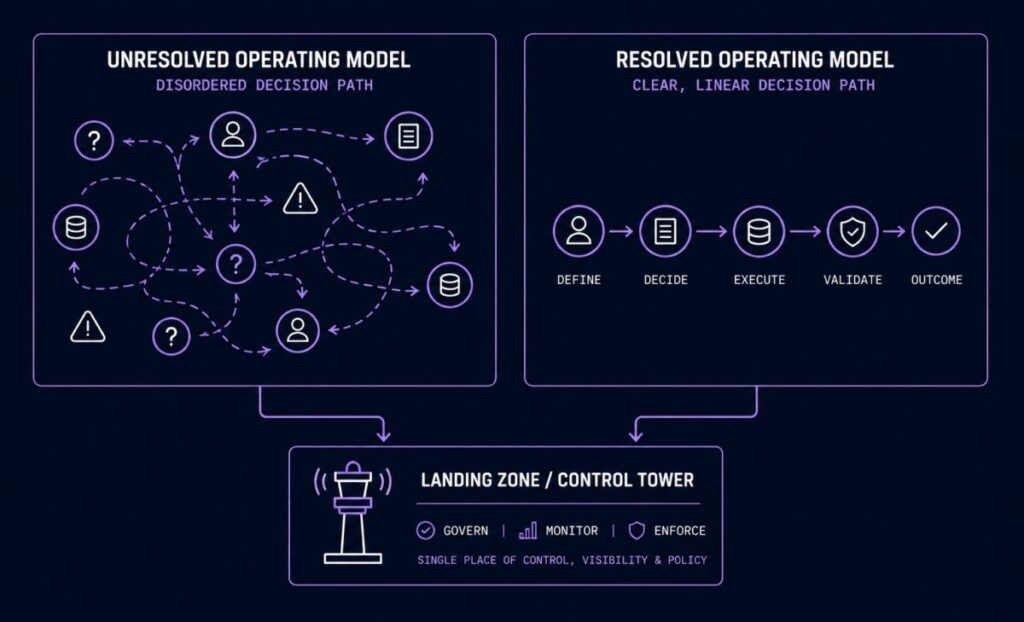
Here’s the comparison that actually matters — not Azure versus AWS, but the same platform under two different operating-model conditions:
| Unresolved Operating Model | Resolved Operating Model |
|---|---|
| Ownership negotiated during incidents | Ownership defined before incidents |
| Policy exceptions become political decisions | Policy exceptions follow established authority paths |
| Drift remediation is unclear | Drift remediation has named ownership |
| Governance depends on individuals | Governance survives personnel changes |
Azure Landing Zones and AWS Control Tower did not change between these environments. The operating model did.
This is the part most landing zone content skips entirely, because it’s more satisfying to write “architecture causes outcome” than “operating model determines whether the architecture is even capable of producing the outcome.” But it’s the more accurate causal chain, and it’s the one that actually explains why two teams following the same Microsoft or AWS reference architecture end up in such different places eighteen months later.
It’s also worth naming where this leads if it stays unresolved long enough. A broken operating model produces unresolved ownership. Unresolved ownership produces unclear decision authority. Unclear decision authority produces authority dependency — governance that only functions because specific people or teams happen to still be there holding it together informally. And authority dependency, left long enough, is exactly the condition that produces an authority survivability failure: the architecture doesn’t just govern poorly, it stops being able to govern at all once the people holding the informal authority together are gone. That’s a different failure mode than anything Landing Zone or Control Tower guardrails are built to catch, and it’s why Strategic Resilience exists as its own concern in cloud architecture — separate from whether your policies are technically well-formed.
What an Architect Should Define Before Deploying Either Platform
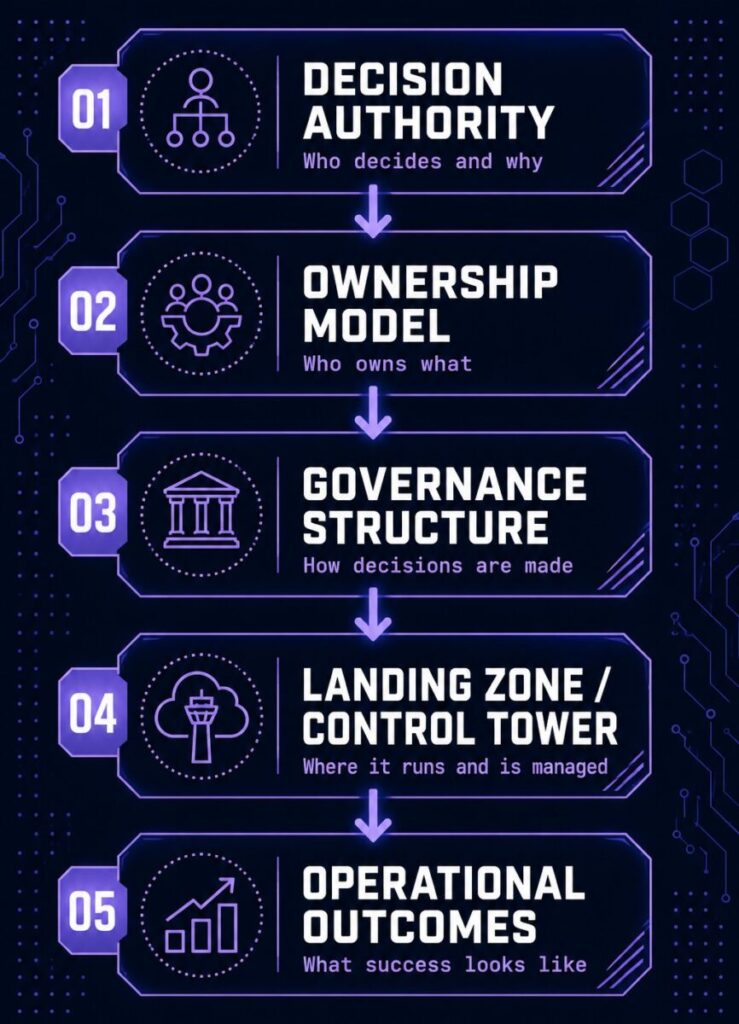
Before the first management group, organizational unit, or account vending request goes in, resolve these — in writing, with named owners, not as a policy document nobody re-reads. AWS’s own Control Tower documentation is explicit that guardrails implement governance rules the organization defines — the service sets up the landing zone and enforces the rule set, it doesn’t originate the rule set.
- Decision authority map — who can approve what, at what altitude, and what happens when a decision doesn’t cleanly belong to one owner
- Ownership assignment by layer — network, identity, policy, cost, workload — each with a named accountable owner, not a team distribution list
- Exception-handling path — a real process for the case that doesn’t fit the standard pattern, defined before the first exception request arrives under pressure
- Drift accountability — who is responsible when the environment diverges from policy, and what the remediation SLA actually is
Deploy the landing zone or control tower after these are resolved, not as a mechanism for resolving them. The platform is very good at enforcing a decision. It has no opinion on whether the decision was ever actually made by someone with standing to make it.
Architect’s Verdict
Azure Landing Zones and AWS Control Tower are governance accelerators, not governance substitutes. They can implement an operating model with real speed and consistency once one exists. They cannot create one, and deploying either platform into an organization that hasn’t resolved decision authority, ownership, and accountability doesn’t produce governance — it produces a very well-instrumented version of the same ambiguity that existed before the platform arrived.
The real diagnostic question isn’t “which landing zone architecture.” It’s whether anyone in the organization can currently say, without a meeting, who owns a given policy exception and why. If that answer doesn’t exist, no reference architecture is going to manufacture it.
Two organizations can run the exact same platform and get better-organized confusion instead of governance. The platform was never the variable that mattered.
Additional Resources
Editorial Integrity & Security Protocol
This technical deep-dive adheres to the Rack2Cloud Deterministic Integrity Standard. All benchmarks and security audits are derived from zero-trust validation protocols within our isolated lab environments. No vendor influence.

R.M.
Senior Solutions Architect with 25+ years of experience in HCI, cloud strategy, and data resilience. As the lead behind Rack2Cloud, I focus on lab-verified guidance for complex enterprise transitions. View Credentials →
Get the Playbooks Vendors Won’t Publish
Choose the architecture problems you care about. Get field-tested playbooks and frameworks delivered to your inbox.
- > AI Infrastructure & Inference Economics
- > Cloud Strategy & Hidden Cost Models
- > Virtualization & Deterministic Migration
- > Kubernetes, IaC & Modern Infrastructure
- > Data Protection & Recovery Engineering
Zero spam. Includes The Dispatch weekly drop.
Need Architectural Guidance?
Independent review before major infrastructure decisions.
- > Validate assumptions
- > Identify hidden dependencies
- > Quantify migration risk
- > Challenge vendor narratives
Triage · Advisory · Fractional · Direct Hire