

The Hypervisor Is Not the Migration Target — The Operating Model Is
The post-migration incident report almost never blames the hypervisor. Workloads came up clean. Networking was verified. Storage performed. The technical migration, by every measure logged during the project, was a success.
Ninety days later, the first real incident runs into runbooks that reference vCenter constructs that no longer exist. The on-call engineer escalates to a team that knows vSphere, not the target platform. A capacity decision stalls because nobody established who owns placement authority on the new environment. The infrastructure works. The operation around it does not.
That gap is not a gap in the technical migration. It is a gap in the virtualization operating model migration — and it is almost never scoped in the original project plan.
The weight of that gap depends on which path got you here. Consolidators — staying on VMware — defer this problem entirely, for now. Replacers and Absorbers, the two camps actually executing a platform migration, inherit it in full regardless of which target platform they picked.
What Decisions the Virtualization Platform Was Making For You
Most migration planning starts with a workload inventory. That is the right first step, but it answers the wrong question. The question that determines operational readiness after cutover is not “what workloads are running” — it is “what decisions has the platform been making autonomously, and what happens to those decisions when the platform is gone?”
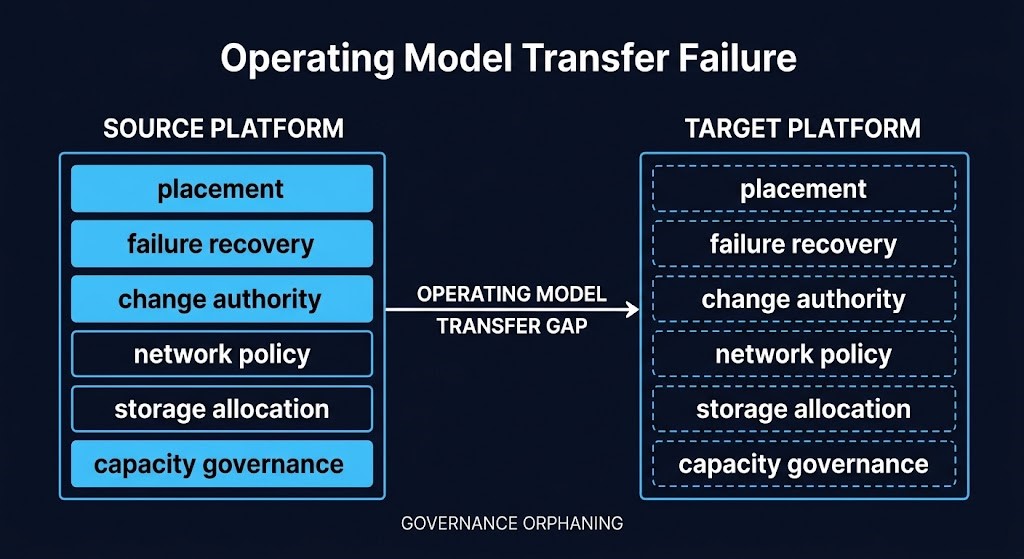
In virtualization architecture, the hypervisor and its management layer accumulate decision authority over time. Not through a deliberate governance design, but through accumulated default behavior, policy configuration, and operational habit. After ten or fifteen years of vSphere, most environments have a platform that is actively governing the following decisions on the team’s behalf:
DECISIONS THE PLATFORM WAS MAKING FOR YOU
- Where workloads run. DRS balances placement continuously. Affinity and anti-affinity rules encode business constraints. The platform decides, within policy bounds, where each VM lands.
- Which failures trigger recovery. HA thresholds, admission control settings, and restart priority rules define what the platform treats as a failure and how aggressively it responds. Those decisions are embedded in cluster configuration, not in runbooks.
- Who can change infrastructure. vCenter roles and permissions encode change authority. Who can provision, who can modify networking, who can touch storage — the platform enforces this without human involvement in every transaction.
- Which networks can communicate. NSX policy or distributed port group configuration determines what can reach what. These are not firewall rules in the traditional sense; they are platform-enforced network authority decisions.
- How storage is allocated. Storage policies, VM storage profiles, and SPBM rules translate business intent into provisioning behavior automatically. The platform matches workload to datastore without requiring a ticket.
- How capacity is consumed. Reservation, limit, and share configuration governs how the platform allocates compute contention. The capacity model is encoded in the platform, not documented externally.
These are not features. They are governance functions that were delegated to the platform — gradually, implicitly, and in most cases without a record that clearly documents the delegation. The migration plan moves the workloads. It rarely moves the governance.
Framework #137 — Operating Model Transfer Gap
FRAMEWORK #137 — OPERATING MODEL TRANSFER GAP
The delta between the governance, authority, policy enforcement, and operational context implicitly provided by a source platform and the explicit capabilities that must be recreated in the target platform after migration.
Governance Orphaning is the failure state: the technical migration completes successfully while operational authority is left behind. The gap is invisible until an incident or governance challenge requires the platform to enforce something that was never re-established on the target.
The Operating Model Transfer Gap is the scope that most migration projects never open. It is not a technical gap — the workloads migrate successfully, and the infrastructure runs. It is a governance gap: the source platform was providing decision authority that the team did not document, did not scope for transfer, and did not verify had been re-established on the target before declaring the project complete.
This is the same evaluation error, one step earlier in the decision chain. Architects scope migration risk by inventorying what a platform enforces underneath a checklist — but they under-scope the initial platform-selection decision the same way, by reading benchmarks and compatibility matrices instead of the engineering investment underneath them. Platform commitment is visible in exactly the same place governance decisions turn out to be — not in what a vendor markets, but in what it has actually built and is actually maintaining.
The Virtualization Architecture Learning Path’s Migration Strategy track treats migration planning as a structured discipline. The Operating Model Transfer Gap names the specific scope that sits outside typical technical migration planning and inside every post-migration incident that cannot be blamed on workload failure.
Four Symptoms That Surface After Cutover
DIAGNOSTIC QUESTION
“Can your team operate this environment the same way they operated vSphere — or have you changed the platform without changing what the team assumes the platform does?”
The Operating Model Transfer Gap does not announce itself at cutover. It surfaces during the first incident that requires the platform to enforce something. These are the four patterns that appear most consistently.
Runbook Rot
Runbooks written for vCenter workflows break silently on the target platform. The procedures reference constructs — DRS clusters, port groups, storage policies, vCenter roles — that do not exist in the target environment under the same names, at the same layer, or in some cases at all. Teams discover this during the first incident response, not during migration testing. Migration testing validates that workloads run. It rarely validates that operational procedures function against the new platform primitives. The governance debt that accumulates before migration even begins is documented in vSphere Lifecycle Management Is a Governance Problem, Not a Patching Problem — the condition that determines how much remediation work precedes cutover.
Policy Blindspot
Security policies, network segmentation rules, and storage QoS policies that vSphere and NSX enforced natively require explicit re-implementation in the target control plane. The migration scope covered workload movement. Policy transfer was either assumed (“we’ll figure that out”) or was left to a separate workstream that closed before the migration completed. The target platform enforces nothing the source platform enforced — unless someone explicitly configured it to do so. That configuration is often missing. The hypervisor’s role as a native policy enforcement point — and what organizations lose when that enforcement layer disappears — is the subject of The Hypervisor Is Becoming a Policy Enforcement Point.
Visibility Fragmentation
Under VMware, vCenter was the operational pane. One console — compute, storage context, networking overview, event log, task history. After migration to a disaggregated target environment, that unified view does not exist by default. Networking lives in one console. Storage in another. Compute elsewhere. Automation tooling elsewhere again. The infrastructure runs correctly. The operator’s ability to observe and reason about it at a platform level fractures. This is one of the most frequently reported post-migration surprises, and it is almost never scoped during migration planning.
This pattern has a direct relationship to the Operational Observability Boundary — the principle that absence of visibility is equivalent to absence of control. Platform migration that does not preserve operational visibility is not neutral; it is a visibility regression.
Authority Vacuum
VMware centralized operational authority into a platform contract. A vCenter role defined exactly who could do what. DRS and HA configuration defined exactly what the platform would do automatically. Most migration targets decentralize that authority — into team contracts, into explicit configuration, into manual processes. The control plane architecture of the target platform determines how that authority gets redistributed — and whether the team can reason about it at all — a problem examined directly in Virtualization Control Plane Architecture. If nobody explicitly reassigns that authority during migration planning, operational decisions become organizational negotiations. Who approves a capacity change? Who owns placement decisions? Who can authorize network policy modification? These questions were answered by platform configuration. After migration, they require human answers that may not exist.
For Absorber-camp migrations specifically — where Kubernetes is the target rather than another hypervisor — the authority vacuum takes a different shape. Kubernetes did not replace virtual machines; it added an application-placement control plane, and the infrastructure-governance decisions vCenter used to make — node lifecycle, storage allocation, network policy underneath the cluster — do not automatically transfer to Kubernetes just because workloads now run inside it. Teams that treat Kubernetes adoption as closing the Operating Model Transfer Gap are solving the placement problem while leaving the infrastructure-governance problem exactly where VMware left it.
⚠ COMMON MISTAKE
Treating operational authority gaps as a training problem. Teams running the new platform with vSphere mental models are not undertrained — they are operating against an authority structure that was never re-established. Training does not fix missing configuration.
Governance Orphaning and blast radius are the same failure shape wearing two different clocks. Both name a control that passed — or a decision that was correctly delegated — while the boundary it was scoped to cover turned out to be smaller than the failure that eventually arrived. Migration surfaces it at Day 90. A cloud outage sequence surfaces the identical shape with no migration involved at all: four unrelated causes, one shared consequence, because nobody had mapped how far any of them could travel.
The same distinction holds against a condition that isn’t triggered by a migration at all. Virtualization Sprawl: When Every Team Owns A Different Infrastructure Reality describes four platform teams whose operational assumptions — patch cadence, on-call coverage, automation standards, DR-tested definitions — were never reconciled, with no single migration event required to produce the gap. The Operating Model Transfer Gap is what happens when one platform’s governance fails to transfer to its replacement. Virtualization Sprawl is what happens when several platforms’ governance was never meant to transfer to each other in the first place, because nobody was migrating — each was simply operated independently, correctly, from day one.
What a Virtualization Operating Model Migration Actually Scopes
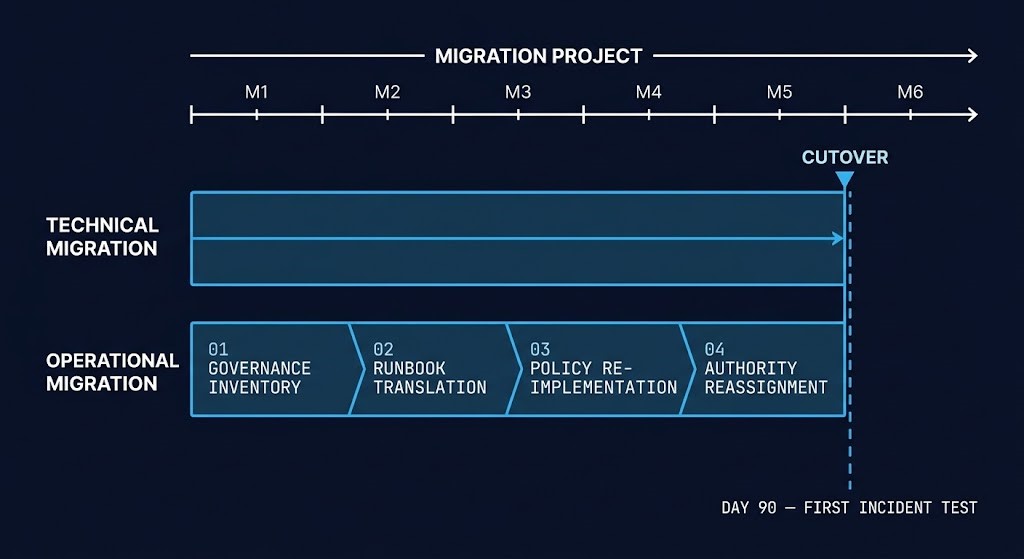
The VMware Exit & Migration Workbench treats migration as an engineering problem with structured phases. The strategic framing for what comes after the technical migration — including how to avoid rebuilding VMware assumptions on a different platform — is in Architecting Beyond VMware Leverage. An operational migration adds four explicit workstreams that run in parallel to the technical migration — not after it.
01 — GOVERNANCE INVENTORY
Document what the source platform was governing — explicitly, before cutover. Not a feature list. A decision inventory: what placement decisions was DRS making, what failure thresholds were configured, what change authority was encoded in role definitions, what network and storage policies were platform-enforced. If it cannot be documented before migration, it cannot be verified after.
02 — RUNBOOK TRANSLATION
Not screenshot updates. A full rewrite of operational procedures against target platform primitives, tested against the target environment during migration validation — not after cutover. Runbooks that reference vCenter constructs are not migrated runbooks; they are broken runbooks with a deadline.
03 — POLICY RE-IMPLEMENTATION
Network segmentation, security policy, and storage QoS mapped to target platform enforcement points and verified as active before go-live. The source platform enforced these automatically. The target platform enforces nothing the source platform enforced unless explicitly configured. Policy transfer is a migration deliverable, not a post-migration task.
04 — AUTHORITY REASSIGNMENT
Who owns what operational decisions on the new platform — written down, mapped to specific roles and teams, tested during DR drill before go-live. The source platform encoded this in configuration. The target platform requires explicit organizational design. If this is deferred, operational authority defaults to whoever makes the first decision — which is not a governance model.
The governance inventory and runbook translation workstreams both depend on knowing what the target platform actually assumes — not what the documentation says it does. For teams migrating to Proxmox, the gap between documented behavior and production behavior is specific and consistent. The Proxmox Migration Assumptions That Break at Cutover maps those assumptions as concrete input to Workstreams 01 and 02.
These four workstreams are not optional. They are the second half of the migration. Technical cutover without operational migration is not a complete project — it is the first half of a project with the second half deferred into production. Executing the second half requires knowing what the platform was actually governing — which is what the VMware dependency audit exists to recover.
The Migration Success Timeline
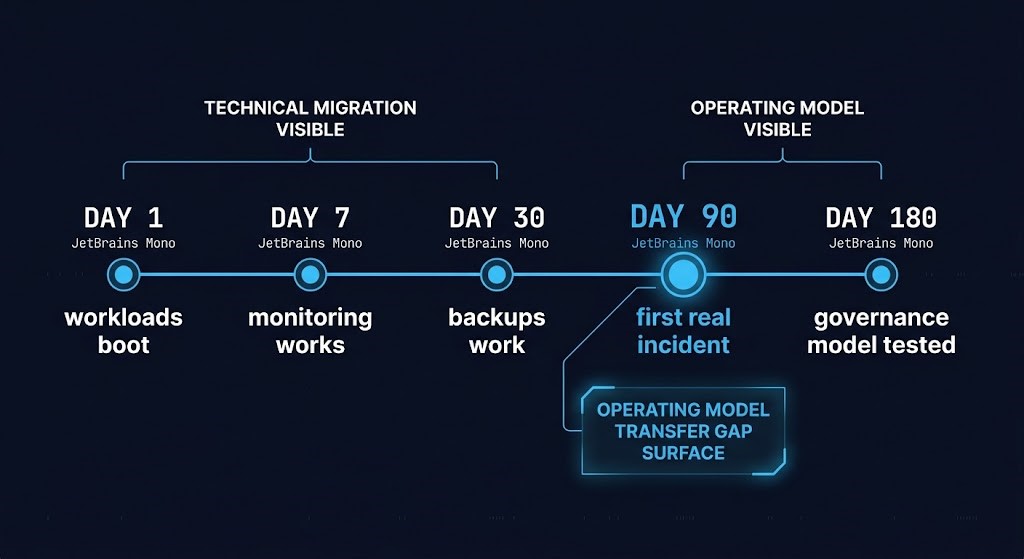
Most migrations measure success at Day 1: workloads up, networking verified, monitoring green. That is the correct measure for technical migration success. It is not a measure of operational migration success.
| Milestone | Signal | What It Measures |
|---|---|---|
| Day 1 | Workloads boot | Technical migration — workload state transfer |
| Day 7 | Monitoring works | Observability coverage — not operational procedure validity |
| Day 30 | Backups work | Data protection continuity — not governance continuity |
| Day 90 | First real incident | Operational migration — runbooks, authority, policy enforcement under pressure |
| Day 180 | Governance model tested | Operating model transfer — does the team govern this platform or react to it? |
Most migrations declare success on Day 1. Operating model success is not visible until Day 90 or later.
The projects that invest in operational migration scope before cutover pass Day 90 without incident. That’s the migration-event version of a pattern that holds in steady state too — The Next Virtualization Battle Is Operational Simplicity covers what organizations pay to avoid ever triggering this test in the first place. The projects that treat governance as a post-migration cleanup task discover the Operating Model Transfer Gap during their first real operational test — and the failure patterns that surface are consistent enough to be predictable. What breaks first after you leave VMware maps exactly those scenarios.
Architect’s Verdict
Infrastructure platforms are not only execution environments. They are governance environments. A migration that transfers workloads without transferring governance has not completed the migration — it has deferred the second half of it.
VMware wasn’t only a virtualization platform. For many organizations, it became the place where operational authority was encoded — placement decisions, failure response, change control, network policy, capacity governance. That accumulation happened gradually, over years, without anyone formally delegating those decisions to the platform. The decisions were just made — automatically, consistently, invisibly — until the platform was gone.
This is not a VMware-specific condition. The SaaS Control Plane Problem documents the same pattern: platforms accumulate authority until organizations depend on that authority without knowing they do. The Infrastructure Control Plane Is Consolidating names this dynamic across the broader architecture stack. VMware is another instance of a pattern that shows up everywhere authority can be delegated to infrastructure.
Migration success is measured at Day 1. Operating model success is measured at Day 90, when the first real incident tests whether the team governs the new platform or discovers, under pressure, that they never finished the migration.
SERIES: VMware Exit Architecture
Additional Resources
Editorial Integrity & Security Protocol
This technical deep-dive adheres to the Rack2Cloud Deterministic Integrity Standard. All benchmarks and security audits are derived from zero-trust validation protocols within our isolated lab environments. No vendor influence.

R.M.
Senior Solutions Architect with 25+ years of experience in HCI, cloud strategy, and data resilience. As the lead behind Rack2Cloud, I focus on lab-verified guidance for complex enterprise transitions. View Credentials →
Get the Playbooks Vendors Won’t Publish
Field-tested blueprints for migration, HCI, sovereign infrastructure, and AI architecture. Real failure-mode analysis. No marketing filler. Delivered weekly.
Select your infrastructure paths. Receive field-tested blueprints direct to your inbox.
- > Virtualization & Migration Physics
- > Cloud Strategy & Egress Math
- > Data Protection & RTO Reality
- > AI Infrastructure & GPU Fabric
Zero spam. Includes The Dispatch weekly drop.
Architecture Audit Services
Fixed-scope audits for Zero-Trust Azure, VMware migration readiness, and recovery posture — no discovery call required to start.
>_ View Audit Services>_Related Posts
ZFS vs Ceph vs NVMe-oF: Choosing the Right Storage Backend for Modern Virtualization
I still have nightmares about a storage migration I ran back in 2014. >_ Architect’s Brief 60-second read before you commit to the full post · Full post: 7 min Generating brief… We were moving off a monolithic SAN and onto an early “software-defined” storage platform. The sales engineers promised infinite scalability and self-healing magic….
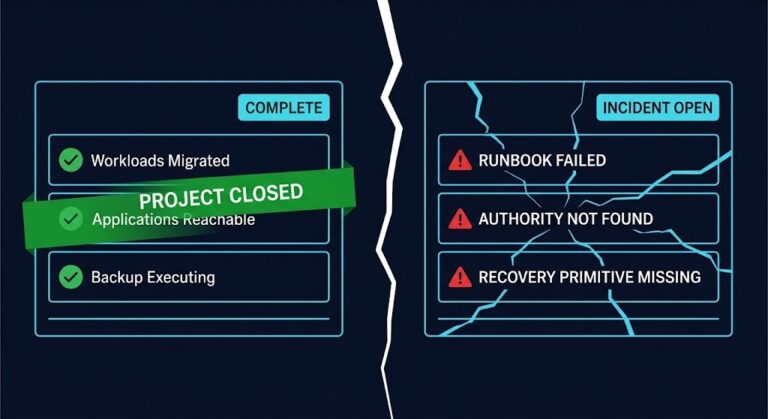
Your VMware Exit Was Successful. The First Incident Will Tell You If That’s True.
VMware exit survivability is the question your migration project never formally scheduled — and the first production incident on the new platform will answer it whether you are ready or not. The cutover completed. The workloads are running. The project closed green. None of that tells you whether the operating model, runbooks, authority structures, and…
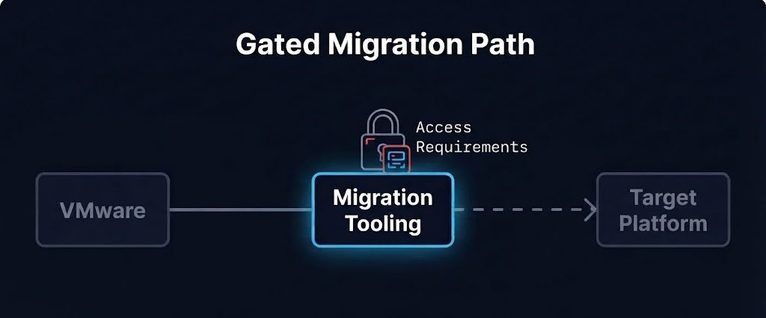
Your VMware Exit Plan Assumed a Tool You Didn’t Control
A VMware exit plan usually treats the migration tooling as a given — something you download, install, and use, not something you have to keep asking permission for. In late August, the public self-service path to the Virtual Disk Development Kit (VDDK) stopped working. No deprecation notice. No public transition announcement. A download path that…
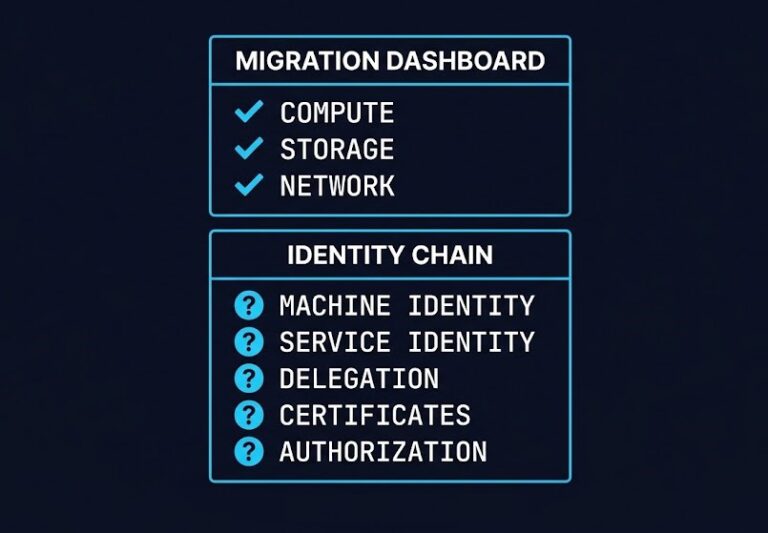
Your Migration Succeeded. The Identity Chain Didn’t.
Identity chain continuity is the thing every migration runbook assumes and almost none of them prove. A migration dashboard can go fully green — compute online, storage attached, network reachable — while the identity chain underneath it is already broken, and nothing in that dashboard will tell you. >_ Architect’s Brief 60-second read before you…
You Had Two Years To Decide On VMware. You Now Have One.
VMware deferral was a defensible posture for organizations that chose it — for the better part of two years, right up until this week, when Microsoft made it structurally impossible to keep pretending “later” was still on the table. >_ Architect’s Brief 60-second read before you commit to the full post · Full post: 9…
Why Arm64 First-Class Target Status Matters More Than A Benchmark
Arm64 first-class target status is decided long before a single benchmark runs. Platform commitment isn’t announced. It’s spent — in engineering effort a vendor didn’t have to fund. This summer, two infrastructure vendors spent that effort on Arm64 at two different layers of the stack: Canonical inside Ubuntu, Proxmox inside its hypervisor. Neither move, alone,…