

VMware Licensing Pressure Created a Dependency Audit Problem
The VMware dependency audit problem didn’t start with the Broadcom renewal. Most organizations could answer what ran on VMware. Very few could answer what depended on VMware — behaviorally, operationally, and at the recovery layer. The difference became expensive the moment the renewal conversation started.
The licensing bill arrived. The vmware dependency audit didn’t exist.
That sequence is what made the Broadcom renewal event structurally different from a typical vendor pricing dispute. Procurement teams could model the cost of staying. They couldn’t model the cost of leaving — because the dependency surface had never been mapped. The pricing pressure was visible. The architectural exposure underneath it was not.
That exposure lands differently depending on which of the three camps an organization sits in. Consolidators carry it forward as unaudited risk sitting under a renewed contract. Replacers and Absorbers carry it into a migration project that will surface it regardless of which target platform they picked.
This Is an Architecture Problem, Not a Procurement Problem
Procurement can renegotiate a contract. It can’t answer the questions that actually determine whether leaving is viable: which workloads have VMware-specific dependencies baked into their runtime behavior? Which integration points assume vSphere semantics? Which backup jobs, monitoring agents, and identity flows are attached to vCenter as an authority source?
Those are virtualization architecture questions. The licensing event forced them into a procurement conversation — which is where architectural exposure gets repriced, not resolved. A VMware dependency audit answers them. A contract renegotiation does not.
The organizations that treated the Broadcom renewal as a procurement event optimized their contract. The organizations that recognized it as an architecture event started mapping what they were actually running. Most did the former. The latter is harder and takes longer. It’s also the only path that produces a defensible exit posture.
Why the VMware Dependency Audit Didn’t Exist Before the Renewal
Dependency mapping requires a forcing function. VMware provided platform stability for fifteen-plus years — predictable renewal cycles, stable ownership models, no planned migrations at scale. Under those conditions, the cost of discovering the dependency graph exceeded the value of knowing it.
The graph existed. The business case to surface it did not.
Every renewal cycle, the contract renewed. Every quarter, workloads were added. Integrations accumulated. Runbooks referenced vSphere constructs. Backup policies built on VADP semantics. DR orchestration anchored to vCenter. None of this was hidden — it was all legitimate operational practice on a stable platform. There was no reason to audit it because there was no scenario in which it would need to change.
Broadcom changed the denominator overnight. Suddenly, the cost of not knowing exceeded the cost of finding out — for every VMware customer simultaneously.
That denominator shift — the cost of not knowing suddenly exceeding the cost of finding out — is the same mechanism behind AI infrastructure’s own approaching consolidation phase. Reserved GPU capacity, allocation authority, and integration dependencies are accumulating in AI environments right now with no forcing function yet large enough to make the audit unavoidable. Virtualization’s dependency graph went unmapped for fifteen-plus years because nothing forced the question. AI infrastructure is earlier in that same clock, not exempt from it.
That’s why thousands of organizations encountered the same gap at the same moment. The gap wasn’t new. The forcing function was. What most of those organizations don’t realize is that the renewal decision itself was effectively made years earlier — every deferred audit, every unmapped integration, every renewal signed without question narrowed the options available at this one.
Framework #143 — The Dependency Visibility Boundary
The pattern has a name: the Dependency Visibility Boundary.
Definition: The point at which a platform accumulates enough operational authority, behavioral assumptions, and integration gravity that its true dependency surface can no longer be reconstructed from configuration state alone.
Once a platform crosses this boundary, a complete dependency map requires instrumentation — active observation of runtime behavior, integration traffic, and operational workflow execution. Documentation, CMDB records, and configuration exports are insufficient. They capture what was configured. They don’t capture what the platform is actually doing on behalf of the workloads and systems that depend on it.
Many organizations crossed the Dependency Visibility Boundary years before the Broadcom restructure. The licensing event simply made it visible. The VMware dependency audit is the mechanism for recovering what the Boundary obscured.
Visibility and access aren’t the same guarantee, either. A dependency can pass every stage of this audit — fully mapped, fully documented, fully understood — and still fail for a different reason entirely: the terms under which you’re permitted to keep using it can change without notice. Your VMware Exit Plan Assumed a Tool You Didn’t Control covers that adjacent failure mode — VDDK access changing mid-project, with no corresponding gap in anyone’s dependency map.
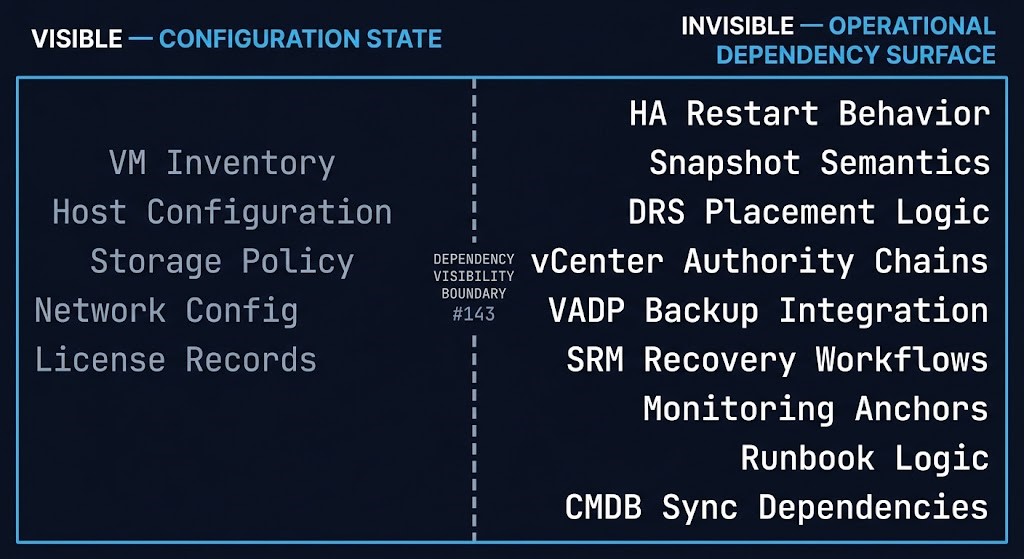
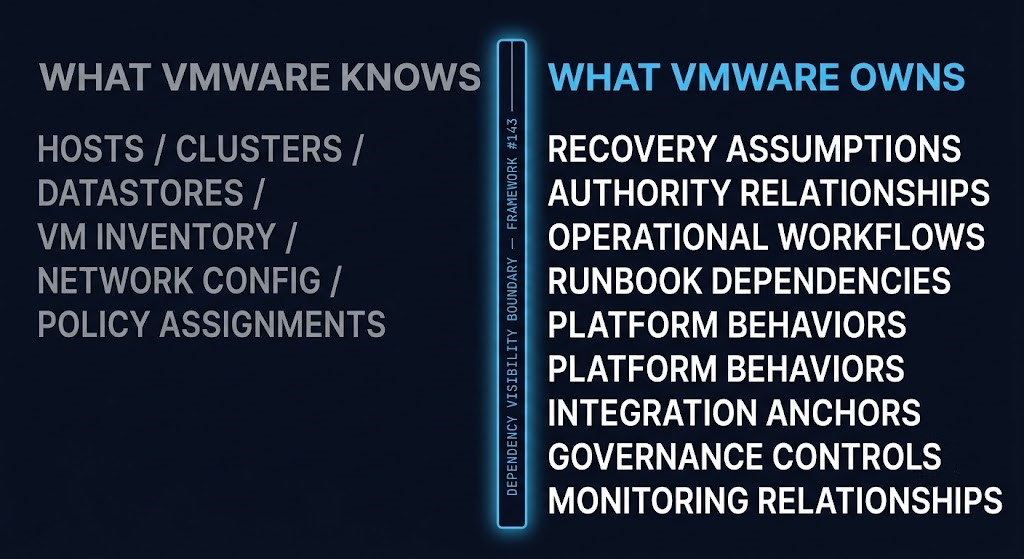
The diagram above illustrates the boundary:
What VMware Knows (visible, inventoriable from configuration state): hosts, clusters, datastores, VM inventory, network configurations, policy assignments.
What VMware Owns (invisible, only recoverable through instrumentation or incident): recovery assumptions, authority relationships, operational workflows, runbook dependencies, platform behaviors, integration anchors, governance controls, monitoring relationships.
Most exit plans are built on the left side. Migration failures emerge from the right side.
The Five Categories the Audit Has to Cover
The Dependency Visibility Boundary explains why the audit must be instrumentation-driven, not documentation-driven. Here is what it has to surface — ordered by discovery difficulty, not by importance:
01 — LICENSING SURFACE
Easiest to inventory. Creates false confidence. Features licensed vs. features actually in use almost always diverge — often significantly. The licensing audit tells you what you’re paying for. It doesn’t tell you what would break if you stopped.
02 — PLATFORM-BEHAVIORAL DEPENDENCIES
Requires workload instrumentation. Snapshot semantics, HA restart behavior, DRS placement assumptions, and storage policy enforcement are not configuration items — they are platform behaviors that workloads have learned to rely on. Some workloads will have been engineered around these behaviors without the engineering team being aware of it.
03 — INTEGRATION AUTHORITY DEPENDENCIES
Often undocumented. vCenter functions as an authority source for identity providers, monitoring platforms, CMDB sync processes, and automation workflows. These integrations were built when the platform was stable and are rarely reviewed. Mapping them requires tracing integration traffic — not reading documentation.
04 — OPERATIONAL MODEL DEPENDENCIES
Usually tribal knowledge. Runbooks reference vSphere-specific constructs. Escalation paths assume vCenter console access. Decision ownership relies on VMware tooling to surface the information that drives the decision. This category is almost entirely invisible until an operational scenario requires it — on a platform that no longer has it.
05 — RECOVERY DEPENDENCIES
Only discovered during failure. SRM assumptions, VADP-dependent backup jobs, restore workflows that reference vCenter as an orchestration authority, DR sequencing logic anchored to vSphere constructs, and replication relationships built on platform-specific semantics. This is the highest-risk category because its failure mode is a recovery event — which is the worst possible time to discover the dependency existed.
The ordering matters. Most organizations run the VMware dependency audit in reverse — they start with licensing because it’s the most visible, declare the audit complete when the cost model is finished, and never reach recovery dependencies. The recovery layer is where migration failures actually show up.
The Governance Debt, the Transfer Gap, and the Dependency Boundary
A VMware exit rarely fails because of a single decision. The conditions for failure accumulate long before the migration begins. Governance debt narrows future options. Operating model assumptions survive the workload migration. Dependency visibility erodes until the platform’s true authority surface can no longer be reconstructed. The licensing event didn’t create these problems. It exposed all three simultaneously.
FRAMEWORK #112 — LIFECYCLE GOVERNANCE HORIZON
The future window during which a platform can execute a planned transition, upgrade, migration, or strategic change without requiring unplanned remediation work first.
Each deferred lifecycle cycle narrows downstream nodes. Governance Lockout occurs when the Lifecycle Governance Horizon collapses to zero — no planned transition can begin without unplanned remediation first.
Governance debt accumulated here. Every undocumented exception, deferred lifecycle decision, and platform-specific operational shortcut reduced future migration flexibility long before anyone planned to leave. By the time licensing pressure arrived, exit optionality had already been constrained.
Even when workloads move successfully, the operating model doesn’t automatically move with them. The runbooks, authority structures, operational assumptions, and governance patterns built around vSphere remain VMware-shaped long after the VMs have been migrated elsewhere. Which means the dependency surface was already partially invisible before the exit project started.
Framework #143 explains the final stage of the problem. Over time, a platform accumulates enough behavioral assumptions, integration authority, operational gravity, and recovery dependencies that its true dependency surface disappears from documentation and survives only in the platform itself.
VMware Exit Architecture — Doctrine Chain
Framework #112 — Lifecycle Governance Horizon
Governance debt accumulates. Exit optionality narrows before anyone plans to leave.
Framework #137 — Operating Model Transfer Gap
Operational assumptions survive migration. Governance doesn’t move with the workload.
Framework #143 — Dependency Visibility Boundary
Dependencies become invisible. The platform’s true authority surface disappears from documentation.
Result — Without a Dependency Audit
Migration effort cannot be accurately estimated. Migration risk is unknown. Recovery risk is unmapped. Exit cost is structurally underestimated.
The dependency audit is not an inventory exercise. It is the mechanism for recovering what the Dependency Visibility Boundary obscured — and producing numbers that are defensible on all four outputs.
DIAGNOSTIC QUESTION
“Does your exit plan include a dependency audit output, or a cost model built on top of an assumed dependency surface?”
The Cost Model Is Easier Than the Dependency Map
⚠ COMMON MISTAKE
Most organizations build the cost model before the dependency map — because the cost model is faster, uses existing data, and produces a number that satisfies a renewal conversation. Completing the cost model without the dependency map means you know what you’re paying to stay. You still don’t know what it costs to leave.
The cost model answers one question: is the renewal price acceptable? The VMware dependency audit answers a different question: is leaving viable, and at what remediation cost? These are not the same question. Answering only the first and proceeding with an exit is how organizations end up with successful migrations that produce failed operations.
Recovery Is Where Unmapped Dependencies Surface
The first incident on the target platform is usually a recovery test. The runbook references a vSphere construct. The backup job fails because it was anchored to VADP semantics. The DR orchestration fires against a vCenter endpoint that no longer exists. None of this appears in the migration checklist — because the dependency was never mapped. It was in the invisible half of the Boundary.
Unmapped VMware dependencies don’t disappear at migration cutover. They move to the target platform as latent failure modes. The backup blast radius analysis your team ran before migration was built on vSphere snapshot semantics — semantics that don’t exist on the target platform. The DR test that passed before cutover validated workload restart. It didn’t validate recovery authority, and it didn’t validate the restore workflows that depend on integrations that were never re-anchored.
This is the downstream path from Framework #143 to Recovery Dependency Collapse (#122):
Dependency Visibility Boundary (#143) → unmapped recovery dependencies survive cutover → Recovery Dependency Collapse (#122) under the first adversarial scenario.
The DR testing failure patterns that appear post-migration aren’t new problems. They’re pre-existing dependencies that were never visible — and are now exposed by the absence of the platform that was satisfying them silently.
What a Complete Audit Produces
The output of a dependency audit isn’t a spreadsheet of licensed features. It’s four artifacts:
An instrumented dependency graph — derived from runtime observation, not configuration export. Every integration, authority relationship, and behavioral dependency mapped to its consuming workload or operational process.
A behavioral delta — per workload class, the gap between what the source platform provided implicitly and what the target platform requires explicitly. This is the remediation input, not the migration checklist.
An integration authority re-anchoring plan — every system that treated vCenter as an authority source needs a new authority source on the target platform. This plan names them and sequences the transitions.
A runbook translation log — every operational procedure that references a vSphere-specific construct, updated for the target platform’s operational model. This is where the operational model dependencies become concrete work rather than tribal knowledge.
Without all four, the exit plan is a cost model with a migration checklist attached. The dependency surface is still unknown. The first incident will map it for you — under pressure, post-cutover, with production workloads affected.
Architect’s Verdict
The VMware dependency audit problem was not created by Broadcom’s licensing restructure. It was exposed by it. The dependency graph accumulated over fifteen-plus years of stable platform operation — every integration, every behavioral assumption, every runbook built on vSphere semantics. The business case to map it never existed until the cost of not mapping it exceeded the cost of finding out.
The Dependency Visibility Boundary (#143) describes a structural condition, not a VMware-specific failure. Any platform that provides enough operational authority and behavioral depth will eventually reach the point where its true dependency surface cannot be reconstructed from documentation alone. VMware reached that point years ago for most enterprise estates. The organizations discovering that now are not behind — they are simply the first cohort with a forcing function large enough to make the audit unavoidable.
The licensing event was a catalyst. The audit is the work. And the work isn’t finished when the cost model is complete — it’s finished when recovery dependencies are mapped, integration authorities are re-anchored, and the runbooks reference constructs that actually exist on the target platform.
SERIES: VMware Exit Architecture
Additional Resources
Editorial Integrity & Security Protocol
This technical deep-dive adheres to the Rack2Cloud Deterministic Integrity Standard. All benchmarks and security audits are derived from zero-trust validation protocols within our isolated lab environments. No vendor influence.

R.M.
Senior Solutions Architect with 25+ years of experience in HCI, cloud strategy, and data resilience. As the lead behind Rack2Cloud, I focus on lab-verified guidance for complex enterprise transitions. View Credentials →
Get the Playbooks Vendors Won’t Publish
Field-tested blueprints for migration, HCI, sovereign infrastructure, and AI architecture. Real failure-mode analysis. No marketing filler. Delivered weekly.
Select your infrastructure paths. Receive field-tested blueprints direct to your inbox.
- > Virtualization & Migration Physics
- > Cloud Strategy & Egress Math
- > Data Protection & RTO Reality
- > AI Infrastructure & GPU Fabric
Zero spam. Includes The Dispatch weekly drop.
Architecture Audit Services
Fixed-scope audits for Zero-Trust Azure, VMware migration readiness, and recovery posture — no discovery call required to start.
>_ View Audit Services>_Related Posts
ZFS vs Ceph vs NVMe-oF: Choosing the Right Storage Backend for Modern Virtualization
I still have nightmares about a storage migration I ran back in 2014. >_ Architect’s Brief 60-second read before you commit to the full post · Full post: 7 min Generating brief… We were moving off a monolithic SAN and onto an early “software-defined” storage platform. The sales engineers promised infinite scalability and self-healing magic….
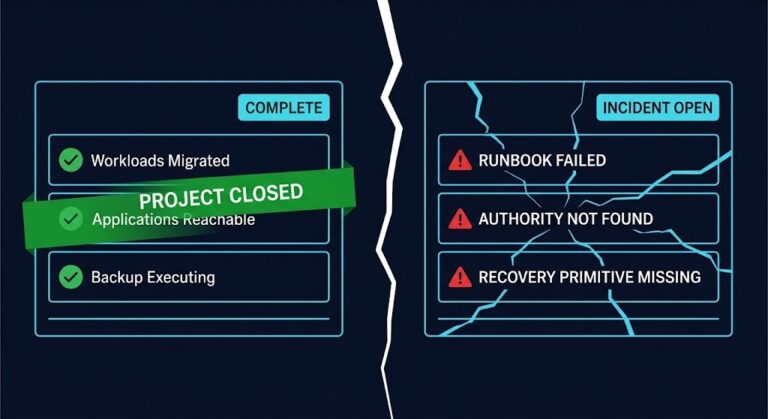
Your VMware Exit Was Successful. The First Incident Will Tell You If That’s True.
VMware exit survivability is the question your migration project never formally scheduled — and the first production incident on the new platform will answer it whether you are ready or not. The cutover completed. The workloads are running. The project closed green. None of that tells you whether the operating model, runbooks, authority structures, and…
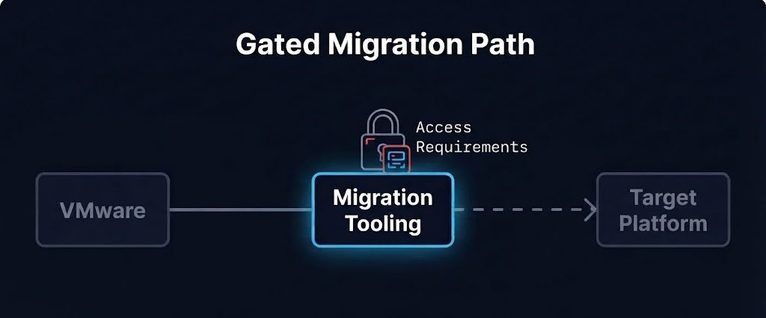
Your VMware Exit Plan Assumed a Tool You Didn’t Control
A VMware exit plan usually treats the migration tooling as a given — something you download, install, and use, not something you have to keep asking permission for. In late August, the public self-service path to the Virtual Disk Development Kit (VDDK) stopped working. No deprecation notice. No public transition announcement. A download path that…
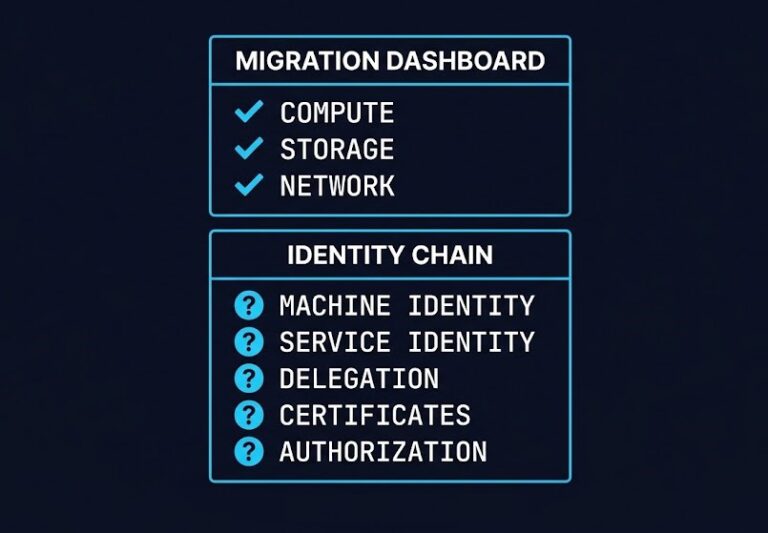
Your Migration Succeeded. The Identity Chain Didn’t.
Identity chain continuity is the thing every migration runbook assumes and almost none of them prove. A migration dashboard can go fully green — compute online, storage attached, network reachable — while the identity chain underneath it is already broken, and nothing in that dashboard will tell you. >_ Architect’s Brief 60-second read before you…
You Had Two Years To Decide On VMware. You Now Have One.
VMware deferral was a defensible posture for organizations that chose it — for the better part of two years, right up until this week, when Microsoft made it structurally impossible to keep pretending “later” was still on the table. >_ Architect’s Brief 60-second read before you commit to the full post · Full post: 9…
What Breaks First After You Leave VMware
On Day 32, the storage team escalates. Veeam SureBackup verifications are silently failing on a subset of workloads that migrated cleanly out of VMware four weeks earlier. The jobs report success. The backups complete. But the verification phase — the part that actually proves the data is recoverable — quietly stopped working somewhere between cutover…