

You Had Two Years To Decide On VMware. You Now Have One.
VMware deferral was a defensible posture for organizations that chose it — for the better part of two years, right up until this week, when Microsoft made it structurally impossible to keep pretending “later” was still on the table.
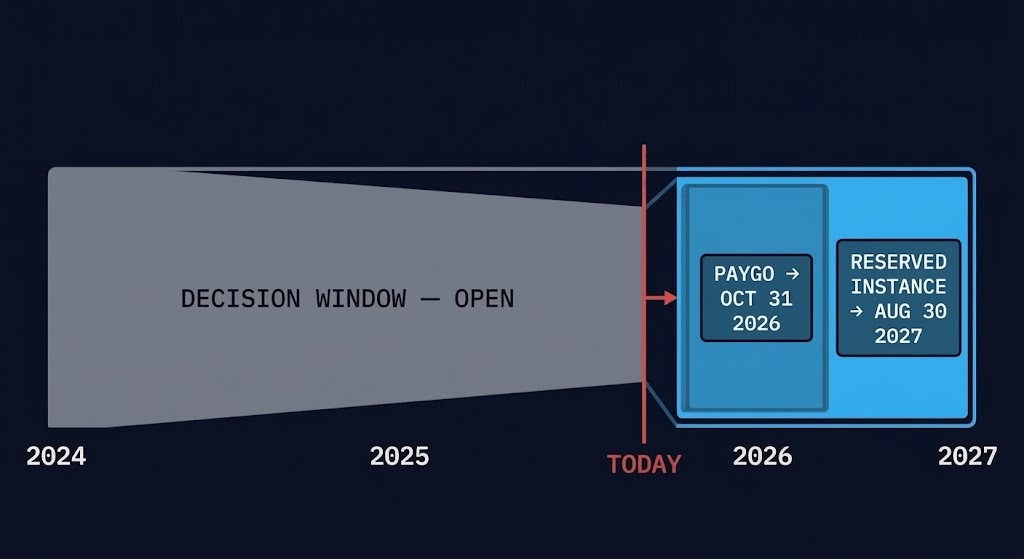
Organizations still running Azure VMware Solution under the license-included model — whether PayGo or Reserved Instance — now have a fixed date they didn’t have before last September, when Microsoft first confirmed the transition timeline. New sales of license-included AVS already ended back in October 2025; what changed this week is how close the remaining transition deadlines have gotten, and how much less room is left to treat them as somebody else’s problem.
The coverage since has mostly treated this as a Microsoft story — a vendor pulling back a convenience, a partner relationship shifting under Broadcom’s licensing pressure. That framing isn’t wrong, exactly. It’s just aimed at the wrong subject. The actual architectural story isn’t what Microsoft changed. It’s what the deadline just proved: the option AVS customers thought they were holding in reserve was never really there — and this is a virtualization architecture problem before it’s anything else, whatever vendor happens to be sitting at the center of this particular version of it.
The Fourth Option Never Existed
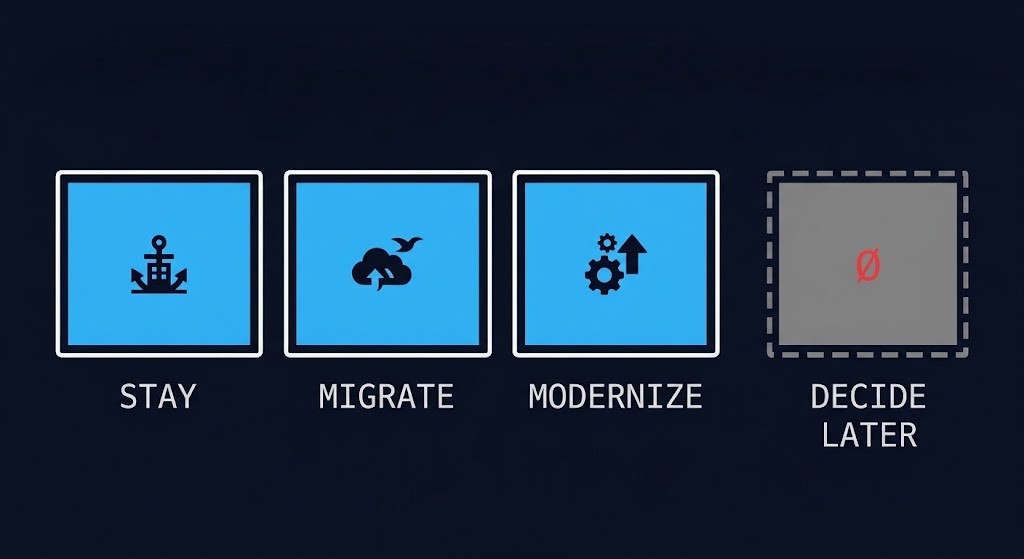
Organizations running VMware on Azure often treated four paths as available: stay on AVS as-is, migrate off VMware entirely, modernize toward native Azure services, or decide later once the picture was clearer. The first three are real architectural positions — each has a cost model, a timeline, a set of trade-offs somebody could defend in a steering committee. The fourth one isn’t. “Decide later” was never a position. It was the absence of one, dressed up to look like patience.
That distinction matters because of how differently the two things behave under pressure. A real position degrades gracefully — you re-run the analysis, you adjust the timeline, you might change your mind, but there’s an actual decision sitting underneath the discomfort. Deferral doesn’t degrade. It just sits there, silently converting elapsed time into constraint, until something external forces the question that internal process never did.
For organizations that let deferral run, that conversion just became visible. Two years of “we’ll revisit this” didn’t produce a stronger negotiating position or a clearer picture. It produced a compressed timeline and a narrower option set, because the fourth option was never actually buying time — it was borrowing it, against a bill nobody had dated yet. The same drift shows up elsewhere in how VMware exits actually play out — it’s a large part of why so many organizations are settling into permanent multi-hypervisor coexistence without ever deciding to: an arrangement nobody chose becomes the plan by default, the same way deferral did here.
What Actually Happened
For new AVS deployments, this part is old news: Microsoft stopped selling license-included nodes after October 15, 2025. New AVS node purchases since then have required a separately purchased VCF subscription from Broadcom under the BYOL model — that part of the story is over a year old, not this week’s news.
What’s actually moving is the runway for everyone who bought in before that cutoff. Organizations running AVS PayGo nodes with included licensing can keep operating unchanged only through October 31, 2026 — a deadline that’s been public since Microsoft’s September 2025 guidance, but is now about ten weeks away rather than an abstraction on a future calendar. Organizations running license-included Reserved Instances purchased on or before October 15, 2025 have longer: those nodes continue under existing terms until the license-included SKUs retire completely on August 30, 2027, at which point every remaining AVS deployment runs on BYOL.
The mechanism driving the transition is Broadcom’s restructuring of VMware licensing on hyperscalers: AVS is moving from Microsoft’s license-included model to customer-owned, portable VCF licensing. The same broader licensing shift has affected other hyperscaler-hosted VMware arrangements as well — Google Cloud VMware Engine hit the equivalent wall in the same window. AVS’s license-included model was one of the last paths that let a customer avoid a direct Broadcom licensing relationship. That path is now closing on a fixed, public schedule.
None of this is a technical failure or a service disruption. AVS keeps running exactly as it does today for every customer, right up until their respective deadline. What changed is the shape of the decision window — not whether AVS works, but how long an organization gets to decide what to do about it before the decision effectively gets made for them by default. That’s a different question than the trade-off framework most AVS-versus-native-Azure comparisons run — that framework asks which path fits better; this one asks what happens once “later” stops being an available answer to that question at all.
The Bill For VMware Deferral Just Arrived
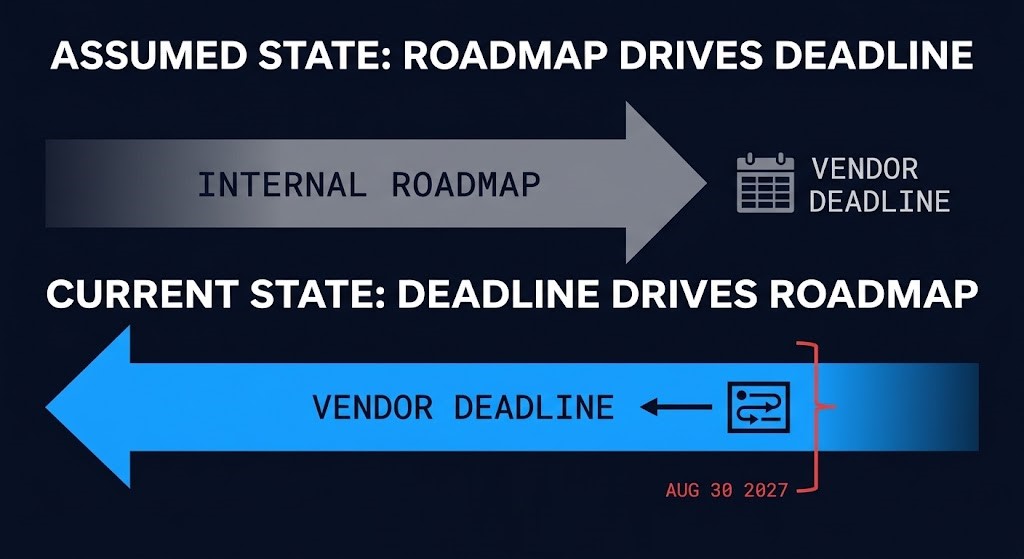
Every migration program assumes the organization’s own roadmap sets the pace — that architecture decisions get scheduled against internal priorities, budget cycles, and staffing availability, with vendors as a downstream input rather than the pacesetter. VMware deferral worked, for a while, precisely because that assumption held. Nothing was forcing the question, so the roadmap didn’t have to answer it.
That assumption just inverted. The roadmap no longer sets the pace against an internal calendar — it now has to fit inside somebody else’s. An enterprise that let its AVS strategy sit untouched doesn’t get to introduce the topic on its own schedule anymore. For anyone still on a license-included Reserved Instance, there’s roughly a year left, as of this writing, to complete a decision that was always going to require workload classification, licensing analysis, and — for anyone actually planning to move off AVS — a migration sequence measured in quarters, not weeks. For anyone on PayGo, it’s closer to ten weeks.
The organizations in the worst position now aren’t the ones who chose to stay on AVS deliberately, and they aren’t the ones who’d already committed to leaving. They’re the ones who never converted “we should look at this” into an actual position. AVS was always better understood as a migration staging decision than as a permanent destination. Treating it as a place to stop, rather than a place to pass through, is what turns a manageable transition into a deadline-driven scramble.
Why This Isn’t A Microsoft Problem
Strip Microsoft and Broadcom out of this entirely and the underlying pattern still holds: deferred architecture decisions eventually become externally scheduled architecture decisions. AVS is this cycle’s version of it. It won’t be the last.
The pattern shows up anywhere an organization outsources the timing of a decision to the absence of pressure rather than to its own judgment. A licensing model gets grandfathered until it isn’t. A vendor’s roadmap quietly diverges from what a customer assumed it would keep supporting. A “temporary” architecture choice — a staging environment, a hybrid arrangement, a stopgap integration — outlives the conditions that made it temporary, because nothing ever forced a revisit. In every one of these, the organization wasn’t choosing to keep the option open. It was declining to close it, which isn’t the same act, even though it feels identical from the inside for as long as nothing happens.
What makes this specific case durable as a lesson, past the point anyone remembers the exact AVS dates, is what it reveals about how these decisions actually get made. They don’t get made in a single moment where someone weighs the options and picks one. They get made — or fail to get made — in a long accumulation of “not yet,” each individually reasonable, none of them adding up to a decision, until an external party sets a date that makes the accumulation visible all at once. The deadline isn’t creating the decision. It’s collecting on the one that was never actually made.
This is also, worth noting explicitly, not a case for treating every vendor deadline as a crisis. Broadcom’s VCSP partner-program termination forced a comparable reckoning earlier this year — but that was a different trigger entirely: a partner-channel wind-down that determined who could sell VMware capacity, not a licensing-bundle change that determines how an existing customer keeps running it. Different mechanism, same underlying failure mode: an unowned decision, sitting untouched, until a vendor’s calendar exposes it. The specifics vary. The shape doesn’t.
Windows 10 ESU is the same shape running on Microsoft’s calendar instead of Broadcom’s: a security-posture purchase that quietly becomes the migration strategy for any organization that buys it without naming the date it stops buying it. October 13, 2026 doesn’t create that failure. Like the AVS deadline here, it just prices the accumulated “not yet” all at once — cumulative, non-negotiable, and dated well in advance for anyone who was tracking the calendar instead of hoping the calendar wouldn’t matter.
Enterprises running any hyperscaler-hosted VMware arrangement — not just AVS — are operating on some vendor’s assumption about how long the current terms hold. Google Cloud VMware Engine and other managed offerings sit on the same kind of foundation. None of them come with a guarantee that today’s terms are the terms in eighteen months. The organizations that treat these arrangements as provisional — worth a standing review cadence, not a “set and forget” decision — are the ones more likely to experience the next version of this as a scheduled check-in. Everyone else experiences it as a deadline.
Architect’s Verdict
VMware deferral was never a hedge against uncertainty. It was the accumulation of a decision nobody made, wearing the costume of patience. AVS customers who spent two years treating their VMware strategy as a problem for future-them didn’t buy optionality with that time — they spent it, on a clock they couldn’t see running.
The real failure here isn’t picking the wrong path among Stay, Migrate, and Modernize. Any of those three, chosen deliberately eighteen months ago, would have put an organization in a defensible position today, whichever one it was. The failure is treating “we’ll decide later” as a fourth path with the same standing as the other three, when it was never anything but the other three minus the deciding.
Microsoft didn’t create the pressure AVS customers are feeling this week. It just picked the date the pressure became visible. The organizations under the most strain right now aren’t the ones running VMware on Azure — they’re the ones who never actually decided that’s what they were doing.
Additional Resources
Editorial Integrity & Security Protocol
This technical deep-dive adheres to the Rack2Cloud Deterministic Integrity Standard. All benchmarks and security audits are derived from zero-trust validation protocols within our isolated lab environments. No vendor influence.

R.M.
Senior Solutions Architect with 25+ years of experience in HCI, cloud strategy, and data resilience. As the lead behind Rack2Cloud, I focus on lab-verified guidance for complex enterprise transitions. View Credentials →
Get the Playbooks Vendors Won’t Publish
Choose the architecture problems you care about. Get field-tested playbooks and frameworks delivered to your inbox.
- > AI Infrastructure & Inference Economics
- > Cloud Strategy & Hidden Cost Models
- > Virtualization & Deterministic Migration
- > Kubernetes, IaC & Modern Infrastructure
- > Data Protection & Recovery Engineering
Zero spam. Includes The Dispatch weekly drop.
Need Architectural Guidance?
Independent review before major infrastructure decisions.
- > Validate assumptions
- > Identify hidden dependencies
- > Quantify migration risk
- > Challenge vendor narratives
Triage · Advisory · Fractional · Direct Hire